The Fierce Initiation of Menopause by Mary Sharratt

Modern Western culture despises aging. Aging women are held in particular contempt. Menopause is meant to be something embarrassing and uncomfortable. The pharma industry peddles hormones and other drugs meant to mask our symptoms. Few women see menopause as something to even talk about, let alone celebrate. But some women are reclaiming the dignity and transformation of menopause as a passage to power. Author and herbalist Susun Weed portrays menopause as a spiritual awakening. She likens the fierce waves of heat traveling upward to our brains to the Eastern concept of a Kundalini awakening that ultimately leads to enlightenment and spiritual liberation. Whether or not you agree with this, you will not make it through menopause without some kind of radical change taking place inside you.

I’ve experienced menopause as an initiation by fire. Having chosen not to have children, menopause has proved the most intense and radical embodied experience and transformation I’ve undergone since menarche and puberty. When a hot flash seizes me, I can no longer continue my train of monkey-mind thinking or be an efficient worker bee of global capitalism. All my old ingrained thought patterns are interrupted and come to a halt as I’m forced to focus on the embodied experience of burning up from within. What if this internal fire is literally burning through old ways of thinking and being that no longer serve me? Maybe we’re supposed to be rattled and disturbed so we can change. It’s even called The Change. So many tired old patterns are falling away from me, because I can’t keep up with them anymore. There’s this profound deepening. A sense of what truly matters.

I resist change so much. I long to remain in the comfortable old rut of the familiar, but menopause makes that impossible. It’s a take-no-prisoners wake up call to the reality of passing time and impermanence. It forces me to reexamine my values, where I truly want to spend the remaining time I have on earth. I’ve always been spiritual, but menopause has deepened my commitment to daily spiritual practice. It’s also taught me to embrace my own fierceness. To say what I mean and mean what I say. Menopausal women might find themselves losing the superficial prettiness of youth. We can no longer pass as objectified eye candy in male-stream culture. With our wrinkles and gray hair, we become something scary but also powerful. Crones and witches. We truly do become wise women if we answer the spiritual call of menopause. If we resist the lure of male-stream medicine to brainwash us into reframing this profound transformation and path of power into a disease that must be treated with hormones and face lifts. While some women benefit from hormone therapy and allopathic medicine, I’m against the generic medicalization of the natural processes in women’s lives.

Pregnant women give birth to new souls. Menopausal women give birth to their wiser selves. Like motherhood, menopause sidelines us on the relentless march towards capitalist achievement and forces us to reexamine our true priorities. We live in a 24/7 culture that expects us to be switched on and working at maximum efficiency every day of the year, as if the cycles of the seasons, sun, and moon didn’t exist. Menopause is an invitation to live in harmony with the tides and seasons of our lives. To claim our time and attention and take our lives back.

If older women truly knew how fierce and powerful we were, we could change the world.

Readers might also want to check out my essay: “Life Begins at 42: Saint Hildegard’s Guide to Becoming a Midlife Powerfrau.” 


Mary Sharratt is on a mission to write women back into history. Her most recent novel Ecstasy is about the composer Alma Schindler Mahler. If you enjoyed this article, sign up for Mary’s newsletter or visit her website.

 

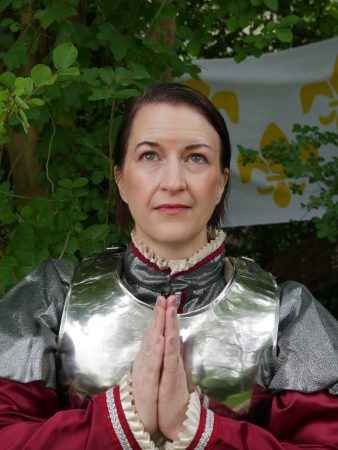
Joan of Arc from The Goddess Project: Made in Her Image by Colette Numajiri

“I’m not afraid. I was born to do this.” -Joan of Arc

Women are inherently valiant. In extreme situations we armor up and lead others through whatever we are battling at the time.

Joan of Arc was a human woman with otherworldly faith who, as a young teenager, listened to Divine voices and lead an army that eventually ended the 100 Years War.  “The real Joan of Arc is an uncomfortable fit as an icon of female solidarity or democratic rights. She achieved what should have been impossible for someone of her gender and class in 15th-century France.” wrote Helen Castor in her book Joan of Arc: A History. She was so respected and revered that 20 years AFTER Her death, 115 people testified on behalf of Joan of Arc (Jeanne d’Arc) and overturned the ruling.

Enbodying the Divine Feminine on Earth, women look to Joan as an inspiring example of a brave and active woman.  Joan inspired the Suffragettes, they held her banner and wore white (as Joan chose to wear white for purity when She was taken to the stake to be burned for the crime of cross-dressing) as they marched for women’s right to vote. Just as, a few months ago our newly elected Congresswomen all wore white in solidarity.

Continue reading “Joan of Arc from The Goddess Project: Made in Her Image by Colette Numajiri”

Adoring God in Labor by K Kriesel

The day before the 2019 Nevertheless She Preached conference at First Baptist Church of Austin, TX my own Catholic church’s young adult ministry hosted Eucharistic Adoration. Although I’ve enjoyed Adoration dozens of times, several factors made this evening different. I was preparing for cervical surgery for one. My Hebrew Bible class at Austin Presbyterian Theological Seminary was grappling with Rebekah, Rachel, Leah, and the voiceless Dinah. The call to write the history of 20th century Catholic women theologians had been at my ear all day. The catalyst was when two men at the Adoration began leading a song about God the Father.

Maybe it was just the incense but I swear I saw something. An image of the baby crowning from the womb, God gasping in labor, as the Eucharist wore the gold of the monstrance as a crown before the tabernacle. God was pushing the Body of Christ into creation while I prayed for my own sick body. God was crying out with the voices of these thousands of unheard women. We were all there. I snuck out my phone and took a picture, determined to put the scene to paper.

Continue reading “Adoring God in Labor by K Kriesel”

“If All Knowledge Must be Reinterpreted, Why Not Religion?” Says Islamic Feminist

xcelina-feminismo.jpg.pagespeed.ic._RyiiQg3TR.jpg

Vanessa Rivera de La Fuente is Muslim, feminist, and a human rights activist
Photo: Personal archive

Background: Journal O ‘Globo, one of the most important newspapers in Brazil, belonging to the transnational media group of the same name, published this interview with Vanessa Rivera de la Fuente on Islamic Feminism. Given its relevance to the discussion on the subject, it was translated by prominent Islamic feminist and scholar Keci Ali to share it with English-speaking readers.

The Muslim women’s movement has different agendas in accordance with the reality of each country. In Latin America, the Muslim Vanessa Rivera fights against prejudice about Islam.

by Isabela Aleixo*

Vanessa Rivera de La Fuente is Chilean and Muslim. Besides being an academic researcher, she’s also an Islamic feminist engaged with questions of gender, human rights, and social development. Vanessa has wide experience in social projects in Latin American countries.

In an interview with CELINA, she discusses the prejudices that Muslim women face in Latin America, explains the movement’s demands, destroys stereotypes, and declares: “I’m a woman and I demand to be treated as a person.”

Do you consider yourself an Islamic feminist? Why?

I consider myself a feminist woman, who lives feminism in all the distinct facets of her life: I’m Muslim; I’m a single mother; I’m a professional woman, an academic; and I’m a women’s rights activist. I’m feminist with all my life experiences. I think being a woman in male-dominated society is itself a political fact, so everything that I am as a woman can be resignified by feminism, including being Muslim. Islam is integrated into my life and my political struggle, which is intersectional. It’s based on the radical idea that all women are people and we deserve equal rights and a world free of violence.

Continue reading ““If All Knowledge Must be Reinterpreted, Why Not Religion?” Says Islamic Feminist”

Greenness, Whiteness, Blackness, and the Nature of the World by Marisa Goudy

There’s magic in hiking alone, but as women, we’ve been taught to worry about venturing far on our own. In fact, we’ve been taught to worry about a lot more than that.

Though once I merely shrugged off the warnings and the horror stories, confident that I was wrapped in some sort of “not me” protective veil, I don’t usually take my safety for granted anymore. Maybe it’s because I’ve outgrown the belief that I’m invincible. Maybe it’s because I’m a mother and have a different understanding of the fragility of life and the female body. Maybe it’s because that murderer on the Appalachian Trail went by the nickname “Sovereign,” appropriating the powerful, beautiful word that is so essential to my life’s work.

This particular day, however, my desire to be outside was more compelling than my new bend toward caution. I called my husband to tell him just where I’d be, joking that he needed to know where to look for me if I didn’t pick up the girls from camp on time.

Continue reading “Greenness, Whiteness, Blackness, and the Nature of the World by Marisa Goudy”

Temple Magdalen by Elizabeth Cunningham

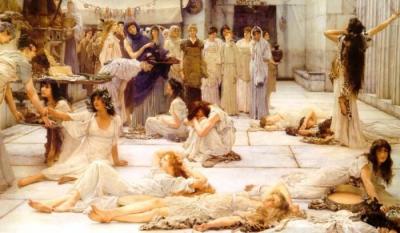
The Women of Amphissa, 1887, by Lawrence Alma-Tadema

Since I began writing for FAR in July 2012, I have written about Mary Magdalen, or excerpted a passage from one of my novels, near or on her July 22 Feast Day. For why I made the controversial choice to depict her as a prostitute, see last year’s post. The below excerpt is from The Passion of Mary Magdalen. I made this selection in remembrance of all the refugees in the world today. In this passage, Judith, a Jewish widow whose family was driven from the land by tax collectors, returns to the place where Maeve (my fictional Celtic Magdalen) and her friends have recently founded a Temple to Isis on the outskirts of Magdala. Maeve has just invited Judith to join them. (Edited for brevity.)

She stared at me, her eyes full of anger and longing.

“I will not be a slave and a whore where I was once a wife, the one who made the challah bread, who said the Sabbath prayers over it. This was our place, my husband’s and mine. We brought the best we had to the temple, the finest oil and wine, the unblemished kid—”

“Goats? You kept goats? You know how to make cheese?”

She sat quietly for a moment before she answered. “How can I live here with you?” she wondered. “I don’t understand.”

Continue reading “Temple Magdalen by Elizabeth Cunningham”

Coming to Terms with Privilege: A Personal Reflection by Elise M. Edwards

elise-edwardsIn my two previous posts, I shared my recent experience talking about privilege at a church near me.  Today, I will wrap up this short series with a more personal reflection about privilege from a Christian perspective.  Last month, I was thinking theologically about what those of us who have privilege should do with it.  But, as feminists and womanists, acknowledging our privilege can be complicated.  Most of us in this FAR community do possess some forms of privilege while, at the same time, we lack other forms of privilege.  Each of us remains the same person wherever we go, yet our status can change when we switch contexts.  As a black woman, I do not have white privilege or male privilege.  But I am privileged when it comes to education and class and physical ability.  I am a Christian who works at a Christian university in a part of Texas that is culturally predominantly Christian. So that’s a form of privilege.  Although as a single woman without children, I don’t fit the cultural norm where I live, my sexual orientation and cis-gendered identity afford me some privilege, too.

Continue reading “Coming to Terms with Privilege: A Personal Reflection by Elise M. Edwards”

We Won’t Go Back by John Erickson

Bottom line: abortion is healthcare. Nearly a fourth of women in America will have an abortion by age 45. Every day, people across the United States make deeply personal decisions about their pregnancies. Those decisions deserve respect.

Someone once asked me: John, why are you a feminist?  It is always a jarring question because I believe all people should be feminists and we should all fight for gender equality no matter what.  I’ve been drawn to Martin Niemöller’s prolific quote:

First they came for the socialists, and I did not speak out—because I was not a socialist.
Then they came for the trade unionists, and I did not speak out— because I was not a trade unionist.
Then they came for the Jews, and I did not speak out—because I was not a Jew.
Then they came for me—and there was no one left to speak for me.

Right now, it seems like a full on frontal assault against all of us.  No matter what community you’re in, you can draw back to an instance of discrimination you’ve faced both pre-2016 as well as after the election of President Trump. Continue reading “We Won’t Go Back by John Erickson”

What Can We Do to Weaken Privilege? by Elise M. Edwards

elise-edwardsIn my previous post, I talked about discussing the concept of privilege (male privilege, white privilege, and class privilege) with nuance.  Earlier that week, I had led a workshop at a local church on “Fine-tuning Privilege,” using Peggy McIntosh’s 1989 essay “White Privilege: Unpacking the Invisible Knapsack” as a resource.  (If you are unfamiliar with it, take a few minutes to read it and reflect upon it.)  Part of my talk was about naming and understanding privilege.  Discussion and comprehension are not enough, though.  We must counter it.

One strategy for fighting privilege is making it visible. The recipients of privilege are often unaware that they have to systemic advantage over others. Privilege, used in the context of racism, sexism, heterosexism, classism, and religious dominance, is not something earned on merit alone. In the essay linked above, McIntosh describes it like this: “I have come to see white privilege as an invisible package of unearned assets which I can count on cashing in each day, but about which I was meant to remain oblivious.” These are conditions built into our culture that some groups receive which benefit them to the detriment of others. Making privilege visible means naming it and calling it out. Wage gaps, digital divides, and racial profiling practices exist; ignoring them perpetrates the problems.

Continue reading “What Can We Do to Weaken Privilege? by Elise M. Edwards”

How Can Change Happen If We Can’t Imagine It First? by Darla Graves Palmer

More than one hundred years ago, a small group of women joined together and decided to create their own village, one rooted in relationship and guided by spirit. They weren’t the first such women-led town in the country – there was a web of sister villages throughout America, some formed as early as the seventeenth century – but Chantilly Lace was unique. Rising out of the dust of an abandoned Gold Rush era in the Rocky Mountains of Colorado, a time when many women were abandoned by men seeking further adventures or widowed when husbands lost their lives in the mines, this mostly female community determined its own fate. Now the modern women (and a minority of men) faced new challenges in the twenty-first century: how would they adapt and thrive?

If this had been true, how might things be different now for all of us?

The above sets the stage for a fictional series of books I’ve been writing (the first book is complete). The locale was always going to be a small town in the Rockies (because I’ve lived there), but the broader ideas about the town’s development have been evolving steadily, especially since the last presidential election. I keep asking myself how a culture based upon principles of peace and values of belonging, established firmly upon a spiritual core, might function in our capitalist patriarchy.

How can change happen in real life if we can’t imagine it in fiction? I’m challenging myself to make it happen.

Continue reading “How Can Change Happen If We Can’t Imagine It First? by Darla Graves Palmer”