My daughters came to me after Sunday School one day, concerned about a story they had heard in which God drowned almost everyone on Earth. So I sat down and thought about why a community might want to tell that story, and what valuable wisdom might be lifted from it for my children. Here is what I told them:
God/ess has many faces, which help us understand different things we need to know at different times. Sometimes we think of God/ess as Crone, an old, old woman crowned with silver hair as an emblem of her wisdom, who helps us learn to let go of anything that is holding back the wellness of our community and ourselves.
After a spring semester-long sabbatical this year, I am back to campus and to teaching. I was effectively off from January to August and the timing could not have been better. After my dad’s death last July (2021), my world was turned upside down. One of the things that happened with his death was a deep realization that he had a lot to do with my sense of grounding. I wrote about this in a previous post, but I hadn’t quite realized how much he was a source of affirmation and grounding for me, an external one—his death was a catalyst for me to learn how to access that grounding more fully for myself, from within.
Having been on sabbatical, then, was helpful in terms of regaining my brain for research and writing, which was its objective, but also for giving me the time and mental space to work on the grounding aspect of my internal life. A few things came together for me during this time. Leading up to the sabbatical and overlapping with it, I got to participate in the Latinas in Leadership (LIL) program with the Hispanic Theological Initiative – a program designed to strengthen the professional development of the Latina women participants.
I personally think the quality of endurance is underrated. Remember Celie in The Color Purple? After living through hell this woman became who she was meant to be. Sometimes endurance does seem to be the way through. Just now the Woman’s Movement seems to be quite dead, but perhaps if we can just endure in time this situation may shift. That at least is my fervent hope.
Endurance and the Long Winding Road
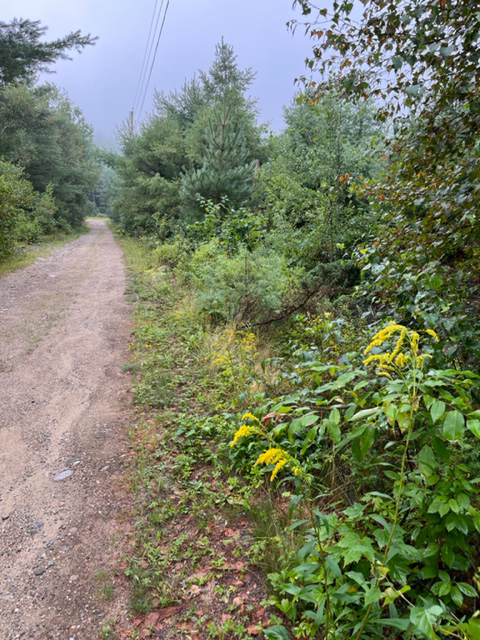
From the day I bought this property almost 40 years ago I walked down this lovely road with a sense of the deepest pleasure. The trees were young then. In spring wild cherries burst with pure white or rosy pink blossoms, the bark of each a different hue, emerald pines bore startling white candles, chattering poplars multiplied, pale gray and pearl white birches leaned in for intimate conversation, smooth barked red maples graced open spaces all lemony lime in spring – leaves and needles etched against cobalt blue. The trees were healthy then.
When I was in my twenties and in therapy I had a recurrent dream in whicha strange man was chasing me and caught up with me and started to strangle me and I could not scream. I was asked to act this dream out by my therapist, who told me that this time I would scream. I could not. She got up and came over and put her hands around my neck and started to squeeze. I still could not scream.
Two decades later I had a dream in which I was a baby and suffocating in my crib. I asked my current therapist if she thought someone had tried to suffocate me when I was an infant. Her answer was simple: “There is no need to think about this happening when you were an infant. You have been silenced all your life.”
When I was a child, my father used to punish us by taking off his belt, sitting down, asking us to pull down our pants and lie across his lap, and then lashing our bare bottoms with his belt. This was typical child-rearing practice in the 1950s and 1960s. Rita Nakashima Brock was the first to name it for me as child abuse. Nonetheless, when we got older, my brother and I preferred to be spanked, rather than to have our 25 cents a week allowance taken away from us. At least, we thought, being spanked was over in a minute, while losing your allowance was something you would suffer for a long time.
Dazed by the breakneck speed of the descending subway ride, the girl collapsed on the marble floor and just sat there for a while. Eventually she noticed a table with two full cups sitting on it and a sign that said Drink Me. “No no no,’ she said aloud. “Auntie said never drink what you don’t know you’re drinking because you never know what’s gonna happen to you.” She sat for another long minute, then said, “So where am I? I know where I was headed. To a committee meeting. But that’s not where I am. Where am I?” No reply. She looked around. To her left was a fancy garden gate, but she could see no garden beyond it, only lots of steps. To her right was a long corridor with office doors on both sides. All the doors she could see had names on them.
“Alice.” Where was that voice coming from? “Alice, you’re here for a meeting. You’re late! Hurry up! We can’t be late!” She stood up, but all she could see was a long-eared shadow (how curious!) running down the corridor. “I’m late, I’m late,” came the echoing voice.
Author’s Note: I write this in honor and celebration of my sister, Jeannie, who is turning 80 today, this third day of September, 2022. My thanks to the editors of FAR for letting me post this on her day.
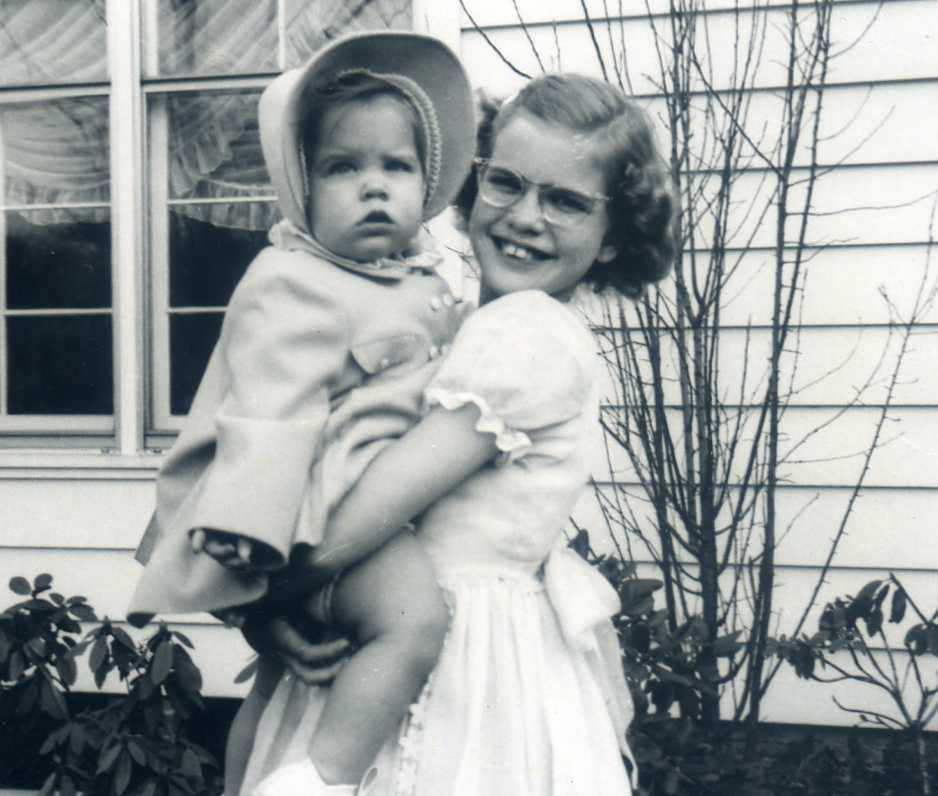
I was born into sisterhood. My sister, Jeannie, who is ten years older than I am, loves to tell the story of how, in the days before prenatal testing, she told her 4th grade teacher that she was going to have a sister. She already had two brothers, and was convinced that the baby our mother was carrying – me – would be a girl. She welcomed my presence on this earth even before I was born. Jeannie has shown me the best of sisterhood – affirming and supporting me in all of my endeavors, giving me a trusted confidante with whom I could share the truths of my life, showing up when I have needed her emotional and physical care and support, celebrating the moments of triumph and joy, and understanding me in a way that few have. So, when I came into feminism in my twenties, I was deeply drawn to the feminist ideal of sisterhood.
I first found nascent notions of the feminist concept of sisterhood when studying early nineteenth century feminists. For Sarah Grimké[i], who closed each of her “Letters on the Equality of the Sexes” with, “Thine in the bonds of sisterhood,” those bonds were primarily of shared oppression. She regarded men’s oppression of women to be universal, knowing no boundaries of race, class, or culture, and wrote at length of the oppressed condition of women in the U.S., Asia, Africa, and Europe. In her abolitionist work she condemned the sexual, physical, and emotional abuse of enslaved females and called on white women to act in solidarity with their enslaved sisters, and refuse their complicity in such abuse.
We have to thank a woman named Natalie M. Kalmus for her contributions to the development of color on screen. Being a woman and the executive head of the Technicolor art department in the 1930’s was nothing short of extraordinary, and, in 1935 she released a document titled Color Consciousness in which she explored color theory and the use of color on screen. And, while this was illuminating and groundbreaking at a time, we also have some serious problems with the document that need to be re-examined from an anti-racist and feminist perspective.
Kalmus tells us how and when to use color given that particular color’s moral and psychological associations. She tells us that different colors evoke emotional reactions from the audience because these colors paint a realistic worldview. This presents a problem because, if, as Kalmus suggests, the usage of color and its associations represent a realistic worldview then the worldview Kalmus presents is an inherently racist one. Kalmus writes that black “… has a distinctly negative and destructive aspect. Black instinctively recalls night, fear, darkness, crime. It suggests funerals, mourning. It is impenetrable, comfortless, secretive.” In stark contrast to the color black, Kalmus writes that white “… reflects the greatest amount of light, it emanates a luminosity which symbolizes spirit. White represents purity, cleanliness, peace, marriage… White uplifts and ennobles, while black lowers and renders more base and evil any color.” To put it simply: black is evil and white is good. What does any of this have to do with spirituality? Well, the way we think and feel about color and how characters are depicted on screen taps into our psychological understanding of how “good” or “bad” a color is. This trickles over into our magical and spiritual practices with the notions of “Black Magic” vs. “White Magic.” We often associate someone who practices black magic as someone who works with dark or evil forces, and white magic with someone who practices magic for the good of others.
TRIGGER WARNING: Post divorce, I find myself redefining my relationships and want to share some discoveries I have made about sex and intimacy, and how that relates to my spirituality and identity as a feminist. I freely admit they might be a bit shocking.
Post divorce, I have had three ‘relationships’. Okay who am I kidding, I’ve had sex with three men. I suppose you could call them ‘relationships’. We talked. We texted. We fucked.
All three were painful in their own way. All three were pleasurable in their own way.
I’m redefining this area of my life just like I am redefining all the areas in my life. ‘Cernunnos’ points the way. This is one of my favorite cards in my Druid Craft Tarot deck, and I pull it often.
‘Cernunnos’ is the Lord of the Animals. “This card represents the raw power of the instincts and of Nature, and also the dangers of delusion and excess, but offers the potential for achieving both freedom and abundance.”
Like so much else in life, it’s all about the balance.
Intolerable temperatures, the air dripping with humidity, unable to sweat, my body catches fire. My aging mind shuts down.
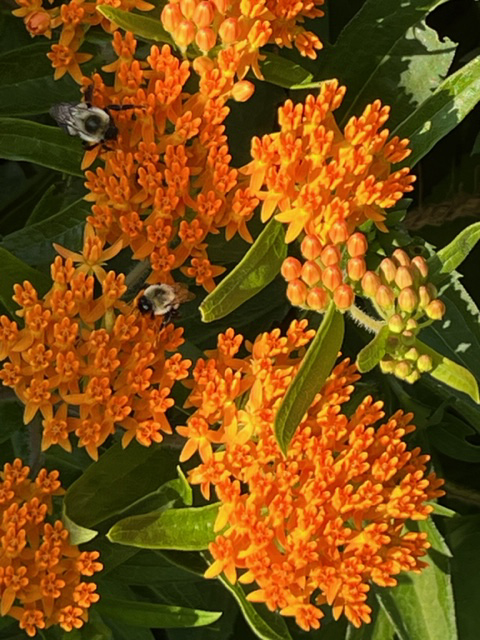
How to find hope in the ruins, not just personally but all around me in dying leaves rife with holes or chewed to bits in late July, flowers shriveling under a merciless sun. A solitary frog croaks from somewhere inside a garden gone wild. Silver swords create an impenetrable bower protecting toads and frogs from within. The scent of bittersweet butterfly weed draws in flaming orange fritillaries, monarchs, bees, a silvery white butterfly with two spots on her wings. A few spikes of scarlet bee balm burst. Flames erupt, crimson, salmon, lemony lilies and golden nasturtiums seduce with sweet nectar. Hummingbirds hover, chirping madly between these and red mint…my breathing is labored – shallow – my body waterlogged and swollen. Together the dogs and I doze lazily, our bodies aching for
Sometimes we think of Greek myth as a pre-patriarchal or less patriarchal alternative to the stories of the Bible. After all, Goddesses appear in Greek myths while they are nearly absent from the Bible. Right?
So far so good, but when we look more closely we can see that Greek myth enshrines patriarchal ideology just as surely as the Bible does. We are so dazzled by the stories told by the Greeks that we designate them “the origin” of culture. We also have been taught that Greek myths contain “eternal archetypes” of the psyche. I hope the brief “deconstruction” of the myth of Ariadne which follows will begin to “deconstruct” these views as well.
Ariadne is a pre-Greek word. The “ne” ending is not found in Greek. As the name is attributed to a princess in Greek myth, we might speculate that Ariadne could have been one of the names of the Goddess in ancient Crete. But in Greek myth Ariadne is cast in a drama in which she is a decidedly unattractive heroine.







 Feminism and Religion