From the Archives: Abortion–the topic that won’t go away–or even morph

This was originally posted on March 12, 2014. It was Esther’s first FAR post.

Recently, I got involved in a conversation about abortion.  It happened on Facebook when a relative posted that her heart hurts when she considers her “sweet baby girl” and how the law (Roe v. Wade, 1973) in the United States gave her the choice as to “whether [or not] I would have her killed.”  She’s sincere.  Many of her friends “liked” her post and, with few exceptions, commented in agreement.  I was one of the exceptions.

March celebrates Women’s History Month–a month to remember the accomplishments of our foremothers, noting their work helping to secure for us (their progeny) certain rights, most notably the right to vote (Elizabeth Cady Stanton, 1815-1902) and reproductive rights (Margaret Sanger, 1879-1966).  Support for abortion nowadays almost always falls under the rubric of “women’s reproductive rights.”  So when we hear, “It’s my body and I’ll decide what I’ll do with my own body,” the speaker is giving voice to what many consider to be a fundamental right–the right to be autonomous and exercise free agency over one’s own person.

Continue reading “From the Archives: Abortion–the topic that won’t go away–or even morph”
Women’s Autonomy and Well-Being v. the Patriarchy by Elizabeth Ann Bartlett

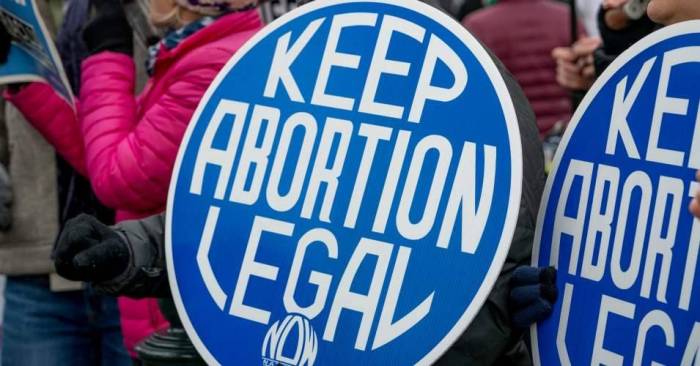
A recently leaked draft of the US Supreme Court’s opinion on Dobbs v. Jackson Women’s Health Organization suggests that the court is ready to overturn Roe v. Wade. Most people know the legal consequence of Roe, but few know the grounds for the decision. The focus was on the “important and legitimate interest” the state has in preserving and protecting the health of the pregnant woman. Defining “health” broadly, Justice Blackmun wrote:

            The detriment that the State would impose upon the pregnant woman by denying this choice altogether is apparent. Specific and direct harm medically diagnosable even in early pregnancy may be involved. Maternity, or additional offspring, may force upon the woman a distressful life and future. Psychological harm may be imminent. Mental and physical health may be taxed by child care. There is also the distress, for all concerned, associated with the unwanted child, and there is the problem of bringing a child into a family already unable, psychologically and otherwise, to care for it. In other cases, . . . the additional difficulties and continuing stigma of unwed motherhood may be involved. (410 U.S. 113, 1973) 

Psychological, physical, familial, social, present and future health of the woman are all to be taken into consideration. I would add to this the spiritual well-being of the woman, for this is a deeply personal spiritual decision as well.

Continue reading “Women’s Autonomy and Well-Being v. the Patriarchy by Elizabeth Ann Bartlett”

Symbols of Hope – Event in Support of Ukrainian Refugees

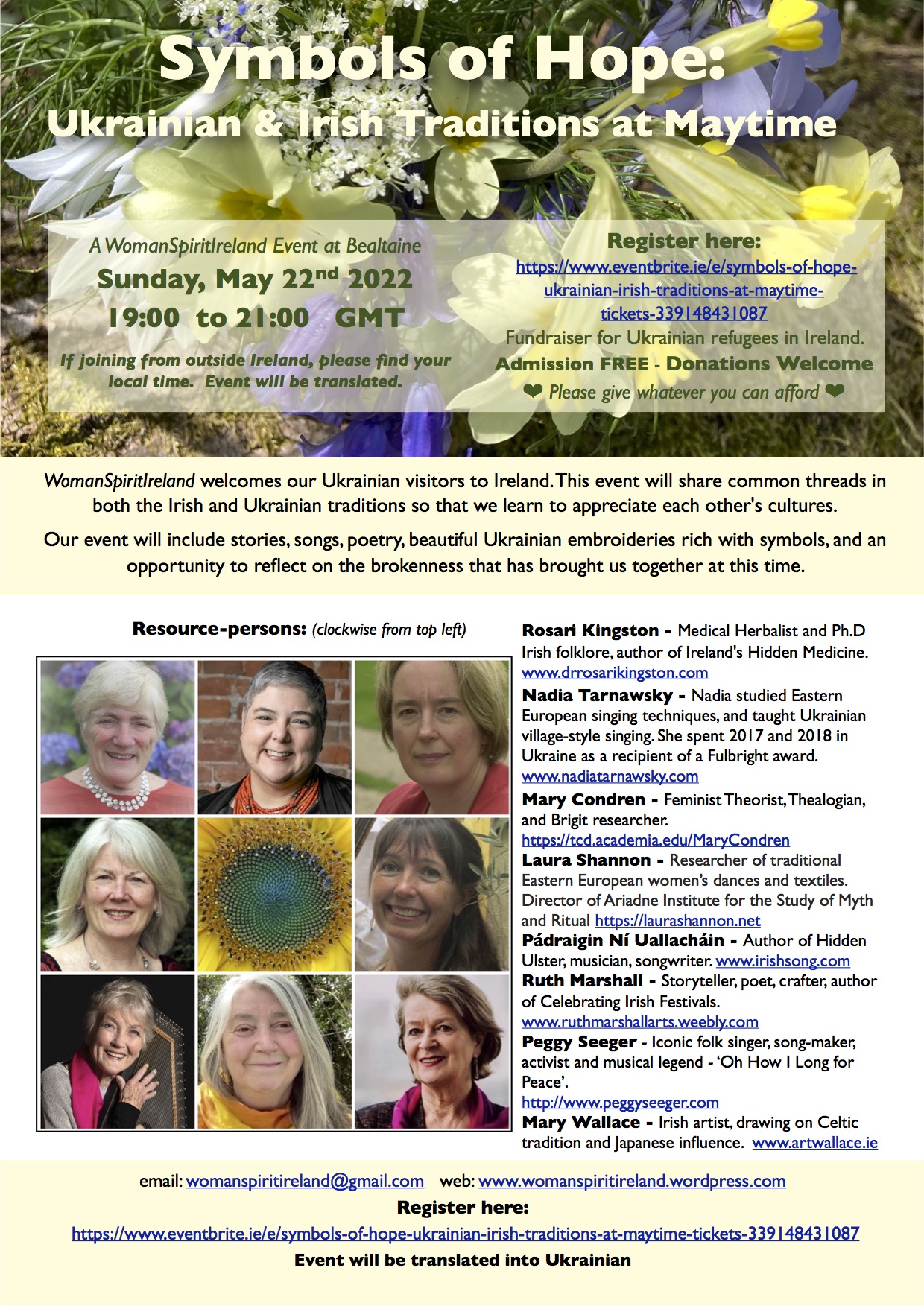
Womanspirit Ireland has organized an event for this coming Sunday, May 22nd, to exchange cultural themes with Ukrainian Refugees and to raise funds for the 30,000 refugees who have already arrived in Ireland, and the many more expected. All donations will go to the group:  “IrelandforUkraine” to maximize the funding for Ukrainians in Ireland and those still in Ukraine.  

FAR is happy to note that one our regular contributors, Laura Shannon, is part of the program. The event will include stories, songs, poetry, beautiful Ukrainian embroideries, rich with symbols, and an opportunity to reflect on the brokenness of the situation that brings folks at this time.

Continue reading “Symbols of Hope – Event in Support of Ukrainian Refugees”

“Calculated Emotional Violence” and Abuse: Memories of ‘Mother Days’ by Sara Wright

I took the above phrase from a post on FAR (published 5/6/22) after it triggered memories of mother abuse. Like Sedna I was a daughter who was thrown into the sea, her fingers cut off one by one (but not by my father). Abandoned and left to die, Daughter sank to the bottom of the sea. The classic Handmaid’s Tale. In the Inuit story the abused daughter survives, transforming into Mistress and Mother of the Animals. As a woman I have followed in Sedna’s footsteps in that I became a dedicated naturalist with a fierce love for all non-human creatures (and plants), but I have yet to transform my unfortunate family history.

With Mother’s Day approaching, I am forced against my will to think about my calculating, deceitful mother who had little use for women in general, and spent her life criticizing and eventually deleting her only daughter permanently from her life. Trashed.

My first crib memory is one of raw terror – a bewildered baby crying out for a mother that never came. Comfort, compassion, love were withheld. Now at 77 I ask myself: what was wrong with this woman?

Continue reading ““Calculated Emotional Violence” and Abuse: Memories of ‘Mother Days’ by Sara Wright”

Carol P. Christ’s Legacy: Is This How Patriarchy Began?

This was originally post on June 19, 2017

In my widely read blog and academic essay offering a new definition of patriarchy, I argued that patriarchy is a system of male dominance that arose at the intersection of the control of female sexuality, private property, and war. In it, bracketed the question of how patriarchy began. Today I want to share some thoughts provoked by a short paragraph in Harald Haarmann’s ground-breaking Roots of Ancient Greek Civilization. Haarmann briefly mentions (but does not discuss) the hypothesis that patriarchy arose among the steppe pastoralists as a result of conflicts over grazing lands. As these conflicts became increasingly violent, patriarchal warriors assumed clan leadership in order to protect animal herds, grazing lands, and the women and children of the clan.

On the recent Goddess Pilgrimage to Crete, while we were driving through sparsely populated grazing land, my friend Cristina remarked that the shepherds on foot wearing traditional clothing that she had seen several decades earlier had been replaced by men in shirts and jeans, driving farm trucks. Her nostalgic reverie was interrupted by our young Cretan bus driver who said, “You would not want to be alone with one of those men, not now and certainly not then.”

Continue reading “Carol P. Christ’s Legacy: Is This How Patriarchy Began?”

On the Good and the Bad of Behar by Ivy Helman

The Torah portion for May 21, 2022 is Behar (Leviticus 25:1 – 26:2).  In it, the Israelites receive instructions for sh’mita and yovel – two types of sabbatical years.  These years attempt to set up right relations between the community, the inhabitants of the land, and the land itself.  From an ecofeminist perspective, not all is as idyllic as the Torah wishes it to seem.   

Behar begins with sh’mitah, a sabbatical year that takes place every seventh year.  During sh’mitah, the land must lay fallow.  Both humans and animals can eat from what the land will naturally grow.  

Continue reading “On the Good and the Bad of Behar by Ivy Helman”

What is Before Us by Xochitl Alvizo

It was a strange thing. I even felt a little self-conscious about it, but it’s just where I was at the time.

I arrived in Mazatlán two days after my dad died. The wake was well on its way and people were already at the funeral home, including my mom and sister. I see my dad in the coffin – it was an open casket with a glass top so you could still see him. I said hi to him like I would on any other day – “Hi papa” – waving toward him from a couple feet away as I greeted the folks already there. I felt no sadness, no grief, no need to cry.

I then went and stood by my mom’s side as she wept over the coffin, talking to him and gesturing as if caressing his face over the glass top. I put my arm over her shoulder. I stood with her in her grief. I felt sad for her – I wanted her to be ok. But me, I felt fine. People would hug me and cry as they did, expressing their condolences or their own grief. I would hug folks back, but there was no part of me that needed to cry – I just wasn’t there yet.

It took me over a week before I felt like crying – before I did cry. People said it was shock; that was why I didn’t cry. At the time, I didn’t know what it was – I just knew that I felt fine, until I didn’t. Today, ten months since my papa’s death, I don’t think it was shock, it was just the fact that he wasn’t who was before me, who I was feeling—it was my mom, grieving, and she was my focus. She was who was before me, and I tended to her.

Continue reading “What is Before Us by Xochitl Alvizo”

A Reflection on Aging by Sara Wright

 In feminism becoming a ‘wise’ crone is acknowledged (it is certainly true that experience brings insight), but the vulnerabilities associated with aging remain hidden. I wonder how much of this silence has to do with shame? Does our culture’s obsession with youth keep us quiet?  If so this attitude isolates women from one another when older women need each other’s support more than ever. Lately, I find myself keenly aware that I need to write about the changes that are occurring in my own life so that I remain visible to myself if not to others.

When it comes to the challenges of aging the silence is deafening.

Turn, Turn, Turn

It’s May Day. At dawn I scoop water from the brook, first pouring some on the earth and then, returning to the house, I bless the floor of the log cabin that is my home. I light candles for intentions… Too sensitive to light (phototrophic) I am acutely aware that the wheel is turning her face towards the harsh white glare of summer.

 A dangerous time.

Continue reading “A Reflection on Aging by Sara Wright”

Legacy of Carol P. Christ: What Does Mother’s Day Mean in a Patriarchal and Matricidal Culture?

This was originally posted on May 9, 2016

When we seek immortality or spiritual “rebirth,” are we not saying that there is something wrong with the “birth” that was given to us through the body of our mothers? In She Who Changes and in “Reading Plato’s Allegory of the Cave as Matricide and Theacide,” I asserted that our culture is “matricidal” because it is based on the assumption that life in the body in this world “just isn’t good enough.”

What is so wrong with the life that our mothers gave us that we must reject it in the name of a “higher” spiritual life? The answer of course death.

Can we love life without accepting death?

Can we love our mothers if we do not accept a life that ends in death?

Jesus was said to have encouraged his disciples to leave their wives and families in order to follow him.  When he was told that his mother and brothers were outside and waiting to speak to him, he is said to have said:

“Who is my mother, and who are my brothers?” And stretching out his hand toward his disciples, he said, “Here are my mother and my brothers!  For whoever does the will of my Father in heaven is my brother, and sister, and mother. (Matt. 12:48-50)

Continue reading “Legacy of Carol P. Christ: What Does Mother’s Day Mean in a Patriarchal and Matricidal Culture?”

From the Archives: A Handy Spiritual Practice by Barbara Ardinger

Originally posted on February 7, 2021. You read the original comments here.

Here’s a simple spiritual practice that I’ve been doing for longer than I can remember. During the regime of the Orange T. Rex, I started doing it at bedtime to calm my mind so I could go to sleep. We’re hopefully living in a more optimistic and peaceable time now, but that’s no reason not to add a new spiritual practice to our lives. I hope you’ll like this one and will try it for yourself.

We’re accustomed to seeing people praying with rosaries or reciting mantras and counting repetitions with strings of beads. We can do that, too. But how about using a simpler “tool” to keep track of our mantras and affirmations—our own hands?

Continue reading “From the Archives: A Handy Spiritual Practice by Barbara Ardinger”