Re-Imaging Three Marys by Janet Sunderland

The recent #metoo movement, along with young women entering Congress, has pointed to an important question. Why, in this 21st Century, are these achievements remarkable? Why has it taken so long for women to be recognized as capable for these positions? One possible reason is the Christian mythology around women. However, to recreate the way women are viewed, we must re-imagine the women who have been standard-bearers for two thousand years.


Continue reading “Re-Imaging Three Marys by Janet Sunderland”

How Can Change Happen If We Can’t Imagine It First? by Darla Graves Palmer

More than one hundred years ago, a small group of women joined together and decided to create their own village, one rooted in relationship and guided by spirit. They weren’t the first such women-led town in the country – there was a web of sister villages throughout America, some formed as early as the seventeenth century – but Chantilly Lace was unique. Rising out of the dust of an abandoned Gold Rush era in the Rocky Mountains of Colorado, a time when many women were abandoned by men seeking further adventures or widowed when husbands lost their lives in the mines, this mostly female community determined its own fate. Now the modern women (and a minority of men) faced new challenges in the twenty-first century: how would they adapt and thrive?

If this had been true, how might things be different now for all of us?

The above sets the stage for a fictional series of books I’ve been writing (the first book is complete). The locale was always going to be a small town in the Rockies (because I’ve lived there), but the broader ideas about the town’s development have been evolving steadily, especially since the last presidential election. I keep asking myself how a culture based upon principles of peace and values of belonging, established firmly upon a spiritual core, might function in our capitalist patriarchy.

How can change happen in real life if we can’t imagine it in fiction? I’m challenging myself to make it happen.

Continue reading “How Can Change Happen If We Can’t Imagine It First? by Darla Graves Palmer”

Coming Home to Spring by Sara Wright

The older I become the more I appreciate Nature as she is, Nature the Creatrix of the Earth. Nature creating without human intervention. The cycles of life and death are so intimately intertwined and never more evident than in the spring when each rotting log becomes home to ants who are feasted upon by black bears (whose primary protein source 93% comes from ants, grubs and larvae). Splintered detritus becomes the rich soil that supports the seedlings of the next generation of trees, even as the ground peppers the moment with the delicate three lobed trillium, lady-slipper, twin flower, partridge berry trailing arbutus, unfurling spirals – the birthing of ferns, and perhaps my favorite, wild lily of the valley soon to fill this forested glade with her intoxicating scent.

Outside my window, diversity reins as Royalty! Maples, ash, oak, beech moose maple, witch hazel, spruce hemlock, fir, balsam converse with one another, above and below ground – their language is made of pulsing vibrations, sound and scent. The naturally fallen white birch logs crisscross each other creating complex and unique patterns apparent to any artistic eye. The brook is wending her serpentine way to the sea, her spongy banks of sphagnum moss are steeped in emerald. The translucent papery thin leaves of the beech tree ripple in the slightest breeze.

Continue reading “Coming Home to Spring by Sara Wright”

Missing from History: Women Composers by Mary Sharratt


Clara Schumann


To a large extent, women have been written out of history. Any surviving record of female accomplishment is often trivialized or dismissed. This seems especially true in the male-dominated world of classical music. When asked to name a single female composer, many people draw a blank. This isn’t because they’re ignorant, but because women’s music has been buried and neglected for far too long. Even pioneering women composers themselves lived and worked in ignorance of their foremothers.

Clara Wieck Schumann, wife of Robert Schumann, composed her first piano concerto at the age of fourteen and wrote a significant body of work in her early life. Mother of eight children and family breadwinner, she became the foremost concert pianist of 19th century Europe. In her sixty-one-year performance career, she interpreted the work of contemporary composers such as Robert Schumann and Johannes Brahms. Yet when it came to establishing herself as a composer in her own right, she was crippled with self-doubt. “I once believed that I had creative talent, but I have given up this idea,” she wrote in her diary in 1839. “A woman must not wish to compose—there never was one able to do it.” She was only twenty when she wrote these words that condemned her music to obscurity. Continue reading “Missing from History: Women Composers by Mary Sharratt”

Grounding My Love by Xochitl Alvizo

I love living in a second-story apartment. Having a view of Los Angeles, of the palm trees, the expansive sky, the distant mountains, and the city lights of downtown, makes life feel bigger, more full of possibilities. In the struggle of transitioning my life back to L.A., the view from my second floor apartment helps make me feel ok in the world. I’m in love with Los Angeles – the land, its topography, its sky, its desertness – and even its traffic. Beside the fact of sometimes being made to arrive late somewhere, I don’t mind being in our famed L.A. gridlocks – I don’t mind being in the slow moving flow of cars. I kind of enjoy being among the thousands of other folks sharing the collective experience of trying to get someplace. Traffic becomes for me a leisurely time when I get to do nothing else but enjoy the city.

Plus, the freeways – I love them! Have you ever driven on one of L.A.’s sky high on-ramps or carpool lanes? It’s like you get to fly. You get to be up in the sky among the top of the palm trees, with all the other cars and buildings off in the distant view. I would drive somewhere just to get onto one of our sky-high carpool lanes, I swear. Just recently I merged onto the carpool lane of the 110 North from an on-ramp I had not taken before, a magnificently long single-lane on-ramp that took me high up into the air, and I immediately thought, I need to remember this way so that I can drive it again sometime. Continue reading “Grounding My Love by Xochitl Alvizo”

Climate Change as a Socio-Spiritual Feminist Issue (Or 10 ways to be a leader in the era of climate change) by Nurete Brenner

Authorities have observed that climate change is a feminist issue because it disproportionately affects women. Among these, the United Nations has gone further to acknowledge that climate change is a feminist issue because women are on the forefront of adopting climate-change mitigating techniques and technologies. A recent UN report states that “women are key actors in building resilience and responding to climate-related disasters…” But overarching these admittedly important issues is the greater understanding – not mentioned by the UN report – that climate change is a feminist issue on the socio-spiritual level. This side of the issue is often overlooked because the institutions who compile reports are immersed in a masculine way of thinking.  

What do I mean by a masculine way of thinking and why do I label it in this seemingly gendered way? Masculine values are those of winning, achieving, proving, succeeding, counting, controlling. pursuit of achievement and status; individual self-reliance; strength and aggression. The UN climate report cited above goes on to say that “Enacting good policies requires quality data, so that we can quantify the issue and measure improvement…” Reports such as this make their points by tabulating numbers and citing statistics, not seeing that these are already masculine ways of expressions and that numbers can only ever tell part of the story.  These masculine traits and values are social constructs and not necessarily to be associated with the male biological sex. Both men and women and other-gendered can display masculine values and attributes but they are labeled masculine because society typically associates them with the male gender. Continue reading “Climate Change as a Socio-Spiritual Feminist Issue (Or 10 ways to be a leader in the era of climate change) by Nurete Brenner”

Lessons Mothers Might Teach Their Daughters by Elisabeth Schilling

There might be lots of lessons to consider. These lessons might have holes, for I’m not a wise sage, and I’m not really even a mother. As I am a couple of years from 40, I think about what lessons I would teach my daughter if I had one, lessons to honor her physicality, lessons to create space for her soul. What do you think of these lessons? Would I be a bad mother?

  1. Be self-sufficient, and work hard and do it early.

I think there is much to say about a woman making her own money so that she can be in relationships that honor her tendencies and desires and contribute in those relationships financially. I’m not sure why it is, but I still feel that we are in a time where most men are more given the idea they should be self-sufficient and work hard and early to do it and many women, although perhaps a hint of this, would not have this as the core of who they are. A woman should have her own money so that she can be free.

  1. Find a spirituality and a community that allows you to be confident in your internal wisdom and body and support learning about life skills.

Continue reading “Lessons Mothers Might Teach Their Daughters by Elisabeth Schilling”

Outtadeway-O: A Found Goddess of Public Transportation (well, you asked for Her last month) by Barbara Ardinger

Tall, hearty. sometimes pushy, and usually very loud, Outtadeway-O is easily able to propagate and multiply Herself so that we can find Her in crowded airport terminals, at bus and subway stops, and just about anywhere people are traveling from or to. She’s in charge of trains, planes, and taxi-cabs. She’s the One who, when we’re in a hurry to get somewhere on time, shouts, “Please, oh, please get out of the way!” Pilots, engineers, station masters, ticket agents, and ÜberAlles drivers all hear Her. You better bet they get out of Her way.

Although there are apocryphal reports that Outtadeway-O was present when Hannibal crossed the Alps (who do you think was in charge of those elephants?) and in the Roman Colosseum (She supercharged some of the chariots, horses, too), She’s most familiar as the gal in the New York subway system who kindly tells you which side of the tracks to stand on so you get on the train going in the right direction. Whether you’re lost in La Guardia, O’Hare, Hartsfield, or LAX (and in the smaller airports, too), She’s the gal in the uniform who explains how to use those dratted ticket machines on the curb and gives you a tidy map that shows where the gates are and how to find them without tripping over the people sleeping on the floor because their flights were delayed or canceled. She’s also the helpful agent who finds food for those people when they wake up and points them toward the bathrooms. Continue reading “Outtadeway-O: A Found Goddess of Public Transportation (well, you asked for Her last month) by Barbara Ardinger”

Islam is my Louvre – Part II by Valentina Khan

I was once asked “why do I stay Muslim”? That was the question prompt, and it begged an answer…Reason #2: I believe Islam has vagueness in the Quran (I answered Reason 1 and 2 yesterday…)

What do I mean by all this vagueness?

First of all, Judaism and Christianity-based characters have made appearances in Islam by way of shared stories and prominent shared figures: Adam, Abraham, Isaac, Ishmael, Lot, Aron, Moses, Job, Jonas, Noah, Jesus, Mary and so on. Growing up Muslim, these prominent religious figures across the Abrahamic spectrum were names that were mentioned time and time again as part of the religious history and teachings. So I feel a sense of relief, that as a Muslim, we are not sailing alone in the sea of faith with no shared history with any other faith, but we are on the same island (so to speak) with our Jewish and Christian brothers and sisters. Continue reading “Islam is my Louvre – Part II by Valentina Khan”

Holy Women of Pride: Queer Spirituality and Worship Resources by Angela Yarber

As we enter Pride month, do you ever finding yourself wishing there were unabashedly queer resources to aid clergy and people of faith in nurturing spirituality, celebrating queer families, or offering liturgies that celebrated revolutionary queer women? Look no farther! The Holy Women Icons Project—a non-profit seeking to empower marginalized women by telling the stories of revolutionary holy women through art, writing, and special events—has created three such resources. Thanks to a generous grant from The BTS Center, these affordable and accessible online retreats and resources are available for clergy and laity alike. Check out these three offerings, along with the revolutionary seven queer women of color who inspired them!
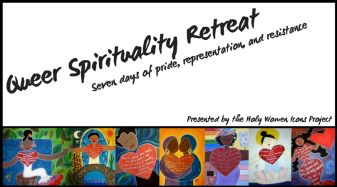
HWIP’s 7-Day Online Queer Spirituality Retreat is an opportunity to subversively queer your spirituality, and for the LGBTQ+ community to celebrate our spirituality without having to translate it through the lens of heteronormativity. Open to everyone, the Queer Spirituality Retreat features seven different queer women of color: Pauli Murray, Frida Kahlo, Perpetua and Felicity, the Shulamite, Marsha P Johnson, Guanyin, and Gloria Anzaldúa. The most important part of the retreat is, of course, the revolutionary queer women who make it possible. So, allow me to briefly introduce you to seven queer women of color… Continue reading “Holy Women of Pride: Queer Spirituality and Worship Resources by Angela Yarber”