“I had known that dumpster diving is subversive….What I hadn’t considered previously is its arguable feminist and biblical precedents.”
The following is a continuation of a two-part blog. Read part I for what prompted me to go dumpster diving, what freeganism is, and what three things surprised me the most about dumpstering beyond the sad and shocking reality of tremendous waste.
My Dumpster Dive Haul
After sorting through several trash bags of edible food in the approximately 10 minutes that we spent at one site in my first ever urban scavenging trip, this is what I ultimately brought home.
(Reminder: As explained in part I, I have intentionally photoshopped out the store’s name and the use-by/best by dates).
“I get that consumers generally prefer to buy produce that looks a certain way, but can the routine act of trashing whole bags of clementines, apples, or tomatoes because of a few imperfections be justified in a world that is full of hungry and malnourished people?”
Renowned climate change activist and author Bill McKibben spoke at our graduation earlier this year. Among the charges he gave to all of us in attendance (i.e., not just the graduates) was for us older folks to be willing to bear more of the possible “costs” of political activism. His reasoning was that being a 20-something with an arrest record was not a particularly good thing for young job-seekers today.
I was inspired. I thought to myself, “I have tenure, I work with colleagues who champion prophetic civil disobedience, and my class privilege would allow me to post bail if arrested.”
When chatting with a graduate that afternoon, I told him that I’d like to make good on something we once discussed in class during a session on the ethics of consumption—I’d like to go dumpster diving with him.
Mind you, I don’t fit the stereotypical urban scavenger profile (although middle class dumpster diving is on the rise). I grew up in a gated community, once brought my portable curling iron on a junior high church group camping trip, and today am more bourgeois than Bohemian. So what interest did I have in electively digging through garbage?
All of us have the same creative power as artists to contribute to the world in our own domains. When we do so, we re-create the world and participate in its ongoing creation.
For years, my friend Lisa Cole Smith has been working with artists and thinking about their important role in the world. She has been building a community to support artists and other creative people through a Christian church in the Northern Virginia/Washington DC area and at times, I’ve been fortunate enough to participate in that effort. My conversations with Lisa are always rewarding, whether we are simply catching up as friends, giving each other encouragement for our work, or discussing theological concepts. Although she works in a church and I work in an academic setting, we have similar pursuits. Continue reading “Re-creating the World by Elise Edwards”
Can women have it all? Possibly. Can men ever have it all? Maybe. Regardless of however we put it, the are ills to every good deed in the world and we need to get back to understanding how and why we use each other in order to fully understand that behind every good man might be a good woman but also behind every good women there might also be a good man.
Growing up, my favorite movie was The Associate staring Whoopi Goldberg as a woman at a Wall Street firm attempting to climb her way up the corporate ladder through hard work and dedication. Her character Laurel Ayres does all the work and comes up with the ideas that clients eventually invest in, her partner Frank takes all the credit and eventually surpasses her at work by getting the promotion she had been vying for. In a prodigious scene that I still vividly remember from my childhood, Laurel quits her job and starts an investment firm on her own; betting every cent and piece of property she has on the eventual success of her new business adventure.
In an attempt to break through the proverbial glass ceiling and play with the big boys of Wall Street, Laurel eventually discovers that although she can be (and is) the genius behind many of the great ideas that would save companies millions, she still needs to have her ideas expelled by a man she creates in order to win over clients, which eventually leads her to become successful. However, while Laurel is reaping in the benefits of having Mr. Cutty, her made up business partner, by her side, she eventually learns that no matter what she does she will always be secondary to her male business partner. Continue reading “Why Men (and Women) Can’t Have It All by John Erickson”
Child abuse does not have to be physical or sexual. The most widespread forms of child abuse are psychological, and therefore harder to see, acknowledge, and eradicate. As abused children, we unconsciously pass on patterns of abuse visited on us to children, and to others we have power over including students, employees, and even friends and lovers.
The recent visit of a friend who is suffering greatly in a “battle” with her own “demons” reminded me of the important work of Alice Miller. My friend’s “demons” take the form of a persistent self-criticism laced with the feeling that “if only” she did or didn’t do certain things, her world would fall into place. My “demons” generally take a different form, telling me that I am helpless and that there is nothing I can do to ease my suffering.
Such “demons” were not implanted in my friend and me by the devil. They took root in interactions with our own parents, who were not themselves any different from most of the parents of their time and place. Recognizing that our parents were not “bad” people should not blind us to the great harm they did to us. However, when abused children speak of their abuse, the statement that their parents did not intend to harm them usually functions to deflect attention away from child abuse that really did occur. Continue reading “Are Most of Us Abused Children? And is Child Abuse the Root of Evil? by Carol P. Christ”
Each month I am writing an article that discusses one of my Holy Women Icons, which are an array of icons painted with a folk feminist twist. These Holy Women Icons are comprised of biblical women, such as the Shulamite, feminist scholars, such as Mary Daly, artists, dancers, and women from mythology and literature. This month, I’d like to focus on a holy woman whose preaching embodied eschatological imagination and whose dance liberated broken bodies. This holy woman cannot be found within the confines of scripture or met in the flesh. Rather, her preaching and dancing are found within the pages of Toni Morrison’s novel, Beloved. If ever there was a holy woman who preached on behalf of all those broken and bound it was Morrison’s stunning character, Baby Suggs, holy.
Eschatological imagination is a communal foretaste of resurrection that does not suppress the social conflicts and injustices of racism, poverty, slavery, and privilege. Through the preaching and dancing of Baby Suggs, enslaved bodies are redeemed and transformed into resurrected bodies. A slave herself, Baby Suggs leads all the black men, women, and children to a clearing each week for worship. After inviting men to dance, children to laugh, and women to cry, she offers up one of the most beautiful sermons on behalf of her enslaved community. Morrison describes the efficacy of Baby Suggs’ message, saying:
She did not tell them to clean up their lives or to go and sin no more. She did not tell them they were blessed of the earth, its inheriting meek or its glory-bound pure. She told them the only grace they could have was the grace they could imagine. That if they could not see it, they would not have it. Continue reading “Painting Baby Suggs by Angela Yarber”
There are some words a mother never wants to hear. For me, those words came one evening as I tucked my 3 year old son, G, in to bed. We had just finished reading God’s Dream, a children’s book by Bishop Desmond Tutu, and were discussing what God might want us to do. The conversation went something like this:
G: “I think God wants me to share.”
Me: “I think so too. God likes sharing.”
G: “ “Yeah, He likes it when I share.”
SCREEEEECH!!! Insert here the sound of the needle suddenly scratching and falling off the record.
He?
Where did G get that? With two theologians as parents, G’s religious world has been carefully and intentionally constructed since birth. Nowhere ever did we refer to God as “He.”
Perhaps it was just a slip of the tongue, a mistaken pronoun, an unintentional lapse. God/dess knows I pride myself on my child’s gender fluidity. I take his vacillating male and female pronouns as a sign of early queer, gender non-conformity. Though, I suspect others might interpret that as part of normal verbal development. You choose.
Spiritual Power is arguably the most dangerous power of all. In the wrong hands, it gives the power to make judgments even about the eternal fate of another person. It needs a sign on it at all times saying, ‘Handle with extreme care.’ The greater the power a person exercises, the more need there is for checks and balances before it is used and accountability after it is used.” – – Bishop Geoffrey Robinson
May 6th, I addressed the issue of abuse of power in the Catholic Church and how we seem to be unraveling any kind of progress made since Vatican II. Since writing that article, the Leadership of the LCWR met with Vatican Officials and expressed their concerns openly. A dialogue occurred and left no resolution, just information that the leadership will discuss with the community at their August meeting. That meeting will reveal their next step in this controversy – concede and follow the conditions and rules sets forth by the CDF or disband and form a new religious community or maybe there will be another option revealed.
I have to ask though – Was this a meaningful meeting or was it meant to pacify the Sisters and their supporters? Will the Vatican change its stance? Certainly, the U. S. Catholic Sisters have not been
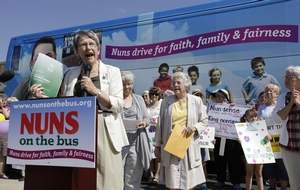
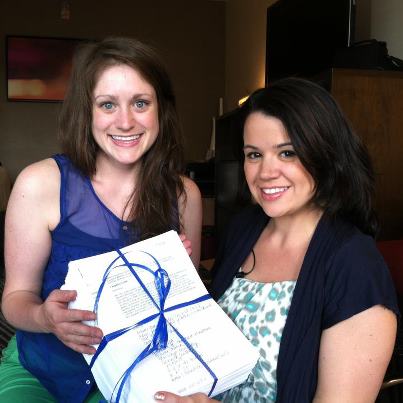
pacified, nor have their supporters. For example, there is a “Nuns on the Bus” tour traveling around the United States, prayer services for the Sisters, #nunjustice and #whatthesistersmeantome campaigns on Twitter. Even the Women’s Ordination Conference delivered a petition containing over 57,000 signatures to the Vatican in support of the Sisters. Certainly, the support for the sisters and their mission is not dwindling, but growing stronger every day.
As for the Vatican, a change in their position is doubtful, but we can continue to pray. I am, however, very discouraged by a statement attributed to Pope Benedict that indicates a desire to have a smaller more faithful Church of Catholics then a large Church of people who do not adhere to Church Teaching – seeking out a small, strong, holy community.
Obviously, it is my hope that this statement was taken out of context, but I have to be honest and say
Women’s Ordination Conference delivering Petition Picture reprinted from WOC’s page on Facebook
that my hope is filled with doubt. This is not the first time I have heard clergy make this statement. Priests have made this statement in my presence – wanting a more faithful flock and dismissing those that do not adhere to their interpretation of Church teaching. This stance does not bear fruit, but is rather a power play – a play that can be called many things – misogynist, arrogant, non-pastoral, cold-hearted, and frankly un-Christian. It also plays with a person’s spiritual fate and in many cases their soul. The psychological impact of something like this is dangerous for some. Some ordained will go so far as to withhold sacraments or even compromise the person’s status in the Church, including their role in ministry, for the sole purpose of inducing compliance – a tactic that dates to the medieval period.
This is a moment we all face—the moment when we slay the enemy, only to realize we have slain ourselves and the enemy is still at large.
In Part I of this blog, I analyzed the themes of power and beauty in the film Snow White and the Huntsman in relation to the character of the Queen. In Part II, I would like to continue exploring these themes in light of Snow White’s character and her relationship with the Queen. That Snow White’s power is her beauty is clear. True, it is stated right up front that Snow White is admired throughout her father’s kingdom “as much for defiant spirit as for her beauty.” However, it is her beauty that grants her agency and power, not her free and defiant spirit. The battle scene in the climax of the film illustrates this connection between power and beauty well—as Snow White drives her dagger into Ravenna’s heart she repeats the mantra: “By fairest blood it is done; by fairest blood it is undone.” After Ravenna breathes her last, we see Snow White looking into the mirror on the wall, the victor, the fairest. Her beauty has allowed her to ascend to power. Her beauty has allowed her to defeat Ravenna. We are left wondering—who has won exactly? Continue reading “A Tale of Power and Beauty, Part II: Snow White by Amanda Kieffer”
My relationship to God changed when I accused “Him” of everything I thought “He” had done or let be done to women—from allowing us to be beaten and raped and sold into slavery, to not sending us female prophets and saviors, to allowing “Himself” to be portrayed as a “man of war.”
In the silence that followed my outpouring of anger, I heard a still small voice within me say: In God is a woman like yourself. She too has been silenced and had her history stolen from her. Until that moment God had been an “Other” to me. “He” sometimes appeared as a dominating and judgmental Other, and at other times as a loving and supportive Other, but “He” was always an “Other.” I as a woman in my female mind-body definitely was not in “His” image.
After I expressed my anger to God, God transformed from an Other into what Whitehead once described as “a fellow [or should I say female] sufferer who understands.” Although I had already been searching for a “God in my image” or “in whose image I could be,” I had yet to find Her. In the quiet after the storm, I came to believe that I would. Continue reading “WHY DON’T FEMINISTS EXPRESS ANGER AT GOD? by Carol P. Christ”


 The following is a continuation of a two-part blog. Read part I for what prompted me to go dumpster diving, what freeganism is, and what three things surprised me the most about dumpstering beyond the sad and shocking reality of tremendous waste.






 Feminism and Religion