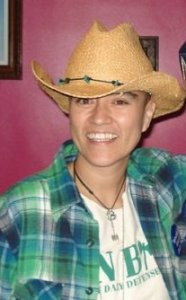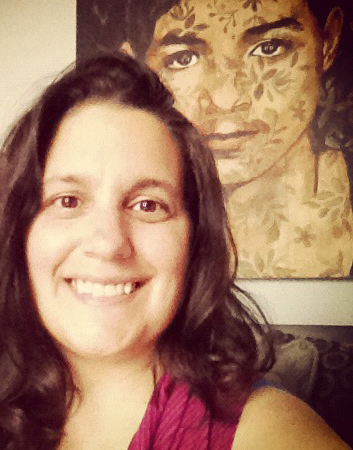
The Changing Face of Christ in the Catholic Church by Janice Poss

Yesterday, as I have done for the last six years, I attended another ordination, an ordination that as the others has been two thousand years in the making.  It was historic, it was Catholic; it was the new face of in persona Christi, the true ideal of Imago Dei.  It was also a retrieval of our roots, of the other side of God.  These ordinations make and bring God and Christ into integrated authentic wholeness and, therefore true holiness.

Yes, it was the ordination of two more women to the Catholic priesthood.  This movement is real and has been going on now since 2003. The changing face of God and Christ is in women, their determination in their discernment as a ‘priestly’ people in living out the Gospel messages with which we are all too familiar and need to be ‘lived’ to make them real and felt in our Church. Continue reading “The Changing Face of Christ in the Catholic Church by Janice Poss”

Hitting the Trifecta in Women’s Issues by Michele Stopera Freyhauf

One did not have to watch the debate between Barack Obama and Mitt Romney this past Tuesday to know that Romney hit the trifecta in the area of women’s issues.  It was all over social media within minutes of statements being made that marginalized or treated women as “less than.”

The issue of contraception and rape is still a topic of debate.  Church’s post signs to “Vote for Religious Freedom” and hand out voting guides that help you gauge the moral candidate.  Bulletin boards stating that “Obama believes in abortion and gay marriage – do you? vote Republican” appear by the highway.  This issue will not be settled during the election.

If people in power set an example of bullying and/or oppressive behavior, this behavior becomes acceptable.  If women are treated “less than,” then their dignity as well as their humanity is compromised.

An extreme example of this de-humanizing treatment of women in American society appeared October 13th in Cincinnati.com.  A story was published about a flyer found in the men’s restroom of a co-ed freshmen dorm at Miami University.  The title of this flyer – “Top Ten Ways to Get Away With Rape:” Continue reading “Hitting the Trifecta in Women’s Issues by Michele Stopera Freyhauf”

Social Engagement as Feminist Praxis in the lives of Patricia A. Reif & Rita Nakashima Brock By Teresa A. Yugar

Today our country and global community need religious leaders to utilize their theological education and feminist principles to model the formation of ally ships across ecumenical and interfaith perspectives, laying the foundation for a more just and peaceful society. While Reif and Nakashima Brock did not know each other, their feminist stance of commitment to social justice and praxis should give us pause.

In 2002, Claremont Graduate University and the Immaculate Heart Community collaborated and created an endowment to sponsor a Lectureship in honor of the memory of feminist teacher, scholar and activist, Dr. Patricia A. Reif. Each year the Dr. Patricia A. Reif committee invites cutting edge feminist scholars in religion to discuss the intersection of their research interests and its influence on their scholarship, activist work and teaching in the broader sense of the term, both inside and outside of the classroom. This year the Reverend Dr. Nakashima Brock is the select guest Lecturer to honor Reif’s life, memory, and legacy. Tammi Schneider, committee member and Dean of the School of Religion stated Nakashima Brock’s visit is timely because in three weeks the national U.S. presidential elections will define the trajectory of our country for, minimally, the next four years. Nakashima Brock’s involvement in the Occupy Movement on a local and national level extends from her feminist commitment and advocacy for the rights of the 99% of our country who are being squelched by U.S. policies that favor the elite 1% of our nation. For Nakashima Brock it is a moral imperative for persons of faith and goodwill to educate individuals and take a stand on policies, on a state and nation-wide level that safeguard the livelihoods of the majority poor of our country. For Nakashima Brock this means quality health care for all, living wages and decent jobs, free high quality public education through college, and an end to the prison-military-industrial complex. Continue reading “Social Engagement as Feminist Praxis in the lives of Patricia A. Reif & Rita Nakashima Brock By Teresa A. Yugar”

The Turtle Goddess from Myrtos in Ancient Crete by Carol P. Christ

“As we bless the Source of Life, so we are blessed.” Song by Faith Rogow

The strange and cheerful figure portrayed in this ancient Cretan vessel comes from the site known as Fournou Korifi near Myrtos, in Crete.  Dated before 2000 BCE, she was called the “Goddess of Myrtos” by the excavator, Peter Warren.  This little Goddess was found on an altar in a small room in the ritual area of a complex of small rooms on a hill above the sea that was home to up to 120 people.  The Goddess of Myrtos is a vessel holding a vessel.  In ritual libations, liquid would have been poured from the pitcher she holds onto an altar.


She is obviously female, with breasts and a sacred triangle. Continue reading “The Turtle Goddess from Myrtos in Ancient Crete by Carol P. Christ”

I’m Tired by Elise M. Edwards

Ms. Mentor warned me that October would be tough.

A few weeks ago, I was walking through the library, looking up books on women and pedagogy, when I saw a newer version of a book I’d seen on my sister’s bookshelf: Ms. Mentor’s Impeccable Advice for Women in Academia.  The newer version, appropriately titled Ms. Mentor’s New and Ever More Impeccable Advice for Women and Men in Academia, jumped into my stack of books and invited  me to take it home where I read it during the wee hours of the night instead of doing something more “productive.” I’ve always been a fan of advice columns, so I was delighted to find that this book features several advice letters organized in chapters on various topics about work and life in the academy.  On page 112, I came across a piece called “My Head is Exploding.” It spoke to me. Continue reading “I’m Tired by Elise M. Edwards”

IN THE NEWS: To Have Eyes to See

Recently at a symposium on interreligious dialogue one of the  Muslim feminist scholars present said, “Just once I would like to be able to have a conversation about Islamic Feminism without automatically having to be put on the defensive.”

When someone is a member of a targeted group it is very hard to have the space to critically reflect on one’s tradition, much less be willing to do so with others. From the get go the person is put in the position of having to defend and speak for the whole. And as feminists, the amount of criticism received for participating in a tradition that others have judged to be irredeemably patriarchal and oppressive, can be downright exhausting, making dialogue all the more difficult. Continue reading “IN THE NEWS: To Have Eyes to See”

Visions of My Grandmother by John Erickson

“I never told my grandmother I was gay. I’ve often wanted to visit her grave, clench my hands together, and pray that she forgive me for betraying the trust she instilled upon me long ago. However, even today, I cannot bring myself to make that trek, up the hill into the countryside where her ashes lay below the ground.”

I haven’t dreamt of my grandmother since her passing one hot summer July evening.

The night, and the days that followed, continue to be a blur.  However, as my family members continue to see her in their nightly visions, I, go on unabatedly longing to see and hear the voice of a woman who made me feel the presence of the divine with each passing story.

My sister saw her in a dream when she was buying shoes, my mother has seen her multiple times when she would be undergoing a particularly stressful situation, and I, left alone and oftentimes wondering through an abyss of loneliness and disarray, wake up each morning wondering why, I am left all alone. Continue reading “Visions of My Grandmother by John Erickson”

“The Language of the Goddess” In Minoan Crete by Carol P. Christ

While the “war against Marija Gimbutas,” rooted in what my friend Mara Keller calls “theaphobia,” is being waged in the academy, her theories continue to unlock the meaning of hundreds of thousands of artifacts from the culture she named “Old Europe.”

According to Gimbutas, the Neolithic and Chalcolithic cultures of Old Europe c. 6500-3500 BCE were peaceful, sedentary, agricultural, matrifocal and probably matrilineal, egalitarian, and worshipped the Goddess as the power of birth, death, and regeneration in human and all forms of life.  The cultures of the Old Europe contrasted with the Bronze Age cultures of the Indo-Europeans who brought the Indo-European languages and value systems to Europe and India and to all of the European colonies.  The Indo-European cultures were patriarchal, patrilineal, nomadic, horse-riding, and warlike, and worshipped the shining Gods of the sky. 

“The language of the Goddess” includes a series of signs and symbols that the people of Old Europe could “read” as surely as you and I know that a cross on top of a building marks it as Christian or that a woman wearing a star of David pendant is Jewish.  Gimbutas identified the meaning of these symbols through a painstaking process that involved comparison of artifacts, attention to where they were found, and clues from the recurrence of similar symbols in later cultures.  In twenty years of leading Goddess Pilgrimages to Crete, I have found Gimbutas’ theories an indispensible “hermeneutical principle” which unlocks the meanings of the artifacts we encounter.

  Continue reading ““The Language of the Goddess” In Minoan Crete by Carol P. Christ”

Like Rain on Dry Land by Marcia Bedard

When first I moved to a rural mountain community near Yosemite, I was spiritually parched, and my soul felt  dry as a bone. Desperate for the rich conversations of my sisters, after taking an early retirement from the CSU Fresno Women’s Studies Program, I had an intuitive sense that I might find some like-minded women friends in a small group that met weekly at our local church, led by Diana, our courageously and outrageously feminist pastor, who has since moved on to what I hope are friendlier communities for feminist pastors.

If PFLAG, and similar marginalized groups, had found an oasis there, in what was called (in order to please the church fathers) a Women’s Bible Study Group, so could I. A year before, this would have been my last choice of groups to join, but in a town where fundamentalist churches thrived, and Starbucks was the only place you could find a copy of literature as subversive as The New York Times, it was my only choice. It was in the church basement, amidst a thinly disguised knitting/bible study group, that we gathered weekly to receive what turned out to be a truly holy (meaning wholly) communion of spirit, enriched by various reading that Diana generously shared with us. Continue reading “Like Rain on Dry Land by Marcia Bedard”

Monthly Highlight: Mary E. Hunt

As a Catholic feminist theologian, activist, teacher, and writer Mary Hunt has made a massive impact in the field of feminism and religion.  Following the completion of her graduate education (MA, Harvard Divinity School, M.Div., Jesuit School of Theology, Ph.D., Graduate Theological Union), Mary recognized a strong need for theological, liturgical, and ethical development by and for women and responded by co-founding WATER (The Women’s Alliance for Theology, Ethics, and Water) in 1983.  Over the last 3+ decades, she has been instrumental in addressing social injustice and creating change in religion and community. Continue reading “Monthly Highlight: Mary E. Hunt”