Her Love is the Love of God by Natalie Weaver

I used to hate Mother’s Day.  I have written about this before, so I won’t belabor the point.  Suffice it to say, I used to believe that Mother’s Day was the one of the biggest lies of all.  It was a day of demonstrated appreciation that seemed to say to me something like, “This card and dinner at Red Lobster is our way of not having to carry our part for the other 364 days each year.  You don’t have to clean up (pause) today, sucka!”  I know I’m getting better and better in my own skin, though, because this year I am not dreading Mother’s Day.  I’m not calling it Mule’s Day.  I’m actually sort of excited about it.

I haven’t swallowed a magic elixir that makes things easier or tidier.  I’m not taking anything for my mood.  My house is messier than ever as I prepare to move homes, and I am working harder than I ever have before.  My kids’ needs are greater than they were when they were babies, and I am doing things I have never done before, such as pleading for financial aid from the school and seeking county assistance for the medical needs of one of my children.  I’m exhausted, but I’m making decisions and signing deeds and taking out loans all by myself.  I get calls from people seeking payment on stuff I never thought possible, such as the daily phone call from the finance department at the cemetery.  My one hundred/month apparently isn’t sufficient.  But, I buried my dad with dignity, and I’m keeping my kids fed, clothed, and educated.  I pass kidney stones almost monthly, and my teaching is laborious, but I feel on fire with the zeal of God.  Truly, I’m starting to feel happy again, and my happiness is rooted in my gratitude.  I think the shittiness of recent years has finely tuned in me an appreciation of decency, and my eyes are opening once more to the radical joy of mere being when being is experienced as gratitude. Continue reading “Her Love is the Love of God by Natalie Weaver”
Hekate, Goddess of Liminality and Intermediary by Deanne Quarrie

Deanne Quarrie

Let me share with you the Goddess most honored as the Goddess of liminal time and space.  It is our beloved Hekate, Great Goddess of the Three Ways, bridging Earth, Sea and Sky as we travel between worlds.

In modern times, She is seen by many as a “hag” or old witch stirring the cauldron. This idea was popularized by Roberts Graves’ book, The White Goddess. In early writings, however, she is portrayed as a beautiful and powerful maiden goddess.

“I come, a virgin of varied forms, wandering through the heavens, bull-faced, three-headed, ruthless, with golden arrows; chaste Phoebe bringing light to mortals, Eileithyia; bearing the three synthemata [sacred signs] of a triple nature.  In the Aether I appear in fiery forms and in the air, I sit in a silver chariot.” (Chaldean Oracles)

She was the only one of the ancient Titans that Zeus allowed to retain her power after the Olympians seized control. She shared with Zeus, the awesome power of granting all wishes to humanity (or withholding, if she chose).

Continue reading “Hekate, Goddess of Liminality and Intermediary by Deanne Quarrie”

Why Pro-Life Stops at Birth: Who Really Supports Life and Why by Winifred Nathan

The patriarchal Catholic Church claims to be pro-Life.  But is it pro-Life?  Or is it pro-Birth?  A Catholic Benedictine sister outed the pro-Life movement. Her position: the pro-life crowd shows little if any ongoing interest in life after birth.  They’re pro-birth, but not pro-life.  Legislators who enact laws to restrict a woman’s right to an abortion, but then stand firm against funding  programs that assist the mother and her baby once the child is born are not pro-life.   Too often the goal of anti-abortion advocates is for the fetus to make it to birth. Birth is the important value, life not so much.

I propose the starting point for deciphering this puzzle is to look at our desire as human beings for immortality.  We want to defy death believing that there is a spiritual continuation of who we are after our bodies shut down.  We want death to be a new beginning.

A great deal of effort goes into seeking  an answer to the question what comes next.  A question we presently lack the capacity to answer. We honestly do not know what if anything happens following death.

Continue reading “Why Pro-Life Stops at Birth: Who Really Supports Life and Why by Winifred Nathan”

New Beginnings: Re-Birthing Myself a Million Times and One by Elisabeth Schilling

Photo 2I think being a mother must be an amazing experience. I don’t really know the glimmers and shadows of any life but mine, even though I would be more than happy to listen. Recently, I’ve been reading the poems of Carol Ann Duffy, Scottish poet, U.K. Laureate, and once partner to poet Jackie Kay, and she writes something in one of her poems (“A Clear Note”) that I resonate with: “Never have kids. Give birth to yourself.” It is not Duffy, the narrator, who says this, but a character named Moll.
In the triptych poem, three women—Agatha, Moll, and Bernadette, three generations of women, speak to and about each other through time and space. The quote is just something Moll recalls saying to her daughter, Bernadette one night when she is drunk. I of course do not think a woman cannot give birth to herself if she has children. But it is certainly a good (in my opinion, for I wish it so) excuse for myself, revising this line of verse in my own voice: I will never have kids; I need the entirety of life to birth myself.

Continue reading “New Beginnings: Re-Birthing Myself a Million Times and One by Elisabeth Schilling”

Tree of Life: The Festival of the Trees in an Age of Treefall by Jill Hammer

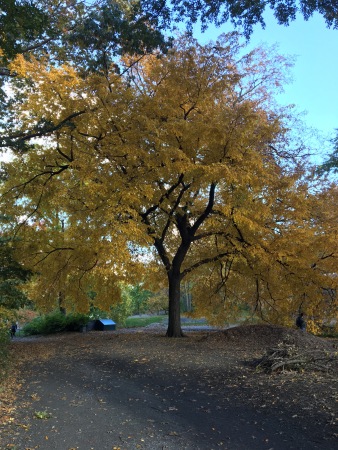
Almost every day, I walk in Central Park.  There are certain trees there I’ve come to know: the gnarled cherry trees by the reservoir, the bending willows and tall bald cypress by the pond, the sycamores that drop their bark each summer, the hawthorn not far from Central Park West.  Lately I’ve been taking photos of the trees to try to capture their essence, their posture in the world.  The trees around me feel like friends, which is what an ancient midrash (interpretation/legend) called Genesis Rabbah says about trees: that they are friends to humankind.  To me, they’ve always been a central manifestation of Mother Earth.

Currently, the national parks in the United States have no staff because of the government shutdown. Some people have taken the opportunity to cut down the rare and endangered Joshua trees in the Joshua Tree National Park—just for fun, I guess, or as a trophy of some kind.  Meanwhile, President Bolsonaro of Brazil recently has indicted that he wants to remove protection for the rainforest, in order to allow development.  It appears that my friends the trees have enemies.  Sometimes the enmity is for personal/corporate gain, and sometimes the enmity seems to have no reason at all.

Continue reading “Tree of Life: The Festival of the Trees in an Age of Treefall by Jill Hammer”

Eulogy for My Father by Natalie Weaver

Fourteen years ago, I was pregnant with William Valentine.  I had no idea what to expect.  I knew only that I was in a body, and it was pregnant.  Things happened to me, to my body, that seemed extrinsic to my person, so much so that for most of those forty weeks, I felt as though the doctor’s office was having the baby, and I was a mere observer.  But, when the time came to deliver the baby, I realized it was my body that was trying to make passage for another’s.  The particularities of myself and the baby’s self seemed to fade away into something more vital and primordial in the process of the transmission of life.  After a safe delivery, I felt a deep and curious gratitude that was beyond the gratitude I had for my child or for our health.  This strange gratitude was born of the passage I had been so fortunate to experience, that is, this novel yet ancient, essential yet unparalleled dimension of human being-ness.  I had given live birth, and I was grateful to know what that was like.  In that experience, I was more connected to my human brothers and sisters than I had ever been before, including to this new baby, who I knew in my deepest self was more fundamentally a brother human than even he was my own child.  I knew that in this transmission, I had helped a fellow traveler, and that transmitting life was simple even while it was giant in scope.  The experience was and would always be about walking with each other, from the cradle to the grave, in our vulnerability, in our fragility, in our humility, and in that walk, to find our strength, our dignity, and our luminescence, as persons, as creatures that think and speak and love.  To have been a party to another’s coming to be, this was an occasion of the greatest gratitude I had known.

In accompanying my father in this final stage of his life during these challenging and difficult months as he journeyed toward his death, I felt that same vital and primordial passage of being that I had in giving birth.  While it was not my body that this time labored and worked, I was party to his experience.  I witnessed his courage and another kind of transmission of life.  For, I saw a man go from self-concern to other-concern; from hope of getting well to hope to of making things better for others; I witnessed a man move from verbal complaint to silent focus; and I heard his relocation of worry for himself to concern for me because he knew I was hurting as I was watching him, mostly powerless to do anything but sit next to him. I saw a man graduate from a regular man to an elder and then to naked spirt in God’s care, and I was honored to be one of his midwives on that journey.  In his final hours, he became full of grace, and he fulfilled the trajectory of becoming the father and man he always intended to be.  It was an honor to behold, and I am grateful.

Continue reading “Eulogy for My Father by Natalie Weaver”

Seeking Happiness, According to Paulo Coelho by Elisabeth Schilling

Lately I’ve been reading a few Paulo Coelho books. I won’t say they are beyond feminist criticism, but it’s not what I’m going to focus on this post; but as always, feel free to say in the comments why/if you find them problematic. I expect and welcome it because it might be another layer of this conversation that I don’t have time or am not yet emotionally ready for myself.

What I want to focus on is the solution the author seems to advance in each of his books, at least those I’ve read, to our perpetual unhappiness despite the evidence that everything is fine, better than might otherwise be.

Adultery: I never finished this one, actually. I had to take it back to the library the last time I had to leave Ireland, but I’m sure I will find it again and read the rest of it soon. So I can’t say what the ending revealed, but what sticks in my mind was the predicament of the main character. She, from her perspective, had it all: wealth, an interesting career she liked, an attractive husband who was attentive and kind, a family, health. This was why she was so confused that she was unhappy. This is the premise of many of his books: the person who doesn’t know why they are unhappy. Also, the observation that no one is really happy.

Continue reading “Seeking Happiness, According to Paulo Coelho by Elisabeth Schilling”

Longing for (Dis)Connection by Katey Zeh

yuzki-yuqing-wang-585257-unsplashAs I type this post, I have another browser window open to track the path of Hurricane Florence due to make landfall in my area sometime later this week. Though I now live a few hours inland, I grew up in a coastal town, so I know how unpredictable storms like these can be. It’s entirely possible that we will get a bit of rain and wind and nothing else–and it’s just as possible that we’ll be spending quite some time without power. I pray that the latter is the absolute worst of what we all endure here.
In preparing for the storm and potential power outage, I was reminded of a time about a year ago when I was returning home after dropping off my daughter at school. As I approached the first stoplight on my route, I noticed that it wasn’t working. That’s odd, I thought.  I drove on, navigating through another half dozen malfunctioning traffic lights before arriving safely back home only to discover that the power was out there too. Continue reading “Longing for (Dis)Connection by Katey Zeh”

Emergence: Poem to a Plant Goddess by Sara Wright


Her name is Datura.

Delicate fluted deep-throated trumpets open to

humming honey bees and summer rains.

She communicates through scent.


 In the fall I collect her sharp-needled pods.

They rattle like dry bones.

I chill them.

In the spring I coax seeds to sprout

wrapping each in papery white cloth,

sing love songs  –  siren calls

to rouse each root from winter’s sleep.


I am patient…

 a woman in waiting for the heat of the sun

to unfurl the mystery of becoming

 that is re-acted in spring.


Only seeds know when to swell and burst.

Continue reading “Emergence: Poem to a Plant Goddess by Sara Wright”

The Wings of the Butterfly by Vanessa Rivera de la Fuente

0e324b7dc38871515f6637945ede9a65


Shhhhh… good women are quiet.
My mother was a beautiful woman, she never complained.

Denial is a silent violence that aims to make invisible a trauma maybe evident or not, to make it acceptable as normal and allow the victims of this trauma to be exploited from a system of oppression or people in power. Denial is that voice sugarcoated with correctness that asks us to shut up and sit down on our own pain so as to not disturb anyone. Is a silence that yells loudly, because sooner or later it will speak through the different ways we hurt ourselves and others.

It is not a mystery that women all over the world are subjected to a variety of violence and oppression. Women and girls are hijacked, raped, assaulted, murdered, their experiences mocked or banalized and their bodies thrown around like trash. People get outraged asking how this is possible? Well, this is possible because when a girl is born, she is “bestowed” the foundational denial that will allow the normalization of this violence and belittling during all her life: The denial that she is a human being. Continue reading “The Wings of the Butterfly by Vanessa Rivera de la Fuente”