Not too long ago I heard someone deride members of a seminar who were building labyrinths in the olive groves of Greece as “a bunch of tree-huggers.” I bristled! I probably first heard of the Chipko tree-hugging movement which is led by women in the 1970s and 1980s. Because I love nature, I naturally assumed hugging trees is a good thing. Originally, I had no idea that the tree-hugging movement was about much more than saving trees from being felled in the interests of short-term profit.
I did not know that the deeper purpose of the movement is to save a way of life based on forest-culture that is being threatened by the imposition of western ideas and practices promoted by colonialism and its successor, the green revolution. Nor did I know that the traditional forest-culture of India is the provenance of women: more than 4000 years of observing and experimenting created a “women’s knowledge” passed down from mother to daughter. Continue reading “Tree-Hugging Is About Trees and So Much More Than Trees by Carol P. Christ”
About 5 years ago, I began a consistent yoga practice. Right around the same time, I started a PhD program in Women’s Spirituality at the California Institute of Integral Studies where I eventually wrote my dissertation on Women’s Spiritual Leadership. Throughout my studies, I realized that the path of the Divine Feminine is an intricate journey that accentuates the mind, body, soul connection. The yogic path does the same. In late 2018, I enrolled in an intensive 5-week 300-hour yoga teacher training in India where I continued my spiritual explorations. Hindu culture reveres the Divine Feminine and Divine Masculine and yoga is viewed as a pathway into God/dess through the body. Here’s the first part of the story…
I’m in India and it’s 5:30 a.m. and an hour of pranayama awaits me. The yogis define prana as the life force that animates the entire body and yama relates to discipline. The practice of pranayama consists of breathing techniques that aim to control the breath in order to connect to the life force that resides within. Accessing this life force can invoke feelings of bliss and a connection to the Divine.
In November, my paternal grandmother passed. She was five days away from her 93rd birthday. As I was/am going through the grieving process, I started to actively recall all the studies I have done regarding death and grieving practices across the globe and throughout the centuries. Mixed with the grieving process was constructing a January term class called “Goddesses Around the World.” As I marked each culture, religion, and goddesses we would be studying I kept coming back to an interesting fact. In many ancient cultures, it was the divine feminine who oversaw death, not only at times as the bringer of death but more importantly, as the guardian of the dead, the protector of all those that have gone from the earthly realm. Continue reading “The Goddesses Ereshkigal and Epona and Their Help in My Grief by Anjeanette LeBoeuf”
The serpent in the Bible is treated as Eve’s partner in crime, a malevolent seducer who is responsible for humankind’s expulsion from paradise. But did you know there are serpents who figure positively in the Bible? There are serpent priests, a feathered serpent and a healing serpent. Check out this passage:
Be ye therefore wise as serpents
Matthew 10:16
Levites were serpent priests as evidenced by the etymology of their name. The root word levi is seen in the name of the creature “leviathan,” the giant serpent. This is reminiscent of the Pythia, the oracle from Delphi whose title is derived from the root word python.
The feathered serpent referenced in Isaiah 30:6 is a seraph, usually translated as a “fiery flying serpent.”
What does it mean to approach the idea of a Godma, a mother-of-all, as an act of the imagination, as a pure act of speculation? I particularly love the word speculator: one who is mining for the diamond, one who is going off the map, a voyager, a voyeur, a seer. A spiritual adventurer. A gambler, a trader in divine currencies.
I am a writer of fictions—speculative fictions. I am a poet-philosopher. Acts of the imagination and divine currencies are my trade.
I like this phrase: In the beginning was an of the imagination, a movement of mind. Or better—an act of procreation, a giving of birth. I love how words lead an idea deeper into the woods. A chance to get lost in variations and find new places to hide and seek. Perchance to meet an angel. Or a wolf. Or yourself in disguise. Continue reading “Creatrix Mundi: Speculating The Godma by Isabella Ides”
When European scholars began to study Sanskrit they were surprised to discover linguistic similarities between Sanskrit and Greek and Latin. Old Persian was found to be even closer to Sanskrit. Scholars thus began to speak of related groups of Indo-European languages stemming from an earlier language they called Proto-Indo-European.
Tracing the earliest incursions of Indo-European speakers into Europe from the north along the Danube River, Marija Gimbutas hypothesized that the Indo-European homeland was in the steppes north of the Black and Caspian Seas. DNA research has confirmed Gimbutas’ view: Indo-European-speaking men from the Yamnaya cultural group who carried the YDNA gene R1b–which now is the largest YDNA group in Europe–arrived in large numbers about 2500 BCE from a homeland north of the Black and Caspian Seas.
Until now DNA evidence confirming the Indo-European incursion into India has been lacking. Hindu nationalist groups and some scholars have rejected the Indo-European hypothesis because it suggested that Hinduism and by extension “Indian culture” had a “foreign” origin.
We’re nearly a week into the new year. I almost wish I were a prophet and could predict with assurance that 2019 will be better than 2018—less filled with hate, name-calling, lies, and all-round trumpery (pun intended: “trumpery” is “worthless nonsense”).
When I wrote my daybook, Pagan Every Day, here’s how I began today’s essay:
The Saxons of northern Europe called the first Monday after January 6 Plough Day and honored Freya, “the Venus of the North.” As a goddess who engages in indiscriminate sex, Freya is the spirit of the earth’s fertility. Like Persephone, she is in the underworld during the winter, but early in January we already see hints that she might be rising. We’ll soon set our ploughs into the earth and plant our crops.
Yeager Empress
We can think of planting our crops in both literal and metaphorical ways, but my best guess is that we’d best think of them metaphorically, at least in the so-called developed world, because our part of the world is mostly urban now and if there’s literal planting, it seems to be mostly done by agribusiness. If we’re not farmers literally broadcasting seeds, how do we plant metaphorical crops for 2019?
We can start with numerology, which I studied back in the early 1980s about the same time I was reading books on metaphysical and occult topics, learning the tarot, and reading every book about the Goddess I could find. (There were already lots of them.) As you no doubt know, numerology is based on the meaning of numbers. Whether we’re working with a name, a birth date, or a situation, we use a chart (which you can find online) to convert letters to numbers, then we add the numbers and reduce them to one number that becomes a kind of prediction. It’s important to remember, of course, that true divination does not forecast a fixed and permanent future. Instead, it notes what is likely to happen if things keep going along the path they’re on.
According to my numerology teacher, 1 means creation and individualization; 2 means love, gentleness, service, harmony; and 3 means self-expression, personal creation, optimism, inspiration. One is also the beginning of a new cycle (year, life, experience, adventure), and 9 is “complete expression,” or the end of a cycle, life, experience, or adventure. It’s interesting that 9 + 1 = 10 = 1. The end always leads to what we call a new beginning.
So let’s do some numerology with 2019. We add the numbers and reduce them to one number that will characterize the year: 2019 = 2 + 1 = 3 + 9 = 12 = 1 + 2 = 3. This means that 2019 is a “3 year,” which can (and may) lead to self-expression, optimism, inspiration, talent, sociability, friendliness, and kindness. (Note that there are two 3’s in the calculation; maybe they reinforce the idea of 3-ness.)
Self-expression, optimism, etc. are good crops to be planting this month! These are crops that need to be growing here. If we think politically, as so many of us have been doing for two years, we can hope that the new diverse and Democratic majority in the House of Representatives will grow and harvest these crops and bring an end to trumpery. What do you think might happen this year? Where are these metaphorical crops best planted? How will we feed and fertilize them? How and where will they grow?
Motherpeace Empress
Several years ago, I moved into what I call tarot numerology. Our new year’s 3 corresponds to Card III of the major arcana: The Empress. You know of course that there’s a nearly infinite number of decks with their own illustrations, but most of them show Card III as The Empress. She is the Earth Mother, Mother Nature, the Great Goddess. My tarot teacher said The Empress advises, among other things, “as above, so below,” and when we get The Empress in a reading, she’s usually telling us that new things will be born, there will be productivity and creativity, there will be good crops.
Gaian Tarot Gardener
Our reading of 2019, therefore, is that we are possibly entering a new year of good crops—those metaphorical ones I listed earlier: self-expression, optimism, inspiration, talent, sociability, friendliness, and kindness. A couple months ago, we elected 100 women to a U.S. Congress that is more diverse than any Congress has ever been before. Can these women, perhaps individually, more likely collectively, embody the Goddess?
Rider-Waite-Smith Empress
I’m going to stop writing now because I want you all to finish this post for me. Give me—give us—your ideas and plans for planting new crops in 2019. How can we bring self-expression, optimism, inspiration, talent, sociability, friendliness, and kindness into our weary society? We can keep voting, of course, but what else? Organizing? Marching? Writing? Please think about this new year and then tell us what you’re thinking. What’s gonna happen??
Note: The cards are from the Tarot of Meditation, drawn by Marty Yeager; the Motherpeace Tarot, created by Karen Vogel and Vicki Noble; the Gaian Tarot, drawn by Joanne Powell Colbert; and the Rider-Waite-Smith Tarot, drawn by Pamela Coleman Smith (who did not receive any credit for her work for nearly a century. Oh, look—it’s the patriarchy in action again).
Barbara Ardinger, Ph.D. (www.barbaraardinger.com), is a published author and freelance editor. Her newest book is Secret Lives, a novel about grandmothers who do magic. Her earlier nonfiction books include the daybook Pagan Every Day, Finding New Goddesses (a pun-filled parody of goddess encyclopedias), and Goddess Meditations. When she can get away from the computer, she goes to the theater as often as possible—she loves musical theater and movies in which people sing and dance. She is also an active CERT (Community Emergency Rescue Team) volunteer and a member (and occasional secretary pro-tem) of a neighborhood organization that focuses on code enforcement and safety for citizens. She has been an AIDS emotional support volunteer and a literacy volunteer. She is an active member of the Neopagan community and is well known for the rituals she creates and leads.
Since I wrote “Claiming the Power to Choose to Our Lovers” and “Choosing to End Love” in the spring, my beloved and I came back together and parted again, not once, but twice. At the end of the summer, believing our separation to be final, I decided to drop a miniature copy of the Minoan bee pendant, symbol of my desire to “let go of a beautiful dream,” into a crevice in the Skoteino Cave while on the Goddess Pilgrimage to Crete.
I don’t believe in divine intervention, but something happened to stop me. The day before the ritual, the pendant disappeared. It was not in my jewelry case, not in my handbag, not anywhere in my suitcase or my hotel room: it was nowhere to be found. That same day I received a gift of a large jar of honey from a local shopkeeper. In the end, I dropped a sugar-coated almond into the crevice and poured every bit of the honey onto the altar of the cave, asking for transformation and love. Continue reading “The Lost Is Found by Carol P. Christ”
Once I became a mother I found the demands as well as my own expectations for holiday gifting, decor and celebrations to be SO taxing that I quickly felt a bit of resentment toward Santa Claus for getting all of the credit. Now I tell my children that Santa Goddess is posing as homekeeping MRS. CLAUSE and that SHE and the elves do all of the work, and that “Santa” is merely their courier. Engulfed in modern society, I don’t think my young children hear me as they still dance with glee at any mention of Santa Claus.
Strawberries shaped my view of a world full of gifts simply scattered at your feet. A gift comes to you through no action of your own, free, having moved toward you without your beckoning. It is not a reward, you cannot earn it, or call it to you, or even deserve it. And yet it appears.
Sweetgrass belongs to Mother Earth. Sweetgrass pickers collect properly and respectfully, for their own use and the needs of their community. They return a gift to the earth.
That is the fundamental nature of gifts: they move, and their value increases with their passage. The fields made a gift of berries to us and we made a gift of them to our father. The more something is shared, the greater its value becomes. This is hard to grasp for societies steeped in notions of private property, where others are, by definition, excluded from sharing.
The essence of a gift is that it creates a set of relationships. The currency of a gift economy is, at its root, reciprocity.
Robin Wall Kimmerer, Braiding Sweetgrass, 27-28
Thanksgiving has come and gone. We gave thanks for the food placed on the table and for the family or friends who shared it with us.
In our culture giving thanks can feel forced: I remember how my brothers and cousins and I hated to be asked to say grace at Grandma’s house. When we have not been taught, it can be difficult for us to understand that nothing is ours by right. Continue reading “The Gifts of Life: Do We Remember? by Carol P. Christ”


 Not too long ago I heard someone deride members of a seminar who were building labyrinths in the olive groves of Greece as “a bunch of tree-huggers.” I bristled! I probably first heard of the Chipko tree-hugging movement which is led by women in the 1970s and 1980s. Because I love nature, I naturally assumed hugging trees is a good thing. Originally, I had no idea that the tree-hugging movement was about much more than saving trees from being felled in the interests of short-term profit.
 About 5 years ago, I began a consistent yoga practice. Right around the same time, I started a PhD program in Women’s Spirituality at the California Institute of Integral Studies where I eventually wrote my dissertation on Women’s Spiritual Leadership. Throughout my studies, I realized that the path of the Divine Feminine is an intricate journey that accentuates the mind, body, soul connection. The yogic path does the same. In late 2018, I enrolled in an intensive 5-week 300-hour yoga teacher training in India where I continued my spiritual explorations. Hindu culture reveres the Divine Feminine and Divine Masculine and yoga is viewed as a pathway into God/dess through the body. Here’s the first part of the story…
 In November, my paternal grandmother passed. She was five days away from her 93rd birthday. As I was/am going through the grieving process, I started to actively recall all the studies I have done regarding death and grieving practices across the globe and throughout the centuries. Mixed with the grieving process was constructing a January term class called “Goddesses Around the World.” As I marked each culture, religion, and goddesses we would be studying I kept coming back to an interesting fact. In many ancient cultures, it was the divine feminine who oversaw death, not only at times as the bringer of death but more importantly, as the guardian of the dead, the protector of all those that have gone from the earthly realm.
 When European scholars began to study Sanskrit they were surprised to discover linguistic similarities between Sanskrit and Greek and Latin. Old Persian was found to be even closer to Sanskrit. Scholars thus began to speak of related groups of Indo-European languages stemming from an earlier language they called Proto-Indo-European.
 We’re nearly a week into the new year. I almost wish I were a prophet and could predict with assurance that 2019 will be better than 2018—less filled with hate, name-calling, lies, and all-round trumpery (pun intended: “trumpery” is “worthless nonsense”).


 Since I wrote
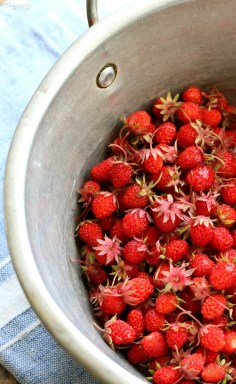 Strawberries shaped my view of a world full of gifts simply scattered at your feet. A gift comes to you through no action of your own, free, having moved toward you without your beckoning. It is not a reward, you cannot earn it, or call it to you, or even deserve it. And yet it appears.
