
She Rises Goddess Feminist Activism Collective Writing Project: Call for Contributions
She Rises: What … Goddess Feminism, Activism, and Spirituality? Volume 3 Two books: The main book and a sectional booklet including poetry, prose, art, the like.
Coeditors include Deanne Quarrie, D.Min., Helen Hye-Sook Hwang, Ph.D.
I am the source, I dream the dreams, I am the spark, Creation lives in me. Jana Runnalls, The Source, Speaking in Tongues
Using She Rises Volume 1 and Volume 2 as a springboard, the collective writing project of She Rises Volume 3 aspires to interweave new patterns in the tapestry of Goddess feminist activism. She Rises Volume 3 invites possible contributors by asking the questions: What do you envision for Goddess Feminism, Activism, and Spirituality? What is Goddess Feminism, Activism, and Spirituality for you? What do you seek from Goddess Feminism, Activism, and Spirituality? What are our practices that will bring more Goddess Feminism, Activism, and Spirituality into the world?
You may like to engineer the question on your behalf or answer it for us all. Here are some examples of the question: “What keeps me continuing in Goddess Feminism, Activism, and Spirituality?” or “What does Goddess Feminism, Activism, and Spirituality mean to me?”
The first volume evolved around stating/proclaiming the rational or cause of our Goddessian/Magoist commitment by answering the question, “Why Goddess Feminism, Activism, and Spirituality?” and the second volume took a step further to ask the “How?” question, “How… Goddess Feminism, Activism, and Spirituality?”
It is our hope that the question “What?” potentially produces a record number of ways we engage in Goddess Feminism, Activism and Spirituality. We foresee the possibility that She Rises Volume 3 may become a guidebook of the common cause for Goddess feminists and activists.
She Rises, Volume One, asked WHY? and 93 contributors answered the question with depth, honesty, insight, creativity, imagination, and inspiration. She Rises, Volume Two, asked How? and 96 contributors answered the question with depth, honesty, insight, creativity, imagination, and inspiration.
Now we are asking What? Your answers will offer:
- a guidebook for those beginning their journey with Goddess feminism, activism, and spirituality,
- a confirmation for those already engaged with Goddess feminism, activism, and spirituality,
- another thread in the tapestry of Goddess feminism, activism, and spirituality that is being woven by women and men all over the World.
Let’s weave a tapestry of answers! Are you interested?
To be part of this weaving, please send your contribution to both emails (please indicate “She Rises Volume 3” in the subject line) See submission form and guidelines below:
Deanne Quarrie – deanne.quarrie@outlook.com
Helen Hwang – magoism@gmail.com
Primary Deadline: January 31, 2018
Submission details:
Short writing – up to 200 words
Longer essays – up to 4,000 words
Research papers – 4,000-12,000 words,
Poetry – any length (please indicate formatting)
Art, photography, illustrations – any form, which may be accompanied by a descriptive paragraph attached as a separate Word file
Please include a brief bio of no more than 100 words at the end of your Word document.
Text: As attachment of Word files (.doc or.docx)
Font: Garamond or Times New Roman (12 font size, 1 spaced)
Style: Chicago Style, footnotes
Art, photography, and illustrations: As attachment of jpg files (must be 300 dpi)
For sample short writings, see below:
http://magoism.net/…/special-post-1-why-goddess…/
For ongoing submissions, see below:
https://www.facebook.com/groups/magoism/
Multiple proposals are allowed. The submission form is included below.
Submission Form
Please fill out the following form and pasted it in the body of your email submission.
| Your name and email address:
“I agree that my proposals may be published in the main book AND the secondary sectional book (poetry, prose, and art).” |
| Number of proposals and their genres: |
| List the titles/contents of attachments including your short bio: |


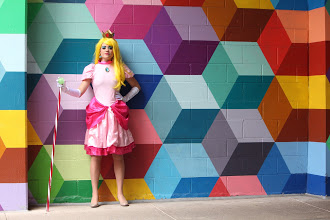
 The symbol of the Goddess is as old as human history. The most ancient images of the Goddesses from the Paleolithic era are neither pregnant nor holding a child. In Neolithic Old Europe the Goddess was most commonly linked with birds or snakes and only rarely portrayed as mother. Yet we tend to equate the Goddess with the Mother Goddess. I suspect that images of the Virgin Mary with Jesus on her lap and prayers to God as Father have fused in our minds, leading us to think that the Goddess must be a Mother Goddess and primarily a Mother.
 In my dream, two large cats are walking towards me on a sidewalk. They are large cats, not house cats, rather, lions or tigers and they are walking on two legs, standing up, like humans. Wait, their bodies are human, only their heads are feline. As they come closer, they appear to have top hats on their heads. They look like twins. I step aside and they stroll past me.
 Brazil is traditionally known as a Roman Catholic country, with a great influence of African cults and a growing number of various Protestant sects and different spiritualist, new age and esoteric groups. One of these, Wicca, has been catching up the public attention, appearing lately on the media and making us ask ourselves many questions such as – with so many myths and legends in our origins, why do we have to import from abroad, through books and especially virtual information, other cultures’ traditions and practices?

 Years ago, in an early postpartum blur, I took a crack at writing a piece on an old personal blog about the question of an at-home mother’s claim to the feminist label. The process of writing it was really an opportunity for me to work out some of my own thoughts about my lived feminism within the framework of my life at that moment as a mother who was at home full time with three young children; a toddler and a brand new set of infant twins. I was completely unprepared for what happened in the comments section of my personal online musings.
 On the morning of January 20, 2017, the world watched Donald J. Trump stand on Capitol Hill for inauguration as the 45th president of the United States. He did not stand alone. Timothy Michael Dolan, Catholic cardinal and archbishop of New York, also stood, and he invoked the divine feminine as he opened the inaugural ceremony with a recitation of King Solomon’s prayer from the Book of Wisdom.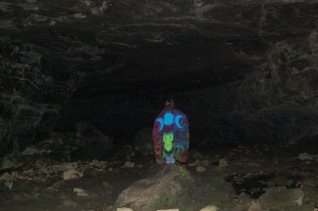
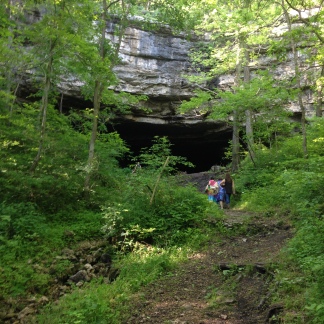 using handspun wool yarn until the yarn releases, taking our burdens with them. Suddenly, we hear the sound of tires on the gravel. Slamming doors. The sound of loud men’s voices. The smell of cigarette smoke. A ripple of uncertainty passes through us. We are once again tentative and we feel a current of unease. What should we do? we whisper to one another. The voices draw nearer, there are calls and hoots. My friend looks at me and says: this is where we make our stand. We hold hands in a line at the edge of the cave roof, gazing out into the horizon. A hawk wheels overhead. We sing. The approaching voices quiet. We sing louder.
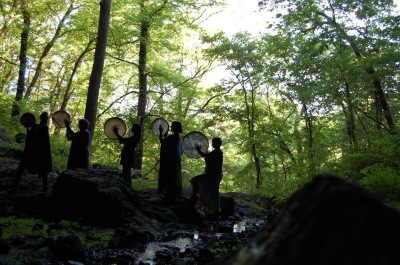 carvings of priestesses carrying drums as, “women carrying cakes to their husbands.”
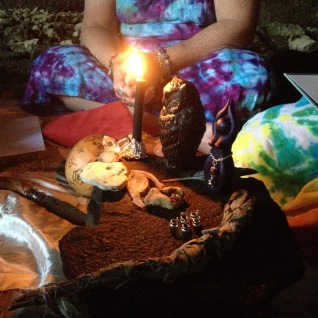 within which women try out what they want the macrocosm, the ‘big universe’ or real world to be. Within the safety and protected space of the cast circle, women create their idea of what the world would be like to live in under matriarchal/Goddess women’s values…The woman who in the safety of the cast circle designs the world as she would like it to be takes that memory of creation and success out into daily life…By empowering women through the microcosm of the ritual’s cast circle, change becomes possible in the macrocosm real world.” (p. 2-3)
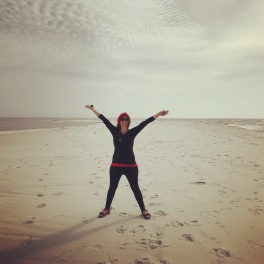 Molly has been “gathering the women” to circle, sing, celebrate, and share since 2008. She plans and facilitates
 Feminism and Religion