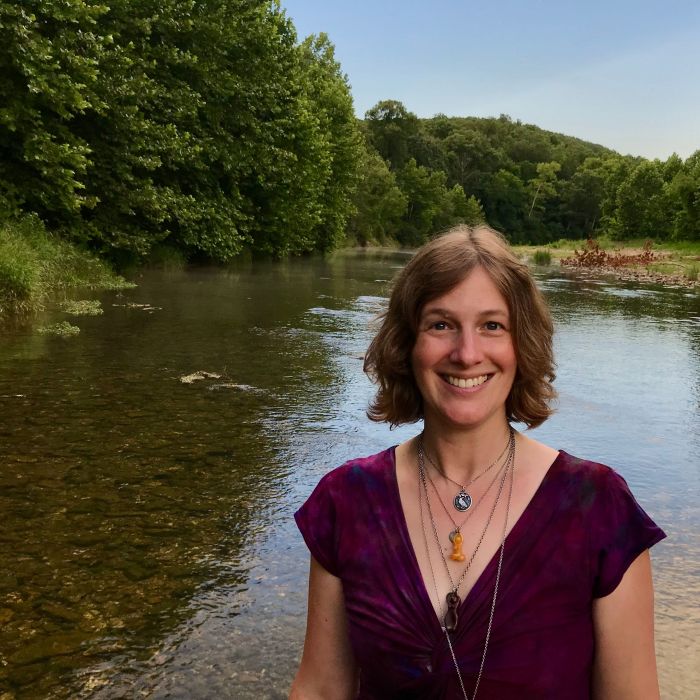
The Crone of Winter, by Molly Remer

Just for right now,
let the swirling soften.
Exhale into the day,
wherever you are,
whatever is happening.
Allow a cloak of comfort
to settle across your shoulders
and enfold you
with peace and restoration.
Draw up strength from the earth
beneath your feet.
Settle one hand on your belly
and one hand on your heart.
Feel the pulse of the sacred
you always carry within.
Breathe in
and know you are loved.
Breathe out
and know you are free.
Trust that you are carried
and enfolded
as you go along your way.

A chill is in the air and Winter’s Queen has spread her gray cloak across the land. She has stilled the leaves and frosted the hills, has quieted the scurrying, and placed her fingers firmly on the pause. In this waiting place, hushed and chilled, we remember the preciousness of the light of renewal, we remember how essential the warmth of connection. Just as the earth does, let us, too,
lay aside what is unnecessary and draw close to one another once more, rekindling the fire of community, offering one another what nourishment we can. Let us enter a time of deep restoration with intention. Let us listen to the call of contemplation that twinkles in these dusky hours of replenishment and renewal. Let us pause and wait with grace.

Continue reading “The Crone of Winter, by Molly Remer”

Carol P. Christ’s Legacy: Love Divine, All Loves Excelling

This was originally posted on Sept. 9, 2011

In my last blog I wrote that the image of God as a dominating other who enforces his will through violence–found in the Bible and in the Christian tradition up to the present day–is one of the reasons I do not choose to work within the Christian tradition.  To be fair, there is another image of God in Christian tradition that I continue to embrace.  “Love divine, all loves excelling” is the opening line of a well-known hymn by Charles WesleyCharles Hartshorne invoked these words and by implication the melody with which they are sung as expressing the feelings at the heart of the understanding of God that he wrote about in The Divine Relativity.

Love divine, all loves excelling also expresses my understanding of Goddess or as I sometimes write Goddess/God.  Though I am no longer a Christian, but rather an earth-based Goddess feminist, I freely admit that I learned about the love of God while singing in Christian churches.  Hartshorne wrote that he knew the love of God best through the love of his own mother, and I can say that this is true for me as well.  My mother was not perfect, and she did not understand why I wanted to go to graduate school, my feminism, or my adult political views, but I never doubted her love or my grandmothers’ love for me.  (I count myself lucky.  I know others did not have this experience.)  Like Hartshorne, I also learned about the love of God through the world that I always understood to be God’s body.  Running in fields and hills, swimming in the sea, standing under redwood trees, and encountering peacocks in my grandmother’s garden, I felt connected to a power greater than myself.


Continue reading “Carol P. Christ’s Legacy: Love Divine, All Loves Excelling”

Carol P. Christ’s Legacy: “THE OLD RELIGION” OR A “NEW CREATIVE SYNTHESIS”?

Moderator’s Note: Carol Christ died from cancer in July, 2021. Her work continues through her non-profit foundation, the Ariadne Institute for the Study of Myth and Ritual and the Goddess Pilgrimage to Crete. This blog was originally posted June 30, 2014. You can read its original comments here.

Is Goddess feminism an old religion or a new creative synthesis? Can it be both?  Goddess feminism draws on the feminist affirmation of women’s experiences, women’s bodies, and women’s connection to nature; the feminist critique of transcendent male monotheism as the symbolic expression of male domination of women and nature; and 19th and early 20th century discussions of Goddesses and matriarchy.

Most Goddess and other spiritual feminists have experienced Wiccan rituals, which are often simply called Goddess rituals.  For many of us, elements of Wiccan practice strike a chord of knowing, while other aspects seem odd or strange or even just plain weird.  What are the roots of Wiccan ritual?

Continue reading “Carol P. Christ’s Legacy: “THE OLD RELIGION” OR A “NEW CREATIVE SYNTHESIS”?”

From the Archives: Miracles Of The Great Mother by Jassy Watson

I was brought up in a household where attitudes to God and church were quite negative. My Nanna, however, was deeply religious, and I can still remember sitting in her dining room as a very young child staring up in awe at a painting of  ‘The Last Supper.’ I was completely mesmerised, there was something haunting about that painting that left a lifelong impression. Art became a passion very early on in life, and whenever I came into contact with images of a religious nature emotions stirred. I was spellbound by divine mystery. The most profound feelings were engendered when I met with images of Mother Mary and the infant Jesus.

Continue reading “From the Archives: Miracles Of The Great Mother by Jassy Watson”

From the Archives: That Which Is Sacred by Max Dashu

Moderator’s note: This marvelous FAR site has been running for 10 years and has had more than 3,600 posts in that time. There are so many treasures that have been posted in this decade that they tend to get lost in the archives. We are beginning this column so that we can all revisit some of these gems. Today’s blogpost was originally posted June 30, 2012. You can visit it here to see the original comments.

We are going through a huge cultural shift toward restoring the female to her full radiance. However you want to define that, it is rising now, through us.

That which is Sacred, what should we call it? We’ve been told to name it he, him, his. That it was blasphemy to do otherwise, to say she, even as they desecrated the Divine with comparisons to mortal overlords, those cruel masters, despoliators, persecutors. No. Reconsider. That fearful address to an authoritarian punisher takes us far from true reverence. Rather revere the roots of Being, manifesting in all Nature around us, within us. The profound silence, and the Deep calling to the Deep.

Deeply I go down into myself. My god is Dark and like a webbing made of a hundred roots that drink in silence. ― Rainer Maria Rilke

Continue reading “From the Archives: That Which Is Sacred by Max Dashu”

From the Archives: Still Practicing Her Presence By Barbara Ardinger

Moderator’s note: This marvelous FAR site has been running for 10 years and has had more than 3,600 posts in that time. There are so many treasures that have been posted in this decade that they tend to get lost in the archives. We have created this column so that we can all revisit some of these gems. Today’s blogpost was originally posted May 27, 2012. You can visit it here to see the original comments.

In my blog of May 11 about practicing the presence of the Goddess, I explained how Brother Lawrence of the Resurrection inspired me. Many thanks to everyone who read that blog and commented on it. One comment came via email from a friend, who said, “I kept thinking as I read about that expression ‘walking one’s talk.’” But of course. It would be lovely if anyone outside a nunnery or monastery could be as filled with their god or goddess as Brother Lawrence was. Though we try to be as mindful as we can, we obviously don’t always succeed as well as we’d like. But surely it’s better to have a positive intention than a negative one.

So let’s get practical. Instead of filling our heads with what’s been called monkey-chatter, let’s fill ourselves with the Goddess so that our thoughts of Her can go on autopilot. Instead of obsessing over, say, if the Lakers, Packers, or Cardinals are going to win their next whatever-they-play or who’s gonna win this week on Dancing With the Stars, let’s set our minds on the Goddess so our thoughts go to Her when we don’t have to concentrate on some specific, important task at hand.

Continue reading “From the Archives: Still Practicing Her Presence By Barbara Ardinger”

The Blessing of the Elders by Rachel Thomas

, elders are people who have illuminated my path, inspired me to see my own potential. To open my eyes, all my senses, even those I did not know I had. Elders show bravery and model for us how to be strong.

What is an Elder?

The word elder comes from an Old English word which also meant ancestor or chief. A lot can change in a thousand years and many of us no longer honor older people or seek out them out for advice.

In my experience, elders are people who have illuminated my path, inspired me to see my own potential. To open my eyes, all my senses, even those I did not know I had. Elders show bravery and model for us how to be strong.

My first wise woman teachings came from my family. My mother, and her mother, taught me to be myself, to love being outdoors and the importance of having a garden. Feeling the joy of flowers, cooking with fresh herbs, planting a tree to honor the dead. These are a few ancient traditions of my ancestors that have survived even in a modernized and urban setting.

Continue reading “The Blessing of the Elders by Rachel Thomas”

As I rediscover my connection with the earth, my eco-consciousness inspires me to transform. As I go back to nature, I re-awaken my ancient cellular memories of living in harmony with the earth. I feel called to dance barefoot, play drums, make offerings, bathe in moonlight, harvest with my own hands. As I move forward on a path which is both new and old, it is my beloved elders who have shown me how to find my way.

What is an Elder?

The word elder comes from an Old English word which also meant ancestor or chief. A lot can change in a thousand years and many of us no longer honor older people or seek out them out for advice.

In my experience, elders are people who have illuminated my path, inspired me to see my own potential. To open my eyes, all my senses, even those I did not know I had. Elders show bravery and model for us how to be strong.

My first wise woman teachings came from my family. My mother, and her mother, taught me to be myself, to love being outdoors and the importance of having a garden. Feeling the joy of flowers, cooking with fresh herbs, planting a tree to honor the dead. These are a few ancient traditions of my ancestors that have survived even in a modernized and urban setting.

Continue reading “The Blessing of the Elders by Rachel Thomas”

Asherah, Blessed, Asherah by Janet Maika’i Rudolph

Once upon a time, the Great Goddess was the spiritual focal point of ancient culture. Her worship included honoring women, living in harmony with the earth, and cherishing the processes of the cycles of nature. Asherah was one of those Goddesses. When the Patriarchs moved in and worked to suppress the old goddess religions, Asherah and her fellow Goddesses were diminished, and in a propaganda coup we might recognize today, defined Her as evil. I imagine that some brave people fought to hold onto the Goddess in Her glory but when they saw they were losing the battle, they encoded Her and Her Sister Goddesses into their cultural mythology. Hidden in this manner, She found Her way into the bible. If we can uncover those codes, we can reclaim Her, others and their Earth-based spirituality.

Continue reading “Asherah, Blessed, Asherah by Janet Maika’i Rudolph”

Carol Christ Symposium ~ Call for Papers by Mara Lynn Keller ~ Deadline for Proposals this Week!

Carol P. Christ
A Symposium in Celebration of Her Spiritual-Feminist Activism and Women’s Spirituality Scholarship

“The Goddess is the intelligent embodied love that is in all being.”
~ Carol P. Christ

Free Symposium via Zoom hosted by
Women’s Spirituality Graduate Studies Program California Institute of Integral Studies
October 22, 2021. 10:00 am to 4:00 pm

Call for papers focusing on Carol P. Christ’s scholarship and activism in the key areas of Women’s Spirituality, Goddess Studies, Ecofeminism, and Women and Religion.*

Please speak to what you think and feel are Carol P. Christ’s most important contributions to one of the academic fields listed below, and then also, to how her writings are important to you personally. We will arrange papers into the following six panels of 3-4 presenters.

  1. Ecofeminist Philosophy and Activism 
  2. Goddess Studies and Egalitarian Matriarchal Studies 
  3. Spiritual Feminism and Peace Activism 
  4. Spiritual Feminist Literary Criticism  
  5. Women and Religion
  6. Women’s Spiritual Pilgrimage 

Please send an abstract of your proposed paper (in 300 words or less) to Mara Lynn Keller at mkeller@ciis.edu, by Wednesday, September 16, 2021. Acceptances will be sent out Friday-Monday, 9/24-27/2021. Papers are to be 12 minutes in length.  

*Primary Sources include:

  1. Diving Deep and Surfacing: Women Writers on Spiritual Quest (1986)
  2. Woman Spirit Rising: A Feminist Reader in Religion, anthology co-edited with Judith Plaskow (1992)
  3. Odyssey with the Goddess: A Spiritual Quest in Crete (1995) 
  4. Weaving the Visions: New Patterns in Feminist Spirituality. Anthology co-edited with Judith Plaskow (1989) 
  5. Laughter of Aphrodite: Reflections on a Journey to the Goddess (1987)
  6. Rebirth of the Goddess: Finding Meaning in Feminist Spirituality (1998)
  7. She Who Changes: Re-imaging the Divine in the World (2004)
  8. Goddess and God in the World: Conversations in Embodied Theology. Co-authored with Judith Plaskow (2016) 
  9. Carol’s blogs on Feminism and Religion can be found at: Carol P. Christ (feminismandreligion.com)

In addition to the panels, the Symposium will include:        
In Memoriam: Ritual Honoring Carol’s Life and Death (1946-2021)
Circle of Remembrance: Personal reminiscences and reflections on Carol’s life and work.


Remembering Carol Christ – and going forward in her footsteps by Laura Shannon

When I was 17, I left the US to live and study in Europe for a year, with Womanspirit Rising crammed into my backpack. This book, edited by Carol P. Christ and Judith Plaskow, gave me the solid ground of a feminist worldview which honoured women, the body, and the earth. My favourite chapter was the last one: Carol’s foundational essay ‘Why Women Need the Goddess’, where she writes, ‘The simplest and most basic meaning of the symbol of Goddess is the acknowledgement of the legitimacy of female power as a beneficent and independent power’. These words, indeed that whole essay, became the pole star for my journey through the world, helping me name what was missing in both the academic world and the world of dance.

Continue reading “Remembering Carol Christ – and going forward in her footsteps by Laura Shannon”