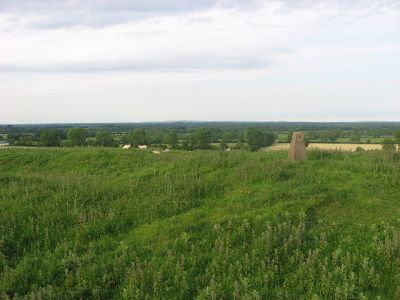
 This is the story of Tlachtga. Her name means “Earth Spear.” Her story gives us the name for a famous place in Ireland where to this day, the rites of Samhain are held in her honor. This location is called the “Hill of Ward” and it is near Tara. At this gathering Druids lit the bonfire on Samhain, from which embers were carried far and wide and were used to light the new fires for the new year. The location of the celebration was critical because they believed it to the place where this world and the Otherworld were the closest together.
Tlachtga is mentioned in two pieces of Irish literature, the Banshenchas, “the Lore of Women” and in the Dindsenchas, “the Lore of Places.” In translations by Christian monks, her story has been confused with biblical characters and Tlachtga has been all but forgotten.
 From all of these stories of Tlachtga, the earliest we can find reveals her as a goddess (druid) who arrived with the Firbolgs, long before the Tuatha De Dannan and Milesians. She was the daughter of the Chief Druid, Mogh Ruith of Munster. His name means devotee of the wheel, which relates to the sun. Mogh Ruith, a blind man, taught his daughter Tlachtga all his skills. Together they worked with all the best masters of magical knowledge in Ireland and Scotland. from this we know she was a highly trained Druid in her own right.
In one story Mogh Ruith and Tlachtga constructed a fabulous flying wheel named Roath Ramach, a machine they used for sailing through the air. It was said to be made from two pillars of stone. She made the Rolling Wheel for Trian, the Stone in Forcathu and the Pillar in Cnamchaill (Cnamchaill means bone damage). These devices were feared by all and stories were told that any who touched them died, any who saw them were blinded, and any who heard them were deafened. The pillars themselves, represent lightning, which does tie in with the meaning of her name, Earth Spear. Lightning certainly could be seen as a spear thrown to the ground and it could also kill, deafen and blind those touched by it.
Tlachtga can be seen as a goddess of death and rebirth as well as the sun and lightning. Hers is a tragic story, for as she gave birth to three boys, her subsequent death gave power to the land in the process. Her sons, Doirb, Cumma and Muach became the rulers of Munster, Leinster and Connaught. It was said that as long as they were remembered, no one could claim the land. (spoken of in the poem below) However, as we know, that did not last forever. And who knows, it may well be because they were all but forgotten. So, it is that Tlachtga is intimately linked with the symbolic death and rebirth of the land at Samhain.
Tlachtga
For Trian – no honour -Tlachtga
Created the red mobile wheel,
With the great Mogh, and Simon she brought
Her wisdom, thus leaving the moving wheel.
Finished stone of Forcarthus she left and pillar of Cnamchaill.
Whoever sees it becomes blind.
Whoever hears it becomes deaf.
Anyone taking from the wheel will die.
[Missing lines in text…]
After the woman came from the east,
She gave birth to three sons in hard labour.
She died, the light & wise one.
This urgent unconceivable news was to be heard by all.
The son’s names were of great import…
Muach and Cumma and Doirb
Others [text missing again]
As long as Banba remembers the names of the
Three sons as the truthful story tells ………….
No catastrophe will befall its inhabitants.
The hill where Tlachtga is buried,
Surpasses all other women,
Remember the name it was given..
The Hill of Tlachtga.
Irish Manuscript Text
Translated by S. Geoghegan.
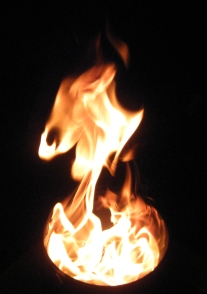 Tlachtga’s story is tragic. It is possible that she was once a Sun Goddess, highly revered for her fertility and the land. Tragically her story changed so thta now it is her tragic death that is remembered. For this reason, she is a goddess of birth and death, “The Hill of Ward” has been regarded by Druids for eons as the “Temple of Tlachtga.” It is here where the old fires of the Celtic Year are ritually smothered out and a new pure flame is lit for the year ahead.
May Tlachtga be remembered as brave, courageous, and wise, her brightness dimmed by the new patriarchal powers that had invaded the land. May her light of the new year carry you bravely into the dark months ahead and may her light stay kindled until we great the rising sun at its new birth.
Deanne Quarrie. D. Min. is a Priestess of the Goddess. She is the author of five books. She is the founder of the Apple Branch where she teaches courses in Feminist Dianic Witchcraft, Northern European Witchcraft and Druidism. She mentors those who wish to serve others in their communities. She is also an Adjunct Professor at Ocean Seminary College and is the founder of Global Goddess, a worldwide organization open to all women who honor some form of the divine feminine.



 The Celts were fascinated by the number three – triple designs, images and triadic ideas. The Goddesses and Gods who related to the mysterious rather than the mundane nature of life were always worshiped in threes. Unlike the Greek triple goddesses who represent the maiden, mother and crone, the Celtic triadic deities reveal the mysterious, unexplainable aspect of nature and human existence. These triple Goddesses are doorways into the unknown and unknowable.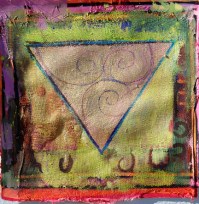
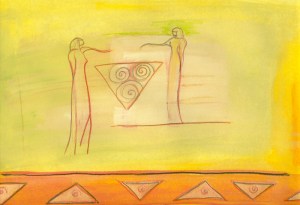
 cycle of birth, death and rebirth. Anu is the source, Danu is the movement and Tailtiu is the endurance inherent in this cycle.
  We are closing in on the last of the season of abundance. Wherever we look we see Her harvest around us. Purple grapes hang from their vines. Branches hang heavy from the weight of fruit and sweet nuts. All the forces of life have done their work ~ the sun ~ the rain ~ the earth ~ the wind ~ all have added and blessed everything with fruitful abundance.
 Last fall, my family took a vacation to Myrtle Beach, South Carolina, where I grew up. As a child, one of my favorite places to visit was Brookgreen Gardens, a wildlife preserve that was once the winter home of Archer and Anna Hyatt Huntington. Anna was a prominent sculptor of the early twentieth century, and decided that part of the property should be sculpture gardens open to the public.
 In the first blog in this series
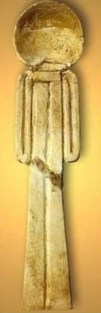 Over the years I have seen the image of the amulet called the Knot of Isis but in all honesty, never paid it much attention. I am on the organizing committee for our annual Goddess Festival here in Austin this year and we have chosen Isis as our Goddess to honor. The intent is to reclaim the Sacred Name of Isis and celebrate Her power, especially for women.
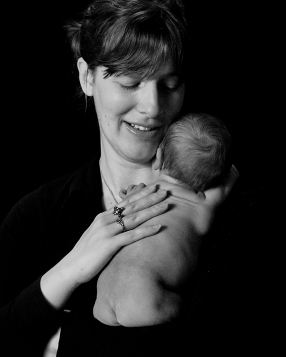 Goddess, explains:
 part of my second trimester and I give birth to him in my bathroom, on my own with only my husband as witness. The blood comes, welling up over my fingers and spilling from my body in clots the size of grapefruits. I feel myself losing consciousness and am unable to distinguish whether I am fainting or dying. As my mom drives me to the emergency room, I lie on the back seat, humming: “Woman am I. spirit am I. I am the infinite within my soul. I have no beginning and I have no end. All this I am,” so that my husband and mother will know I am still alive.
 The image of the Goddess as Maiden, Mother, Crone is widespread in contemporary Goddess Spirituality. The Triple Goddess honors three ages of women, in contrast to the wider culture that: affirms young women as sex objects while shaming them as sluts; celebrates mothers on Mother’s Day, while providing few legal and economic protections for mothers; and ignores older women.
 Feminism and Religion