In the early 1990’s I discovered the compelling story of Inanna, the ancient Sumerian Goddess, translated and retold in the book, Inanna, Queen of Heaven and Earth by Diane Wolkstein and Samuel Kramer. I was inspired to create a series of paintings from Inanna’s story.
Both the art and writing side of the project have been a monthly part of Feminism and Religion since 2012 as I feature the story of one of my holy women icons, along with the icon I’ve painted depicting them. As I paint revolutionary holy women from history, scripture, and myth, I also write about their lives; in addition to painting and writing, the bold witness of these women has inspired and grounded many of the retreats I lead in churches, seminaries, women’s and LGBTQ centers. Now the time has come for us to try and fulfill our dream of creating a home for this work, a little off-grid retreat center where people can come on retreat to create, sustain, and empower (by paying to attend or receiving scholarships from grants, but more on that later).
We were thrilled to film the first step of this process—building our family’s “tiny house”—with the television show Tiny House Nation. Since then, we’ve been working tirelessly to get our acre of land ready to build more housing for those on retreat, and to find funding sources to make it possible. Anyone who runs a non-profit or works in sustainable construction knows this is no easy (or affordable) task. We’re realizing that this far-flung dream may take longer than we’d envisioned due to lack of funding. We have some fabulous monthly patrons through Patreon, and we’d surely welcome more tax-deductible patronage or donations! Other than this, though, it’s the scrappy work of my wife and I to try and make this whole intersectionally-ecofeminist-off-grid-Hawai’i-retreat-thing a reality. Continue reading “Holy Women Icons Online Retreats by Angela Yarber”
In a world where humans were small and nature was big, surrounded by forests of trees of immense size and stature, it’s not surprising that the ancient Celts came to hold trees as sacred. Like many others, the Celts revered the World Tree or the Tree of Life as the mythic bridge between heaven and earth. The roots reach down and ground with the Earth while the branches spread their canopy up to the heavens.
Magic, divine intervention, shapeshifting – what do these things offer the modern mind, concerned with time clocks, definitive proofs and skeptical disbelief? Yet to the ancients, shapeshifting was a well known tale, found in stories and mythologies across the world.
Our first ritual on the Goddess Pilgrimage to Crete is a death ritual in which we honor the memory of those who have gone before us. Like so many things on the pilgrimage, the death ritual evolved. I did not consciously plan to begin with death. Rather, the death ritual inserted itself at the beginning of the tour. Now I understand that the timing is right.
As we begin our pilgrimage, seeking new insight about the meaning of our lives, about the meaning of life and death, we pause to remember those who have gone before us.
Before the ritual begins, I discuss the communal burials in round tombs of the ancient Cretans, sharing my belief that the purpose of their rituals was not to secure immortality or eternal life for the individual, but rather to affirm and ensure the regeneration of life in the community and in nature. I add that though I have no desire for personal life after death, I care deeply about the continued flourishing of life for human and other than human beings.
Years ago, in an early postpartum blur, I took a crack at writing a piece on an old personal blog about the question of an at-home mother’s claim to the feminist label. The process of writing it was really an opportunity for me to work out some of my own thoughts about my lived feminism within the framework of my life at that moment as a mother who was at home full time with three young children; a toddler and a brand new set of infant twins. I was completely unprepared for what happened in the comments section of my personal online musings.
While many self-identified feminist mothers seemed to resonate with the underlying personal themes of my post, many, many other feminists felt the need to comment on what they saw as my harmful attempt to justify choice feminism; a feminist theory they felt needed to be forcefully shouted down. While some of the comments were jarring, to say the least, they did serve to introduce me to the concept of choice feminism and the critiques surrounding it. I did not necessarily agree with the style or content of many of those comments, but they did deepen my thinking around reconciling my lived experience of at-home motherhood and my ethical commitment to feminism.
“Let the beauty we love Be what we do
There are hundreds of ways to kneel and kiss the Earth.”
–Rumi
Introductory note: At the end of 2016, my parents purchased a piece of land about one mile from where I already live (they live one mile further away than that). In addition to woodland and meadow, this land has two springs, three creeks, a cave, and ¼ mile of river access. While I have been deeply connected to the land of my birth, the Missouri Ozarks, for a long time, and have written about that connection in multiple past posts for FAR, this new-to-us land has offered a new opportunity: the chance to get to know another section of land “from scratch,” deeply, wildly and well, and to become wise stewards of it for the time in which it is in our care. It is also the first time I have been able to so closely and intimately observe the origin source of a body of water. Previously not giving it much thought, I now have the daily privilege of observing the source of the flow as I watch water emerge directly from the ground. First, there is simply none and then, suddenly, a deep blue pool constantly bubbling as water rises to the surface and flows away on its long, long journey to the sea. This essay is a series of three vignettes as I spend this year immersing myself in relationship with this land.
We walk along the nearly vertical hillside hanging onto small trees for support. Finally, though we almost miss it, we spy the opening to the cave nestled behind several mossy stones. The sun is still on the rise above the tree line and the rays filter through the trees so one ray is pointing directly at the cave entrance. We crawl inside, bumping our heads and scraping our backs as we wiggle into this womb in the earth. Once inside, the chamber enlarges so we can stand up. Unlike other caves we have experienced in this area, the only human signs we find are a single bottle cap, a glass bottle, and two sets of initials carved into a rock. In the dark silence we hear the sound of water dripping steadily. I make my way further into the cave, acutely aware that this is living cave and being careful not to step on the fresh, wet, cervix-shaped beginnings of new stalagmites on the floor. At the back of the cave, I find her. A Madonna-like stone column, glistening with water. In the silence of the cave, I quietly sing Ancient Mother to her, as tears well in my own eyes.
I am of this earth for this earth and by this earth.
We skirt carefully along the bank of the creek, making our way to the largest spring. Over three million gallons of water a day flow effortlessly from this small, deep pool nestled quietly in the middle of the woods. I am stunned by the magnitude of this flow as I stand there with my husband, my head resting on his shoulder, hawks wheeling overhead, redbud trees in full bloom. It has never seemed more clear to me how very “small” we are, but a blink of an eye to this spring and its countless years and countless gallons of water, not caring whether it is witnessed in its work or not, but simply, continually, creating and producing. I try to explain this feeling aloud, but words fail me. It is a humbling sensation, not a depressing one. The actual emergence of the water at this origin point of the river is nearly invisible, the continuous gentle, small popping of bubbles on its surface, the only sign that something significant is happening here that distinguishes this body of water from a pond or pool. Yet, those never-ending bubbles rapidly expand to a wide, swift-moving creek, which joins the river and another smaller spring-fed creek to continue to make their way southward across the state. We smell something sharp and see a dead armadillo by the roots of a giant sycamore. We hear a shrill cry and look up to see two bald eagles riding the currents of air high above us. We are so small. So many thousands of years of water have passed, but we are here right now.
Unfathomable eons
Glacier time
I am just a blink of an eye
But I can sit, and watch, and wonder.
We scramble along the uneven terrain on the rocky and wooded hillside, slipping, laughing, and looking. I am exhilarated by the simple thrill of exploring the world right here in front of me. We find tiny flowers. I kneel by the roots of fallen trees. We stop to admire moss on stones. We find gigantic black snake napping in the sun. A complete turtle shell. A shed antler. Each moment feels like a new opportunity to “kiss the earth.” I sing Reclaiming’s song-version of the Rumi quote over and over and as I kneel in each spot to see what it has to show me, in each, I kiss my fingers and press them to the earth. I see all the kissing going on around me…the sun filtering through branches, the fiddlehead ferns kneeling to kiss the earth, the roots wound through rocks, the trillium and bloodroot blooms pushing up between leaves, the water seeping out of the ground and flowing down the hill, the dogwood blossoms opening to the sun, the moss covering stones, the fallen trees stretched along the slope.
“And that is just the point…how the world, moist and beautiful, calls to each of us to make a new and serious response. That’s the big question, the one the world throws at you every morning. ‘Here you are, alive. Would you like to make a comment?’”
–Mary Oliver
We emerge from our walk to find morels growing alongside the path (morels are wild, edible mushrooms found for about two weeks in Missouri each spring and considered a delicacy by many). The afternoon suddenly becomes even more rewarding and we stoop and peer through fallen oak, sycamore, and elm leaves looking for the telltale conical form of these forest treats. We quickly discover that we must tune in and “listen” for the mushrooms, so to speak, or we’ll walk right by them, none the wiser. The moment I start thinking about anything else, I stop finding any. Once I settle into my body and the moment and really look at the world again, there another morel will be.
“I think this is how we’re supposed to be in the world … present and in awe.”
–Anne Lamott, Bird by Bird: Some Instructions on Writing and Life
Molly has been “gathering the women” to circle, sing, celebrate, and share since 2008. She plans and facilitates women’s circles, seasonal retreats and rituals, mother-daughter circles, family ceremonies, and red tent circles in rural Missouri and teaches online courses in Red Tent facilitation and Practical Priestessing. She is a priestess who holds MSW, M.Div, and D.Min degrees and finished her dissertation about contemporary priestessing in the U.S. Molly and her husband Mark co-create Story Goddesses, original goddess sculptures, ceremony kits, and jewelry at Brigid’s Grove. Molly is the author of Womanrunes, Earthprayer, and The Red Tent Resource Kit and she writes about thealogy, nature, practical priestessing, and the goddess at Brigid’s Grove.
With the Sun in Aries and then Taurus from late March through mid-May, representing Spring and the renewal of all things creative, it is a good time to think about the evolution of the goddess Sedna who created the walruses, seals, and new kinds of fish to feed her Inuit tribe which until then had to make do with bearberries, seaweed, and arctic moss. Sedna’s name means “provider of food,” but of course her creations came at a very dear price.
Her father, in a moment of patriarchal panic, cut off her fingers to separate her from their lifeboat kayak during a storm in which he could only think to save himself, as he was the chief of the tribe. As Sedna fell deeper and deeper into the sea, she was surprised that, instead of feeling frightened, she felt more like her real self than ever before. She saw her father (who had lied about killing her first love) and the “bad crow” husband he had selected for her instead, for who they were, and she saw her fingers, as they tumbled down with her, turn into wondrous, powerful animals.
When she got to the bottom of the sea, her bones had been purified by her blood and the salt water of her tears, and her skeleton was radiant. She quickly put on body weight, of a sea kind, and with the help of her sea-children she made herself ruler of the under-water world.Continue reading “Sedna in Spring by Anna Marie Laforest”
“Deep in their roots, all flowers keep the light.” – Theodore Roethke
“Returning violence for violence multiplies violence, adding deeper darkness to a night already devoid of stars. Darkness cannot drive out darkness; only light can do that. Hate cannot drive out hate; only love can do that.” – Martin Luther King, Jr.
As we wander together through the maelstrom of our world today, trying to keep our eyes open, our voices firm and truthful, our feet bravely taking one step and then another, may we reclaim our gift of future-envisioning boldly, outrageously, and together as a global community. In perilous times we may think that envisioning a future that may never be is a waste of time and energy. When we look into the future and see only uncertainty, we may no longer be sure that the kind of world we have been working towards for decades could ever exist.


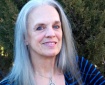 In the early 1990’s I discovered the compelling story of Inanna, the ancient Sumerian Goddess, translated and retold in the book, Inanna, Queen of Heaven and Earth by Diane Wolkstein and Samuel Kramer. I was inspired to create a series of paintings from Inanna’s story.
 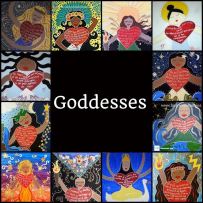 I’ve
I’ve 
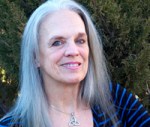
 Our first ritual on the Goddess Pilgrimage to Crete is a death ritual in which we honor the memory of those who have gone before us. Like so many things on the pilgrimage, the death ritual evolved. I did not consciously plan to begin with death. Rather, the death ritual inserted itself at the beginning of the tour. Now I understand that the timing is right.
 Years ago, in an early postpartum blur, I took a crack at writing a piece on an old personal blog about the question of an at-home mother’s claim to the feminist label. The process of writing it was really an opportunity for me to work out some of my own thoughts about my lived feminism within the framework of my life at that moment as a mother who was at home full time with three young children; a toddler and a brand new set of infant twins. I was completely unprepared for what happened in the comments section of my personal online musings.
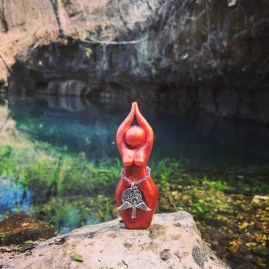 live (they live one mile further away than that). In addition to woodland and meadow, this land has two springs, three creeks, a cave, and ¼ mile of river access. While I have been deeply connected to the land of my birth, the Missouri Ozarks, for a long time, and have written about that connection in multiple
 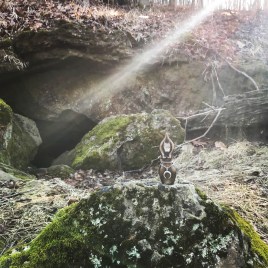 spy the opening to the cave nestled behind several mossy stones. The sun is still on the rise above the tree line and the rays filter through the trees so one ray is pointing directly at the cave entrance. We crawl inside, bumping our heads and scraping our backs as we wiggle into this womb in the earth. Once inside, the chamber enlarges so we can stand up. Unlike other caves we have experienced in this area, the only human signs we find are a single bottle cap, a glass bottle, and two sets of initials carved into a rock. In the dark silence we hear the sound of water dripping steadily. I make my way further into the cave, acutely aware that this is living cave and being careful not to step on the fresh, wet, cervix-shaped beginnings of new stalagmites on the floor. At the back of the cave, I find her. A Madonna-like stone column, glistening with water. In the silence of the cave, I quietly sing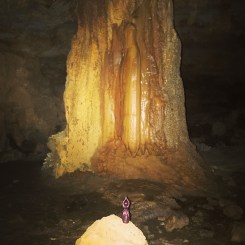
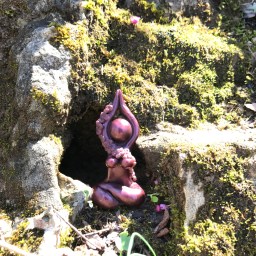
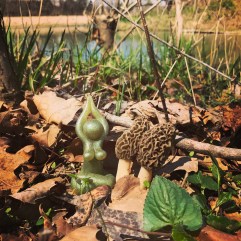 about two weeks in Missouri each spring and considered a delicacy by many). The afternoon suddenly becomes even more rewarding and we stoop and peer through fallen oak, sycamore, and elm leaves looking for the telltale conical form of these forest treats. We quickly discover that we must tune in and “listen” for the mushrooms, so to speak, or we’ll walk right by them, none the wiser. The moment I start thinking about anything else, I stop finding any. Once I settle into my body and the moment and really look at the world again, there another morel will be.
 Molly has been “gathering the women” to circle, sing, celebrate, and share since 2008. She plans and facilitates women’s circles, seasonal retreats and rituals, mother-daughter circles, family ceremonies, and red tent circles in rural Missouri and teaches online courses in
  With the Sun in Aries and then Taurus from late March through mid-May, representing Spring and the renewal of all things creative, it is a good time to think about the evolution of the goddess Sedna who created the walruses, seals, and new kinds of fish to feed her Inuit tribe which until then had to make do with bearberries, seaweed, and arctic moss. Sedna’s name means “provider of food,” but of course her creations came at a very dear price.
 “Deep in their roots, all flowers keep the light.” – Theodore Roethke
 As we wander together through the maelstrom of our world today, trying to keep our eyes open, our voices firm and truthful, our feet bravely taking one step and then another, may we reclaim our gift of future-envisioning boldly, outrageously, and together as a global community. In perilous times we may think that envisioning a future that may never be is a waste of time and energy. When we look into the future and see only uncertainty, we may no longer be sure that the kind of world we have been working towards for decades could ever exist.
