At Thanksgiving and the solstice holidays many of us are reminded that we are the “black sheep” of our families. In my case this means that I am too “assertive,” too “aggressive,” too “demanding,” too “political,” too “willing to upset my father,” too “opinionated,” too “feminist,” and so on.
“In the English language, black sheep is an idiom used to describe an odd or disreputable member of a group, especially within a family. The term stems from the genetic effect in sheep whereby a recessive gene occasionally manifests in the birth of a sheep with black rather than white coloring; these sheep stand out in the flock [emphasis added] and their wool was traditionally considered less valuable.” (Wikepedia, “Black Sheep”)
Despite all of the ways Western society has separated the spiritual pursuit from the material and deemed spirituality superior to physicality, the religious holiday of Pesach doesn’t. In fact, it is the physical liberation of the Israelites from slavery in Egypt that starts them on their path toward the covenant and an even deeper spiritual connection to the divine. The Exodus story overflows with images, tales and situations in which: bodies are not ignored; nourishment, comfort and care is addressed spiritually as well as physically and the divine’s spiritual gift, so to speak, to the Israelites is not some other-worldly paradise but a this-worldly land flowing with milk and honey.
Of course, this doesn’t mean that the story is perfect: it is replete with war, murder, militarism, forms of colonialism and other manifestations of patriarchal violence. Patriarchal influences encourage androcentric tellings of events and sexism as well. Three examples are the all-male priesthood, the tenth plague “death of the first-born” (of course the only first born that counts are boy children), and the over-the-top covenantal concern about women as menstruators, adulterers, untrustworthy and so on. These aspects are important to acknowledge and critique, but we cannot stop there. We must cherish the story for its insights as well. Continue reading “Pesach, Toilets, and Clean, Local Water: Seemingly Mundane Yet Necessary Components of an Embodied Liberation by Ivy Helman”
Western Easter has come and gone, and I missed it this year, by design. I went to Athens for the weekend, where Easter this year won’t come until May 1. In the Greek Orthodox Church, Easter is reckoned differently, so that sometimes (like next year) Easter falls on the same date in both faiths and sometimes (like now) the celebrations are several weeks apart.
In contrast to the UK, where Easter now seems to be mostly about chocolate, Easter in Greece is the main festival of the Christian year, much more important than Christmas. Throughout the Lenten period, fasting foods – ‘nistisimo’ – are available everywhere (heaven for vegan visitors).
As bright red hearts grace every storefront in anticipation of Valentine’s Day, the virtue of love remains at the forefront for many feminists. Let’s set aside Hallmark and the commercialism of romance for a moment and focus on some forms of love often overlooked: love for friends, love for the world, and love from women for women. All of these are manifested in one of my Holy Women Icons with a folk feminist twist: Jane Addams.
Known as the Mother of Social Work, this revolutionary woman did so much more than begin a new field of study. Jane Addams (1860-1935) was a pacifist, sociologist, public philosopher, founder of the Hull House, co-founder of the ACLU, and the first American woman to be awarded the Nobel Peace Prize. All of her romantic relationships were with other women, including Ellen Star and Mary Smith. In fact, Smith and Addams considered themselves married. Is any of this brief information about Addams new to you? It certainly was to me. Continue reading “Painting Jane Addams by Angela Yarber”
This week, the Christian season of Lent began. Ugh. Lent can be so somber and serious and gloomy. Last year, I didn’t want to place myself in that frame of mind. I was experiencing grief and self-doubt and loneliness, and felt that an extended period of reflection about self-denial, Christ’s suffering, and the sinful condition of humanity might pull me into an unhealthy depression. Also, I questioned why I should seek silence and solitude when I was already experiencing too much of it. I felt isolated.
This year is different for me. Once again, I’m entering the season with a grieving heart. I’m mourning the death of my cousin. But I do not feel isolated. I am not self-doubting. This January, I spent four continuous days with mentors and peers in academia who poured love and wisdom and inspiration into me. The women in our group sought each other out and had honest and authentic conversations about the successes and struggles in our lives. We affirmed self-care. We affirmed milestone birthdays. We affirmed our bodies, despite the physical limitations we sometimes feel. We affirmed the tough decisions some had made, the transformations some were pursuing, and the exciting opportunities that had developed for others since we last met over the summer.
It was a powerful experience, but there was pain, too. We confronted fear, rejection, anxiety, exhaustion, and frustration. I felt blessed—divinely gifted—to have an opportunity to speak honestly with my sisters in the spirit about the people and issues on our hearts: challenges with students, systemic racism and sexism, menopause, children, research questions, financial decisions, romance, and health.
Every year on New Year’s Eve, I read creation stories to my family. We light candles, sit in a circle, eat, drink, and read. This little ritual began as my protest to the vulgar commercialization of the New Year and the ponderous weight of trying to be/do/achieve something new every twelve months. Last year, I discovered, however that I felt like the ancient creation myths and the new ways of bringing in the new year messaged similar things. I wrote about it in my blog post from January 2015, committing to write my own creation myth to read this year. I like where it is going… even this little exercise is causing me to think differently about sacred literature. I am becoming Inspired, I gasp to myself, to write my own Scripture, my own sacred truth. Here’s what I’ve got so far. I hope you enjoy it. Happy New Year!
1 The beginning could not be reckoned in the time before time was reckoned. 2 For, what was had yet to know itself, and it could not know itself alone. 3 But, for its love, it could not be known. So it was that the beginning that could be reckoned was not the beginning but the beginning of loving, which was the beginning of knowing, which was the beginning of being. 4 And, in that beginning, a great ellipsis had already become of particle and light, and the particle and light thrummed through darkness forming a whole body. 5 Of the great ellipsis of particle and light, a body and a body and a body were formed, in and of the great ellipsis, thrumming through darkness. 6 The thrumming ellipsis pushed forward so far that its particle and light extended beyond itself and then beyond itself and then beyond itself, as though it were to separate, but it did not. 7 A whole body was formed, which was the beginning of the simultaneity of what was and what is and what will have been. Continue reading “In the Beginning by Natalie Weaver”
Marie bringing in Elen of the Ways photo by Tony Mierzwicki
One of my colleagues at Feminism and Religion recently wrote of Xmas and Feminine Wisdom.My blog, for Christmas Day continues this exploration.
Elen of the Ways is a figure primarily studied by scholar, Carolyn Wise. She wrote two core articles available on the web hereand here. Wise writes that in order to “track” and find Elen of the Ways she had to peel back the layers:
…to the earliest track ways, the migratory tracks of the Reindeer and Elk. Elen moves across vast tracts of time, and land, cloaked and masked appropriately for each age.
As the Green Lady, she peers out between the trees in forests …As a British Venus… she is guardian of the underground streams that carry the sacred waters. She is the Guardian of the ancient track ways, the Leys, the Kundalini currents in nature. And as the Horned Goddess, she leads us to the first trackways, the migratory tracks of the reindeer and later, to the path of the red deer through the forests. From here she leads us to the lost Shamanism of the isles of Britain and we can follow her across Scandinavia, Russia, Mongolia, Siberia, India and beyond.
…part goddess, part dream, part saint, a green lady and a water nymph, primordial mother and patroness of deer, and guardian of the Old Straight Tracks and solar alignments. …Elen is as real as the roads named after her, as solid as the ancient paths that carry her presence.
What are these tracks? Part of the story can be explained by understanding that there are ley lines, or energy paths throughout the globe. These paths were “tracked” by shamans, pagans, and regular folk and still exert their influence today in very recognizable ways. People celebrated earlier this week on the Solstice (December 21) at Stonehenge. “One of the most important and well-known features of Stonehenge is its alignment on the midwinter sunset-midsummer sunrise solstitial axis,” a spokesperson said. “The midwinter sun sets between the two upright stones of the great trilithon.” The solsitial axis is part of the ley line network that connects sacred sites such as Newgrange in Ireland, a sacred burial mound which lights up only the morning of Solstice.
Remembering to be thankful may just be a privileged illusion that individuals in positions of power get to write about in the December of each year to self-congratulate themselves about being actually able to be able to be thankful. It may just seem like people who write about being thankful are complaining or pontificating that being thankful is in itself a chore.
With the holidays just around the corner and the frazzled, crisp ping of anxiety, rush, and panic take over the air around us, it is easy to forget to stop and “smell the roses.” In times where teaching positions continue to shrink and more universities switch to adjunct labor, fees and class costs continue to rise, or just simply life becomes a little more complicated, due to the nature of balancing life, activism, work, friendships, or relationships, remembering to remind myself to be thankful is another task, I find adding to the never-ending list of stuff I always seem I have to do.
However, remembering to be thankful, scheduling it into one’s daily schedule are vital to our success as new and emerging faculty or activists or just in general because being thankful reminds us that we have aspects of our lives that are worth being thankful for. Remembering to be thankful proves that we are in some way, connected to a larger sense of life that, at times, grants our wishes, wants, or desires, brings us despair, and then allows us to get through it, or even makes us feel alive.
As I sit back and look at the personal and professional landscape around me I understand that I have a lot to be thankful for both consciously and unconsciously. Most recently at AAR, I participated on a panel in response to Bernadette Barton’s Pray the Gay Away. During the course of our panel, the conversation of chosen vs. biological families came up. Most recently, my mentor and panel moderator, Dr. Marie Cartier, talked about the same topic here on FAR and the difficulties many of us experience in regards to our chosen families vs. our biological families. With the holiday season all around us, and regardless of what or if, you celebrate it or not, it is quite hard to get away from it all without realizing who your “family” is and whether or not you’re close or connected with them can be traumatizing during these times where we’re taught or expected to be with them.
After our discussion on the panel and then at the hotel bar, people discussed the pains and traumas in relation to not having a biological family to go home to during the holidays. Sitting there and listening to the conversations, I realized that, for once in my life, I had nothing to say. Continue reading “Remembering to Be Thankful by John Erickson”
When I first started back on my journey to reclaim Judaism, I distinctly remember the first Hanukkah I lit candles. Not only was I bringing light into the literal darkness of night, I was also kindling the divine spark within myself. Each night I walked through a meditation I had created using the letters of the word Hanukkah, since there were eight letters and eight nights. I remember some of the words I had assigned to the nights: Holiness, Attentiveness, Night, Understand, Knowledge and Keep. I can’t remember the rest, but I do remember feeling the calm of the candlelight and the deepness of the meditation. I also remember that at some point, either I missed a night of lighting or I repeated one night twice because the days were officially over, and I still hadn’t lit all eight candles.
That has happened to me twice since I returned to Judaism. Yes, twice. Maybe three times. Oh, I don’t know. Now every time the festival approaches I worry that I’m going to do it again. I’m constantly rechecking the calendar so that I am certain I know which night we are on and so that I don’t miss one. I know it sounds like a mundane worry. Yet, in many ways Judaism works on turning the mundane into the holy. This was clearly a lesson on the ways in which the routine of life had too much control over me. Continue reading “I Missed a Day Again: Reflections on Hanukkah by Ivy Helman”
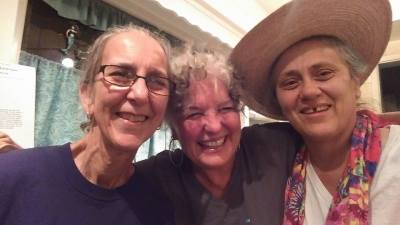
Last week I went out to eat with a group of insightful scholars at the American Academy Religion 2015 Conference held in Atlanta, Georgia. We had just participated on a remarkable panel which was an “Author Meets Critic” session with Bernadette Barton, author of the book Pray the Gay Away: The Extraordinary Lives of Bible Belt Gays. One of our panelists was in Georgia after years of estrangement, not only from his biological family, but also from the geography of his birth because of the biological familial estrangement. He was experiencing the geography of his hometown for the first time in many years. He spoke eloquently in the panel about how much being in the geography itself again was triggering, but also how somatically it was necessary for his own healing. He needed to revisit and be embodied on the actual land—which was very different than re-remembering the hurt from a geographical distance. Also, in order to fully participate in the life of a scholar, which he was now choosing, he had to reconcile being able to revisit this geography in order to attend this particular conference. And frankly, to be able to participate on the panel which was so close to his heart—being a person who was from the Bible Belt and had literally been “prayed” over so that his “gay would go away.”
I have moderated many panels, but this is the first one where I wrote “Congratulations!” on a piece of paper to one of the panelists and passed it to him after his reading.Overall it was a great session of papers and as mentioned we all adjourned for drinks and conviviality. And to celebrate that our gay had not been prayed away.
We began to discuss holiday plans. I said to the young man who had presented his paper so courageously that I was very proud of him not only for his work, but for his ability to return to the geography in which he had experienced so much harm. I said that I was from a very abusive biological home in New England and I had not been north of New York since leaving at age 30 (I am now 59); that for me, putting my embodied self into the actual geography where I had experienced so much harm had not been possible, except for attending my mother’s funeral- its own extreme event.
Some folks at the table expressed surprise and much sadness—how could those of us without biological ties to family handle the holidays? I realized that for me it has been almost thirty years since I began creating “alternatives” to the family I was born in—my biological family- and that I have successfully created chosen family and chosen traditions instead. One of the ways I first learned to deal with holidays which had expected traditions and attendance at biological family functions was to create alternate plans well before the expected day (Thanksgiving, Christmas, etc.) and stick to that plan. I learned that once that day was “here,” I would be triggered and would not be able to create spur of the moment alternatives in the midst of those feelings.
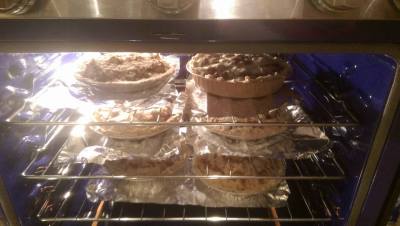
One tradition I created 20 years ago was the tradition of “Pie Day” with a good friend of mine. We realized this year that we have been doing that for 20 years! Now that is my “tradition” and that is my “family.” We bake an inordinate amount of pies on Pie Day—a very specific recipe—green apple with golden raisin reduction— and people and friends come over. We celebrate. We eat pie with cheese (a New England tradition) and salad- I call it “a French meal” after my Canadian heritage. Whoever bakes or drops by, eats. Some folks walk away with a pie. We freeze a bunch and have “pie nights” throughout the year. Various girlfriends, friends and friends of friends have helped throughout the year make our estimated 15-20 pies per year, complete with hand rolled, all butter crusts every year.


 At Thanksgiving and the solstice holidays many of us are reminded that we are the “black sheep” of our families. In my case this means that I am too “assertive,” too “aggressive,” too “demanding,” too “political,” too “willing to upset my father,” too “opinionated,” too “feminist,” and so on.
 Western Easter has come and gone, and I missed it this year, by design. I went to Athens for the weekend, where Easter this year won’t come until May 1. In the Greek Orthodox Church, Easter is reckoned differently, so that sometimes (like next year) Easter falls on the same date in both faiths and sometimes (like now) the celebrations are several weeks apart.
 As bright red hearts grace every storefront in anticipation of Valentine’s Day, the virtue of love remains at the forefront for many feminists. Let’s set aside Hallmark and the commercialism of romance for a moment and focus on some forms of love often overlooked: love for friends, love for the world, and love from women for women. All of these are manifested in one of my
 Dear Friends,
 1 The beginning could not be reckoned in the time before time was reckoned. 2 For, what was had yet to know itself, and it could not know itself alone. 3 But, for its love, it could not be known. So it was that the beginning that could be reckoned was not the beginning but the beginning of loving, which was the beginning of knowing, which was the beginning of being. 4 And, in that beginning, a great ellipsis had already become of particle and light, and the particle and light thrummed through darkness forming a whole body. 5 Of the great ellipsis of particle and light, a body and a body and a body were formed, in and of the great ellipsis, thrumming through darkness. 6 The thrumming ellipsis pushed forward so far that its particle and light extended beyond itself and then beyond itself and then beyond itself, as though it were to separate, but it did not. 7 A whole body was formed, which was the beginning of the simultaneity of what was and what is and what will have been.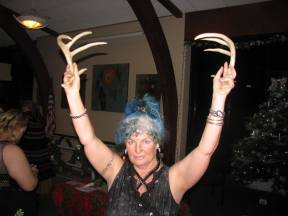


 Last week I went out to eat with a group of insightful scholars at the American Academy Religion 2015 Conference
  One tradition I created 20 years ago was the tradition of “Pie Day” with a good friend of mine. We realized this year that we have been doing that for 20 years! Now that is my “tradition” and that is my “family.” We bake an inordinate amount of pies on Pie Day—a very specific recipe—green apple with golden raisin reduction— and people and friends come over. We celebrate. We eat pie with cheese (a New England tradition) and salad- I call it “a French meal”
  Feminism and Religion