

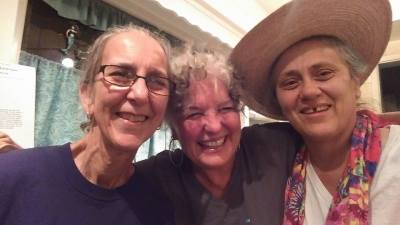
 Last week I went out to eat with a group of insightful scholars at the American Academy Religion 2015 Conference held in Atlanta, Georgia. We had just participated on a remarkable panel which was an “Author Meets Critic” session with Bernadette Barton, author of the book Pray the Gay Away: The Extraordinary Lives of Bible Belt Gays. One of our panelists was in Georgia after years of estrangement, not only from his biological family, but also from the geography of his birth because of the biological familial estrangement. He was experiencing the geography of his hometown for the first time in many years. He spoke eloquently in the panel about how much being in the geography itself again was triggering, but also how somatically it was necessary for his own healing. He needed to revisit and be embodied on the actual land—which was very different than re-remembering the hurt from a geographical distance. Also, in order to fully participate in the life of a scholar, which he was now choosing, he had to reconcile being able to revisit this geography in order to attend this particular conference. And frankly, to be able to participate on the panel which was so close to his heart—being a person who was from the Bible Belt and had literally been “prayed” over so that his “gay would go away.”
I have moderated many panels, but this is the first one where I wrote “Congratulations!” on a piece of paper to one of the panelists and passed it to him after his reading. Overall it was a great session of papers and as mentioned we all adjourned for drinks and conviviality. And to celebrate that our gay had not been prayed away.
We began to discuss holiday plans. I said to the young man who had presented his paper so courageously that I was very proud of him not only for his work, but for his ability to return to the geography in which he had experienced so much harm. I said that I was from a very abusive biological home in New England and I had not been north of New York since leaving at age 30 (I am now 59); that for me, putting my embodied self into the actual geography where I had experienced so much harm had not been possible, except for attending my mother’s funeral- its own extreme event.
Some folks at the table expressed surprise and much sadness—how could those of us without biological ties to family handle the holidays? I realized that for me it has been almost thirty years since I began creating “alternatives” to the family I was born in—my biological family- and that I have successfully created chosen family and chosen traditions instead. One of the ways I first learned to deal with holidays which had expected traditions and attendance at biological family functions was to create alternate plans well before the expected day (Thanksgiving, Christmas, etc.) and stick to that plan. I learned that once that day was “here,” I would be triggered and would not be able to create spur of the moment alternatives in the midst of those feelings.
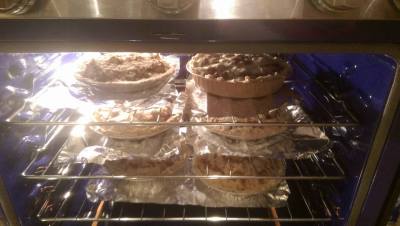 One tradition I created 20 years ago was the tradition of “Pie Day” with a good friend of mine. We realized this year that we have been doing that for 20 years! Now that is my “tradition” and that is my “family.” We bake an inordinate amount of pies on Pie Day—a very specific recipe—green apple with golden raisin reduction— and people and friends come over. We celebrate. We eat pie with cheese (a New England tradition) and salad- I call it “a French meal” after my Canadian heritage. Whoever bakes or drops by, eats. Some folks walk away with a pie. We freeze a bunch and have “pie nights” throughout the year. Various girlfriends, friends and friends of friends have helped throughout the year make our estimated 15-20 pies per year, complete with hand rolled, all butter crusts every year.
Continue reading “Creating Families and Traditions of Choice—and Saving Your Life by Marie Cartier”

 When I was growing up in the 1950s in my Egyptian Jewish immigrant home, each of the High Holidays was imbued with sacredness, thanks largely to my mother’s commitment to a creating a harmonious and memorable gathering of family and friends. Around a long table, covered with an embroidered white cloth and set with sparkling silver and delicately fluted china, she served at each season the festive meal that made manifest for us the presence of the Divine.
 In the Smithsonian Museum of American History, there is an exhibit on food and the way it has changed on the American table over the years. It is an interesting exhibit for a number of reasons. It shows, for example, a reproduction of Julia Child’s kitchen. It shows the advent of T.V. trays and Swanson frozen dinners. It shows when wine became a staple beverage. And, there is one of the most entertaining images in all of Washington, D.C. …
 My sister once said about me, “One thing you have to understand about Elise—she takes the ritual of whole thing very seriously.” My sister was right and her words helped me see this quality about myself. What ritual was she talking about me taking so seriously? Happy hour on Fridays.
 According to their website,
 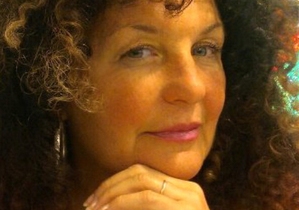 I know that you all will be reading this the day after Christmas…so this is my Christmas and/or winter holiday gift to you. I so love the Feminism and Religion (FAR) community—its discourse, intelligence, and its community of like minds. And I appreciate that so many of us offer lessons to each other on how to live—wild. For in some ways the very juxtaposition of the words “feminism” and “religion” posits an out of bounds existence. What does it mean?
 For those of us in the northern hemisphere, December is one of the darkest months. The days are shorter. Night comes earlier. Each morning I eagerly await the dawn, the potential sliver of sunshine seeping through my window and warming my otherwise cold wintery skin. For those of us who struggle with seasonal depression, December can be difficult. The colder and shorter days cast shadows on our spirits as we yearn for the warm glow of light. Each December as we inch toward the winter solstice, I am reminded of the Goddess of the Dawn, Aurora, and of the unique ways in which a variety of wisdom traditions invoke the coming of light amidst the stark December night skies.

