Dancing for Forgiveness and Reconciliation – Part One By Laura Shannon

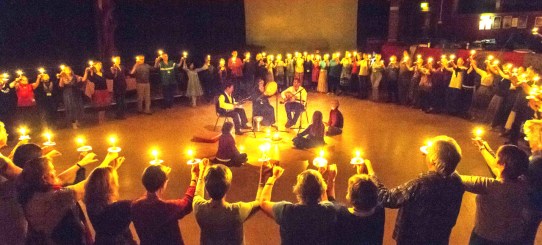
Armenian Candle Dance with Laura Shannon, Findhorn 2015 (photo: Hugo Klip)
When I first began researching traditional circle dances in the mid-1980s, I was amazed to find that the peoples who have suffered the worst of human experience – oppression, exile, genocide, war – also produce the most vibrant and joyful music and dance. Armenian, Jewish, Kurdish, and Romani (Gypsy) dances, in particular, were passionate affirmations of life, despite the horrors these peoples have gone through in their history. The dances seemed to hold clues to the mystery of moving on with life after trauma.
This was something I was desperate to learn how to do. Barely 20 at the time, I was struggling to keep my dignity and optimism while growing up female in a woman-hating world. The trauma of a violent rape on my 18th birthday had robbed me of my joy for life – but I could experience joy again in those dances.
Early on in my research and teaching, therefore, alongside the women’s dances which were always my main interest, I began to focus on the traditional dances of persecuted peoples, which I called Dances of Exile and Homecoming. These songs and dances seemed to have an inherently therapeutic potential, profoundly moving for people from any background and any culture.

Continue reading “Dancing for Forgiveness and Reconciliation – Part One By Laura Shannon”

Help, My Daughter Got a Bunch of Princess Stuff for Christmas! by Trelawney Grenfell-Muir

Every year, I see multiple pleas from concerned mothers (rarely fathers, because (straight) fathers rarely take on emotional labor of child rearing) wondering what to do about the pile of pink plastic that just came into their home. It’s such a scary pile. It whispers, “come here, little girl… let go of your individuality, your power, your freedom. Join me in the glamour and popularity of gendered subordinate dehumanized servitude… everybody’s doing it… first one’s free….” Mothers (well, the ones who pay attention) look at that pile and see a desolate road ahead of princess girls who grow into teens that think they need to look like pornified sex kittens, who grow into young adults that think it’s ok for men to treat them like sex objects, and on into a bleak dystopian future of internalized misogyny.

I can’t promise that I’ve come up with a magic formula to prevent all that. After all, our girls are met with a barrage, a deluge, of toxic messages luring them down that path in every movie, TV show, magazine, billboard, and media around them. Even female meteorologists can’t just wear suits or have short hair or look plump. And none of my strategies will work if family members are modeling that females should try to please the “male gaze.” So I am not offering a magic bullet. All the same, here is how I handled the Pink Plastic Menace – as usual, a joint effort with my sister Tallessyn Grenfell-Lee.

Continue reading “Help, My Daughter Got a Bunch of Princess Stuff for Christmas! by Trelawney Grenfell-Muir”

Seeking Happiness, According to Paulo Coelho by Elisabeth Schilling

Lately I’ve been reading a few Paulo Coelho books. I won’t say they are beyond feminist criticism, but it’s not what I’m going to focus on this post; but as always, feel free to say in the comments why/if you find them problematic. I expect and welcome it because it might be another layer of this conversation that I don’t have time or am not yet emotionally ready for myself.

What I want to focus on is the solution the author seems to advance in each of his books, at least those I’ve read, to our perpetual unhappiness despite the evidence that everything is fine, better than might otherwise be.

Adultery: I never finished this one, actually. I had to take it back to the library the last time I had to leave Ireland, but I’m sure I will find it again and read the rest of it soon. So I can’t say what the ending revealed, but what sticks in my mind was the predicament of the main character. She, from her perspective, had it all: wealth, an interesting career she liked, an attractive husband who was attentive and kind, a family, health. This was why she was so confused that she was unhappy. This is the premise of many of his books: the person who doesn’t know why they are unhappy. Also, the observation that no one is really happy.

Continue reading “Seeking Happiness, According to Paulo Coelho by Elisabeth Schilling”

What Gender is God Anyway? by Janet Maika’i Rudolph

Adult Daughter (“AD”): Hi Mom, Alex said to tell you “hi.”

Me: That’s nice. How is she?

AD: How are “they?” Alex uses “they,” mom.

Me: Oh right, sorry. I am having some trouble wrapping my head around using “they” and “them.”

AD: Well mom, that is something you’re going to just have to get over.

Using “they” to refer to one person short circuits my long life of grammar training. I found my mind resisting the plural no matter how many times I reminded myself that Alex uses plural pronouns. As I considered my brain’s resistance to “they/them,” I realized that singular gendered pronouns are truly a cultural construct. I went on to muse that maybe Alex was on to something bigger than themselves. I began to think about the Bible, arguably the foundational document of our patriarchal society, and how it uses a plural form while referring to a singular or one God.

Continue reading “What Gender is God Anyway? by Janet Maika’i Rudolph”

Jewish Hair, Witch Hair, and the Problem of Identity by Jill Hammer

This is a time of increased vulnerability for many minority populations in the United States: people of color, immigrants, LGBT people, native peoples. The policies and rhetoric of the current administration have left all these groups exposed to hostility.  Women are also feeling the pressure, as the gender split in voting in the past election suggests. And, Jews also are facing increased visibility.  In addition to the murders in Pittsburgh, anti-Semitic incidents around the country have increased in the last few years.  All this has me thinking about visibility, chosen and unchosen.

My father, an Ashkenazi Jew with curly black hair, green eyes and dark skin, came from an immigrant family that arrived here in the early 20th century from the region of Poland known as Galicia.  His mother in particular valued assimilation into American identity, and prized blond hair as a sign of this identity– she in fact later dyed her black hair blond.  His aunt had blond hair and it was considered a family coup.  (There’s much to say here about developing an assumed American identity of whiteness, as well as the presumption of Christianity.) When I was a little girl, I had blond hair and blue eyes.  My father used to call me his blond-haired, blue-eyed girl.

“No,” I would insist.  “My hair is brown and my eyes are green.” Continue reading “Jewish Hair, Witch Hair, and the Problem of Identity by Jill Hammer”

Israel Francisco Haros Lopez by Sara Wright

Borderless Haiku:

We have forgotten the names of each other underneath the shedding skin those names written in our blood that have danced to tonantzin tonatiuh before they knew they were lovers. (IFHL)

Last week I was fortunate to have attended a poetic reading and performance by a remarkably gifted young Mexican man named Israel Francisco Haros Lopez who was born to immigrant parents in Los Angelos. He is both a visual and performance artist, and his work transcends borderlands of all kinds. Israel believes that it is critical to honor and remember the ancestors so that we may once again become one with the winged ones, all those who crawl or walk on this earth, the Four Directions, Earth Air Fire and Water,  Tonanztin and Tonatiuh – the Aztec Earth Goddess and the Sun God – Israel’s expression of unity in divinity, and the universe as a whole. His visual motifs are drawn from Pre – Columbian America and his work is an attempt to search for personal truths within the context of today’s world incorporating Mexican/Indigenous stories into the whole.

Continue reading “Israel Francisco Haros Lopez by Sara Wright”

Small Victories by Sara Frykenberg

Last year was a hard year. I wrote about this difficulty—vaguely eluding to challenges of environment, home, and work—in my last post. In this blog, which was a copy of my reflection for our last faculty meeting of the year, I asked my colleagues and myself: should I take the year apart or find thoughts that will help us put ourselves back together again in the fall? I am pretty good at taking things apart. But returning to school in less than a week, I find myself most concerned with the latter question: have I put myself back together again? Have I found these thoughts?

I have slept more, but am I rested?

I have taken space, but am I ready to be close again?

I don’t know. But I am beginning to find the answers, the fragments of thought, in my small victories.

Bringing my panic to ‘get it together’ before school starts to my brother, he said to me: “You have a stubborn Taurus heart.” He’s right. My Taurus moon, which tends towards obstinacy, perfectly suits my Libra (in)decisiveness. I might have a lot of trouble coming to a decision, but once I have, you better believe that I am going to hold onto that decision—particularly in matters of the heart. I tend to hold onto anger too, problematically. I once lived an entire year in perpetual rage. But, I eventually had to let it go to learn how to breathe again (literally and figuratively). This summer has also been a practice in breathing; and the process feels at best, incomplete. Continue reading “Small Victories by Sara Frykenberg”

A Curious Blessing by Natalie Weaver

A few years back, I turned forty years old. On the cusp of this landmark birthday, I wrote about the stigma of so-called midlife crises.  I resisted the idea that changes associated with midlife should be mocked, when indeed many of those changes actually represent something like birth itself.  I have come to think, however, that I was perhaps naïve in my wild embrace of midlife self-birthing.  I still believe what I said before, basically, which was that midlife occasions opportunity for self-knowledge in a way that is largely inaccessible to babies, children, adolescents, and novice adults.  What I could not have known a few years back is how much it costs to answer the waking self’s summons.
In the years since I first started thinking about myself as a person in midlife, I have experienced a trifecta of sweeping changes in work, family, and health.  My sense of self has been destabilized, and, even more, what I value has changed.  In ways, I do not recognize myself, while in others, I do not recognize the girl in the photographs around my house.  It seems like she was always hiding beneath her Mona Lisa smile the woman that would show up in a few decades.  All these disillusionments!  All these decisions!  All this stuff in my kitchen and basement! Continue reading “A Curious Blessing by Natalie Weaver”

Another Gay Bar Closes – Paradise Lost by Marie Cartier

It’s where I went when I wanted to be around other gay people when John Kerry debated George Bush in 2004 for the presidency. I had just moved to Long Beach from Los Angeles and I was still figuring out the city. I didn’t have access to the debate on my TV at home, and I needed to see it. The bartender turned it on for me and we all gathered around and watched. By we all, I mean the gay men and lesbians who frequented that corner café and bar.

I remember laughing so hard that day when someone in the bar said what I still love as a quote, “John Kerry: Bring complete sentences back to the White House.”

Later when I met my girlfriend, who would become my wife, we were living a few blocks apart and in the middle of those few blocks was The Paradise Café. We didn’t have access to the lesbian TV series smash The L-Word. We often went to the Paradise and guilted them into turning it on. We’d sit at the bar with French fries, which to this day I think are the best fries in Long Beach, and watch The L-Word, chiding a lot of gay men around us that they needed to watch to and catch up on this “amazing show!!”

It was where I went, where tons of us went after gay marriage was declared legal in California. I went in with a friend of mine, Carolyn Weathers, who is the cover girl on my book, Baby, You Are My Religion: Women, Gay Bars, and Theology Before Stonewall (BYAMR).

Continue reading “Another Gay Bar Closes – Paradise Lost by Marie Cartier”

Reflections on the Theology of Simone Weil by Elisabeth Schilling

French philosopher and mystic Simone Weil, in Gravity and Grace, says forgiveness is knowing I am other than what I imagine myself to be (9).  For Weil, our true selves seem to be inextricably intertwined with each other, with the universe; knowing this can bring compassion for the self and world.

Upholding the constructed self that needs to be justified, protected, and admired can cause a lot of stress within our bodies and perhaps violence in relationships. Weil says that the cause of war is that we do not know we have access to the universe in our own bodies (86). Sometimes I feel that we avoid each other, looking in to each other’s eyes, because we cannot bear the weight of energy, the collision of spinning vortex that might occur the closer we move. Our DNA might hold memories, shared vibrations with ancient mountains, and the bodies we inhabit feel so intensely. Every cell seems alive with sensation, and most of us want to avoid the pain that cannot always be extracted from the pleasure that is also ready to be encountered.

One of my students asked me, as we discussed Weil in class, why we should improve, try to become better people, what the point was of anything. I don’t always know the answer to these questions or what might prompt them, but what I think for the time being is that we get up off the floor because there are these moments of intimacy where the universe is felt through our veins, and to experience that, even occasionally, might be worth everything. To do what we might be destined to do, to co-create and do that in healing, pleasurable ways, is to align with something beyond, but not excluding, ourselves.

Continue reading “Reflections on the Theology of Simone Weil by Elisabeth Schilling”