Winter Lessons, by Molly M. Remer

Yes, it is December
already and again.
Let yourself notice the milkweed pods,
how they have split their sides
and are sending silky white seed fluffs
into the waiting air.
Witness the trees,
bare and gray and patient.

Yes, it is December
already and again.
Let yourself notice the milkweed pods,
how they have split their sides
and are sending silky white seed fluffs
into the waiting air.
Witness the trees,
bare and gray and patient.
Watch the squirrels,
tails puffed against the chill,
stored nuts in their cheeks.
Listen to the wind
how it whispers and rattles
through the empty branches.
Watch the clouds,
slow-moving white billows
in a pale blue sky.
Be patient with yourself.
Grant yourself grace.
Remember the three invitations
of the solstice season:
to listen,
to wonder,
to be content.
Remember your promise
to keep company with joy.
Remember your vow
to be in devotion
to your own life.
Think about everything
there is to do.
Open your hands.
Feel that thin, whispering
winter wind
skim over your palms.
Take a deep breath.
Allow yourself to marvel
at all this year
has held.
Bless it.
Thank it.
Cup your hands
around your own face.
Say: thank you.
Here you are in the center
of your own life’s unfolding.
There is nowhere else to be.
Be gentle with yourself.
Invite the winter crone to tea.
Look into her eyes.
See yourself reflected there,
your own winter eyes open
to the possibility
of both clarity and delight.

I have been writing for Feminism and Religion for 13 years. In the summer, I compiled a post with 13 summer lessons from 13 years of posts here at FAR. I decided to bookend that post with a Winter Lessons post as well. Here are thirteen lessons to share from past winter posts:

Continue reading “Winter Lessons, by Molly M. Remer”
Threshold Time, by Molly M. Remer

Step by step,
we make our way.
Breath by breath,
we choose.
Day by day,
we see where we are.
Let us remember
that we do not really finish anything,
we tumble with the turning
which is right where we belong.

It is now
in this liminal space
between the cauldron
and the cave,
as obligation struggles
to come roaring back
into center,
that we sense what we truly need
whispering beneath the surface
of all that clamors to co-opt our time
and all that howls
to claim our attention.
Stand steady.
Inhabit your own wholeness.
Cast a one word
spell of power: return.
Step into the sacred
right where you are.
Re-collect yourself.
Reclaim your right
to your own life.
Defend your edges.
Give clarity space
to crystallize
and your own knowing
space to emerge.
It is vital,
this work of reclamation.
Hold it holy.
Let the knots unravel.
Set yourself free.

Continue reading “Threshold Time, by Molly M. Remer”

Legacy Of Carol P. Christ: The Great Commandment for Women: Love and Care for Yourself as You Love and Care for Others

carol-christ

This post was originally published on Feb. 3rd, 2014.

A rabbi known as Jesus of Nazareth taught that you should  “love God with all your heart and your neighbor as yourself.”  Charles Hartshorne, philosopher of relationship and a twentieth century advocate of the “two great commandments,” added that it should be understood that this means that God wants you to love yourself too.

I quote Hartshorne’s midrash on the great teaching often because, sadly, too many women—and some men too–have been taught to love their neighbors at the expense of themselves, to care for others, but not to care as much for themselves.  Continue reading “Legacy Of Carol P. Christ: The Great Commandment for Women: Love and Care for Yourself as You Love and Care for Others”

Summer Lessons, by Molly M. Remer

Let us be gentle with ourselves 
as we cross the threshold 
into summer, 
as we both open our hearts to change 
and open our hands to choice. 
It is now that we both let things go 
and celebrate what is flourishing, 
what is thriving and growing 
and calling us onward. 
Let us be soft and supple, 
luminous and languorous. 
Let us practice the discipline of pleasure 
and the liturgy of delight. 
Let us protect wide margins for magic,
commit to our own life’s unfolding 
and swim freely 
in the current of the sacred 
that is always available 
to receive us 
and welcome us home.

Today, I sit missing the orioles and thinking about cycles of change, how things grow and decline, and how we can choose to be present or not with what we see and feel. I tip my head back in the green filtered light of morning and discover berries beginning on the mulberry trees. The wild raspberries and blackberries too are tipped with small, firm caps of green. I am feeling the sort of overdue clarity that descends when I finally realize I can let something go, that not everything is mine to carry or mine to fix. I know that this clarity too will come and go, but for now, I welcome it, feeling the cool wind stirring my hair and brushing my shoulders as I enjoy the sunshine and the sound of hawks on the wing. There is a powerful hope in these blue sky days and for now, I bask in the sensation of both remembering and reclamation.

This year, as we tip into summer in the Northern hemisphere, the temperatures in my own Midwestern biome have been surprisingly cool, peaceful and rainy. In an era of climate change, this slow entry into the heat of the year has felt welcome and encouraging. Something that continues to inspire and teach me this year has been to start where my feet are, to return again and again to where I am on this earth and in my body. In a culture that encourages fragmentation and distraction, distance, discord, and dis-embodiment, this practice of return is an act of both rebellion and reclamation.

I have been writing for Feminism and Religion for 13 years. This year, sitting down to write and reflecting on the life lesson of starting where my feet are, I decided to go back through my past summer posts here to discover the other lessons I have learned from summers gone by. I chose thirteen lessons to share from past summer posts:

Continue reading “Summer Lessons, by Molly M. Remer”

Hydrangea Lessons, by Molly Remer

How to create a ritual:
Look at the sky.
Touch your skin.
Breathe deep in your belly.
Feel your heart beat.
Stand on the earth.
Let life carry you.

How to create a ritual:
Look at the sky.
Touch your skin.
Breathe deep in your belly.
Feel your heart beat.
Stand on the earth.
Let life carry you.

September 2024:

It is now that slender bush clover makes flower crowns along the roadside and coreopsis lifts its yellow faces to the sky. There is change in the air, whispering on cooling winds and shrieking by above the field on the feathers of broad-winged hawks. The last cicadas continue to drone and the apples hang rosy on the trees. The deck bears a sprinkling of yellow walnut leaves, and I picked up a brown and green patterned oak leaf to press into the pages of my prayers. It is now that I pause to steep, to listen to myself before pressing onward into the final part of the year. There is both an invitation and a summons here, to evaluate and renew, to consider the pace of life and whether to ease off or push onward. It is now that I remember that restoration is the antidote to depletion and I gather myself up, tenderly calling the fragments home, recollecting myself and taking time to look at where I am and what I have and what I’ve chosen. There are crows calling at the end of the driveway. I keep my eyes open for any passing monarchs. There is a slight hint of spiced pumpkin on the wind. The Virginia creeper has darkened to rusty red. 

Continue reading “Hydrangea Lessons, by Molly Remer”

The Nature of Reality Is Relationship by Carolyn Lee Boyd

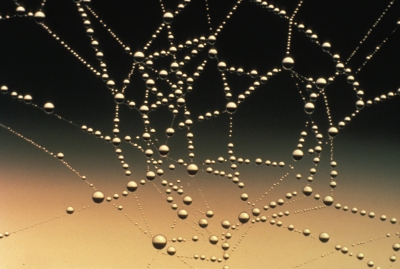
Water drops on spider web, US Fish and Wildlife Service, Public Domain.

According to the Universe, the true nature of reality is relationship. In fact, at the level of quanta, the smallest objects in the cosmos, we don’t even exist outside of our relationships1. How different this is from our common 21st century understanding of ourselves as inherently alone in our bubbles of existence, our societies conceived of as a collection of individuals all wrestling each other for the basics of life. What if we took this truth about quanta to heart on our human level? What if we began to think of ourselves as not primarily alone, but rather as a node in a web of connection, an essential part of a greater, even universal, whole? How might our lives and societies be different? When I experience Goddess myths and traditions and look at some of the societies from which they rose, I seem to catch a glimpse of what this change in perception might be like in our daily lives.

Continue reading “The Nature of Reality Is Relationship by Carolyn Lee Boyd”

Listening to Our Landscapes, by Molly Remer

Today the hawk is back, tail feathers lit gold and black by a bright and welcome sun. It stays only a moment before tilting out of the tree and continuing on its way, but this moment is enough to spark a sense of joy and wonder in my chest, the awake kind of glee that fuels and feeds me, that inspires and holds me. This feels like the Year of the Hawk to me, of clear focus and intentional commitment. I watch it glide away between the trees and take a deep breath of release and freedom. I re-center myself into my body and reconnect to the sacred What Is. I am open to clarity. I am open to trust. I am present with this day’s unfolding. 

Continue reading “Listening to Our Landscapes, by Molly Remer”

Legacy of Carol P. Christ: Mountain Mother, I Hear You Calling

This was originally posted on July 7, 2014

The mountaintop shrines of Mount Juctas in Archanes, Crete are situated on twin peaks, which may have symbolized breasts. Ancient shrines on the northern peak date from 2200 BCE until at least the end of the Ariadnian (Minoan) period in 1450 BCE. A crevice in the rock was filled with offerings of pottery, clay images of women and men in ritual dress, diseased bodies and body parts, sheep and cattle, and other objects. Excavations to a depth of 13 meters did not reach the bottom layers. Many offerings had been burned, suggesting that the objects were first thrown into fire and then dropped into the crevice. People who climbed the mountain for the festivals would have spilled over both peaks and there may have been shrines as well as fires on both of them.

Continue reading “Legacy of Carol P. Christ: Mountain Mother, I Hear You Calling”

Una Hora de Vida, Es Vida! by Xochitl Alvizo

I learned, recently, that this is a common phrase among my family members – “an hour of life, is life.” I remember the first time I heard my mom use the phrase, not more than a few years ago, I latched onto it immediately. Since then, I have realize that many of my relatives use the phrase – it’s kind of a family mantra, which makes sense, then, that when I heard it, it reverberated within me—“Yes! An hour of life is life.”

To me it was a clarion call to not waste a single hour – to never think, “Oh, but I only have an hour…” and instead embrace the hour for all its potentiality—I have an hour, what will I do with it?

Continue reading “Una Hora de Vida, Es Vida! by Xochitl Alvizo”

Ode to Seeds by Janet Maika’i Rudolph

“In this is all that is.” 

Julian of Norwich (while purportedly holding a seed in her hand) – 14th century

“Even if I knew that the world would end tomorrow,

I would plant an apple tree today.”

Martin Luther

Have you ever had bedbugs or lice? If not, you’re lucky. If so, you understand just how hard they are to get rid of. Why is that? Because they are essentially seeds with legs.

Seeds need to be able to travel in order to be successful spreaders of life. For example, when an acorn falls from an oak tree, it probably can’t germinate right where it falls. The mama tree has already taken up all the earth/soil space as well as the water sources for its own roots. And the mama tree’s own leafy branches will block out access to the sun. So the innate goal of the seed is to move to find a more friendly space. Evolution has created all sorts of ways for seeds to use motion in the service of finding their own place to germinate. In the case of the acorn, there are squirrels. Because they are a food source, many of the acorns get taken to dens under the earth. Many of those are not eaten. Either they are forgotten or the squirrel in question meets another demise. An acorn that is nestled in a den under the earth, can have a potentially perfect environment to sprout far from its origins.

Continue reading “Ode to Seeds by Janet Maika’i Rudolph”