The path leading to the Klapados Waterfall begins at the edge of an open meadow in the pine and oak woodlands of a mountain in the island of Lesbos. After driving several miles on a very rutted dirt track, we parked under an oak tree, crossed the meadow and scrambled down a winding path. After about 20 minutes, it ended at a stream surrounded by plane trees. From there, we climbed over rocks to reach a pool created by the seasonal waterfall.
On the day we visited it, the waterfall was only a trickle of cascading drops that moistened its moss-covered path to the pool. The roots of a plane tree growing at the top of cliff followed the path of the water, weaving a web over the rockface all the way down to the pool.
Apple trees have always been dear to my heart and of course, they are associated with the goddess. What follows is a little story where the goddess is made manifest.
Torn Apple Heart
Three years ago I had a beloved apple pruned – I do not normally prune trees, believing that to do so may harm them, but because I once trusted a young boy who also loved trees, I allowed him to make a few cuts that spring.
Last year my apple struggled and dropped her apples too soon.
I worried.
This year rain has been scarce except for monsoons that first drown the trees, leave roots barren, with most of the moisture rushing down the hill to the brook. When I noticed so many many apples on too thin young branches I became uneasy….
It’s almost mid August; since mid July we have experienced the hottest summer I have ever endured.
Intolerable temperatures, the air dripping with humidity, unable to sweat, my body catches fire. My aging mind shuts down.
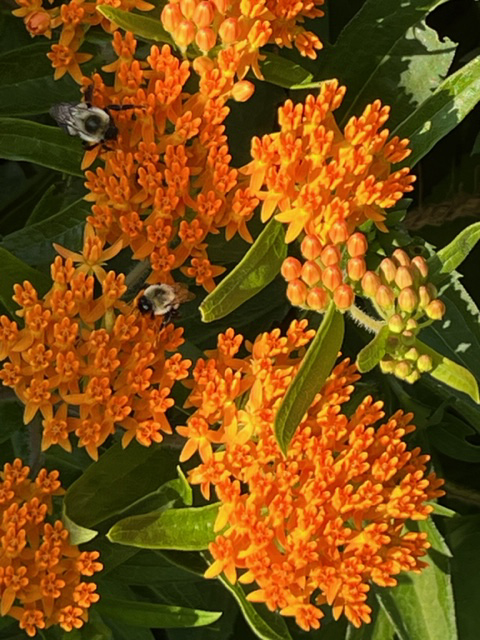
How to find hope in the ruins, not just personally but all around me in dying leaves rife with holes or chewed to bits in late July, flowers shriveling under a merciless sun. A solitary frog croaks from somewhere inside a garden gone wild. Silver swords create an impenetrable bower protecting toads and frogs from within. The scent of bittersweet butterfly weed draws in flaming orange fritillaries, monarchs, bees, a silvery white butterfly with two spots on her wings. A few spikes of scarlet bee balm burst. Flames erupt, crimson, salmon, lemony lilies and golden nasturtiums seduce with sweet nectar. Hummingbirds hover, chirping madly between these and red mint…my breathing is labored – shallow – my body waterlogged and swollen. Together the dogs and I doze lazily, our bodies aching for
I often speak of being in the temple of the ordinary, of seeing the enchantment in the ordinary. In the book The Spirituality of Imperfection, the authors write that “beyond the ordinary, beyond material beyond possession, beyond the confines of the self, spirituality transcends the ordinary, and yet, paradoxically, it can be found only in the ordinary. Spirituality is beyond us, and yet it is in everything we do. It is extraordinary. And yet, it is extraordinarily simple.”
This spring, I presented at an event and the concept of “being versus doing” arose. I reminded participants that “being” is not a competitive sport. We cannot not be, we are being all the time. I think sometimes the pressure we put on ourselves to be better, to “do” being better, can be really hobbling. Likewise, the sensation that spirituality is somewhere “out there” or that it has to be bigger than or better than or transcendent instead of present in the ordinary. On a goddess based path, with a feminist orientation, I find that the Goddess herself pervades all of existence, pervades your whole entire life, even the rough and weary places, even the ragged and strange places. Returning to Kurtz and Ketcham, they write: “Now…beyond the ordinary is not meant to suggest something complicated, different, different or self-consciously special. Nothing is so simple, or so out of the ordinary for most of us, then attending to the present. The focus on this day, suggested by all spiritual approaches, attending to the present, to the sacredness present in the ordinary, if we can get beyond the ordinary is, of course, a theme that pervades Eastern expressions of spirituality and other expressions too.”
I know that I often find myself seeking or longing for the special moments, the magic, the flashes of transcendence, and sometimes this can cause me to miss the ordinary, to miss the present, to miss where I am because I’m longing for something else. Adages to the effect of “do what you are doing” and “be where you are” may begin to sound cliché almost and the reason they do is because it’s so simple and so out of the ordinary to simply come back to attending to the present. The present moment is, in my eyes, truly where we find the goddess, in the pulse of presence in the every day. In the book She of the Sea, author Lucy Pearce addresses the question of the transcendent ordinary as well: “I want to write of the oceanic mystery, the soul of goddess magic, the sacred that which lies beyond words, because the repeated deliberate seeking of connection to this is at the heart of what I do and who I am. It is my creative and spiritual practice. I want to speak of this so that you can close your eyes turn inwards and smile knowing, just knowing until our conversation can continue without words…I want to share what I have known and for not to sound strange, yet strangeness is its nature. The soul is not of this world. It’s not rational, the sacred is not logical, but nor is this chaotic, magnificent, contradictory, and complex world of ours. And yet, we insist on pretending that it is and being disappointed, afraid, or bemused when it shows us its reality, again and again.”
The sacred is not logical, and neither is the world itself, but we pretend that it is, and then we get disappointed when we see reality. I originally learned the phrase “don’t argue with reality” from self-help author Wayne Dyer. There can be a whole range of potential experiences that are beyond objective reality or the reality that people sometimes insist is all there is. Jeanette Winterson, in her book Lighthousekeeping writes: “I do not accept that life has an ordinary shape, or that there is anything ordinary about life at all. We make it ordinary, but it is not.”
Maybe we are trying to make things ordinary that are not. My kids are growing up and getting ready to graduate from high school. One of my sons is very into science and loves biology and genetics and he is fond of boiling things down to an “everybody’s just a mass of cells having a collective hallucination” type of rhetoric that leaves little room for the esoteric and little room for inherent meaning. However, for me, I come back to the reality of being human as its own kind of miracle, its own profound magic. The reality of having this body with all these cells, which are doing all these things day in and day out that I don’t consciously know how to do, and yet my body does them every single day. That’s magic, even if we can explain the objective “why” of it. I don’t consciously know how to beat my own heart, but wait a second, yes, I do, because here it is beating every day from birth till death. Some people may be quite attached to maintaining the assertion that life is random and pointless, but this is not the story I see. I see wonder. I see magic. I see a miracle in motion. I am awestruck at the impossible reality of being a bundle of cells typing this essay right now. Yes, I am “only” a bundle of cells and that is absolutely pure magic to me. In fact, your very presence right here, right now is proof of the sacred on this earth in my eyes. May we all love the ordinary and let it whisper of the magic right beneath the skin.
Breathe deep and allow your gaze to settle on something you love. Draw up strength from the earth. Draw down light from the sky. Allow yourself to be refilled and restored. There is good to be done on this day. Let your own two hands against your heart be the reminder you need that the pulse of the sacred still beats and the chord of the holy yet chimes.
Molly Remer, MSW, D.Min, is a priestess facilitating women’s circles,seasonal rituals, and family ceremonies in central Missouri. Molly and her husband Mark co-create Story Goddesses at Brigid’s Grove. Molly is the author of nine books, including Walking with Persephone, Whole and Holy, Womanrunes, and the Goddess Devotional. She is the creator of the devotional experience #30DaysofGoddess and she loves savoring small magic and everyday enchantment.
It’s been just over a week. Last Tuesday night to be exact. That’s the night the four of us huddled around our beloved companion of sixteen and a half years and said goodbye.
Buck became a part of our family when he was three months old. We were living in Oakland, California at the time. My son was five and my daughter had just turned one. My husband was coaching for the Raiders and he was gone all the time. It wasn’t a great time to get a puppy on paper—but our hearts said otherwise, so we did.
Just a little over a year earlier I had said goodbye to Tino. He’s the Blue Heeler that found me in a dream when I was living in Santa Fe, New Mexico. That morning I woke up and just had to get a puppy. It was a visceral pull. And I went to the Santa Fe Human Society and there was the puppy from my dream. He didn’t look like any dog I had ever seen until my dream the night before.
Sometimes I’m asked where I get my inspirations for verses to explore. In this case it was from the God Squad’s Rabbi Marc Gellman who discussed Psalm 93 in a recent column. In his analysis, he used Psalm 93 to wax poetic about how powerful god is outside of nature. In fact, he declared that the worship of nature is idolatry because it only points toward God but can’t completely match God’s majesty. Ahem and Excuse me! With my ire raised, I had to go and look at the Hebrew from my own Mystic Pagan perspective. Rabbi Gelman looks at these verses and his take-away is that “God is more powerful than even the most powerful storm.” Ahem and Excuse me again!
After delving into the Hebrew words, I see a whole other side to this powerful Psalm. I see the “power of God” [as he would say] or the “beauty of the divine [as I would say],” is that most awesome ability to midwife creation and birth. In other words, to make love manifest. I see in Psalm 93, an esoteric poem bursting with motion that begins by creating a place (Earth) for life to exist. This poem is filled with sound vibrations, thunderous surf, the movement of water and descriptions of thresholds. As the motion unfolds, one is invited to participate in the energies [powers] of the divine pouring out through these threshold gateways.
We take a slice of honey cake and a pottery cup of grape juice and leave it by the rose bush as an offering, arrayed on a bed of petals and topped with a single daisy and a ring of wild raspberries. We make some wishes in the dusty air, kneel down with our palms upon the warm earth and sing for rain. We walk under a half-moon sky beside a blood-red sun, the sound of coyotes rising into the night as a silent deer watches us, head a triangle of alertness, black eyes staring across the heat-weary field. We catch fireflies, winking above the wildflowers sparks of yellow-green, and find a plump brown toad waiting in the path. Then, we stand quietly together, mosquitoes beginning to cluster around our legs, our heads tilted back watching carefully for fairy silhouettes against the deepening gray of the midsummer sky.
It is summer here in the Northern Hemisphere. Deep summer. Dusty summer. Thirsty summer. Humid summer. In central Missouri, it is the type of thick, wet heat that soaks into you and saps your strength and enthusiasm about life. Life can feel faded, dull, and magic hard to see. The woods, where I find such solace, renewal, and enchantment, become closed to me as poison ivy, thorns, ticks and chiggers, resolutely bar my way. So, I walk on the road these days, in the mornings and at sunset, seeing what I can see from my vantage point on a dusty gravel road. Deep summer I find offers an opportunity to look around to see what flourishes of its own accord, to see what grows without tending, to see what rises wild and unfettered from the natural conditions in which they thrive.
Sometimes as humans we become used to controlling as much of the world as we can control and as much of ourselves as we can control. Sometimes we get focused on what we can cultivate and grow and intentionally tend. So focused on this conscious tending may we be, that we may even rip up or destroy or change what is naturally growing in our own little ecosystem, our own little biome, what is growing right where we are. We may even pull it up and put something else in its place that we think is prettier, or nicer, or even more beneficial or useful. I encourage us to consider summer as a time in which to pause with, appreciate and look at, savor and explore, learn about and discover, what really grows right where you are, what thrives right where you stand, without the need for you to manipulate or control or change it. And, I invite you to also consider how this might apply to the growing and thriving in your own personal life? How or what are you perhaps trying to manipulate or change or control in yourself or with the people in your life? Perhaps it is time to take a step back, to sit back, and to see what is already growing. What is already there? What is thriving in your world? What is thriving for you that doesn’t require wrestling with or changing or trying to make it fit in a certain way? I encourage you to soften and see. Perhaps the mulberry trees are green and spreading in your world. Perhaps the clover is in bloom. Perhaps there are daisies. Perhaps there are monarch butterflies still bravely persistent on the milkweed in the field. Perhaps there are wild onion scapes, with their little purple heads. Perhaps there is yarrow, white, and waiting, and interwoven in its own curious way with the health of your own blood and body. Perhaps that book you want to write is bubbling right behind your fingertips, waiting for your pen to be set against the page. Perhaps that project that sings your name is waiting for you to pause to see it.
We doubt sometimes our place in the natural world. And, yet these plants that surround us, that spring up around us, that grow right where we are, are here and growing, just like we, ourselves, are growing where we are. These plants are intertwined with the health of our own bodies. That is amazing and enchanting and wondrous to me.
My youngest son, Tanner, is six and we are working together on an earth science class, studying planets and the earth and geology and the universe. He came to me saying: “Mom, did you know, there’s real iron in us! There’s real ironin us.” And I replied, “there’s real iron at the core of the Earth too. Isn’t that amazing? The earth has iron in it and so do we.” He looked at me and asked then, “is magic real?” And I replied, “yes, honey, we walk around inside of it every day.” I pause here in the hot exhaustion of summer to marvel that so it is. In truth, it is not only that we walk around inside of it every day. We walk on top of it every day. We walk with it every day. It beats in our veins every day. We live with it every day. If we carry an awareness of this embodied magic with us, then every day becomes enchantment. Every day becomes sacred space in motion. Every day becomes the opportunity to fully inhabit our own living magic as we literally walk around within it each and every day.
So, what is growing for you? What is blooming for you? What is flourishing and healthy, just of its own accord, asking nothing else from you, but witnessing?
The earth is made of days beyond count and roots beyond question. The fire in your belly is that which whirls worlds into being. There is iron in your blood, iron at the planet’s core, iron in the stars, iron in beak of hawk and eye of crow, and iron in the red rocks beneath your feet. This air you breathe is river woven, lightning laced, tear salted, iron eyed, earth kissed, raven winged. Wait, let this breath expand your chest and know: here you are, today, in-dependence with all things.
Molly Remer, MSW, D.Min, is a priestess, writer, and teacher facilitating ritual, making art, and weaving words together in central Missouri. Molly and her husband Mark co-create Story Goddesses at Brigid’s Grove. Molly is the author of nine books, including Walking with Persephone, Whole and Holy, Womanrunes, and the Goddess Devotional. She is the creator of the devotional experience #30DaysofGoddess and she loves savoring small magic and everyday enchantment.
Like so many others, I learned this jingle, actually the opening of a lovely poem by Joseph Parry, during a brief stint in the Girl Scouts when I was nine or ten. I’m not sure I understood it then—what was wine, after all? what did it mean for it to “mellow and refine”?—but the words stayed with me, echoing unbidden through the years and shaping many of my choices.
Make new friends, but keep the old;
Those are silver, these are gold.
New-made friendships, like new wine,
Age will mellow and refine.
Like so many others, I learned this little jingle, actually the opening of a lovely poem by Joseph Parry, during a brief stint in the Girl Scouts when I was nine or ten. I’m not sure I understood it then—what was wine, after all? what did it mean for it to “mellow and refine”?—but the words stayed with me, echoing unbidden through the years and shaping many of my choices.
I’m sure it was thanks to these words that, three years ago, I found myself dancing at the wedding of my childhood best friend. Deb lives in Southern California; I live in New York. Yet I never had the slightest hesitation about saying “yes,” I’d attend. This was to be her second marriage, after a painfully failed first. For years she’d sworn she would never remarry; the wonderful man she’d been living with for two decades finally persuaded her. Clearly, a moment to celebrate. And although we’d missed all the other milestones in each other’s lives, I knew I had to be there for this one.
At Deb’s San Diego wedding, 2018
I’ve known Deb since we were seven; we’re now both in our seventies. For nearly forty years we had no contact—different cities, different lifestyles, different choices. But when Deb sought me out after Hurricane Katrina (I’d been living in New Orleans and somehow she knew that); when she came to see me in New York and we revisited our childhood haunts; when she took to phoning me regularly on Jewish holidays—I was irresistibly drawn back into this relationship that linked me not only with her but with my own self over time. (“For ’mid old friends, tried and true / Once more we our youth renew.”)
My recent move from Northern England to the Silver Coast of Portugal has been a radical change on so many levels. Not only am I coming to grips with a different climate and culture and immersed in learning a very challenging new language, I have embraced a completely different lifestyle.
For the first time ever, I can keep my beloved Welsh mare and matriarch, Ms. Boo, at home, along with her companion, the dashing Zinco, a very handsome but sometimes aloof Lusitano gelding. My pet name for him is Mr. Darcy.
I could have taken the easy route and put Boo on a livery yard that did all the care for me, but I wanted to give Boo a lifestyle with daily year round turn out in a big field and none of my local livery yards offered this, though I talked to some very kind and helpful people at these establishments. It’s just a different approach to horse care in Portugal, which prioritizes stabling horses and using their energy for training exercises and riding.
My life now literally revolves around horse care and feeding. As soon as it’s daylight, I’m out bringing them their morning feed before I even have my human breakfast or coffee. I bring them their evening feed some time before sunset. So my writing, intensive Portuguese classes, or whatever else I’m doing is necessarily book-ended by horse care. My “productivity” can suffer as a result. If you have animals or children or other care-taking duties, the care-taking always has to come first. My change in lifestyle prompted me to question precisely why our culture privileges such a narrow view of productivity in terms of working for and selling ourselves to the corporate world rather than caring for the land and beings all around us.
I addition, I poo-pick the field twice daily, a very time-consuming task. I was in a bit of a quandary whether all this meticulous poo-picking was actually necessary. Many UK-based sites insists it is an obligatory part of horse welfare to control both flies and the spreading of parasites. However, my Portuguese farmer neighbor and my farrier both hinted that I could just leave the stuff on the ground and it might actually be better for the soil if I did.
I actually don’t mind poo-picking. It’s good exercise and very meditative, especially in early morning when the sun is rising above the mist and the dew is sparkling on each blade of grass. The other morning I saw a magnificent full moon setting majestically over the Atlantic Ocean on the far Western horizon. It’s so serene and peaceful, just listening to the birds and the horses munching their hay. I feel like I’m entering a slower, more authentic world where time is measured not by smart phones bleeping at you but by the deep cycles of nature, the sun and the moon, and the distant chiming of village church bells.
Breakfast at dawn
I think if certain world leaders got up early to poo pick, they would spend far less time spreading verbal horse sh*t on Twitter.
In many ways this feels like a homecoming, a return to my roots. On both sides of my family, my grandparents were farmers and many of my first cousins and their children are still farmers. Although I’m not an actual farmer, keeping horses at home has made me an accidental small holder.
Alas, the consequence of my poo-picking habit is an ever-growing mountain of a muck heap. What to do with all this manure is a perplexing problem if you don’t have a manure spreader and other fields to spread it on. I offered it to the farmer next door, only to receive a lecture on his view that chicken poo, sheep poo, goat poo, and cow poo are all superior to horse manure! A hierarchy of poo! (It was this gentleman who hinted that I was better off just leaving the stuff where the horses dumped it.)
Nonetheless I have a most imposing muck heap that will only get bigger unless some action is taken. I posted that I had free horse manure to collect on some local gardening sites. So far two people have taken me up on it. Both people took as much manure as they could possibly squeeze into their cars–it hardly made a dent on my manure pile! But from them I learned some valuable tips on composting and have been inspired to dig out the mature stuff at the bottom of the pile to put on my roses and hydrangeas. Hint: if you ever have insomnia, spending a day carting wheelbarrows full of horse manure all around your garden will insure you sleep like a rock.
It’s something sad if horse manure is just viewed as an unwanted waste product instead of being recognized as part of the deep ecology of animal-keeping and gardening. Manure is compost in the making.
In the meantime, my “manure friends” who have collected the stuff for their gardens have gifted me with organic produce and homemade fig jam. I still have a lot to learn but this new life is teaching me so much. Living in harmony with nature isn’t just posting pictures of pretty flowers on Instagram. It’s getting actual dirt under your fingernails.
Mary Sharratt is on a mission to write women back into history. Her acclaimed novel Illuminations, drawn from the dramatic life of Hildegard von Bingen, is published by Mariner.Her new novelRevelations, about the globe-trotting mystic and rabble-rouser, Margery Kempe, will be published in April 2021. Visit her website.
The word apocalypse keeps coming up when I talk to friends about how our present times feel. We’ve all noted how cracks in our society are tearing open and fault-lines are rising to the surface. It is disorienting yet also potentially transforming. I realized I’ve felt this way before:
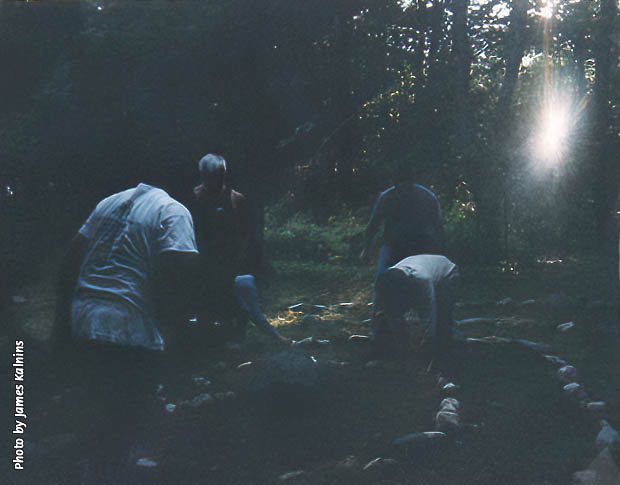
In January 1997, I became an apprentice to a husband and wife shaman team. They ran an old-style mystery school with regular weekend workshops in Maine and a 4-day in the summer. In August 1997, we met on forested private property that was far from any “civilization.”
Regular weekend meetings began after dinner which gave our small NYC area contingent plenty of time for a leisurely drive up the coast. In August, our teachers wanted us to arrive earlier. We arranged to take the Long Island Sound ferry to Connecticut to avoid the time-consuming drive around the city. About ½ way through our 1 ½ hour ferry ride, a shocking event happened. An elderly woman sitting near us dropped like a rock to the ground. Her daughter began screaming. No one could rouse her. The ferry returned to NY where an emergency crew tried and failed to revive her. She had literally died at our feet. By this time, I was not only thoroughly rattled, I was also deep into contemplating issues of life and death. Because of our delayed arrival in Conn, we began hitting evening rush hour along the major cities of our route. We did not arrive in Maine until well after dark. Continue reading “An Outrageously Strange, Bizarrely Weird, Completely True Tale by Janet Maika’i Rudolph”







 Feminism and Religion