The Flesh Made Word: Colm Toibin’s “The Testament of Mary” on stage and in print By Joyce Zonana

Colm Toibin Fiona Shaw Testament of Mary Ephesus Artemis House of the VirginBefore the play begins, the audience is invited on stage; we walk around, not quite knowing what to do, gazing at the props, uncertain.  A few chairs, scattered jars of honey, jugs of water beside a free-standing waist-high faucet, a tall ladder, a long table, a stripped tree trunk with a wooden wheel at the top suspended from the rafters, a menacing roll of barbed wire, and a live turkey vulture occasionally spreading wide its iridescent blue-black wings: such is the set for Deborah Warner’s searing production of Colm Toibin’s The Testament of Mary, a one-woman show currently in previews at the Walter Kerr Theater in New York.  In a large open-sided box, stage left, the actress Fiona Shaw, draped in blue from head to toe, arranges herself, then sits perfectly still, holding a lily and an apple.  We know this woman.  The Virgin Mary.  The Icon.  Incarnate.

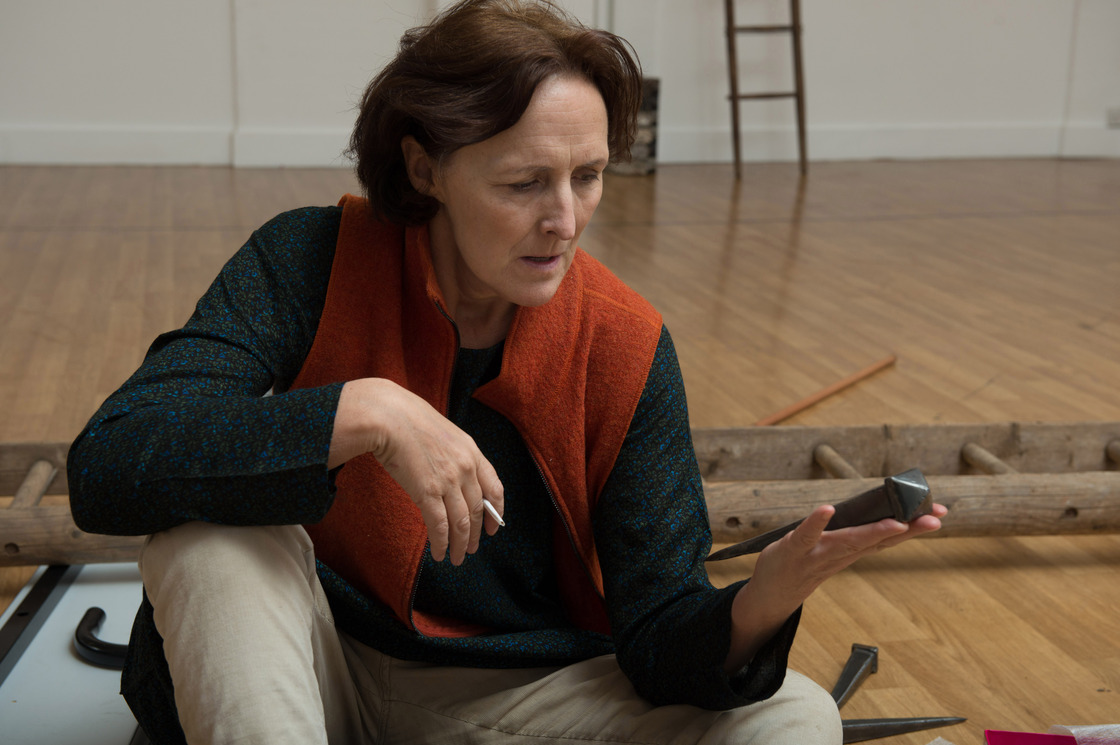
Fiona Shaw rehearses for her role as the Virgin Mary in The Testament of Mary. Irish novelist Colm Toibin's one-woman play opens April 22 at Broadway's Walter Kerr Theater.
Shaw in rehearsal. Photo by Hugo Glendinning

But when we are all back in our seats, Mary casts off her robe to stand before us in a simple black shift, flowing easily over narrow brown pants. Her hair is cropped, her face haunted; wearing short leather boots, she fumbles as she searches for a hand-rolled cigarette to steady herself.   “I remember everything.  Memory fills my body as much as blood and bones.”  No longer an icon, hardly a virgin, this Mary addresses us with the piercing directness of the passion she has suffered: to have seen her only son crucified despite her efforts to save him. Now, interrogated by two unnamed apostles (John and Luke?) who want to fix the story of her son’s life and death and resurrection, Mary insists on reporting only what she knows:  “I was there.  I fled before it was over but if you want witnesses then I am one and I can tell you now, when you say that he redeemed the world, I will say that it was not worth it.  It was not worth it.”

Continue reading “The Flesh Made Word: Colm Toibin’s “The Testament of Mary” on stage and in print By Joyce Zonana”

Truth and Consequences–This Feminist’s Perspective? by Marcia Mount Shoop

Marcia headshotIn John’s Gospel, Pilate’s response to Jesus’ self-identification as the one who “came into the world to testify to the truth” is a simple question:  “What is truth?”  His question hangs in the air as he moves from that conversation to the throngs he sought to please.  Pilate took the temperature of that crowd to decide Jesus’ fate even though he, himself, found no reason to charge Jesus with a crime.  Pilate asks the question from a position of power—literally holding life and death in the ambivalence and maybe even in the sincerity of his words.

The “t” word has been center stage in our collective conversation of late with Lance Armstrong’s Oprah-event confession  and the Manti Te‘o girlfriend-dying-of-cancer hoax at Notre Dame .   The Internet is abuzz with reactions to both confessional moments.  Lance Armstrong’s confession apparently didn’t play well with the general public.   And people are weighing in about whether Manti Te‘o could really be so naïve or if he just didn’t know how to tell everyone the truth when the story got out of hand.   Continue reading “Truth and Consequences–This Feminist’s Perspective? by Marcia Mount Shoop”

Cancel Christmas? By Elise M. Edwards

Elise EdwardsDespite the time and energy it takes to participate in the religious and social rituals associated with Christmas, the result is that I am spiritually grounded, emotionally provoked, mentally rested, and physically fed.   Advent, Christmas, New Year’s, and the last week of the year are times when I reconnect to what is important to me, and the holiday rituals help me do this.

The “holiday season” is upon us, and I’m still busy and exhausted, as I’m sure many of you are.  Although my life isn’t as stressful as it was in October, I am still juggling multiple commitments while trying to make significant progress on my dissertation.  This past weekend, I spent some time with other dissertation writers in the same predicament, and quite a few of them were thinking of cancelling Christmas in their households in response.

My immediate reaction to canceling Christmas (or another alternative they mentioned, micro-Christmas) was to inwardly scream “THAT’S RIDICULOUS!!!!”  To be honest, I’m not sure my facial expression didn’t make my reaction plain.  But since I value my relationships with these people and I genuinely respect their insights, I decided to keep my reaction to myself and to give the matter more thought.  I realized later on that all of the “cancel Christmas” advocates were women.  So I began to consider what the implications of cancelling Christmas would be for women. Continue reading “Cancel Christmas? By Elise M. Edwards”

Validating the Gospel of “Jesus’ Wife” is not Necessary to Prove Female Discipleship by Michele Stopera Freyhauf

The Gospel of “Jesus’ Wife” is certainly at the center of a battle that was last seen when questions of authenticity were raised about the James (Jesus’ brother) ossuary.  In a New York Times article, September 30th, Judith Levitt states that this document adds weight to theological and historical flaws surrounding the issue of the ordination of women.  The Vatican believes that their theology is still sound, calling the document a forgery.

The Gospel of “Jesus’ Wife.” [www.boston.com]
Frankly we do not need this document to validate the existence of female deacons and disciples – we have the biblical text and writings of the early church to validate this position.

Nor do we need this document to show that the standing from the Vatican’s point of view of ordaining women is theologically and historically flawed.

“In 1976, experts of the Pontifical Biblical Commission determined that there were no scriptural reasons preventing women’s ordination. The Congregation for the Doctrine of Faith overturned the commission’s judgment and instead wrote its own statement (Inter Insigniores, 1976) stating that women do not image Jesus who was a man; and therefore only male priests can adequately represent Christ.” – Women’s Ordination Conference

John Ortberg, in the Huffington Post, addressed a bigger issue surrounding female leadership in the Church brilliantly:

“perhaps what matters most in this discussion is the impact Jesus had — not on one woman — but on the status of women as a whole.”

Continue reading “Validating the Gospel of “Jesus’ Wife” is not Necessary to Prove Female Discipleship by Michele Stopera Freyhauf”

IN THE NEWS: Wives – Silent, Hidden, and Unnamed

“Jesus said to them, ‘My wife…'”

It is now public news that there is a fragment of ancient text in which Jesus makes reference to a wife. Based on testing of the papyrus fragment the text is calculated to have been from 150 years after Jesus died, a time when Jesus followers are still discerning how they should live and what practices they will keep. Though scholars all agree that this does not prove Jesus actually had a wife, it does reflect the liveliness of the debate nonetheless: Karen King explains, “This fragment suggests that some early Christians had a tradition that Jesus was married…There was, we already know, a controversy in the second century over whether Jesus was married, caught up with a debate about whether Christians should marry and have sex.”

The fragment also makes reference to a female disciple. Continue reading “IN THE NEWS: Wives – Silent, Hidden, and Unnamed”

Living Liminality: Of Thresholds and Dwelling Places by Marcia W. Mount Shoop

Sometimes I think it happened gradually.  Other times it feels like sudden change.  Either way I find myself in an in-between space that is my life.

With apologies to Victor Turner and his cultural anthropological appropriation of liminality as a threshold space, I have come to view my liminal living as a more permanent dwelling place these days.  Turner’s category of liminality locates subjects in the betwixt and between as they move from one manifestation of identity in community to a new kind of integration or role in community.   I am starting to wonder, however, if the thresholds are actually dwelling places for some of us in this world.

I don’t know if that means I am actually more marginal than I am liminal.  The margins are margins because they remain on the outskirts and they help define the boundaries.  Margins are permanent.  Am I marginalized if I live at the edges of the communities and identities I use to occupy, perhaps never to return to the bosom of the center? I hesitate to make such a claim mostly because I still occupy privileged spaces not the least of which are those constructed from how whiteness grants access and authority in this world. Continue reading “Living Liminality: Of Thresholds and Dwelling Places by Marcia W. Mount Shoop”

Discrimination, the Catholic Bishops, and Chick-fil-A by Michele Stopera Freyhauf

You may be tired of the controversy about Chick-fil-A, but the events of the last few weeks revealed a big issue in the organization – that of discrimination and the illusion of religious freedom.  However discrimination exists beyond the LGBTIQ community, it applies to Catholics and those “outside” their strict fundamentalist belief system.  However, the hierarchy in the Catholic Church seems to be embracing many of the beliefs put forth by Evangelical Fundamentalists in the political arena.

When it was time for my eldest daughter to get her first job, she applied and was hired to work at Chick-fil-A.  Knowing they were a  Christian organization, I felt that she would be well treated and we could still have family time on Sundays.  Everything started out o.k. but the longer she worked there, problems developed.  First, when I stopped through the drive-thru to show my support as her mother, I received apocalyptic material in my bag talking about the end times, where my soul would go, and inviting me to their church.  I found the material offensive and never returned. Despite the organization’s community support and “Christian” values, I was still fairly naive about their discriminatory practices that many experience on a daily basis.

Continue reading “Discrimination, the Catholic Bishops, and Chick-fil-A by Michele Stopera Freyhauf”

Abuse of Power in the Catholic Church Part II – WE are the Church! By Michele Stopera Freyhauf

Spiritual Power is arguably the most dangerous power of all.  In the wrong hands, it gives the power to make judgments even about the eternal fate of another person.  It needs a sign on it at all times saying, ‘Handle with extreme care.’  The greater the power a person exercises, the more need there is for checks and balances before it is used and accountability after it is used.” – – Bishop Geoffrey Robinson

 May 6th, I addressed the issue of abuse of power in the Catholic Church and how we seem to be unraveling any kind of progress made since Vatican II.  Since writing that article, the Leadership of the LCWR met with Vatican Officials and expressed their concerns openly.  A dialogue occurred and left no resolution, just information that the leadership will discuss with the community at their August meeting.  That meeting will reveal their next step in this controversy – concede and follow the conditions and rules sets forth by the CDF or disband and form a new religious community or maybe there will be another option revealed.

I have to ask though – Was this a meaningful meeting or was it meant to pacify the Sisters and their supporters? Will the Vatican change its stance? Certainly, the U. S. Catholic Sisters have not been

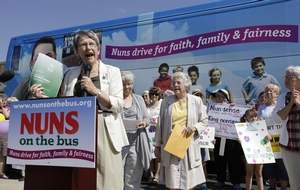
reposted from http://www.nunsonthebuss.com/bus

pacified, nor have their supporters.  For example, there is a “Nuns on the Bus” tour traveling around the United States,  prayer services for the Sisters, #nunjustice and #whatthesistersmeantome campaigns on Twitter.  Even the Women’s Ordination Conference delivered a petition containing over 57,000 signatures to the Vatican in support of the Sisters.  Certainly, the support for the sisters and their mission is not dwindling, but growing stronger every day.

As for the Vatican, a change in their position is doubtful, but we can continue to pray.  I am, however, very discouraged by a statement attributed to Pope Benedict that indicates a desire to have a smaller more faithful Church of Catholics then a large Church of people who do not adhere to Church Teaching – seeking out a small, strong, holy community.

Obviously, it is my hope that this statement was taken out of context, but I have to be honest and say

Women’s Ordination Conference delivering Petition
Picture reprinted from WOC’s page on Facebook

that my hope is filled with doubt.  This is not the first time I have heard clergy make this statement. Priests have made this statement in my presence – wanting a more faithful flock and dismissing those that do not adhere to their interpretation of Church teaching. This stance does not bear fruit, but is rather a power play – a play that can be called many things – misogynist, arrogant, non-pastoral, cold-hearted, and frankly un-Christian.  It also plays with a person’s spiritual fate and in many cases their soul.   The psychological impact of something like this is dangerous for some. Some ordained will go so far as to withhold sacraments or even compromise the person’s  status in the Church, including their role in ministry, for the sole purpose of  inducing compliance – a tactic that dates to the medieval period.

Continue reading “Abuse of Power in the Catholic Church Part II – WE are the Church! By Michele Stopera Freyhauf”

The Transformative Power of Daily Practices by Ivy Helman

My simple daily rituals and spiritual practices are what keep me mindful of G-d and G-d’s presence in my life.  They also remind me of G-d’s call to justice, care, compassion and love. 

“I find by experience, not by reasoning,

but by my own discovery that G-d is near me,

and I can be near G-d at all times.

I cannot explain it but I am as sure of my experience

as I am of the fact that I live and love,

but I know I do.

In the same way, I know I am in contact with G-d.”

This poem by Lily Montagu speaks to me.  I read it most mornings as I say my morning prayers, and it is one of those mantras I try to live by.  I have found that contrary to popular belief, sustained religious practices can be just as transformative as instantaneous conversion experiences.  This is why I have developed certain spiritual and specifically Jewish practices (For more about my joinery to Judaism, see one of my previous blogs “Reflections on my Spiritual Journey: Claiming Judaism”).  I find that they help me develop and cultivate a strong relationship with G-d.  For example, I keep a kosher home; wear a kippah daily; try to pray at least twice a day and before snacks and meals; practice the principles of Mussar; attend regularly Shabbat services Friday evenings at my Reform Congregation in Lowell and Saturday morning services at a Conservative congregation in Nashua, NH; light Shabbat candles; try not cook or create on Shabbat; make Havadalah to mark the end of Shabbat; give tzedakah as much as I can and study Torah with my friends.  This list is not all encompassing and there are quite a few areas of my practice I wish were more disciplined as well.

Continue reading “The Transformative Power of Daily Practices by Ivy Helman”

Abuse of Power in the Catholic Church: Undoing Almost Fifty Years of Progress – Part I, by Michele Stopera Freyhauf

“Now the Vatican says that nuns are too interested in “the social Gospel” (which is the Gospel), when they should be more interested in Gospel teachings about abortion and contraception (which do not exist).  Nuns were quick to respond to the AIDS crisis, and to the spiritual needs of gay people—which earned them an earlier rebuke from Rome. They were active in the civil rights movement.  They ran soup kitchens.” —  Roman Catholic Women Priests (via Facebook)

I once had a conversation with my New Testament Professor about the issue of women ordination.  He was optimistic and thought there might be a possibility that change was in the air – that was six years ago.  The basis for his statement had to do with language.  Of the journals and articles read, he felt the language used was more inclusive and that once people adjust to this discrete change in gender inclusive language, change for women in the Church can come.

He was right about change coming.  The result was not equality and ordination for women, but an attempt to silence and force these women back into their habits and cloisters. Continue reading “Abuse of Power in the Catholic Church: Undoing Almost Fifty Years of Progress – Part I, by Michele Stopera Freyhauf”