

 I have always had a particular fascination with women warriors—particularly ancient and medieval ones. Joan of Arc was a favorite, as was Artemis, Greek goddess of the hunt. My father had a sword from Spain hanging on his wall in his study and I used to stare at it with curiosity and longing—and once even took it off the wall when a babysitter’s boyfriend scared me. Later on, I learned about the women warriors of Dahomey in West Africa, Mu Lan Hua of China, and the Scythian women who were the real-life inspiration for the legend of the Amazon. The story of Durga, the warrior goddess of India who combats demonic forces and destroys illusion, also compelled me. I think, having felt under siege from relatives and schoolmates early in my life, the image of the woman warrior made me feel safer, even if in real life, my college karate class made me feel uncomfortable.
In my own tradition, I explored the biblical character of Devorah, the prophetess and tribal leader who directed the Israelites in battle. Then I discovered the apocryphal Judith, who defended her city of Bethulia by cutting off the enemy general’s head–Judith is celebrated in art in a variety of European paintings and on Chanukah menorahs. Judith is also celebrated during the North African Jewish holiday ritual of Chag haBanot or Eid Al-Banat—the Festival of the Daughters, a day that honors women and girls. In addition to these legendary women, I was moved by other, non-legendary women who fought for justice and their people in a variety of ways. Continue reading “The Kreismesser: Women and Magic Swords in Jewish Tradition by Jill Hammer”
 This week’s Torah portion, or parshah, is Shemot (Exodus 1:1-6:1). This parshah sets the scene for the liberation of the Israelites from slavery both by introducing main characters and elaborating on just how difficult life was for the Isrealites under Pharoah’s rule. The parshah contains many noteworthy aspects: the death of Joseph and the multiplication of the Isrealites in Egypt; the increasing wrath of the Egptians; the birth and adoption of Moses; Moses’ encounter with the Divine in the form of a burning, yet unconsumed, bush; the revelation of the divine name, G-d’s plan for Moses’ role in the liberation of the Israelites from slavery; Moses’ attempts to get out of his assigned role; and Moses’ first confrontation with Pharoah.
 This week’s Torah parshah is Vayera (Genesis 18:1– 22:24). The parshah contains the the destruction of Sodom and Gomorrah, the questionable hospitality of Lot, the incestual sexual relationships between a drunken Lot and his daughters, the revelation of Sarah’s pregnancy, the birth of Issac, the expulsion of Hagar and Ishmael from Abraham’s family, and the legendary story of the binding of Isaac. Needless to say, there is much that can be said, but today I want to focus on the women from Lot’s and Abraham’s families.
 The Torah parshah Ki Teitzei, Deutornomy 21:10 to 25:19, contains 74 of the 613 commandments/mitzvot found in the Torah. These mitzvot cover a wide range of topics and concerns. For example, there are mitzvot about how to sow and harvest your fields and others about aiding those in need, including animals. Some of the mitzvot describe how and why divorces can be decreed, to whom can one charge interest, and the punishments for various crimes. There is a mitzvah concerning the requirement to erect a fence on one’s roof to prevent people from falling off, one about not wearing clothes of the opposite gender, one about returning and/or caring for lost property and another detailing from what type of material one’s clothes can be made.
  Va’etchanan (Deuteronomy 3:23-7:11) gives us pause for thought in its contradictions. First, the
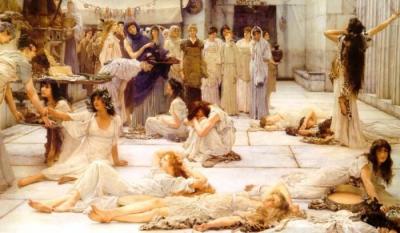
 This week’s Torah parshah is Behaalotecha: Numbers 8:1 to 12:16. By now, much of what comes to pass should sound familiar. The parshah starts with another discussion of leadership and the priesthood. It then prescribes a second Pesach for those who happened to be ritually unclean for the first one and describes the consequences of not participating in the first Pesach if you had been ritually clean. Next, the Israelites’ wanderings through the desert are detailed which includes the divine appearing as natural phenomena and the very loud rumblings of the Israelites’ tummies. Finally, the parshah ends with a discussion of Moses’ wife and Miriam’s punishment.
  Every year when the cherries, pears, plums, and apple trees begin to bloom, I go out walking. I look for every spot in my vicinity where white and pink blossoms are blooming in exquisite profusion like foam on an ocean. Every year I take photographs, even though I already have so many. I walk at every hour of the day because, as the light changes, the colors change. I have albums and albums of pictures of my beloveds, the trees.
 Feminism and Religion