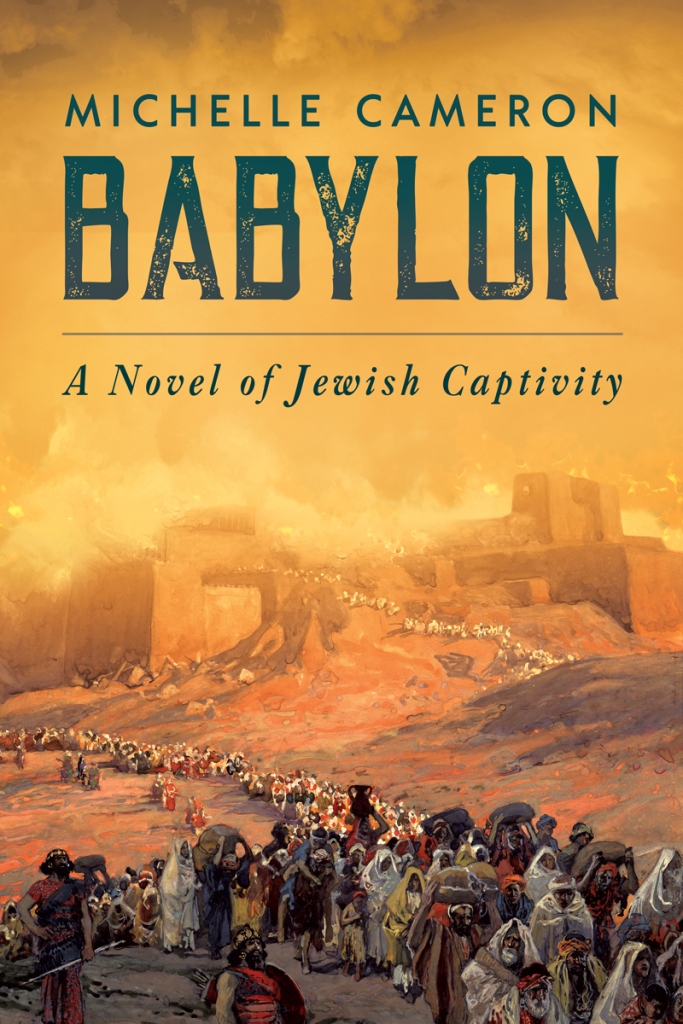
The Queen of Heaven Cakes: Asherah and Ishtar by Michelle Cameron

When one nation conquered another in antiquity, vanquished peoples typically switched allegiances to that country’s gods, since those deities were clearly stronger than their own. In my novel, Babylon: A Novel of Jewish Captivity, the prophet Daniel warns against this tendency, so the Judean exiles would remain faithful despite their captivity:

“You may be tempted to slip away from your Hebrew roots. Many of us struggle to remain steadfast to our faith. We are seduced by the lure of the gods of Ishtar and Marduk, Sin, Damkina, and Ea. Their temples overflow with riches and their ways are strange and compelling.

Continue reading “The Queen of Heaven Cakes: Asherah and Ishtar by Michelle Cameron”

Lilith: Evil Demon or Feminist Role Model?

Today, we celebrate Simchat Torah (the Joy of the Torah) which marks the end of a cycle of Torah readings and the beginning of a new one.  Therefore, the Torah portion for October 14, 2023 is Bereshit (Genesis 1:1-6:8), the first parshah of the Torah.  This parshah is most known for its myths surrounding the beginning of the world, including, within it, two creation stories, the first one running from 1:1 to 2:3 and the second from 2:4 to 2:25.  These accounts of creation are followed by a story about Adam, Eve, a snake, and the Tree of the Knowledge of Good and Evil.  The parshah concludes with the happenings of Cain and Abel, the descendants of Adam and Eve, and Noah, a man who found divine favor.

I wrote briefly about this parshah in the midst of the pandemic.  The writing there mirrors the chaotic and often difficult nature of that time.  Thus, I want to revisit the parshah now.  Interestly, I am drawn to comment on the same topic: Lilith. 

Continue reading “Lilith: Evil Demon or Feminist Role Model?”

Nitzavim-Vayeilech: Inspiration for a More Egalitarian Judaism.

The Torah portion for yesterday was a double one: Nitzavim-Vayeilech (Deuteronomy 29:9-31:30).  I have already written about Vayeilech here, yet as with any parshah there is always more to say. Nonetheless, I will mainly focus on the motifs that are more particular to Nitzavim (Deut. 29:9-30:20).  Some we have seen before like an obsession with idolatry, threats and punishments in the forms of disease, plagues, destructions, and annihilations, the Israelites’ persistent betrayal, and this-worldly rewards for good behavior.  Yet, there are some ideas we haven’t seen yet.  I want to focus on three: the Torah referring to itself; the idea of the Torah being heard; and the freedom of people to choose their own heart’s inclinations.

Deuteronomy 29:20 refers to the book of the Torah.  However, it is only in verse 31:9, that we learn that Moses is the author of the Torah.  More orthodox versions of Judaism adhere to this belief that Moses wrote the Torah (except for perhaps the last 8 verses or so since he had died), but according to biblical historians, the Torah was compiled out of a myriad of sources during the Babylonian exile.  Nonetheless, I find it interesting that in Vayeilech-Nitzavim, the Torah refers to itself eight times (29:20, 21, 27, 30:10, and 31:9, 12, 24 and 26).  To some extent, it seems to be setting itself up to be an equal to the ten commandments within Israelite temple worship as there are also instructions to put this book of Moses next to the ark of the covenant within the tent of meeting (31:26).  While Moses may not have written the Torah, it is clear that its authors intended for it to be a religiously significant book within Israel.  And, it has become for Jews, the religiously significant book.

Continue reading “Nitzavim-Vayeilech: Inspiration for a More Egalitarian Judaism.”

Re’eh: When Turning to Monotheism Requires Violence.

I have covered all of the Torah portions for the month of August except for Re’eh (Deuteronomy 11:26-16:17), which was the parshah for yesterday the 12th of August, 2023.  It contains discussions of idolatry, the inheritance of the land, what counts as kosher animals, the prohibition against eating blood, the sabbatical years, and a list of festivals and their observance.  As one reads, it becomes clear that the main concern of the parshah is threefold: observance; idolatry; and place.  Re’eh is more or less an argument for monotheism, one that acknowledges the existence of other gods, institutes a series of rewards and punishments to convince people to join in, and resorts to violence when people are unconvinced.  What does that mean for feminism?  We will see.

Continue reading “Re’eh: When Turning to Monotheism Requires Violence.”

Matot-Massei: The Question of Women’s Agency and Lives under Patriarchy.

The Torah portion for July 15th is the double-portion, Matot-Massei  (Bamidbar/Numbers 30:2-36:13).  Matot, meaning tribes, runs from Numbers 30:2 to 32:42 and covers vow making as well as what the spoils of war with the Midianites are.  Massei, or journeys, is Numbers 33:1 to 36:13 and describes the Israelites journey through the desert after fleeing Egypt and the boundaries of the Promised Land.  While Matot-Massei have so much that could be discussed including war, images for the deity, and cities of refuge, this post focuses on their women. 

There are three occasions where women are specifically mentioned.  The first concerns vows and their atonement when broken.  Next, women are discussed as spoils of war.  Finally, Matot-Massei describes what to do with inheritance when there are only daughters. 

Continue reading “Matot-Massei: The Question of Women’s Agency and Lives under Patriarchy.”

From the Archives: The Three Mothers: Feminine Elements and the Early Kabbalah by Jill Hammer

This was originally posted May 22, 2108

For over ten years, I’ve been teaching a work of early Jewish mysticism known as Sefer Yetzirah, or the Book of Creation.  There are widely differing opinions on the book’s origin and dating, but many scholars date it to the sixth century.  Its core concept can be described simply: the Divine used the Hebrew letters as metaphysical channels to create the different aspects of reality: the directions, the elements, the planets, the months of the year, and so forth.  Each letter is a channel by which God creates a unique form or entity, and meditating on the letters provides us with a connection to divine creative power. In its discussion of the letters, Sefer Yetzirah shows a strong connection to feminine imagery, and thus helps the later kabbalah develop its own link to the feminine.

Continue reading “From the Archives: The Three Mothers: Feminine Elements and the Early Kabbalah by Jill Hammer”

From the Archives: No Hope, No Problem: Reflections on Pesach, Time and Paradox.

Author’s note: This post was originally published on April 19, 2019.

In “Time Telling in Feminist Theory,” Rita Felski suggests that there are four main ways feminists discuss and use time: redemption, regression, repetition and rupture.  They are aptly named as they behave similar to their labels.  Redemption is the linear march of time, hopefully progressing step by step towards a redeemed, or at least better, future even if sometimes things get momentarily worse.  Regression is the want to go back in time or at least return to idyllic and/or imagined pasts: to matriarchy or to a time before patriarchy’s violent arrival.  Repetition is a focus on the cyclical nature of time in bodies, in daily chores, in seasons and so on. Rupture posits a break in time in a way what was before no longer makes sense or doesn’t exist.   Think utopia or dystopia.

Continue reading “From the Archives: No Hope, No Problem: Reflections on Pesach, Time and Paradox.”

Vayak’hel-Pekudei: On the Contributions and Gifts of Women by Ivy Helman.

This week’s Torah portion is a double one, Vayak’hel-Pekudei (Exodus 35:1 – 40:38 and Exodus 12:1-20).   Vayak’hel covers the construction of the Mishkan, or the temple that traveled with the Israelites while in the desert, and Pekudel outlines the requirements for Pesach, particularly the sacrificial lamb, the blood on the doorposts, and the requirement to eat unleavened bread. For this post I will focus on Vayak’hel as it is the only portion that makes direct mention of women.  It reminds us of the ways in which religion and religious institutions would not be possible without the contributions of women.

 Vayak’hel centers on the construction of the Mishkan beginning with the general assumption that everyone (here men and women) will donate the items needed to construct the Mishkan.  The text also contains verses in which women are specifically mentioned.  They donate their gold jewelry (35:22) and mirrors (38:8) as well as  spin wool and linen into yarn to be used for the Mishkan’s copious amounts of curtains  (35:25-26).  

Continue reading “Vayak’hel-Pekudei: On the Contributions and Gifts of Women by Ivy Helman.”

On Mishpatim, Feminism and A Caring Community by Ivy Helman.

Mishpatim (Exodus 21:1 – 24:18 and 30:11-16) is the Torah portion for February 18, 2023.  Its name, mishpatim, means laws or ordinances, and the portion is essentially just that – a list of laws to be followed.  It is not the easiest parshah to follow as it jumps around, backtracks numerous times, and sometimes contradicts itself, particularly in the sections with Moses. 

That being said, there are two main themes in Mishpatim; both of which I have discussed in past blogs.  First is the death penalty.  There is an overabundance of crimes that result in the death penalty in this parshah.  Way, way too many.  Another theme is idolatry.  In many ways, that is a theme in the Torah itself.  For more on these themes from my feminist perspective, see here: Sh’lach; Ki Tisa; Shofetim ; and on b’tzelem Elohim.

Continue reading “On Mishpatim, Feminism and A Caring Community by Ivy Helman.”

Vayeishev: A Feminist Reflection on the Women in Joseph’s life and Dreams by Ivy Helman.

This week’s Torah portion is Vayeishev, Genesis 37:1-40:23.   The portion covers too much information to address it adequately in one post.  Therefore, in this post, I will examine, from a feminist perspective, Joseph, the women in his life, and dreams. While the women in Vayeishev leave much to be desired, its dreams point to an important connection between humanity, divinity, and nature.

Vayeishev starts with the raw jealousy that some of Jacob’s sons have for Joseph. This jealousy is so great that it sends Joseph all the way to Egypt. As a feminist, I have always found it both comforting and completely realistic the way the Torah delves into emotion.  Since even the lofty patriarchs are jealous, no superhuman behavior is expected of us. Despite this comfort, I am not happy that it is once again men and boys who take centerstage. We know that these men and boys also had women and girls in their lives.  

Continue reading “Vayeishev: A Feminist Reflection on the Women in Joseph’s life and Dreams by Ivy Helman.”