In a repetitive culture of abuse and silence, is it really shocking to find out that an individual who preached such hate and discontent for others actually perpetuated other forms of heinous abuse against others?
In 2013, I wrote an article about the then latest reality TV scandal featuring A&E’s Duck Dynasty’s Phil Robertson and his rampant foot-in-mouth disease that caused him to express, in the pages of GQ, his true distaste for the LGBT community and specifically for the sexual proclivities of gay men.
Now, two years later in another reality TV show, TLC’s ’19 Kids and Counting’, it isn’t star Josh Duggar’s anti-LGBT statements getting him into trouble but rather his sexual assault and molestation of 5 girls, including two of his sisters. However, while the Internet explodes with attacks against Josh Duggar and his Quiverfull background, it is vital to remember that the silence that he and his family inflicted upon his victims since 2006 has not only been ongoing since then but is also being reemphasized today with each keystroke focusing on the assailant rather than the victims. Continue reading “The Religiosity of Silence by John Erickson”
In January 2015, I presented at the LGBT Faith Leaders of African Descent‘s third annual forum in Harlem, NYC. As an ally, I was honored to be invited. The theme of the forum was “Ain’t No Hurt Like Church Hurt.” I spoke about becoming an ally as wekk as about sexuality in Islam and among Muslims. However, what I learned while listening to other speakers and audience members will stay with me for life.
I have Christian family members who are gay and have dealt with church hurt because of it. Yet, it is not something I ever witnessed up close or spoke in depth about with them. Being Muslim, heterosexual and cisgender at the conference made me feel like an outsider yet everyone treated me as an insider. I felt as if I were witnessing pain I had no business seeing yet I felt obliged to witness and testify to it. So many people stood up to talk about their church hurt. There were so many tears of great pain and rejection shed during the conference. Everyone there was a great example of resilience. Throughout the day, I just kept thinking how blessed I was to be in the company of such wonderful, embattled, yet humble and loving people. Continue reading “LGBT Faith Leaders of African Descent by Jameelah X. Medina”
Consider a gay woman (myself) being asked by a straight attempting to understand the “right” for gay marriage, “What does it matter if I know you’re ‘gay’ if I’m not attracted to you?”[1]
Then consider that another right of “marriage” –or being known as “gay”—is the right to be admitted into the hospital room of a loved one, who is considered one’s primary partner, or “spouse.” Yes, one wants to say to the questioning woman in the above scenario, the rights for marriage include the crucial family relationships which allow one person to be able to take sick leave to care for a partner, or a partner’s child; being able to make critical medical decisions, and the right to be together in crisis situations (such as a hospital emergency room).[2]
What is the shifting conception of religious liberty as religious groups carve out exemptions in complying with laws on LGBTQI rights, particularly as they relate to marriage? As gay marriage becomes “normative” how does it change the structure and study of religion? How did the anti-gay rights movement in California, regarding Proposition 8, funded largely through religious organizations such as the Church of Latter Day Saints and the Catholic Knights of Columbus, have a direct impact on state decisions, and animate new conversations about the juncture of religion and politics?
Let’s start with this information:
Sociologist Brian Powell posed the question of why people were opposed to gay marriage. Do what people say match the legal arguments that justify the opposition to gay marriage? Since legal arguments are based on public policy, what public policy was shaping the legal arguments? The findings, published recently in Social Currents, show that the most common reason for gay marriage opposition was given as: “Because I don’t believe God intended them to be that way.” Running a close second was: “Well, they’re sinners.”
If public opinion drives public policy, then the motivation for banning same-sex marriage is moral disapproval. Or as stated in Powell’s findings—religious disapproval—and the belief that God is not “on the side” of the homosexuals; casting homosexuals as sinners in the faith choice of the person formulating the public policy critique. With these formulations, Powell suggested that public discourse —based on religious formulations such as “sinner” and what “God intended” are the primary agents erecting state laws that ban access to civil rights- such as marriage- for the LGBTQI population. Continue reading “Spouse for Life & the Fight for Gay Marriage by Marie Cartier”
We find our versions of home in these communities and it is within these spaces where our home not only begins to define who we are but we, as a reflection of that space, begin to outwardly redefine the spaces we exist in. If we slowly begin, through our experiences to shape our homes based on privilege and power without self-reflection and acknowledgment of others, then we are no better than those oppressive forces we say we’re against.
This post is a response to a recent blog entry titled “Who is Gender Queer?” on this site from Carol Christ. The post can be read by clicking here.I want to thank my friend, advocate, and upcoming scholar Martha Ovadia for reasons only she knows! Stay brave, speak up, be heard! _________________________________________
It is terrifying to know that something is wrong but not be able to speak truth to power.
It is even more terrifying to know something is wrong, be able to speak to it, and then silence those voices that do not have that same privilege, power, or position.
The struggle that many of us in positions of privilege and power face is not just that of being ostracizing and essentializing forces—it is that we, as allies, members of communities, or even those dedicated to a cause, can ourselves participate in the oppression we are fighting against and can do harm.
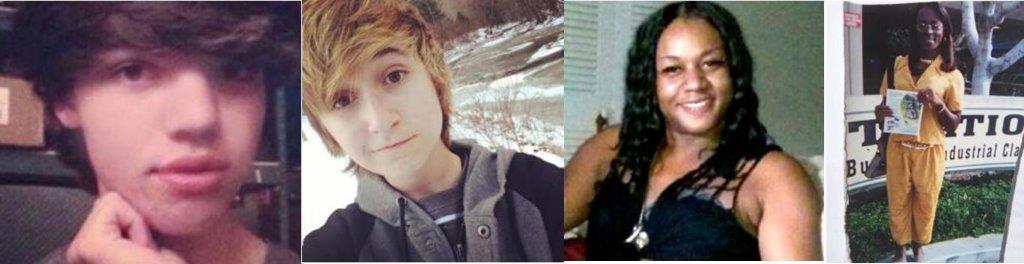
It’s taken me a long time to not only be comfortable with who I identify as, but also how I go about fighting and defining my life based on said identity and experience. However, the one thing that I have the ability to do is choose that identity more freely than others. Unlike Leelah Alcorn, Ash Haffner, Aniya Knee Parker, or Yaz’min Shancez pictured above, I did not have to face the types of oppressions they did, to which they sadly lost their lives, as a result of the fact that we exist in a society that can’t deal with the inability to leave things undefined or to allow people to define who they are on their own terms.
It is vital that although my lived experiences could never meet nor match the same types of oppression that these brave individuals had to face, I, as a white, cisgendered gay male, do not become part of their oppression through my own position and privilege.
As a man who exists in the world of feminism and within various women’s communities, I walk a daily tightrope of privilege and power to insure that I do not silence those that I consider allies, friends, mentors, or colleagues. As a man who exists in the world of the LGBTQ community, I walk an additional tightrope to additionally not take away from or diminish the experiences of those members of our community that do not have the same type of lived experiences as myself. Even within minority communities, there are positions of hierarchy and within these hierarchies of knowledge, identity, or power, comes a responsibility to insure that the oppressed do not become the oppressors.
We find our versions of home in these communities and it is within these spaces where our home not only begins to define who we are but we, as a reflection of that space, begin to outwardly redefine the spaces we exist in. If we slowly begin to shape our homes based on privilege and power without self-reflection and acknowledgment of others, then we are no better than those oppressive forces we say we’re against.
I can’t speak for what identity feels like –I can only speak for what essentializing does, and what it does is reflected in the deaths of Lelah, Ash, and the many others who die nameless. It is our responsibility, as allies, members of communities, and those fighting to end sexist, patriarchal, and, even now, homonormative oppression, to make sure that no more deaths occur on our watch or that truth is spoken to power even when power is masquerading around as truth.
John Erickson is a Ph.D. Candidate in American Religious History at Claremont Graduate University. He holds a MA in Women’s Studies in Religion; an MA in Applied Women’s Studies; and a BA in Women’s Literature and Women’s Studies. He is a Non-Fiction Reviewer for Lambda Literary, the leader in LGBT reviews, author interviews, opinions and news since 1989 and the Co-Chair of the Queer Studies in Religion section of the American Academy of Religion’s Western Region, the only regional section of the American Academy of Religion that is dedicated to the exploration of queer studies in religion and other relevant fields in the nation and the President of the University of Wisconsin Oshkosh’s LGBTQA+ Alumni Association. When he is not working on his dissertation, he can be found at West Hollywood City Hall where he is the Community Events Technician and works on policies and special events relating to women, gender, sexuality, and human rights issues that are sponsored or co-sponsored by the City of West Hollywood. He is the author of the blog From Wisconsin, with Love and can be followed on Twitter @JErickson85
My partner is a lawyer who works with asylum seekers and other immigrants here in the Czech Republic (ČR). She’s amazing at her job and I’m constantly in awe of her passion and commitment along with her righteous anger at systematic injustices. In fact just last week, her workplace, together with a consortium of other immigration organizations in the ČR, helped organize a demonstration in the center of Prague to protest the Czech Republic’s refusal to admit Syrian children and their families into the country. She invited me to attend the event with her. I went.
It was my first time attending a public demonstration in Europe. It was moving to see many of her co-workers there and inspiring to listen to the passionate speeches against xenophobia, Islamophobia, racism, the plight of the Roma people as well as the need to come together and welcome diversity. In addition, there were signs in Czech, German and English saying “No One is Illegal,” “End Xenophobia,” “Do Syrian Children Have to Wait for their (Nicholas) Winton?” “I want to have a Syrian Friend!” and “Refugees Welcome!” I wanted to hold each one of those signs! Continue reading “Being Scared: Fear and Authenticity by Ivy Helman”
This post builds on yesterday’s post on Marcella Althaus-Reid’s indecent theology.
In her book, From Feminist Theology to Indecent Theology, Marcella Althaus-Reid states that liberation theology has two dominant characteristics: the familiar ‘preferential option for the poor,’ with its suspicion of class structures and the influence these have on faith and church teachings to perpetuate and preserve its unjust systems of oppression and domination; and for its praxis of transformation of said unjust systems (FFTIT, 11). Marcella Althaus-Reid credits liberation theology for “systematically and structurally using the concept of ideological formation in order to unveil class economic interests embedded in theology” (FFTIT, 11).
To build on this, Althaus-Reid uses the concepts of ‘decency’ and ‘indecency’ to challenge theology’s obsession to regulate and control “sexual performances, roles and behavioral patterns of people…through a sexually based patriarchal hierarchy based in a particular androcentric understanding of life according to predetermined identities” – in other words, heterosexism. Indecent theology, then, aims to strip away theology’s false claim to sexual neutrality and its obsession to control, and instead aims to develop a theology free from the heterosexism that confines it (FFTIT, 83). One key place in theology she seeks to indecent (she used the word as a verb) is the “legend of Mary” (IT, 40).
Marcella Althaus-Reid opens her book by recalling a question she received from one of her colleagues: “What has sexuality to do with a Feminist Liberation Theology?” To answer she reflected on early liberation theology when it was still in formation and later liberation theology as it gained its place in the academy and the church:
[T]imes change and subversive theology becomes incorporated: church leaders claim that they themselves have always been liberation theologians. They guarantee to the state that there is no danger here…It is acceptable in the academy, entertaining to the wider public and a valuable commodity to publishers. Having reached calm waters, why would I as a feminist liberation theologian risk rocking the boat by introducing such a scandalous theme as sexuality, especially when it is not the theology of sanctified sexuality? (Indecent Theology, 2)
Most of the time, when we talk about being “Queer in Islam,” we identify the term with a hermeneutics developed by or on behalf of LGTBQI Muslims in order to allow their inclusion in religious spaces and recognize their agency in matters of faith.
My mother-in-law is currently in hospice and expected to cross over any time now. My wife is with her. Those two sentences alone—since I am a woman writing this blog—signify historic/herstoric change. I am a woman and I am writing about my mother in law and I am writing that my wife is with her. We are in a sea change regarding gay marriage. I will be allowed bereavement to go with my wife, when the time comes, for the services.
What has not changed in my life is my dependence on traditional prayer. Although I am a witch/Wiccan, have done all kinds of meditation from Transcendental Meditation, and Buddhist chanting, to visualization, spell work, and New Age affirmation—when push comes to shove as they say, I get out the Rosary.


 In 2013, I wrote an article about the then latest reality TV scandal featuring A&E’s Duck Dynasty’s Phil Robertson and his rampant foot-in-mouth disease that caused him to express, in the pages of GQ, his true distaste for the LGBT community and specifically for the sexual proclivities of gay men.

 Inspired by the conversation following Vanessa Rivera de la Fuente’s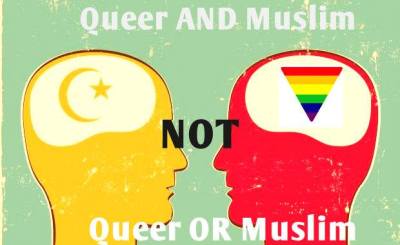
 My mother-in-law is currently in hospice and expected to cross over any time now. My wife is with her. Those two sentences alone—since I am a woman writing this blog—signify historic/herstoric change. I am a woman and I am writing about my mother in law and I am writing that my wife is with her. We are in a sea change regarding gay marriage. I will be allowed bereavement to go with my wife, when the time comes, for the services.
 Feminism and Religion