Mother – Daughter Betrayal by Sara Wright

(1)

Today is my mother’s birthday and although she has been dead for more than a decade I still think of her almost every day. At the time of her death I had not seen her for twelve years. Not by choice. After my father’s sudden demise my mother chose my children, her two adult grandsons to be her protectors, and dismissed me from her life, permanently.

When she died, my mother divided her assets evenly between my children and me, forcing her only daughter to live beneath the poverty level for the remainder of her life.

The final betrayal.

At the time of her death I was teaching Women’s Studies at the University.

Continue reading “Mother – Daughter Betrayal by Sara Wright”
Temple Magdalen by Elizabeth Cunningham

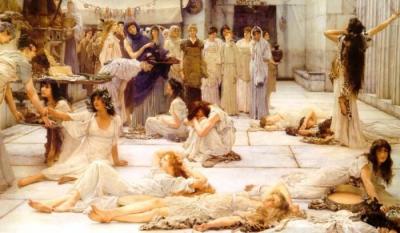
The Women of Amphissa, 1887, by Lawrence Alma-Tadema

Since I began writing for FAR in July 2012, I have written about Mary Magdalen, or excerpted a passage from one of my novels, near or on her July 22 Feast Day. For why I made the controversial choice to depict her as a prostitute, see last year’s post. The below excerpt is from The Passion of Mary Magdalen. I made this selection in remembrance of all the refugees in the world today. In this passage, Judith, a Jewish widow whose family was driven from the land by tax collectors, returns to the place where Maeve (my fictional Celtic Magdalen) and her friends have recently founded a Temple to Isis on the outskirts of Magdala. Maeve has just invited Judith to join them. (Edited for brevity.)

She stared at me, her eyes full of anger and longing.

“I will not be a slave and a whore where I was once a wife, the one who made the challah bread, who said the Sabbath prayers over it. This was our place, my husband’s and mine. We brought the best we had to the temple, the finest oil and wine, the unblemished kid—”

“Goats? You kept goats? You know how to make cheese?”

She sat quietly for a moment before she answered. “How can I live here with you?” she wondered. “I don’t understand.”

Continue reading “Temple Magdalen by Elizabeth Cunningham”

Re-Imaging Three Marys by Janet Sunderland

The recent #metoo movement, along with young women entering Congress, has pointed to an important question. Why, in this 21st Century, are these achievements remarkable? Why has it taken so long for women to be recognized as capable for these positions? One possible reason is the Christian mythology around women. However, to recreate the way women are viewed, we must re-imagine the women who have been standard-bearers for two thousand years.


Continue reading “Re-Imaging Three Marys by Janet Sunderland”

The Gift by Sara Wright

We drifted through

the green

hungrily absorbing

plant souls,

each twig, flower, and tree

has her own story to tell…


Such a joyful way

for me

to spend a

‘mother’s day.’

Being with him

when family

extends sharp claws

is an antidote to suffering.


“This is my church”

He said,

not for the first time.

I nodded.

He and I are almost

always in agreement

when it comes

to plants

and people.

Continue reading “The Gift by Sara Wright”

May is the Month of Mary by Mary Jane Miller

 Mary Icons

There are three classic prototypes of Mary Icons, their collective messages point toward a new contemporary kind of trinity. Perhaps the concept of Mary is still undeveloped, as our society has changed her message is still provocative and meaningful. It has been through contemplating her image, and painting icons of her that I have come to realize a deeper mystical message. Her popular iconography may have the keys to how we are to care for creation and one another in the world.

Mary Icon of the Panagia

Mary looks directly at the viewer, beckoning us towards poised stillness and constant prayer with palms extended outward in total surrender to what she receives. She contains the Creator of the Universe in her womb.

Mary Icons of the Theotokos

She is the feminine energy which tenderly nurtures Jesus to become a teacher, rabbi, master and lord. She is the icon which reminds us to love one another, to love life, and to love creation.

Mary Icons of the Hodegitria

Mary becomes a mystical location where we can be taught to give ourselves to God and one another. There, held by the church tradition, we like Mary are called to release to the world what we most love and cherish.

Continue reading “May is the Month of Mary by Mary Jane Miller”

Dear Mary by Sara Wright

This piece was written in response to Gina Messina’s recent Feminism and Religion piece “Who is God?”

Dear Mary,

When I responded to a post on feminism and religion this morning I wrote that you were my first goddess. As a child I knew little beyond that you were the “Mother of God,” and I found your presence immensely comforting, even seeking you out in secret, entering your rose garden in a local monastery. I needed you so.

Early in adolescence I learned that your life was one of purity, sacrifice, and loss. Your purity left me bereft. How could a young Victorian girl be “good enough” to serve such a figure? I was fierce and passionate – a thorny red rose – with an empty hole in my heart.

Sadly, I released you and chose your sister the whore, the Black Goddess in disguise… but I didn’t know that then; I only knew that the “black” woman succumbed to her flesh as I did, covered herself in shame…What lies Patriarchy tells…

Continue reading “Dear Mary by Sara Wright”

We Might Need to Die by Tallessyn Zawn Grenfell-Lee

Last week was the first week of Advent – in my tradition, the week of lighting a candle for Hope. This year has felt uniquely intense as I enter into Advent. Hope, even as headline after headline continues to warn us of the climate crisis. Just this past week alone – the week of Hope – we read:

EPA Rolls Back Coal Rule Despite Climate Change Warnings (CNN)
Greenhouse Gas Emissions Accelerate Like a ‘Speeding Freight Train’ in 2018 (NY Times)
Climate Change and Marine Mass Extinction (Science Magazine)
David Attenborough Warns Of ‘Collapse Of Civilizations’ At U.N. Climate Meeting (NPR)
The Climate Apocalypse is Now, and it’s Happening to You (Wired)

Hope? In the midst of literally the greatest crisis in the history of the planet? We are facing alarmingly strong odds of annihilation. Hope? Hope for what?

Continue reading “We Might Need to Die by Tallessyn Zawn Grenfell-Lee”

La Llorona by Sara Wright

The legend of La Llorona has been a part of Hispanic culture in the Southwest since the days of the conquistadores. Though the tales vary from source to source, the one common thread is that La Llorona is a woman named Maria who is always dressed in a white gown, the spirit of a young Mexican mother who drowned her children in the river in a moment of rage or abandonment by her lover and then took her own life in her deep shame and sorrow. La Llorona’s disembodied spirit is said to haunt the rivers at night – especially the Rio Grande – where she can be heard weeping in remorse for her dead children. Children are cautioned not to go out after dark because La Llorona might murder or drown them too. Because the tale of the Weeping Woman originated with the Patriarchal Spanish conquest I have always been suspicious of the various versions of this story believing that its meaning has been distorted.

Immediately what comes to mind is the Mater Dolorosa, Our Lady of Sorrows, or Mother of Sorrows. All refer to the Virgin Mary, the only goddess left in Christianity. Our Lady of the Seven Sorrows is another name used to refer to this goddess. The Mater Dolorosa is also a key subject for Marian art in the Catholic Church.

Continue reading “La Llorona by Sara Wright”

Depicting Mary by Natalie Weaver

In October I had the opportunity to travel to the Louvre Museum on a free day I had from a conference I was attending in Leuven, Belgium.  I went predisposed to consider images of the Madonna as I had been thinking about her representations in art for some time.  In my own painting, I have been developing a version of the Annunciation that depicts Mary as a teenage girl reading a pregnancy test.  Her fear and consternation, coupled by the shock of the event of learning of her pregnancy strikes me as a more accessible telling of the true vulnerability and risk of the unwed child Mary than classic depictions of Mary as a reclining queenly figure quietly receiving the angel’s message.  I likewise had been working on a wood burnt figure of a Black Madonna as a study in both icon making and also understanding the tradition of Black Madonnas found throughout Eastern Europe.

I am deeply aware that representing this figure is a culturally laden task because the Madonna speaks both to some of the deepest spiritual needs and inclinations of many faithful Christians world over, just as she is almost shorthand for division among Christian communities.  Her presentation is tremendously political as it is received by fans and critics simultaneously as at once championing women (and the divine within women) and also condemning real women whose maternity and bodies can never be as morally or physically pristine as Mary’s.  Mary’s skin, clothing, age, gesturing, posture, gaze, and more speak volumes about the social location of her patrons and creators as well as the manner in which the viewer is being invited to receive her.

Continue reading “Depicting Mary by Natalie Weaver”

Who is She? an excerpt (edited for brevity) from the 25th anniversary edition of The Return of the Goddess, A Divine Comedy by Elizabeth Cunningham

Introduction by Maeve: Elizabeth’s July post usually features an excerpt from my Chronicles in honor of my feast day, July 22.  This year the excerpt comes from the novel that opened the way for my story.  Ever since a playdough figure took shape spontaneously in her hands, Esther, a minister’s wife,  has been on a quest to find out Who She Is! Here she encounters the Lady as the Virgin Mary. (For my take on the BVM, aka Ma, the scene stealer, see The Passion of Mary Magdalen and Bright Dark Madonna.)

A kitchen, yes. That’s what a sacristy was: a sacred kitchen, Esther mused as she stood in St. Paul’s sacristy, the light strong but thickened by the plain, stained-glass, lead-fitted windows over the sink—the piscina, if you were high church. The walls, an ancient, graying yellow, did what they could to reflect the filtered light in a gallant effort to create an atmosphere intended to be cheery. Continue reading “Who is She? an excerpt (edited for brevity) from the 25th anniversary edition of The Return of the Goddess, A Divine Comedy by Elizabeth Cunningham”