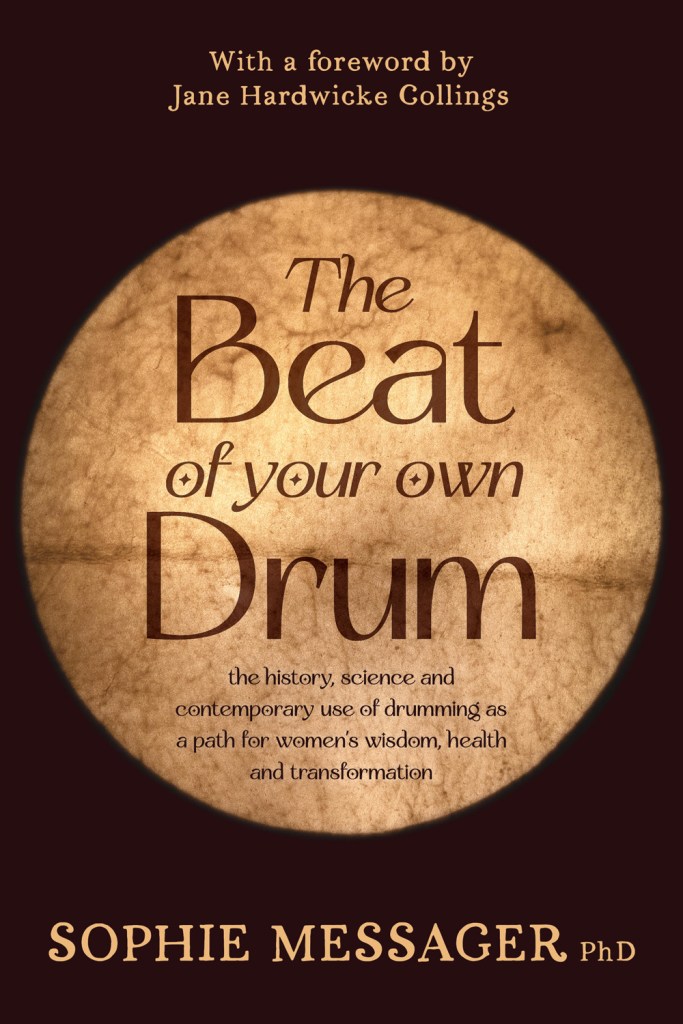
The Beat of Your Own Drum by Sophie Messager – Book Review by Judith Maeryam Wouk

Pick up a drum and start your unique journey with this sacred tool; there is no one right path.  The drum can help women hear their inner voice, access their own wisdom, reclaim their power, and heal. The drum in its simplicity offers a direct link to our deepest selves. 

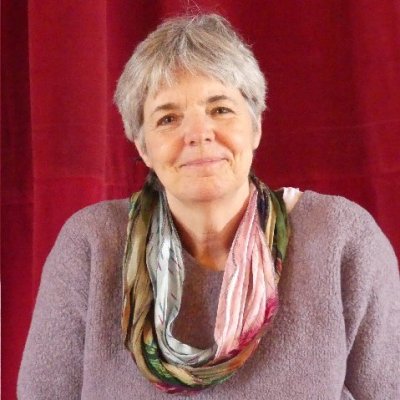
That is the message of this profoundly personal saga, told through the stories of Sophie Messager and others.  She recounts her own transition from scientist to birth doula to journey guide for women in life transition, through reiki and a diagnosis of ADHD, growing into her identity shift from outer- to inner-centered wisdom.  Her personal practice now includes weekly drumming at dawn in a woodland with two friends and monthly drum circles.      

Continue reading “The Beat of Your Own Drum by Sophie Messager – Book Review by Judith Maeryam Wouk”

PEOPLE GET READY by Esther Nelson

I recently attended an event in Salem, Virginia, put on by The Salem Choral Society titled “People Get Ready,” directed by S. Reed Carter IV.   This popular group has sung on numerous occasions locally as well as performing at Carnegie Hall in New York City and the National Cathedral in Washington D.C.  The choir (11 men and ~45 women) sang fourteen selections.  The song arresting my attention was “People Get Ready.” 

From Wikipedia:  “‘People Get Ready’ is a 1965 single by the Impressions, the group’s best-known hit, reaching number three on the Billboard R&B chart.  The gospel-influenced track was a Curtis Mayfield (1942–1999), American singer-songwriter, guitarist, and record producer.  This particular composition displayed [his] growing sense of social and political awareness…. In 2021, Rolling Stone named this song the 122nd greatest song of all time.  Martin Luther King Jr. named the song the unofficial anthem of the Civil Rights Movement and often used the song to get people marching or to calm and comfort them.”

Continue reading “PEOPLE GET READY by Esther Nelson”

No Day But Today by Beth Bartlett

Driving north on I-35 after having just left a powerful Somatic Experiencing® training session in which I relived significant moments of my heart transplantation, tears streamed down my face as I blasted the musical Rent at full volume on my car’s CD player.

There’s only us
There’s only this
Forget regret or life is yours to miss

No other road no other way
No day but today

There’s only now
There’s only here . . .
No other path
No other way
No day but today

Continue reading “No Day But Today by Beth Bartlett”

The Motomami Theology: “Segundo chingarte, lo primero Dios.”* Part I

*“God comes first. Fuc*king you, a close second.”

I went to Rosalía’s promotional concert for the Motomami album in Boston a month ago. I knew some songs from her 2018 album El Mal Querer (Bad Love), a musical masterpiece. That album made Rosalía a visible star in the constellation of musicians and composers in Hispano-American mainstream music. The album has a particular story that Wikipedia explains very well:

The album was written by Rosalía and co-produced with El Guincho on an initial low budget as an independent artist. Presented as experimental and conceptual, revolving around a toxic relationship, the album was inspired by the anonymous 13th-century Occitan novel Flamenca. Therefore, every song on the album is conceived as a chapter of the book. It served as the singer’s baccalaureate project, graduating from Catalonia College of Music with honors. [Read more here]

In El Mal Querer, Rosalía mixed electronics, contemporary dances and rhythms, and traditional flamenco sounds and movements in a beautiful musical and visual collage. Some musically conservative audiences characterized the album as the “profanation” of traditional flamenco music, but there’s no doubt that Rosalía brought the genre back to life and made it mainstream again.

Continue reading “The Motomami Theology: “Segundo chingarte, lo primero Dios.”* Part I”

From the Archives: Lessons from Candide by Barbara Ardinger

Moderator’s note: This marvelous FAR site has been running for 10 years and has had more than 3,600 posts in that time. There are so many treasures that have been posted in this decade that they tend to get lost in the archives. We have created this column so that we can all revisit some of these gems. Today’s blogpost was originally posted August 5, 2018. You can visit the original post here to see the comments.

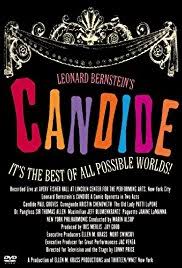
Candide, ou l’Optimisme (in English, Candide, or Optimism) is a satirical, picaresque novel published in 1759 by François-Marie Arouet, better known as Voltaire, who was possibly the smartest author of the Age of Enlightenment…but he annoyed so many courtiers and public officials that he was forever traveling around Europe to get away from their threats of arrest and bodily harm. A picaresque novel is an adventure novel with a clever, tricky hero who somehow survives and makes us like him. Voltaire wrote his novel primarily to criticize the optimism of the German writer Gottfried Wilhelm Leibniz, who said that because God is always benevolent, everything that happens is always for the best. This presumably includes the bloody Seven Years War (Protestant vs. Catholic, fought mostly in Germany and France) and the Lisbon earthquake of 1755, which occurs both in Lisbon and in the novel. Even though Voltaire was accused of blasphemy and heresy, among his other sins and crimes, Candide was enormously popular throughout Europe, a popularity that continues to this day.

Continue reading “From the Archives: Lessons from Candide by Barbara Ardinger”

Sappho in a Locrian Mode by Carolyn Lee Boyd

Sappho

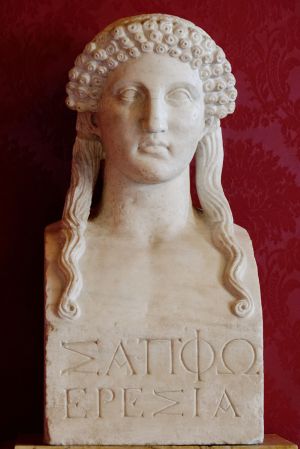
The world Sappho envisions in her poetry is one with many lessons for us in the 21st century about how to live. While ancient Greek society, especially in later eras, was deeply misogynistic and women had few rights, Sappho’s words evoke a perspective in which goddesses, especially Aphrodite, are revered and the connection of worshippers to goddesses is intimate, art created by women is celebrated, women’s relationships are central to one’s well being, and love and sensuality are enjoyed.

But words only tell part of the story. Sappho’s poetry was meant to be sung, and while we can’t hear the songs she wrote, I think it is interesting to note that Anne Carson, in her 2003 translation “If Not, Winter” says that Sappho is credited with inventing the Locrian musical mode.  A mode is a scale in which the progression of notes follows a set pattern of whole and half notes. We are all familiar with the major mode that makes music sound happy (Happy Birthday song) and the natural minor mode that we use for sad music (House of the Rising Sun). But there are many other modes, and the Locrian mode is one of them. (just a note: the Locrian mode is the same as the Greek Mixolydian mode and completely different from the modern Mixolydian mode, just to be confusing.)

Continue reading “Sappho in a Locrian Mode by Carolyn Lee Boyd”

Looking Again at The Magic Flute by Barbara Ardinger

I have just spent a week watching four productions of Mozart and Schikaneder’s 1791 opera. Four in a row! Now we all know that I adore musical theater more than almost anything else in the world. Operetta. Nelson and Jeanette. Fred and Ginger. Broadway musicals (but not the movies made from them that rewrote them completely). But opera?? Certainly not Italian opera seria. It’s just too loud. Besides, why isn’t La Boheme sung in French? Carmen in Spanish? Madame Butterfly in Japanese? Aida in Egyptian? Turandot in Chinese?

All right—yes, these are ridiculous questions. I’ve seen La Boheme and Turandot live. I’ve seen The Magic Flute live two or three times. Mozart is my favorite classical composer. Born in Salzburg (which was then part of the Holy Roman Empire and now is the site of an annual Mozart festival), he began composing at age five, and he and his sister Nannerl toured the courts of 18th-century Europe and performed before Louis XVI and Marie Antoinette. (BTW, while much of his story is told in the play and film Amadeus, Mozart was not murdered by Salieri. He died from a highly contagious miliary fever.)

Continue reading “Looking Again at The Magic Flute by Barbara Ardinger”

Singing Is a Sacred Power by Carolyn Lee Boyd

Carolyn Lee Boyd

A moss-soft ballad sung from a mountain top to the sunrise.  A parent’s lullaby to soothe a newborn to sleep. Thousands of voices rising together to banish injustice from our planet. A single wavering melody infusing inspiration into a moment of despair. Whenever we open our mouths to sing, no matter how tuneful or discordant our song, we have instant access to a well of power to transform ourselves and others.

Over the years, I’ve been amazed at how often singing denotes spiritual power in myths and stories about goddesses and holy women from across the globe and throughout time. These are just a few examples from around the world. You may know others.

Continue reading “Singing Is a Sacred Power by Carolyn Lee Boyd”

The Healing Spirit of Sacred Play by Carolyn Lee Boyd

Many years ago I participated in seasonal, Goddess-focused celebrations featuring handmade decorations, including some by enormously talented artists who attended.  One year, our spring fete was graced with gorgeous paintings, intricately woven and colorful fabric art, sensuous sculptures, and exquisitely painted eggs. I brought a Peeps diorama depicting the reunion of Demeter and Persephone.  (For anyone wondering, Peeps are brightly colored marshmallows in the shape of bunnies, chicks and other shapes and are sometimes made into dioramas for contests in schools and libraries.) The reason I brought the diorama was partly because, though my own artistic talent is somewhere between extremely questionable and non-existent, I thought people might enjoy a little bit of whimsy to honor spring’s exuberance. In addition, however, I was  also going through a time of great personal and professional stress and my soul deeply needed to be creative with just a little outrageous fun. 

Demeter and Persephone diorama

To recap the story, Persephone had been abducted by Hades and taken to the Underworld. Her mother, Demeter, made the Earth barren until the gods agreed to Persephone’s release. Demeter is the purple Peep and Persephone is yellow, and they are about to be reunited. Hades is pinkly enraged as he stands at the gateway to Hades. Gummi bears are romping while green humans dance in a circle. Snow is on the trees to show that winter is giving way to spring as Demeter returns abundance to the world.

Continue reading “The Healing Spirit of Sacred Play by Carolyn Lee Boyd”

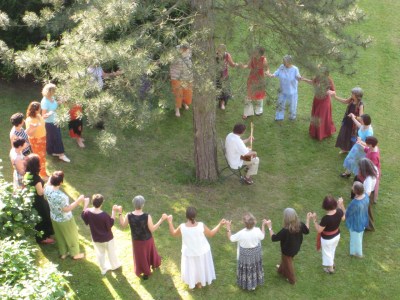
Dancing for Forgiveness and Reconciliation – Part Two By Laura Shannon

In Part One of this article, I described dancing Jewish, Romani, and Armenian dances for forgiveness and reconciliation with groups in Germany and all over the world. I also offered danced rituals of remembrance at former concentration camps and other places scarred by the atrocities of war.
I went to camps including Dachau and Auschwitz, to genocide memorials and sites of massacre throughout Eastern Europe, in Australia, and the Americas. At first, my prayers were private: I brought flowers, lit candles, danced my grief, and spent time in meditation. I tried to visualise the prisoners in those places, sending them my deep sorrow and regret back through time. I wanted to let them know that they are remembered and mourned by people from their future. My prayers contained a fervent apology as well as a soul commitment to do my part in this lifetime to overcome prejudice and stand for peace.
In time I invited others to dance with me for healing and peace. We danced at former camps in Germany, including Bad Gandersheim, a subcamp of Buchenwald, and on many occasions in Steyerberg, a former prison camp and forced-labour munitions factory which is now the site of an intentional community called Lebensgarten (‘Garden of Life’), a centre for permaculture, non-violent communication, and other ecologically and spiritually oriented ways of living.

Continue reading “Dancing for Forgiveness and Reconciliation – Part Two By Laura Shannon”