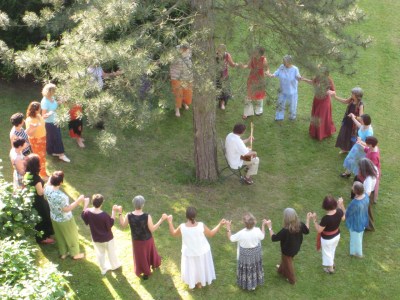
In Part One of this article, I described dancing Jewish, Romani, and Armenian dances for forgiveness and reconciliation with groups in Germany and all over the world. I also offered danced rituals of remembrance at former concentration camps and other places scarred by the atrocities of war.
I went to camps including Dachau and Auschwitz, to genocide memorials and sites of massacre throughout Eastern Europe, in Australia, and the Americas. At first, my prayers were private: I brought flowers, lit candles, danced my grief, and spent time in meditation. I tried to visualise the prisoners in those places, sending them my deep sorrow and regret back through time. I wanted to let them know that they are remembered and mourned by people from their future. My prayers contained a fervent apology as well as a soul commitment to do my part in this lifetime to overcome prejudice and stand for peace.
In time I invited others to dance with me for healing and peace. We danced at former camps in Germany, including Bad Gandersheim, a subcamp of Buchenwald, and on many occasions in Steyerberg, a former prison camp and forced-labour munitions factory which is now the site of an intentional community called Lebensgarten (‘Garden of Life’), a centre for permaculture, non-violent communication, and other ecologically and spiritually oriented ways of living.
Sing to the LORD, all you godly ones! Praise his holy name.
Psalm 30:4 (New Living Translation)
Therefore I will give thanks unto thee, O LORD, among the heathen, and I will sing praises unto thy name. 2 Sam 22:50
Let them praise the name of the LORD: for this name alone is excellent. Psalm 148:13
The wording of these passages is very odd. After all, why is God’s name always being praised? It’s like saying to someone, “you must be a wonderful person because you have a lovely name,” or “the LORD must be great because ‘he’ {sigh} has such a great name.” Actually though, as I began to go deeper into my own personal practices of spirit work and chanting, I found that there is a profound truth to this use of praise. Most, if not all, of the ancient names of deities are made up of power syllables. By this I mean certain sounds that have a vibrational essence which not only resonate within our bodies but connect us with all the vibrations that surround us. Sounds made by these syllables are a bridge between worlds created by our breath.
Mystically speaking we could say that the breath of creation and our own breath interfuse. We can experience this through the vibration of power syllables. The most common syllables in the west are familiar ones – AL LA HA AH YA LO WAH and the mighty HU. Think of all the names of divinity that can be created by experimenting with these syllables. Continue reading “The Sacred HU by Janet Maika’i Rudolph”
Daniel Deitrich, a worship leader in South Bend City Church, a “Jesus-centered community” in South Bend, Indiana, isn’t the first evangelical Christian to go up against fellow evangelical Christians who support the current U.S. president. Perhaps, though, he’s the first to author a hymn as a scathing rebuke to those 81% of white evangelicals who voted for Trump in the 2016 presidential election and those who continue to uphold him.

We cannot force a connection with God through a faulty conduit. What is important is that we affirm ourselves when we find it — when we feel it. Embrace those experiences, name them for what they are and recognize that you are sacred and the divine – whatever that means to you – is present.
When I’m in a funk, I generally feed into it and make it worse. Once we are in a rut it is easy to continue the spiral downward. I’m good at admonishing myself for lacking gratitude when I feel this way. It might be a Catholic guilt thing.
A few days ago, I was in a dark place; but this time I tried to own my sadness, acknowledge it, and let it go. The only thing I could think to do in hopes of shifting my emotions was to put on music – something up beat that would allow me to transcend the moment.
I listened to a live version of “Stay” by The Dave Matthews Band, a song about embracing the beauty of our lives and the idea that those moments where it feels like we are just wasting time are often our most precious; the ones that allow us to connect with each other and ourselves. It was the sermon I needed — and an important lesson my uncle taught me — but more on that shortly.
I often say that I think music is the sound of my spirit — our spirits. As I started writing this, I struggled with finding the words to articulate the feeling music provokes within me. There is little else that creates such an indescribable experience and that is why I think that music is where I find my connection to the divine.
Traditional religious services have always felt challenging to me. I don’t connect to much of anything and generally find myself feeling angry and rejected by the Church and the community where I am supposed to find God. My grappling with Catholicism aside, we are told that our spiritual lives must take place within particular dimensions, and for many of us God is not there. Continue reading “Finding God in Music by Gina Messina”
For many of us, listening to women-loving-women songs is a spiritual experience. That is because somehow it makes us feel seen, puts a sense of hope into our world as well as daydreams of romance. We can understand the challenges and the regret or guilt that comes with disappointing others and ourselves, them for not being who they wanted us to be and for us, not being who we are for far too long. Holly Near’s Simply Love album narrates a story that I might envision as a musical theatre production, and I really wish someone would ask me to write it and then hold the casting call (yeah, I’d want to be in it too, so save me a part). I offer some of my thoughts on two central songs in the would-be musical in hopes of sacred liturgy on a potential stage.
Simply Love has 28 songs and was released (according to Spotify) in 2000. I think the synopsis would be surrounding Cassandra, in a loving relationship with her partner, reflecting on her journey to this place of authenticity. I can imagine how it might be living one’s live in an exploratory way and coming to new revelations later in life.
Here is a hymn of praise, a beautiful and intimate piece meant to be sung. Reader, I invite you to guess the author of this text and the sacred figure to whom this work is addressed.
Hail, O greenest branch, sprung forth on the breeze of prayers.
. . . . a beautiful flower sprang from you which gave all parched perfumes their aroma. And they have flourished anew in full abundance.
The heavens bestowed dew upon the meadows, and the entire earth rejoiced, because her flesh brought forth grain, and because the birds of heaven built their nests in her.
Behold, a rich harvest for the people and great rejoicing at the banquet. O sweet Maiden, no joy is lacking in you . . . . Now again be praised in the highest.
I am falling in love with failure. At least I’m trying. It is time I have to.
We shouldn’t, lovely womyn, be short on our accomplishments. It doesn’t matter how slow going we’ve been, what we haven’t done yet, or what we haven’t quite obtained. We have to focus on the great strides we’ve made despite all the seeming nothings. If we fail, that means we put ourselves out there. Many times I submit a request or offer myself, the answer is silence, but other times the answer has been “yes.” I just haven’t heard many yesses because I don’t really try all that often. I’m timid, beat myself up, get down on myself, give up. Failure feels most like failure, though, the bad kind, when I’m indecisive and I don’t or can’t act. Not committing to something or deciding feels like a weight or blades inside. How can I love this failure? Or, at least, how can we be compassionate toward ourselves when we are in this situation?
I get Esther in Sylvia Plath’s The Bell Jar, at least from what I can gather from this quote: “I saw my life branching out before me like the green fig tree in the story. From the tip of every branch, like a fat purple fig, a wonderful future beckoned and winked. One fig was a husband and a happy home and children, and another fig was a famous poet and another fig was a brilliant professor, [. . .] and another fig was Europe [. . .]. I saw myself sitting at the crotch of this fig tree, starving to death, just because I couldn’t make up my mind which of the figs I would choose.” Continue reading “Love a Good Fail, and Fiona Apple is my Liturgy this Morning by Elisabeth Schilling”
Candide, ou l’Optimisme (in English, Candide, or Optimism) is a satirical, picaresque novel published in 1759 by François-Marie Arouet, better known as Voltaire, who was possibly the smartest author of the Age of Enlightenment…but he annoyed so many courtiers and public officials that he was forever traveling around Europe to get away from their threats of arrest and bodily harm. A picaresque novel is an adventure novel with a clever, tricky hero who somehow survives and makes us like him. Voltaire wrote his novel primarily to criticize the optimism of the German writer Gottfried Wilhelm Leibniz, who said that because God is always benevolent, everything that happens is always for the best. This presumably includes the bloody Seven Years War (Protestant vs. Catholic, fought mostly in Germany and France) and the Lisbon earthquake of 1755, which occurs both in Lisbon and in the novel. Even though Voltaire was accused of blasphemy and heresy, among his other sins and crimes, Candide was enormously popular throughout Europe, a popularity that continues to this day.
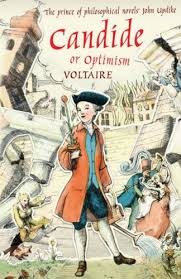
In 1956, playwright and screenwriter Lillian Hellman (who had been persecuted by Sen. Joseph McCarthy and HUAC) proposed to composer/conductor Leonard Bernstein that they turn Voltaire’s novel into a Broadway musical. Bernstein composed some of the most beautiful music ever written for this show, which has been produced as an opera, an operetta, and a musical comedy. Hellman’s libretto turned out to be weak, so Bernstein turned to the poet Richard Wilbur and Stephen Sondheim, among others for new libretto and lyrics. It’s been through numerous revisions, and every time it’s staged, it’s different. I have four or five versions on DVD. My favorite is the New York Philharmonic staged concert written and directed by Lonny Price and broadcast on PBS in 2004. Continue reading “Lessons from Candide by Barbara Ardinger”
My four year old is crooning quietly to her dolls. She is making sense of the crucifixion through play, asking her Disney princesses to stand in for Jesus, the Marys, and “the bad guys.”
We have been lost to each other for so long. My name means nothing to you. My memory is dust.
This is not your fault or mine. The chain connecting mother to daughter was broken and the word passed into the keeping of men, who had no way of knowing. That is why I became a footnote, my story a brief detour between the well-known history of my father and the celebrated chronicle of my brother.
Anita Diamant, The Red Tent
I am an expat author. My home is everywhere and nowhere. A wanderer, I have lived in many different places, from Minnesota, my birthplace, with its rustling marshes haunted by the cries of redwing blackbirds, to Bavaria with its dark forests and dazzling meadows and pure streams where otter still live, to my present home in the haunted moorlands of Pendle Witch country in Lancashire, England. My entire adult life has been a literal journey of finding myself in the great world.
For as long as I remember, I longed to be a writer. As a novelist I am on a mission to write women back into history. To tell the neglected, unwritten stories of women like my pioneering foremothers who emigrated from Bohemia (now the Czech Republic) in the 1860s to break the prairie soil of southern Minnesota.
To a large extent, women have been written out of history. Their lives and deeds have become lost to us. To uncover their buried truths, we must act as detectives, studying the sparse clues that have been handed down to us. We must learn to read between the lines and fill in the blanks. My heroine’s journey, in other words, is about reclaiming the lost heroines of history. My quest is to give voice to ancestral memory of that lost motherline.