Can We Honor Inanna and Her Gifts? by Judith Shaw

Judith Shaw photoSpring has arrived and my garden begins to emerge once more.  The world greens and blooms all around, reminding me that Mother Earth remains constant in Her desire to bless us with Her bountiful abundance. I am also reminded of Inanna and Her love for humanity.

Inanna, Goddess of Heaven and Earth, a Sumerian Goddess who encompasses all aspects of life, was greatly revered by the  people of Uruk as she brought them the gifts of civilization.

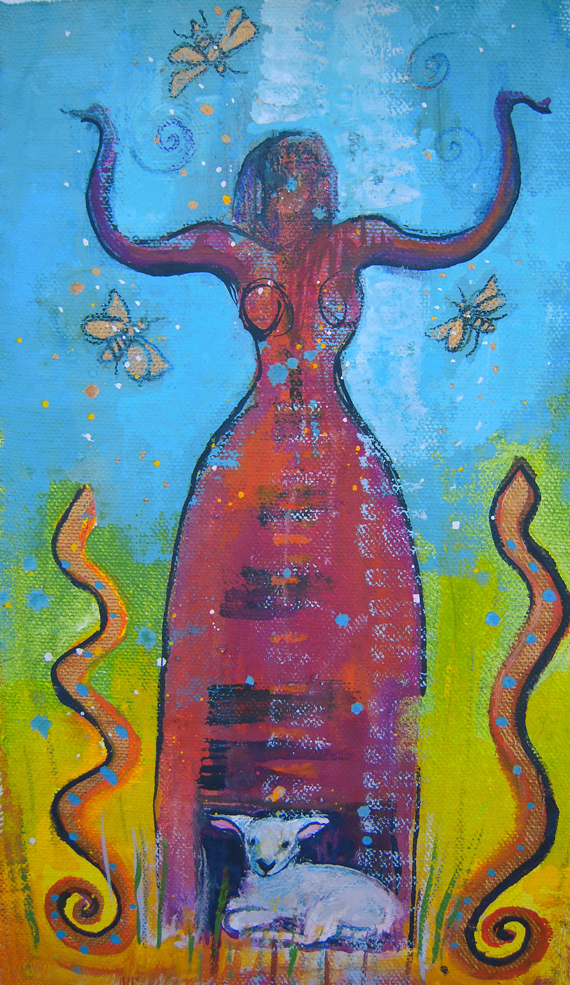
Inanna painting by judith shaw
Inanna in Her Boat of Heaven, pastel and beeswax on paper

This part of her story begins when she visits her father, Enki, God of Wisdom.   As they share drinks and a meal, Inanna proceeds to drink Enki under the table.  Once he’s well into His cups He gives Her the sacred me, the gifts of civilization.   Inanna rejoices as she claims these gifts for Her people, gifts such as:
kingship, the divine queen priestess,
the art of the hero, the art of treachery,
the rejoicing of the heart, the art of lovemaking,
the craft of the builder, the perceptive ear,
fear, dismay,
the kindling of fire, the making of decisions.

Continue reading “Can We Honor Inanna and Her Gifts? by Judith Shaw”

Brigid, Goddess of Healing, Poetry, and Smithcraft by Judith Shaw

judith Shaw photoBrigid, the Celtic Goddess of Healing, Poetry, and Smithcraft, begins her reign on Imbolic, February 2, the midpoint between winter solstice and spring equinox. On this day the ancient Celts held their Fire Festival in honor of Brigid and the growing light. In Scotland, as recently as the mid-twentieth century, houses were cleaned and the hearth fires rekindled on February 2, to welcome in  Brigid.  Remnants of this festival are found in America today on Groundhog Day.

Like the Cailleach, She existed in many places and  was known by many names.  The Irish called her Brighde; she was Bride in Scotland,  Brigantia in Northern Britain, and Brigandu in France.  Some called her Brid, Brig or Brighid.  Later she was transformed by Christianity into Saint Bridget.  Her older name was BREO SAIGHEAD.   Her name has various interpretations, many relating to fire – “Power,” “Renown” “Fiery Arrow of Power ” “Bright Arrow”, “The Bright One”, “The Powerful One”, “The High One” and “The Exalted One”.

Brigid, Celtic Goddess Continue reading “Brigid, Goddess of Healing, Poetry, and Smithcraft by Judith Shaw”

And Thus God made a Covenant with Hagar in the Wilderness by Michele Stopera Freyhauf

Freyhauf, Feminism, Religion, Durham, Old Testament, Blogger, BibleWe are familiar with the covenant God made with Abraham and Moses, but are you aware that God also made a covenant with Hagar?

In the wilderness Hagar encounters a deity at the well named Beer-lahai-roi (Genesis 16). Water and wells are important because they symbolize fertility and life. Wells for women are common places where they met their future spouses. Because wanderers in the desert need water to survive, water itself becomes a symbolic of life-giving or life.

In the seemingly barren dessert, the fertile Hagar finds out that she is pregnant and going to be the mother of many children. Hagar is promised progeny in a motherless state.  According to Pamela Tamarkin Reis, this is called the “after-me” descendants, which guarantees Hagar that her children will live for “immeasurable generations;” a pattern that fits within the scope of this promise. This same promise of progeny is also given to Eve in Genesis 3:20, providing and interesting parallelism between Eve and Hagar.

It is worth pointing out the irony exists in this promise.  Sarai uses Hagar to “build her up.” According to Nahum Sarna, to be built up in terms of the number of children that you have, implies that you are mother to a dynasty.  In this pericope, however, it is Hagar, not Sarai that is built up through this divine promise.

This patterns of promise exists within the birth narrative through the annunciation of Ishmael and the promise of progeny.  It is through this narrative that Hagar enters into a covenantal relationship with the deity.  According to J. H. Jarrell, birth narratives have six common elements that establish this relationship:  mother’s status, protest, offer, son’s future forecast, Yahweh naming, and acceptance of the contract. Hagar’s story contain these elements:

  1. Mother’s Status:  Hagar is without child because she is a virgin (16:1).
  2. Protest:  Hagar flees from her mistress (16:8).
  3. Offer:  Return to your mistress and submit to her authority (16:9).
  4. Son’s Future Forecast:  He will live at the east of all his brothers (16:12).
  5. Yahweh Naming:  You will bear a son Ishmael because the Lord has given heed to your affliction (16:11).
  6. Acceptance of the Contract:  She called the name of the Lord (16:13).

Continue reading “And Thus God made a Covenant with Hagar in the Wilderness by Michele Stopera Freyhauf”

Imix: Primal Mother and Dawn of a New Age by Michele Stopera Freyhauf

Michele FreyhaufIf you are reading this, then we survived another apocalypse.  People are fixated on end-times; especially predictions, prophecies, etc.  Specials on Nostradamus, the Book of Revelation, TV Evangelists looking for end signs plague television shows, movies, and writings.  Countdown clocks and reminders to repent are all around us.

Original image found at http://www.dwayneedwardrourke.com/Pages/TIMEWAVE0728/page21/page21.html

What is unnerving is how we obsess about the end of the world instead of living in the world we have right now.

I would like to share a Mayan poem that I came across.  It is called “Imix”- a Mayan Oracle Interpretation translated by Ariel Spilsbury and Michael Bruner and I am drawn to it due to the imagery and symbolism:

I Am Imix, Primal Mother.

Still, dark womb of the patterned potential of becoming, sacred, interstellar genesis, I Am.

Nourishing, fertile abyss, I birth you.

Benevolent, my mighty cauldron of primal waters, enveloping the living seed. Eternal is my embrace. Continue reading “Imix: Primal Mother and Dawn of a New Age by Michele Stopera Freyhauf”

Cailleach, The Queen of Winter by Judith Shaw

judith shaw photoThe Cailleach (KAL-y-ach), which literally translates as the “Veiled One” is an ancient Goddess whose origins are unknown.  When the Celts arrived in Ireland and Scotland she was there. Over time Her name came to mean “old wife” or “old woman”.  And yet she was thought to never grow old, an all powerful, ageless, Goddess of transformation.

In one of her stories, Cailleach, as an old hag, seeks love from the hero.  If he accepts Her, She then transforms into a beautiful young woman, symbolizing the transformation occurring in the depths of winter when the seeds lay dormant in the earth.  Yet alive within this dormancy is the promise of rebirth in the spring.  She is the guardian of the life force, finding and nourishing the seeds, commanding the power of life and death.  As the final phase of the Triple Goddess, she rules the eternal wheel of reincarnation. Cailleach personifies death and the transformative power of darkness.  She leads us through death to rebirth. Continue reading “Cailleach, The Queen of Winter by Judith Shaw”

The Ferryman by Daniel Cohen

 She’s changeable in Her ways. She is power, love, justice, mercy, and also rage, anger, sometimes even despair and misery, and more besides. She once said, “I am all that is, was, and ever will be”.

~~~~~~~~~~

Would I like a change from rowing this ferryboat? No, sir, I would not, and you folks wouldn’t like it if I did change. Why wouldn’t you like it? I was created for this job when the first human being came into existence, and I’ll continue in it till the last human dies – the way you people go on that may not be long.

Yes, many people do think they are going to go a different way, but they all take this boat in the end. What about near-death experiences? Those people may have been near Death, but they hadn’t got far enough to be anywhere near me.

Do I mind that they used to bring money for me but have stopped doing so? No, sir, I do not mind – that was just their own idea, that all ferrymen should be paid. Still, it was a nice thought, but they might have considered that there was nowhere for me to spend the money. In fact, getting rid of it used to be a bit of a bother. Continue reading “The Ferryman by Daniel Cohen”