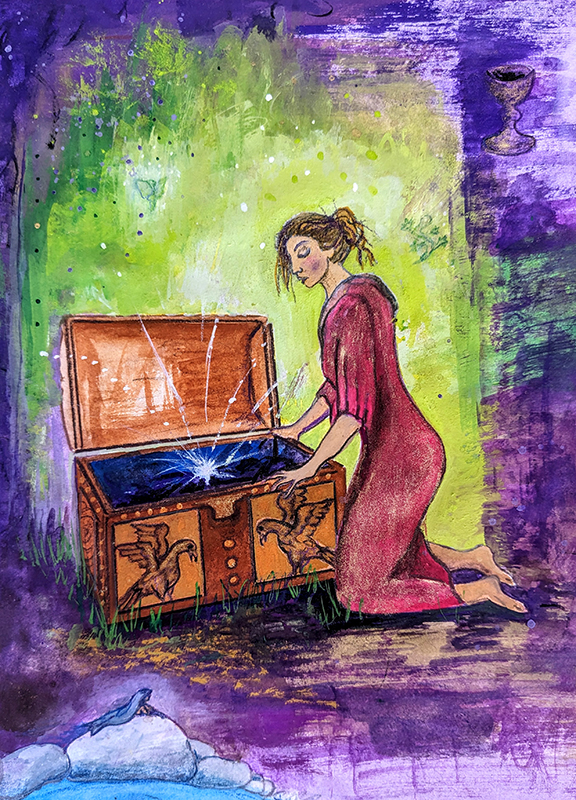
Pandora/Gaia—Bringer of Gifts by Judith Shaw

As we move deeper and deeper into full autocratic rule, the timeless themes found in mythology help me find my way. 

My first thought for these days was of Pandora, whose story in the myth of Pandora’s Box serves as a powerful metaphor for the complexities of human choice—relevant today by the choice of many to elect Trump, resulting in multiple destructive consequences. 

Hope Endures, by Judith Shaw, gouache on paper, 7.5″x10″
Continue reading “Pandora/Gaia—Bringer of Gifts by Judith Shaw”

Blodeuwedd; The Flower that Does Not Bloom and the Transhuman Death Spiral by Kelle Ban Dea

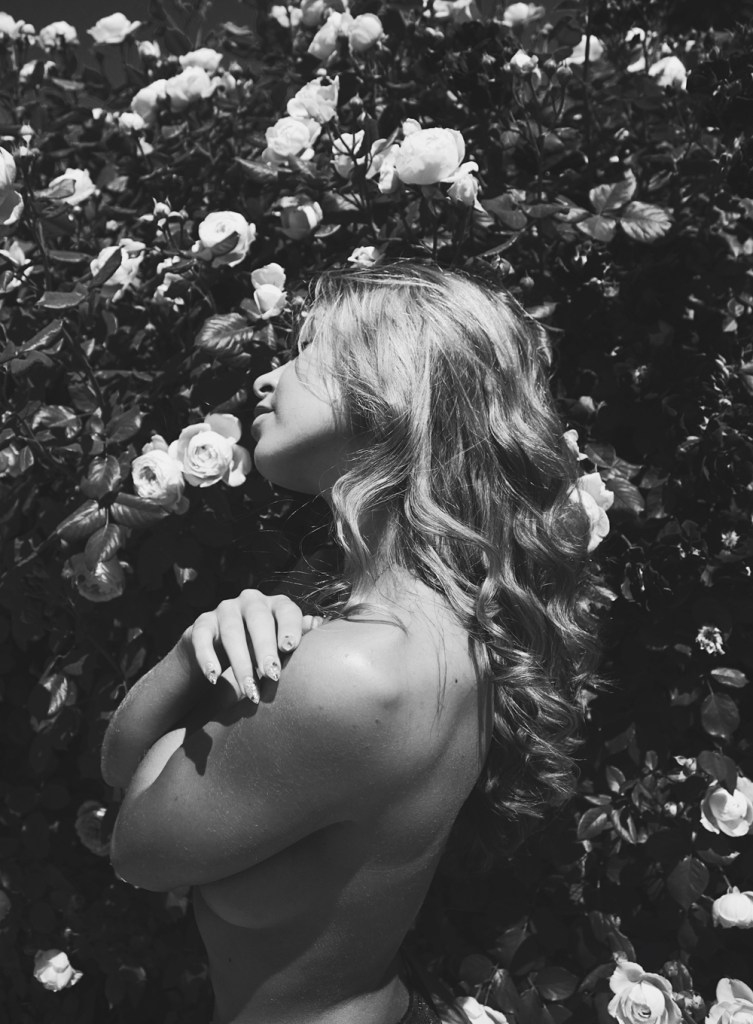
Blodeuwedd is often viewed as a Spring goddess, a personification of flower and bud and bloom. And why not; she is made of flowers after all; flowers and magic. It’s only when you read her original myth in the Fourth Branch of the Mabinogi that you realise how dark it is.

Of all the famous women – now seen as goddesses by many – in these ancient Celtic legends, Blodeuwedd is the only one who is not a mother, and therefore not seen as an aspect of the mother goddess, Modron. Bloduwedd cannot be a mother, because although she is made of flowers, she is a flower that will never bloom, that cannot reproduce.

In both ancient mythology and in the neopatriarchy we live in today, women who either cannot or will not be mothers (despite these being very different things; one a choice, one a lack of choice) are viewed with suspicion. As the opposite of the nurturing, fecund Mother, Bloduwedd instead brings betrayal and death to the hero of the tale. Yet, it was never Blodeuwedd at fault. She is created by the rapist magician Gwydion and given without her consent to be the wife of Lleu, the king, and our shining ‘hero’ of the story. Lleu has been cursed by his own mother to never have a human wife or children, so Bloduwedd is the best that Gwydion can conjure up, and he is celebrated for this marvellous feat of magic.

No-one, of course, bothers to ask Blodeuwedd what she might want.

Continue reading “Blodeuwedd; The Flower that Does Not Bloom and the Transhuman Death Spiral by Kelle Ban Dea”

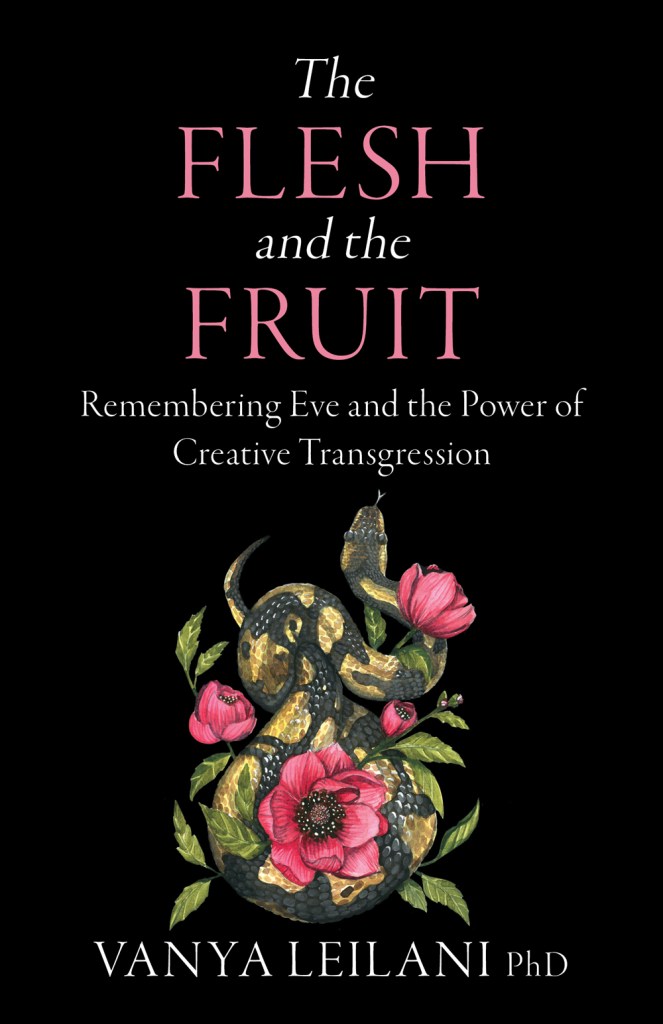
The Flesh and the Fruit by Vanya Leilani, PhD: Book Review by Janet Maika’i Rudolph

Subtitle: Remembering Eve and the Power of Creative Transgression

I have learned that every good story of spirit has many layers of meaning and pathways of understanding. Dr Leilani has found particularly relevant and even beautiful aspects of the biblical story of Eve. She uses Eve’s actions as a template of her own spiritual journey. Her pathway begins in obedience (listening to the voice of authority), travels through transgressive acts (eating of the fruit), and finally results in a self-knowing that had not been possible at the beginning of her journey.  In this book we follow along on her quest to learn about herself with Eve as her inspiration.

This is a luscious book. Vanya Leilani’s insights are not only profound but are written with a poetic sensibility. I found myself speaking some of her passages out loud because the vibration of her words are powerful and feel so sensuous on the tongue. I wanted to take them into my body, as well as read them on the page.

Continue reading “The Flesh and the Fruit by Vanya Leilani, PhD: Book Review by Janet Maika’i Rudolph”

Priestess or Goddess? The Real Morgan le Fay by Kelle ban Dea

Morgan le Fay is a popular figure for goddess-women and those interested in depictions of female spirituality, as well as a role model for some witches and pagans. Entire modern spiritual traditions such as the Avalonian tradition in Glastonbury have been created around her. She’s been portrayed in various ways in popular media and culture, and for many is more beloved than her mythical contemporaries, Arthur and Merlin. Which is interesting, because she’s a wholly fictional character, first encountered in the medieval Vita Merlini. Or is she?

While Morgan herself is, indeed, a fictional creation, many have seen echoes of ancient Celtic myth in her story. She’s a healer and magic worker, living on an Otherworldly island, sometimes with her eight sisters, guardian of Avalon with its magical apples and mists. In later iterations she’s a darker figure, an enemy of her brother Arthur, a witch and a seductress. A story we’ve all heard before.

Continue reading “Priestess or Goddess? The Real Morgan le Fay by Kelle ban Dea”

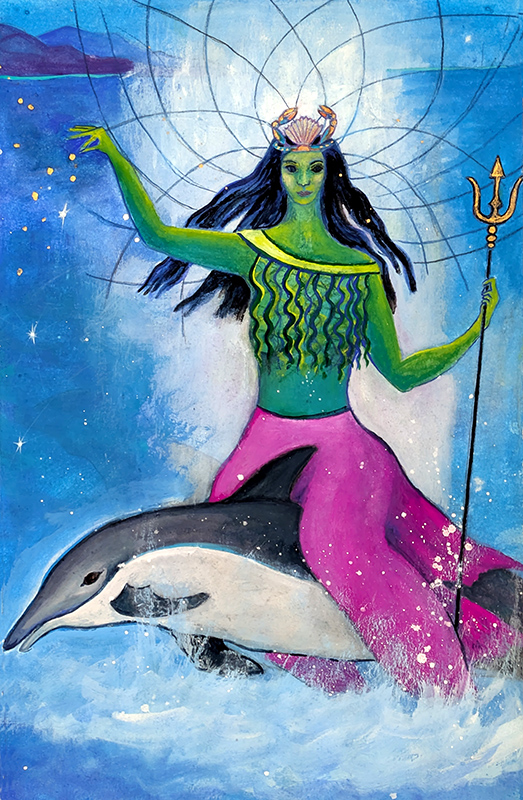
Amphitrite: Greek Sea Goddess — Balance, Abundance and Protection, by Judith Shaw

In the origin stories of the Greek deities the overarching importance of water, which surrounds their domain, is undeniable. Water held the power of life, death and renewal.

In each successive pantheon of Greek goddesses and gods — the Primordials, the Titans, and the Olympians — a goddess and a god ruled the seas together. During the time of the Primordial deities, it was Thalassa and Pontus, followed by the Titans, Thetys and Oceanus, and Doris and Nereu, and finally by the Olympians, Amphitrite and Poseidon.

“Amphitrite, Greek Sea Goddess,” gouache on paper, 11″ x 17″ by Judith Shaw
Continue reading “Amphitrite: Greek Sea Goddess — Balance, Abundance and Protection, by Judith Shaw”

Blue Raven and Murmurations by Margot Van Sluytman/Raven Speaks

Meandering
 Murmurations.
Myth and mystery
Beckon. We do not
[As yet]
Resist.
© Margot Van Sluytman

I have been fighting with myself to eradicate or somehow fit in the fact that I am in the throes of a profound transition. With “the new adventure’s” approach, death, roommates we have been for decades and decades, a new conversation between us is unfolding. Me and my compelling companion, daily and diligently, engage in what can sometimes feel a relentless row. Sculpting our symbiotic connection with meaning. Aligning dull and divine evocative evocations, as we share tea, toast, temerity, tempestuous alarm, sympathy, chagrin. Intermittent joy. Explorers we are. Searching out hope. Seeking sightings of simple strength. Seated at simple repasts. Inviting courage. Encouraging surrender. Crying out for creativity. Debating and discussing if Camus is correct in writing that suicide is disavowed because the meaningless of life, is, in fact, its very meaning.

Continue reading “Blue Raven and Murmurations by Margot Van Sluytman/Raven Speaks”

Arianrhod; Postnatal Trauma and the Rejecting of Patriarchy by Kelle BanDea

Mothers and sons. The stories that make up the Four Branches of the Mabinogi, a Welsh medieval collection of Celtic legends, are in large part about mothers and sons. Mostly about their separation. Mabon is stolen from Modron. Rhiannon’s son Pryderi is twice captured. Branwen’s baby is murdered. In Arianrhod’s tale, the Fourth Branch, it is she, the mother, who rejects her son.

Continue reading “Arianrhod; Postnatal Trauma and the Rejecting of Patriarchy by Kelle BanDea”

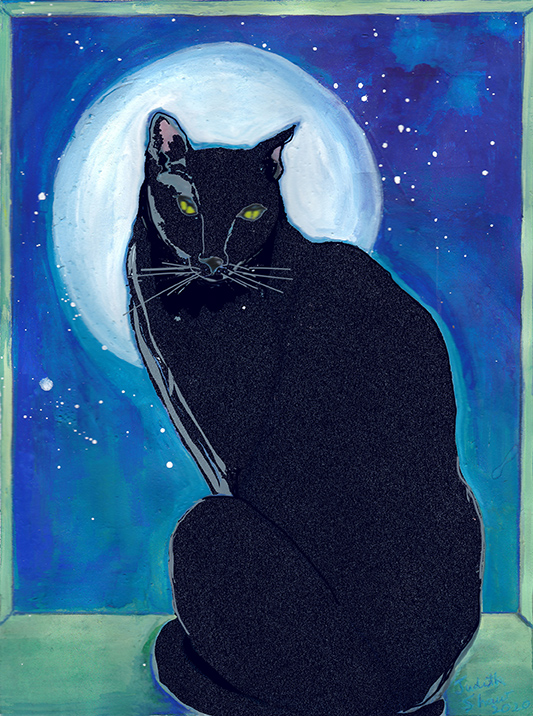
Samhain: The Cailleach, Wolf, and Black Cat  by Judith Shaw


Halloween, with its Celtic pagan roots in the sacred day of Samhain, which later morphed into a Christian holiday, is now mainly a nonreligious celebration in Europe and North America. It’s enjoyed by both young and old with scary outdoor decorations, parties, spooky costumes, haunted houses, carved pumpkins, and candy-giving.

Continue reading “Samhain: The Cailleach, Wolf, and Black Cat  by Judith Shaw”

Flowers — Gifts of Goddess by Judith Shaw


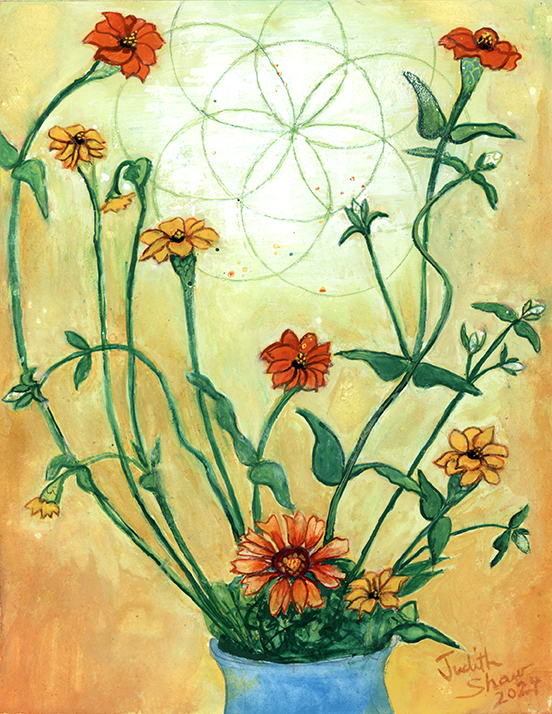
I was captivated by a bunch of wispy, weedy zinnia flowers on my dining-room table, with its bright blossoms sprinkled on the curling stems. The zinnias pulled me from my current obsession with sea goddesses into a different zone, into the Kingdom of Plants (Kingdom Plantae). The Plant Kingdom is an important part of Goddess manifest, having come into being long before the appearance of our human family. It’s no wonder that flowers and other members of the Plant Kingdom play an important part in the mythology of our ancestors worldwide. 

Zinnia Joy, gouache on paper by Judith Shaw
Continue reading “Flowers — Gifts of Goddess by Judith Shaw”

Cerridwen’s Cauldron; Stealing from Old Mother Universe by Kelle ban Dea

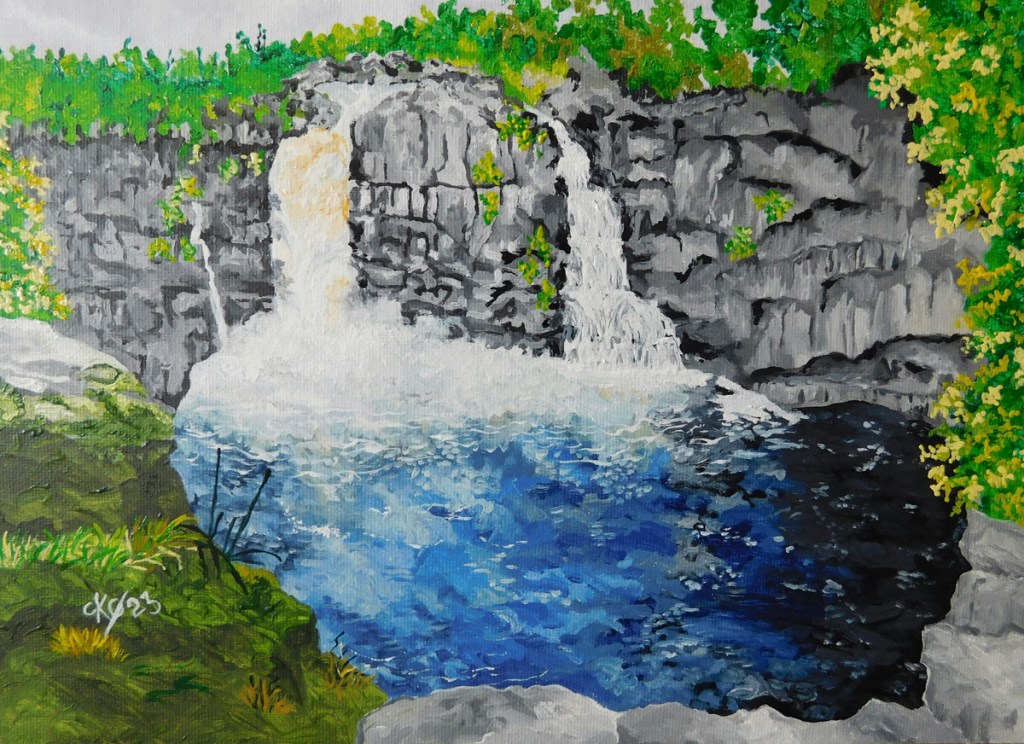
Catherine Kay Greenup, blue well
Unsplash stock

The story of how Cerridwen, the witch goddess, brews a magic potion full of awen (inspiration) which is then accidentally imbibed by the boy Gwion Bach, is well loved across the Western world, especially by neo-Druids. Gwion Bach is then reborn as Taliesin, the greatest bard in Britain. It is a typical heroes tale, with Cerridwen as the muse and initiatrix.

Or is it? This tale has always left a funny taste in my mouth, and when I recently read The Broken Cauldron by Lorna Smithers, I understood why. In the oldest version we have of this tale, Gwion Bach doesn’t accidentally taste the awen. He steals it.

Continue reading “Cerridwen’s Cauldron; Stealing from Old Mother Universe by Kelle ban Dea”