Dahut, the Once and Future Goddess by Judith Shaw

judith Shaw photoDahut Ahes, Breton goddess of Love and Sensuality is a Celtic Goddess whose origins are obscured by patriarchal tales which cast Her as wanton and depraved.  By weaving together the tales as they are today with an understanding of the life-affirming nature of the old pagan ways Dahut emerges as more than a glittering goddess of beauty; She is revealed as an ancient goddess in a long line of goddesses who holds the rebirth of the old ways in Her loving arms.

Continue reading “Dahut, the Once and Future Goddess by Judith Shaw”

Can You Imagine a Society of Peace? by Carol P. Christ

Carol Molivos by Andrea Sarris 2As war and the fruits of war, including hatred and the desire for vengeance, threaten our human community, I take this opportunity republish a vision of a Society of Peace. If we cannot imagine a Society of Peace, we will never be able to create one. Can you imagine that:

As a child, you would not have to fight with your sisters or brothers for your father’s or your mother’s attention. You would not have one mother but many as you would be raised in a large extended family. Both girls and boys would be equally loved and cherished by their mothers and grandmothers and by their uncles and great-uncles. Both girls and boys would know that they would always have a place in the maternal clan. As a boy or a girl you would never have to “separate from” or “reject” your mother in order to “prove yourself as an individual” or in order to “grow up.” You could grow up without severing the bond with the ones who first loved you and first cared for you.

You would be raised in a large family with sisters and brothers and cousins, all of whom you would consider your siblings. You would never feel lonely. You would not be taught to compete with your siblings. You would never be hit by or hit others, because violent behaviors would not be considered appropriate in families. Continue reading “Can You Imagine a Society of Peace? by Carol P. Christ”

Chlíodhna , Celtic Goddess of Beauty, the Sea and the Afterlife by Judith Shaw

judith Shaw photoHaving spent the past year and a half immersed in the study of Celtic Goddesses, I am intrigued by the sharing of many of their attributes, symbols, and associations – shape-shifting, magical birds, and apple orchards in the Otherworld to name just a few. One other common thread found in so many Celtic Goddesses is the existence of many contradictory folk tales about them.  Their stories, like the otherworldly mists of the Celtic countryside, which materialize suddenly, obscure reality and then melt away again, exist on the frontier of myth and reality.

Chlíodhna (pronounced Kleena), Celtic Goddess of Beauty, the Sea and the Afterlife, is such a Goddess.

Continue reading “Chlíodhna , Celtic Goddess of Beauty, the Sea and the Afterlife by Judith Shaw”

Why Is Pizza Round? The Black Goddess of Rome by Stuart Dean

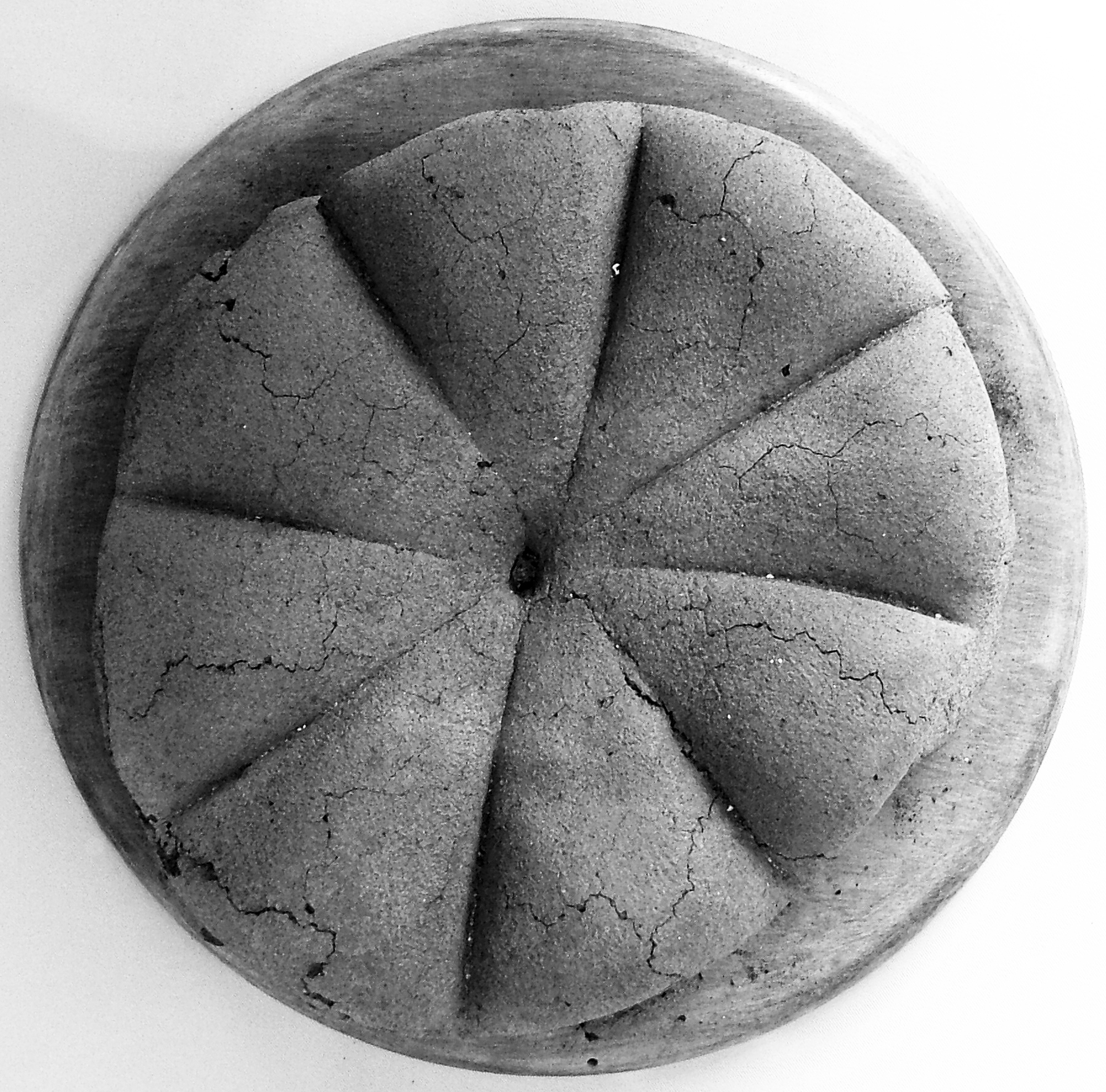
The remains of an ancient Roman bread pie from Pompeii, carbonized in the eruption of Vesuvius in 79 CE
The remains of an ancient Roman bread pie from Pompeii,
carbonized in the eruption of Vesuvius in 79 CE

The poem Moretum (discussed in my last post) narrates the preparation of a meal that can be characterized in modern English as ‘pizza.’  Round flatbread is baked; to go on it, a cheese spread is mixed.  The details of the narration are such as to create a recipe of its ingredients and related cooking instructions.  

The most important ingredient, however, is not an ‘ingredient’ as such, but a shape.  The bread, the cheese, and the cheese spread are all round.  That by itself might not seem remarkable, but the Latin terminology (words from which ‘orbit’ and ‘globe’ derive) is identical to then contemporary astrological terminology.  The bread is even scored into quadrants, symbolizing, among other things, the four elements and the quadrants of an astrological observer’s circle. 

The ancient audience of Moretum would have recognized in all this the world view of the Italian poet from southern Campania, Parmenides.  Though the only poem he is known to have composed is in Greek, the combination of the fact that he likely wrote it while in Italy and that it had over the centuries since its composition become one of the most influential philosophical works of pre-Christian antiquity meant Parmenides had special importance to Romans.  It is not surprising Moretum has the same meter and many of the poetic images as are found in the poem of Parmenides. Continue reading “Why Is Pizza Round? The Black Goddess of Rome by Stuart Dean”

E Pluribus Unum and The Unrecognized Black Goddess of Rome by Stuart Dean

Stuart WordPress photoE pluribus unum (‘EPU’), which first began to be used by the U.S. in the 18th century, comes from a poem entitled Moretum that until well into the 19th century was generally attributed to Vergil.  During those centuries Latin would have been studied from what was the equivalent of today’s elementary school through at least high school.  Because Vergil is to the study of Latin what Shakespeare is to the study of English, Moretum would have been read by anyone lucky enough to receive formal education in those centuries–mostly boys–including the white sons of slave owners.

Those boys, however, would have been motivated not just to read, but to memorize Moretum.  That is because Moretum, through a variety of clues, encourages allegorical interpretations, one of which is that it celebrates the sexual intercourse of a single white farmer and his sole companion, his black female slave.  Such an interpretation requires ignoring the clues that the author thinks of such sex as rape (as anyone other than a male slave owner would); those clues lead me to think the author may have been a woman.

Illustration of Moertum (1558 Edition of Vergil's works)

Illustration of Moretum from a 1558 edition of the works of Vergil available here.

Continue reading “E Pluribus Unum and The Unrecognized Black Goddess of Rome by Stuart Dean”

Sappho, Frankincense, and Female Spirituality by Stuart Dean

Frankincense

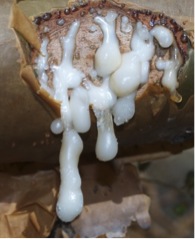
White Howjary Frankincense (photo: Trygve Harris (www.enfleurage.com))

Sappho is the first Greek author to attest to the usage of frankincense.  The word she uses to refer to it (libanos) is what comparative linguists call a ‘loan word,’ in this case from ancient South Arabic (the root meaning of which is ‘white’), the language spoken in the only region in the world still now, as then, where the trees grow that produce the resin that is frankincense (the finest being White Howjary from near Salalah Oman).

This was long before Amazon Same-Day Prime: that frankincense even made it to where Sappho was is astonishing given the thousands of miles of desert terrain that had to be covered.  That fact plus the fact that Sappho chose to use the Arabic word for frankincense suggests it must have been of special importance to her.  How important can be seen in the power she attributes to it.  In one prayer poem (S.2, composite translation and very brief notes here) she completes a stanza by referring to frankincense burning from Aphrodite’s altars; she completes the very next stanza with a reference to ‘sleep falling.’  The parallelism implies a reciprocity: the smoke goes up, the sleep comes down and a stanza later, there is Aphrodite. Continue reading “Sappho, Frankincense, and Female Spirituality by Stuart Dean”

Aine and the Giant Leap by Deanne Quarrie

Deanne Quarrie, D.Min.For our full moon rites coming up on the first of July we will be honoring Aine, Goddess of Love, Light, and Fertility who is also Queen of the Faeries. Aine’s name means “Bright” and She is typically honored at the Summer Solstice when the sun is at its peak of power.  The next full moon falls just after the Summer Solstice. The Solstice is associated with abundance, beauty and bounty.  It is not necessarily about the harvest season, as that is yet to come.  However, everywhere we look we can see the abundance of the Mother and so it is when we first acknowledge, with joy, what is before us.

In my Tradition, the Summer Solstice falls within the Oak Moon, the Moon in which we “court the lightning bolt.”  What that means to us is that with our roots planted firmly in the ground, as does the Oak tree, now is the time to take all of our plans and put them into action.  “Go for it” is what we are saying to ourselves and to the world. Continue reading “Aine and the Giant Leap by Deanne Quarrie”

All Hail a New Priestess! by Marie Cartier

ordination photo
“All hail- the new priestess!” they all shouted at the end.  I was recently ordained near Midsummer Eve (June 20, 2015) as a priestess with the Temple of Isis, Los Angeles and Fellowship of Isis. As befits feminism and religion — I felt it important to share the document read by my scribe – the person who did a lengthy interview and wrote up a summary of why I should be accepted into ordination. I am sharing this with her permission with the Feminism and Religion community. Why do we choose the paths we choose? Why did I choose this Goddess path? The document that explores those reasons follows:

~~~~~~~~~~~~~~~~~~~~~~~~~~~~~~~~~~~~~~~~~~~~~~~~~~~~~~~~~~~~~~~~~~~

June 20th 2015 – 4:00 p.m.
Ordination of Dr. Marie Cartier into the Fellowship of Isis,
Temple of Isis Los Angeles and the Temple of Isis Long Beach.

Our dear sister has reached a point in her life that our ancient mothers of old have been preparing for her and she is ready to be dedicated to and be an emissary of the Goddesses.  She is ready to take on the responsibilities of Priestess and is very honored and proud to be accepted by her Priestess Sisters who she dearly loves and admires. 

Dr. Marie Cartier is a scholar, visual/performance artist, queer activist, writer and theologian. She has been active in many movements for social change. Marie teaches at UC Irvine in the Film & Media Studies Department and CSU Northridge in Gender and Women’s Studies and Queer Studies. She received her Ph.D. in Religion from Claremont Graduate University, 2010, in Women Studies in Religion, with an emphasis on theology, ethics, and culture. She published in 2013 through Routledge the book Baby, You Are My Religion: Women, Gay Bars and Theology Before Stonewall and created the concept of “theelogy” a religion of friendship for people in exile, particularly lesbians prior to 1975. Continue reading “All Hail a New Priestess! by Marie Cartier”

Grainne – Sun Goddess/Winter Queen by Judith Shaw

judith Shaw photoIn the ancient Celtic world the Goddess was the One who expressed Herself through the many.  Grainne is such a one. She is both Winter Queen/Dark Goddess, nurturing seeds through winter, and Solar Sun Goddess, welcoming the rebirth of spring.  She is Aine’s sister or another aspect of Aine. She, like Aine, was honored at the summer solstice and the first grain harvest of early August with bonfires and torchlit processions on top of her sacred hill at Leinster, Ireland.  Remnants of these festivals are still found in folk ritual today.

Continue reading “Grainne – Sun Goddess/Winter Queen by Judith Shaw”

Aphrodite in Bagram Afghanistan & The ‘Friend of the World’ of the Flower Ornament Scripture by Stuart Dean

Stuart WordPress photo

 In the 1930s two ancient storerooms in Afghanistan near what is now the Bagram US Air Base were discovered by French archaeologists and unsealed for the first time in about two thousand years.  They contained artifacts from all over the ancient world, evidencing just how active trade then was along the complex network of routes known collectively as the Silk Road.  Among the artifacts in one of the storerooms was a plaster statuette of Aphrodite (‘Bagram Aphrodite’).

BagramAphroditeThough it is not known what the motivation originally was for acquiring the Bagram Aphrodite, its presence in Afghanistan arguably evinces an interest in female spirituality–if not in the owner of the storerooms then among some of the people in the market for which she may have been destined.  Evidence of such interest among Buddhists is to be found in the Flower Ornament Scripture (FOS), a compendium of sutras dated to approximately the same time (and possibly the same region) as the storeroom containing the Bagram Aphrodite.  Female spiritual figures, both mortal and immortal, some portrayed as having official positions, others without any, are prominent in the final chapter of the FOS, so prominent that one scholar suggests Buddhist women of the time in some way influenced its composition (see Douglas Osto, Power, Women and Wealth in Indian Mahayana Buddhism).

Continue reading “Aphrodite in Bagram Afghanistan & The ‘Friend of the World’ of the Flower Ornament Scripture by Stuart Dean”