The poems below are excerpted from my new (I hope forthcoming) collection, Tell Me the Story Again. Ancient dreamer’s voice is one among many voices including sorrow singer, temple sweeper, sword woman, morose fool, merry drunk, grey cat and mouse, stone mountain, skeleton woman, mother rain and many more. The voices speak from a time perhaps just after (or long before) our time, in a real and magical world.
I chose to excerpt ancient dreamer’s poems because winter is the time, in Celtic lore, of the Cailleach, the old one, the divine hag. When I began writing the poems in 2014, my mother-in-law, then age 101, was in the last stages of her life. She slept and dreamed most of the time, and I would sit and daydream with her. She died two months before her 102nd birthday. When I took up the collection again in 2018 to complete it, ancient dreamer remained a strong presence and has the last word.
During the last year I have been struggling with the catastrophic effects of Climate Change like never before as I witness the continuation of a drought that is withering plants, starving tree roots, shriveling our wildflowers and wild grasses, leaving our mountains barren of snow, and changing the face of the high desert for the foreseeable future. With forest fires leaving me literally breathless from plumes of thick smoke that turn the sun into a ball of orange flames at dawn, unable to cope with 100 plus degree heat, my body forces me to surrender: I will not be able to make my permanent home here. Instead I will migrate like the birds do – from south to north and back again.
Coming to terms with the ravages of Climate Change brought me to my knees; it has been one of the most difficult adjustments I have ever had to make. I mourn the death of the trees, plants, the loss of precious frogs and toads, insects, birds, lizards – every plant and creature is under attack and few of us can thrive (let alone survive) in such an unforgiving climate. Continue reading “When “The Storm Left No Flowers” – A Review by Sara Wright”
Last month I looked back over six years of postings I have done for FAR. In November, I noticed that I usually during that month tend to review the year and find something to be grateful for.
I decided this month to follow that up by looking back at the posts I have done for the past six years at this time of year, right before the wheel turns into the New Year. I have the privilege of writing for FAR usually right after Thanksgiving and right after Christmas and before New Year’s. I tend to think of this time as a time of looking forward, and Thanksgiving as a time of looking back.
Once she believed that
it was her fault
they came on to her,
that she owed them something…
They owned her?
Secretly the
girl was pleased
because any kind of attention
was better than none,
or being so “different” –
stitched into an Indian skin.
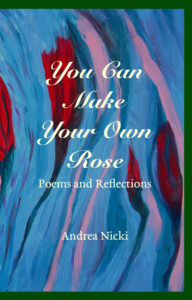
You Can Make Your Own Rose by Andrea Nicki is a collection of poems infused with the spirit of feminist sensibility, social justice and activism. The poems offer more than mere therapeutic comfort while depicting shamanic-inspired healing rituals and magical encounters. They are trauma-free in the sense that Nicki doesn’t ask for our sympathy nor does Nicki simply wish to share traumatic memories. On the contrary, she utilizes somewhat analytical and educational language, interlaced with subtle picturesque and lyrical details alongside a severe social critique, to depict the emotional, intellectual, and social landscape of her reflections on incest and other gender-related forms of abuse.
My walk to the river is a joyful entrance into the eternal Now. The water flowing, crushed fresh mint, trilling bird song desert air so sweet my body vibrates drumming with all that is…
For about a year and a half, I have been working on a collection of poetry that I feel is worth something. I have been writing poetry since I scribed pages hidden between my math textbook when I was 9, gone through poetry workshops in graduate school where I produced a creative thesis, and continued to write off-and-on after that. I have an extensive cornucopia of poetry, but it was around last October of 2016, perhaps, that I decided to write my experience.
As a pre-teen, I wrote about what I thought my life could be, fantasizing about being an older woman with mottled relationships, missing opportunities to discuss my fragile relationship with my parents as the only-child-golden-child, my passion and doubts as a religious, my shame at not being more experienced. Even when I was in graduate school for poetry in Ohio, I didn’t think my life was worth excavating. I wrote dreamy, dense poetry that was surreal and symbolic but largely incoherent. I could again have written about my evolving religious beliefs, my curiosities and risks I took living outside of my home state of Oklahoma as a young woman for the first time, my declining relationship with my mother, or my insecurities again, but this time as a lesser-prepared graduate student in comparison with my literary and theory-laden colleagues.
On one hand, some might say the culture I come from is narcissistic and navel-gazing. I would agree, but just like I feel women can sometimes be selfish in a quite necessary and liberating way (as opposed to those around her accusingly saying she is “so selfish” for abandoning them/following her own path/needing a room of her own), I feel the confessional and self-reflective can be the healing and helpful side of the coin. For me, at least in my experience, my “finished” collection feels exactly this way.
One of my undergraduate professors was (and still is) a haiku enthusiast. When I took his Zen Buddhism course, students were required to write haiku throughout the semester. He encouraged us to focus on the natural world as we struggled to come up with three lines of seventeen syllables, arranged in a five-seven-five pattern. I eventually discovered lots of pleasure creating a haiku poem—crisp, even stark—using words with a precision I found beautiful.
I recently spent some time in North Carolina (from the Outer Banks to Asheville), treating myself to a short vacation after finishing up the Spring semester. In spite of good intentions, I have failed over and over again to keep a detailed journal while traveling. On this trip, I made a vow to write at least one haiku a day. I kept that vow.
Writing haiku daily forced me to be mindful of my surroundings, reflect on my experience, and then use carefully-chosen words to capture the moment. That mindfulness created a glue of sorts, anchoring me in time and place. To my delight, have found this trip lingering in my memory in ways that other trips have not. Continue reading “Haiku Getaway by Esther Nelson”
Five years ago, I moved to Texas from California. In that time, my spiritual practice and my feminist and womanist worldview has grown through contemplative practices. It’s ironic. “Everything’s bigger in Texas!” the saying goes, but in the presence of big, sweeping landscapes and open skies, big storms, and big egos, I’ve found the sacred in the small things. I have deepened my connection to God through a small group of women who practice group spiritual direction.
This past Sunday evening, I gathered with these women at my church for our spiritual direction group. We sat comfortably in a circle, relaxing on a couch and chairs around a coffee table, as the evening sun streamed in from a large picture window and lit the room. As we read a passage from the Bible (Mark 3:34-35) in which Jesus looks at the people sitting around him and says, “Here are my mother and my brothers! Whoever does the will of God is my brother and sister and mother,” I saw my companions more clearly. Although my eyes were closed, I had a vision of these women sitting around me, halos made of sunbeams shimmering over their heads. I thought, “Here are my sisters!”



 During the last year I have been struggling with the catastrophic effects of Climate Change like never before as I witness the continuation of a drought that is withering plants, starving tree roots, shriveling our wildflowers and wild grasses, leaving our mountains barren of snow, and changing the face of the high desert for the foreseeable future. With forest fires leaving me literally breathless from plumes of thick smoke that turn the sun into a ball of orange flames at dawn, unable to cope with 100 plus degree heat, my body forces me to surrender: I will not be able to make my permanent home here. Instead I will migrate like the birds do – from south to north and back again.

 One of my undergraduate professors was (and still is) a haiku enthusiast. When I took his Zen Buddhism course, students were required to write haiku throughout the semester. He encouraged us to focus on the natural world as we struggled to come up with three lines of seventeen syllables, arranged in a five-seven-five pattern. I eventually discovered lots of pleasure creating a haiku poem—crisp, even stark—using words with a precision I found beautiful.
 Feminism and Religion