

 I entered the Silent Tomb;
the Mosque felt
devoid of Presence.
We wandered through
a myriad of glorious arched rooms,
ornately carved woodwork –
soft carpeted floors.
Removing our shoes
we spoke softly
in deference to
Something ineffable?
Each tiled courtyard,
Mute, yet
starred in
cobalt blue.
Opaque light streamed
through precisely cut
geometric shapes,
domed ceilings
cracked the heavenly stream
into patterned shards.
Outside,
unattended,
High mud walls
kept Creation
at bay.
Fruit trees
twisted by bitter west winds
ragged junipers
sagging in sorrow
rendered invisible
by those who choose
not to see…
I wept for the casually discarded
living breathing
Beings –
Pulsing with Light.
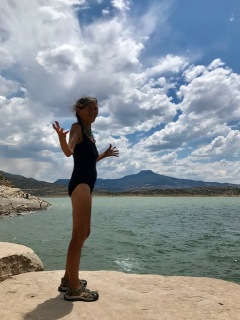
Beyond white sand walls
the stark white capped
Mountains cried out in torment
“Here we are!”
“Sangre de Christos” –
it is our body, our blood
that has been shed
not just his.
Stretching north –
Ridged, ribbed serpents
split the continent in two,
valley gorges meandered far below
arroyos flooded Rio Grande
and all the colors of
the rainbow streamed
out of mud and stone. Continue reading “Our Lady is on Fire by Sara Wright”
Category: Poetry
Slippery Package: A prayer poem by Isabella Ides

She speaks a various language.
Bound in the bardo bereft
vaguely present, almost dead.
For fucking shining aloud
let me
back in. Come again, sweet terror
Carve my shadow on your cave walls
Render me a soul, source me
mystify, crush, obscure me
in that deep gorge
confine, stretch, reveal me
Let me wobble
stand.
Continue reading “Slippery Package: A prayer poem by Isabella Ides”
Superstorm (a poem of feminist rage) by Trelawney Grenfell-Muir

Sometimes it whirls together, a superstorm of pain and despair,
and the shittiness of it all is just too damned much to bear
girls and women beaten, raped, abused, and all you nice guys don’t care
and my little daughter starts saying how she doesn’t want underarm hair
it’s weird, she said, and I know none of the tv women have any
because one goddamn sign of humanity in females is too many
and the amount of makeup my other little girl is wearing is uncanny
almost every villain in Disney is basically a strong granny Continue reading “Superstorm (a poem of feminist rage) by Trelawney Grenfell-Muir”
Seed Bearer by Sara Wright

Yesterday old eyes
stung –
fierce white
heat –
blurred vision.
Singing love songs,
I scattered seeds
in furrows
raked smooth,
tucked tufts
under stone…
Imagining
a Wildflower riot!
Bittersweet orange,
blue and gold
winding through
rice grass –
sage scrub,
vining over
wave -like gopher mounds. Continue reading “Seed Bearer by Sara Wright”
Elk Speaks – For Andrew by Sara Wright
 In the dream
the elk’s antler
was a tree made
of bone.
Silvery tines –
tongues of flame
hummed at dawn.
“Embodied Light.”
I would use these words,
if asked to describe
my young friend’s
personality.
But words fall short
of wonder. Continue reading “Elk Speaks – For Andrew by Sara Wright”
When the Cranes Come by Sara Wright

Departure.
I stood deep
in a toad hole
slinging mud
at twilight
when the sky
turned lemon
and gold.
They arced
over
my head
in pairs,
loose aggregations –
it seemed like thousands
crying out,
crossing
the river.
Ensouled.
Spirits defying
image or word.
A Mighty Migration begins…
I shivered.
Tears rose unbidden
Who calls them North?
I call out “I love you” –
Believing they know.
A crescent moon listens
cradled by nightfall.
To witness
a sky full
of Sandhill
Cranes
dark red heads
ebony eyes
long graceful necks
curved gray wings
dripping black legs
descending out of the blue
to roost
along this
winding Red
Willow River,
gracing fields
of depleted grain
is a Gift
given
at midnight;
the moment
before
departure.
This turning
of the wheel
births
days full of light
and an empty
sky bowl.
Haunting cries
in my ears
ring in the silence
of beloved crane absence
for another year.
Continue reading “When the Cranes Come by Sara Wright”
I Celebrate Love by Elise M. Edwards
 Happy Valentine’s Day! I know, I know… so many of us do not like this holiday. It’s too commercialized, we say. We don’t need card-makers or florists to tell us how or when to show affection. Some of us don’t like Valentine’s Day because it reminds us of loves we have lost or never found. I get it. This day can seem shallow, overhyped, and falsely sentimental. It can be lonely. And yet, I won’t let today pass without celebrating and honoring love. Love is too important to concede to commercial interests.
Love, in its many forms, keep us alive and able to endure. Love is powerful because it is expansive, growing in unexpected places and ways. We tend to separate our celebrations of romantic love, friendship, familial love, self-love, and religious devotion. We make distinctions between our valentines and “galentines.” Rarely do we shout for joy in ecstatic worship while also celebrating the passionate longings of our innermost desires. But occasionally, in my religious tradition, we let our disparate loves come together. We unite them on holy feast days, enjoying the sensual pleasures of good food and company to mark spiritual occasions. So that’s my inspiration. Today, I’m celebrating love by reflecting on various forms of love merged together and sharing insight from poets and mystics about the power and beauty experienced in love.
Devotion by Molly Remer
There are things that ask
 to be remembered
or, is it that I ask to remember?
The everyday enchantments
of our living
words forming slices of
memory.
A white squirrel watching
from a sycamore tree
the sounds of black
crows calling
from within the secret
passages
between oak tree
and neighborhood
footprints of a shy orange
coastal fox in the sand.
Rays of sunlight
forming individual white rainbows
stretching from cloud
to water.
I no longer feel like I have anything
to teach
I just want to tell you about the
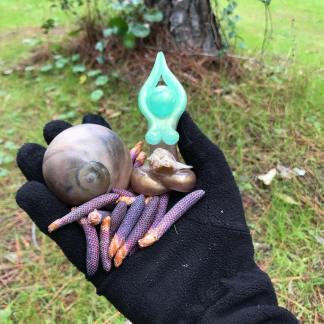
shell I found today
the sandy pink color
of its wave-shaped spiral
the way the pine needles
form a canopy under
which orange monarchs dance
the surprising softness and bright
green hue of thin fingers of grass
the pretty purple pollen cones
of a longleaf pine.
The colors of a morning woven
into a tapestry of devotion.
That is the word for this feeling
in my chest.
Devotion
to noticing.
Devotion is not a word that I have previously felt particularly inspired by or connected to. Perhaps it is too heavy, too responsible, or even “too religious”—carrying connotations of dogma or roteness. However, in the last month or so, something has opened up for me to consider the word, and the process, in a different way. Continue reading “Devotion by Molly Remer”
I Shall Make Prayer of It by Natalie Weaver

This is a poem I published almost ten years ago. It is as if I wrote it yesterday. The image is more or less of the same sentiment as the poem.
I publish these again here in memory of my father.
~~~~
I am always cleaning
though not fast enough
to really organize
what I cannot put away.
It is messy in closets
that cover the appearance of order.
I am still sitting on wool carpet watching
The dusts dance in little beams of hope.
The same ones that lighted by wonder
in warmth and youth a beauty made
of windows and particles.
Probably the same ones that caused dirt and flu.
But what matter is it in the world that is merely
the simultaneity of being in which at once
the limos and the hearses depart for the church. Continue reading “I Shall Make Prayer of It by Natalie Weaver”
Ancient Dreamer by Elizabeth Cunningham

The poems below are excerpted from my new (I hope forthcoming) collection, Tell Me the Story Again. Ancient dreamer’s voice is one among many voices including sorrow singer, temple sweeper, sword woman, morose fool, merry drunk, grey cat and mouse, stone mountain, skeleton woman, mother rain and many more. The voices speak from a time perhaps just after (or long before) our time, in a real and magical world.
I chose to excerpt ancient dreamer’s poems because winter is the time, in Celtic lore, of the Cailleach, the old one, the divine hag. When I began writing the poems in 2014, my mother-in-law, then age 101, was in the last stages of her life. She slept and dreamed most of the time, and I would sit and daydream with her. She died two months before her 102nd birthday. When I took up the collection again in 2018 to complete it, ancient dreamer remained a strong presence and has the last word.

