so said black Jesus by Natalie Weaver

Natalie Weaver editedLast month, I went to a conference in San Antonio, Texas. Feeling overwhelmed by the combined elements of work, family, and creative writing, I did not have much of a desire to go. It was right before Valentine’s Day, which I try to celebrate with the kids, especially since my oldest is named Valentine. The house was not clean. I was not packed. I had not bought or helped fill out cards for the kids to distribute in the classrooms, nor did I remember whether I had signed up to bring in juice boxes or cupcakes. I just wasn’t ready to travel.

Beyond that, I developed some health issues last year that impact my daily life. I have found it hard to recognize the consequent shifts in my energy or output as legitimate bodily realities. I must be imagining it, right? I’m not this tired really… just lazy or something. Among the things impacted, my vision is sometimes dark and distorted. Plus, I broke a toe at the beginning of January, and I am still limping. As I imagined traveling alone, I felt myself wondering whether I was up to trekking through the airports with a broken gait, blurred vision, and the fatigue that sometimes quite rapidly descends when I least expect it. I didn’t want to go.

To top it off, I knew I wasn’t going to a regular hotel. I was going to the Oblate Renewal Center. I felt I could handle the Riverwalk and a couple nights at the Hilton, but I was really questioning whether I was in the right mental space for a retreat center. I was not feeling still, nor did I really want to be still. I had too much to do, of course. I compounded that feeling by stopping off on my way there for a short visit with my sister’s family at the point of my flight’s connection, where she and I drove around for hours picking up and dropping off her five school age children at their various extra-curricular activities. When I eventually made it to the retreat center, I was very much decentered in my own skin and underprepared mentally. I had neither gifts to bring nor expectations about what I would take home.

And this led to something remarkably beautiful… Continue reading “so said black Jesus by Natalie Weaver”

And No Religion Too by Elizabeth Cunningham

Elizabeth Cunningham headshot jpegReligion. As a species we can’t seem to live with it or without it. There is dispute about the derivation of the word, but some scholars believe it has the same root as the word ligament, ligare, to bind or tie, to reinforce the bonds between human and divine, or perhaps the bonds between believers. The words bond and bind also have a variety of meanings and connotations. A bond can be used to tie someone up; it can be a bond of kinship, or bond given as surety.

Religion’s impulses and manifestations are just as ambiguous. Did religion arise because the world seemed so beyond human control (weather, health of crops, availability of game)? Perhaps there were gods or spirits to appeal to or propitiate? Or did it arise equally from a sense of gratitude for the earth and seas that feed us, for a sky that dazzles us, for the life that flows through us and surrounds us. Song, dance, storytelling, drama, art likely began as religious or ritual expression. No aspect of life was beyond the sacred. And so religion also went into the business of law, social control. Religion has a long, bloody, ongoing history of occasioning and/or justifying war, oppression, persecution, torture, genocide.

Was religious expression ever purely benign? Were humans? Perhaps when we were still small bands of hunter-gatherers or when we lived in matriarchal, matrilineal cultures where men did not feel obliged to control women (or each other) to ensure the perpetuation of their own DNA. There are benign tenets in most religions still—food as something to share, the stranger as someone to welcome. Birth and death and all the phases of life as a time to gather in community to celebrate or mourn. The call to respond to infirmity, grief and suffering with compassion and to injustice with bravery and truth.

lennonI titled this piece “And no religion, too” after a line from John Lennon’s song “Imagine.” Maybe I am struck by that line, because my life and work have been dominated by religion, literally since birth. My mother’s labor was induced to accommodate my curate father’s schedule. One of my earliest memories, age three, is of plotting to kill God and Jesus. Other childhood memories include being terrified that I would go to prison or hell for trespassing on the property next door. (From the Episcopal version of the Lord’s prayer, I knew trespass meant sin.) I also remember a skirmish with the Roman Catholic kids down the street who used to be my best friends until we went to different schools. A backyard holy war.
As I grew up, I repressed my deicidal tendencies and remained a creed-saying Christian until my mid-twenties when I began to participate in the silent worship of The Religious Society of Friends (Quakers). Later an encounter with the goddess called me to join with others in creating earth-centered ritual at High Valley, a center I directed for eighteen years. During that time, I also became an ordained interfaith minister and counselor. All my life I have been writing novels that ponder religious questions, starting with The Wild Mother, a reimagining of the Garden of Eden story. For twenty years I worked on The Maeve Chronicles, novels from the point of view of a Celtic Magdalen who remains an unconverted pagan. My latest novel, Murder at the Rummage Sale, is set in the church of my childhood. Clearly I am still working with my primary material.

Yet I don’t know that I have a religion any more. I am still friends with my co-celebrants. We meet in a variety of contexts. But for the first time in my life I am not part of a religious community. No doubt I have beliefs, but I have no belief system. As I struggle to write this post, it dawns on me that it is my own life without religion that I am trying to imagine.

Continue reading “And No Religion Too by Elizabeth Cunningham”

Ghosts by Lauren Raine

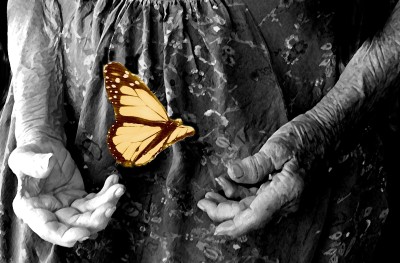
Florence's Hands by Lauren Raine
Florence’s Hands by Lauren Raine


GHOSTS

Where do the dead go?

The dead that are not corpses, cosmetically renewed

and boxed, their faces familiar and serene.

Or brought to an essence, pale ashes in elegant canisters.


I ask for the other dead

those ghosts that wander unshriven among our sleep,

haunting the borderlands of our lives.


Continue reading “Ghosts by Lauren Raine”

E Pluribus Unum: The Woman From Africa by Stuart Dean

Stuart WordPress photoShe’s his only savior.  African in origin, her figure bears witness to her homeland: her hair twisted in dreads, her lips full, her color dark, her chest broad with pendulous breasts, her stomach flat and firm, her legs slender, her feet broad and ample.
The passage above translates the portrayal of Scybale, the black female slave of the farmer in the poem Moretum, that as discussed in an earlier post, is the source of the phrase ‘e pluribus unum.’  It is reasonable to infer it is a self portrait.

The case for Moretum being the work of a woman (and perhaps incorporating a self portrait) begins with the very fact that it portrays a woman so positively.  Portrayals of women in such positive terms in ancient literature are rare.  The details are impressive because they seem so real.  The form of the description manifests a diagnostic technique (head to feet) well attested in ancient poetry.  That includes Sappho’s self portrait (S. 58b), which reads as if composed while standing in front of a mirror, as does this portrait. Continue reading “E Pluribus Unum: The Woman From Africa by Stuart Dean”

Why Is Pizza Round? The Black Goddess of Rome by Stuart Dean

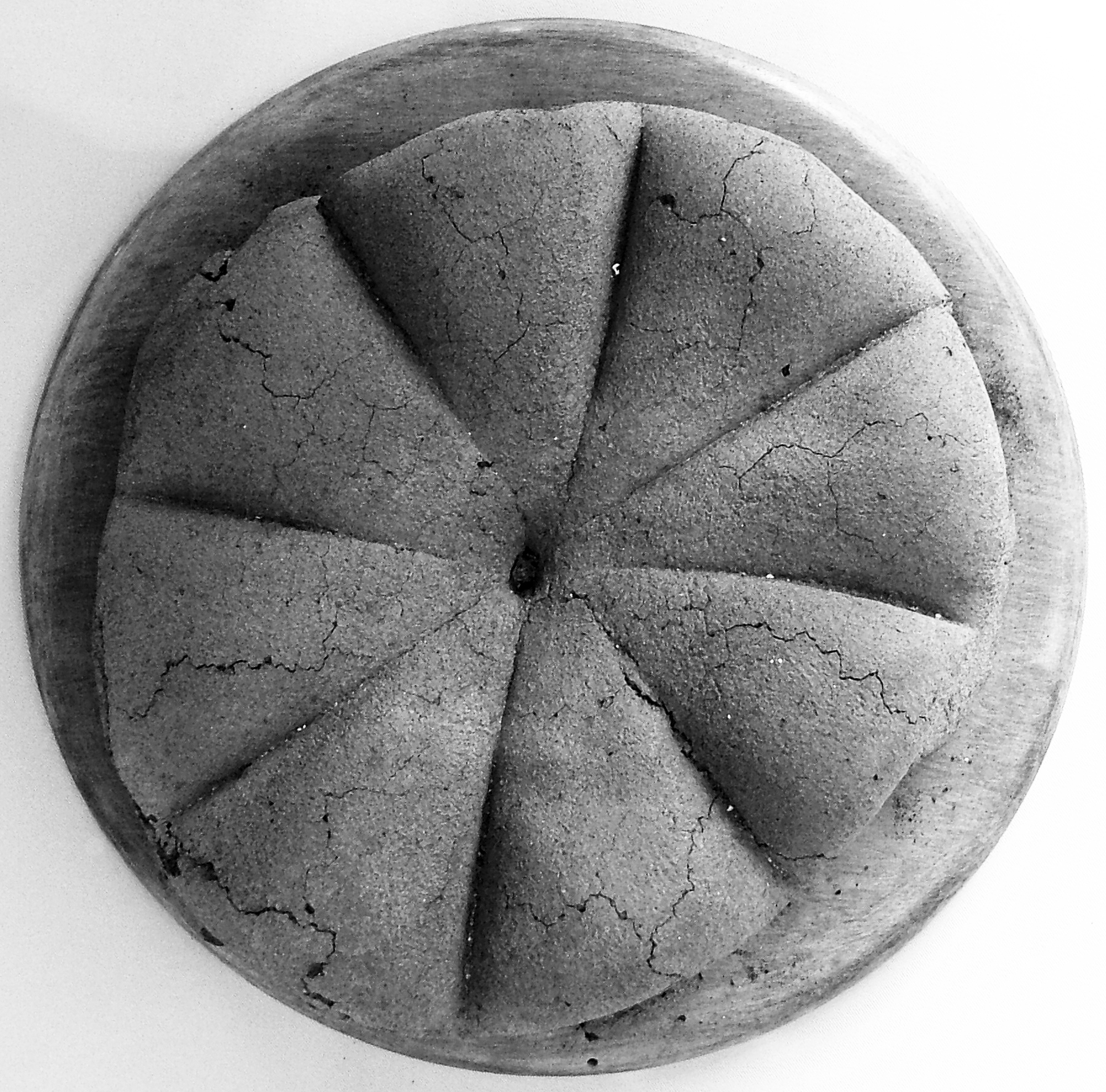
The remains of an ancient Roman bread pie from Pompeii, carbonized in the eruption of Vesuvius in 79 CE
The remains of an ancient Roman bread pie from Pompeii,
carbonized in the eruption of Vesuvius in 79 CE

The poem Moretum (discussed in my last post) narrates the preparation of a meal that can be characterized in modern English as ‘pizza.’  Round flatbread is baked; to go on it, a cheese spread is mixed.  The details of the narration are such as to create a recipe of its ingredients and related cooking instructions.  

The most important ingredient, however, is not an ‘ingredient’ as such, but a shape.  The bread, the cheese, and the cheese spread are all round.  That by itself might not seem remarkable, but the Latin terminology (words from which ‘orbit’ and ‘globe’ derive) is identical to then contemporary astrological terminology.  The bread is even scored into quadrants, symbolizing, among other things, the four elements and the quadrants of an astrological observer’s circle. 

The ancient audience of Moretum would have recognized in all this the world view of the Italian poet from southern Campania, Parmenides.  Though the only poem he is known to have composed is in Greek, the combination of the fact that he likely wrote it while in Italy and that it had over the centuries since its composition become one of the most influential philosophical works of pre-Christian antiquity meant Parmenides had special importance to Romans.  It is not surprising Moretum has the same meter and many of the poetic images as are found in the poem of Parmenides. Continue reading “Why Is Pizza Round? The Black Goddess of Rome by Stuart Dean”

Covenanting Justice. Covenanting Joy. by Margot Van Sluytman

MargotJustice as a lived and living experience is a poem. Is a song. And as a song it is filled with all manner of rhythm, of texture, and of sound via melody and lyric which affects us in an infinity of ways. The voice of poetry is the voice of The Song of Songs. It is a voice of invitation. Chapter Two of The Song of Songs is an invitation to strangers to Scripture. Strangers who want to feel a rhythm of joy, of loving embrace of tender and generous welcome. The gravity of the language is its graceful invitation to be seen, to be gazed at, to be heard.

My own vocation as a Sawbonna/Restorative Justice practitioner and a Therapeutic Writing facilitator, has blessed me with the opportunity to share words, via Word, in many different places and spaces around the Globe. The word that I use for justice as a lived and living experience is: Sawbonna. Sawbonna is a Zulu greeting that means I see you. You see me. I hear you. You hear me. Sawbonna contextualizes Restorative Justice in the crucible of our connectedness. Sawbonna, which is the essence of Chapter Two of The Song of Songs, clears the way for engagement, via words, with Word. Continue reading “Covenanting Justice. Covenanting Joy. by Margot Van Sluytman”

I Am A Woman’s Poet by Marie Cartier

MarieCartierforKCETa-thumb-300x448-72405This is the first poem I ever wrote and had published.

I wrote it in the early 80s at the height of the second wave of Women’s Liberation.

Having just returned from the final Michigan Womyn’s Music Festival, I publish it here with FAR today as an homage to that time period, to those women (myself among them), to many “womyn with a ‘y,’” and what we accomplished—battered women’s shelters, rape crisis centers, health clinics, women’s studies programs, bookstores, festivals, music and culture etc. etc.

Much of what we accomplished is because we learned to listen to each other’s repetition until, as Nelle Morton said, we “heard each other into speech.” Continue reading “I Am A Woman’s Poet by Marie Cartier”

My Problem with the “Proverbs 31 Woman” by Elise M. Edwards

elise-edwardsIn my home, in my journals and notebooks, and in my office, I display proverbs and quotes of all kinds around me to inspire me to live meaningfully. Proverbs and fables from around the world are stacked on my bookshelves and bedside tables. I love reading what is called “wisdom literature” in the Christian Scriptures. But when I get to those final lines of the Book of Proverbs in the Bible, Proverbs 31 sets me on edge.

Proverbs 31 is a poem that begins with sayings of King Lemuel described as “an inspired utterance his mother taught him.” Lemuel’s mother instructs him to not spend his strength on women, to refrain from drinking and to defend the rights of the poor and needy. Verses 10-31, the ones I’ve heard most often read in church settings, follow that advice. They are an acrostic poem of verses that begin with the successive letters of the Hebrew alphabet to describe a noble wife. Instead of reciting the entire A-Z list (A is for adoring, B is for busy, C is for caring, D is for dutiful…), Christians will frequently read aloud only the verses selected below.

Epilogue: The Wife of Noble Character

10 A wife of noble character who can find?
She is worth far more than rubies.
11 Her husband has full confidence in her
and lacks nothing of value.
12 She brings him good, not harm,
all the days of her life.

25 She is clothed with strength and dignity;
she can laugh at the days to come.
26 She speaks with wisdom,
and faithful instruction is on her tongue.
27 She watches over the affairs of her household
and does not eat the bread of idleness.
28 Her children arise and call her blessed;
her husband also, and he praises her:
29 “Many women do noble things,
but you surpass them all.”
30 Charm is deceptive, and beauty is fleeting;
but a woman who fears the Lord is to be praised.
31 Honor her for all that her hands have done,
and let her works bring her praise at the city gate.

I’ll admit it–the woman described here does sound honorable and praiseworthy.   My problem with this poem has more to do with the way I’ve heard it used than its content. In all but one setting, I’ve heard these verses proclaimed as a model for the ideal woman or as a guide to virtuous living for young women.

My first concern about that is a common feminist criticism: Not all women aspire to be wives and mothers. Some of the poem’s statements could apply to all women, like verse 21: “She opens her arms to the poor and extends her hands to the needy.” But others are specific to marital domestic life, like verse 28 (above) and verse 15: “She gets up while it is still night; she provides food for her family.” Women without husbands and children cannot meet all Proverbs 31’s standards. And while family is of primary importance to many women, it is not the only area of a woman’s life that can provide her value and meaning.

I am also concerned that defining Proverbs 31 as a standard of womanhood communicates the idea that it is about women only. While there are references to tasks that have been traditionally gendered (women cook and sew, men take leadership roles outside the home), many of the qualities extolled here are commendable for adults of all genders. Strength, dignity, wisdom, and care are not gender-specific virtues. So why haven’t I heard this proverb set as an example for men, too?

My third concern about making this a guide to womanhood is that it seems to reinforce a standard of perfection. The Proverbs 31 woman is certainly industrious—no one can call her idle! But she also sounds exhausted. By my count, this woman does 23 things surpassingly, including buying fields, planting vineyards, making clothes and selling them. I’m concerned that when emphasizing the Proverbs 31 woman tells Christian women that they are not good, are not lovable, or are not enough until they meet this standard. For me, the message of the Christian gospel is about God’s radical, all-encompassing love for humanity in the face of our imperfection. While I do know some women with a healthy self-image, many are painfully aware that they do not meet some standard set for them. They could stand to be told more often that they are loved simply because they exist, not for what they do.

When I heard Proverbs 31 read at my Aunt Ruby’s funeral , I began to see something more meaningful in these words than an impossible standard for women to attain. The preacher quoted “She is worth far more than rubies” noting my beloved aunt’s name and her character. However, the message he preached that day wasn’t to set a standard of a good wife. It was to honor a woman who had lived a noble life. She was strong, dignified and wise. Her family knew she was blessed and that they were blessed by having her in their lives. She worshiped God and communicated her love of the Lord to successive generations.

When I heard Proverbs 31 spoken about my aunt, I began to find resolution to my concerns. In that setting, the poem was an affirmation of a life lived well, not an exhortation to perfection. Honoring someone is primarily about demonstrating love or respect to that person, not a list of qualities or accomplishments. Certainly, the person we admire may have qualities we seek to adopt to our own lives, but following their model involves more creativity and agency than reducing a poem like Proverbs 31 into a list of standards allows. Integrating those qualities into our own lives requires adapting their traits to our own circumstances and even rejecting some of our model’s qualities that don’t fit the unique vision of our lives that we (or God) have. While I admire the Proverbs 31 woman’s work ethic, I strive for a life with regular periods of rest and renewal.

Elise M. Edwards, PhD is a Lecturer in Christian Ethics at Baylor University and a graduate of Claremont Graduate University. She is also a registered architect in the State of Florida. Her interdisciplinary work examines issues of civic engagement and how beliefs and commitments are expressed publicly. As a black feminist, she primarily focuses on cultural expressions by, for, and about women and marginalized communities. Follow her on twitter, google+ or academia.edu.

E Pluribus Unum and The Unrecognized Black Goddess of Rome by Stuart Dean

Stuart WordPress photoE pluribus unum (‘EPU’), which first began to be used by the U.S. in the 18th century, comes from a poem entitled Moretum that until well into the 19th century was generally attributed to Vergil.  During those centuries Latin would have been studied from what was the equivalent of today’s elementary school through at least high school.  Because Vergil is to the study of Latin what Shakespeare is to the study of English, Moretum would have been read by anyone lucky enough to receive formal education in those centuries–mostly boys–including the white sons of slave owners.

Those boys, however, would have been motivated not just to read, but to memorize Moretum.  That is because Moretum, through a variety of clues, encourages allegorical interpretations, one of which is that it celebrates the sexual intercourse of a single white farmer and his sole companion, his black female slave.  Such an interpretation requires ignoring the clues that the author thinks of such sex as rape (as anyone other than a male slave owner would); those clues lead me to think the author may have been a woman.

Illustration of Moertum (1558 Edition of Vergil's works)

Illustration of Moretum from a 1558 edition of the works of Vergil available here.

Continue reading “E Pluribus Unum and The Unrecognized Black Goddess of Rome by Stuart Dean”

A Cornucopia Sometimes Curiously Stuffed With Nothing by Natalie Weaver

Natalie Weaver editedThe summer is getting late. School supplies are coming in, and it is time to try on the uniform pants in order to get them hemmed before the first day. I always feel a little funny at this time of year, almost queasy from my mixture of nostalgia for waning days at the pool and excitement for crisp plaids and fresh notebooks. I continually miss the scents of summer skin, chlorine and suntan lotion, even while I look forward to the autumnal fragrances of newly sharpened pencils, cinnamon sticks, and rubbery Halloween costumes. Time, at this transitional time, is always pregnant with the promises of both bounty and loss, so I am not surprised by my wistfulness as we turn to fall. I am, however, taken by its depth for me this year. For, this transition has been a little heavier than usual as I ask myself, “Where did it go?” and “What did I do?”

You see, I wanted to travel more with the kids, but I became sick, or rather, a sickness I already had presented itself unmistakably and irrevocably just as the summer was getting under way. So, I slept a lot, but it was not the sleep of rest and recovery; it was lost time. I felt bad about my crankiness and limitations, so I tried to make up the time by adding more play to the times of day when I felt good. The kids weren’t playing along though, and I just felt more exhausted. I was a broken record, as I kept asking what anyone wanted to do. And, I felt like I was failing when we couldn’t arrive at activities, or menus, or destinations. Continue reading “A Cornucopia Sometimes Curiously Stuffed With Nothing by Natalie Weaver”