Lucy Burns, A Look at a Catholic American Suffragette by Michele Stopera Freyhauf

As we approach the election period infused with controversy, saturated by television commercials, as well as endless advertisements on the radio, Internet, and yes, even Facebook, we must remember the sacrifices made by our foremothers during the suffrage movement, which gave women the right to vote.  While all elections are important, this one has targeted issues involving women in a way that could negatively impact our rights – to the point of rewinding the clock on progress made in women’s equality during the last 40+ years.  This election needs the voice of all informed voters.  However,  it is imperative for all women to make their voices heard this year by casting a vote.  To turn a blind eye to these issues diminishes the sacrifices our foremothers made for us. To not cast a vote takes away your voice, makes you a silent bystander – something that was tried by the government and patriarchal system during the suffrage movement.

To illustrate this, I would like to highlight Lucy Burns and the Night of Terror endured at the Occoquan Workhouse by her and many of her friends.   Of all Suffragettes, Lucy Burns spent more time in jail then any other protesters.  Born 1879 in Brooklyn, Lucy was raised in the Roman Catholic tradition by a father who believed that his sons and daughters should be educated equally.  Burns gradated from Vassar College in 1902, then attended Yale Graduate School studying linguistics.  She eventually went to Oxford University in England to resume her studies.  It was at Oxford that she became involved with activism and the suffrage movement. Continue reading “Lucy Burns, A Look at a Catholic American Suffragette by Michele Stopera Freyhauf”

8 Simple Rules for Being a Queer Godfather by John Erickson

Becoming a Godfather was more than just a reentry into the Catholic traditions I had long given up but rather a journey back in time that would grant me the ability to rewrite the wrongs I felt as a kid growing up in a tradition I not only didn’t understand but also didn’t feel like I belonged in.

I often wondered why I wasn’t asked to be the Godfather of my niece and nephew.  It made perfect sense to me that I would be the best person to guide and provide spiritual care for either of them as I was the only member, in both my family and my brother-in-law’s, getting a PhD in Religion.  I didn’t think there would be much to it.  I would go, hold my nephew, and watch a priest pour water over his head, and then go and enjoy some very sugary cake in my sister’s backyard.

On August 18th, 2012 my wish came true and I became the Godfather to my sister’s second child, Drew.   I had always believed that there was nothing to being a Godfather.  That it was a title in name only and a tradition that many individuals bestowed upon members of their family as ritualistic habit rather than a sacred institution of spiritual care and upbringing.  Boy, was I wrong. Continue reading “8 Simple Rules for Being a Queer Godfather by John Erickson”

Why Men (and Women) Can’t Have It All by John Erickson

Can women have it all? Possibly. Can men ever have it all? Maybe. Regardless of however we put it, the are ills to every good deed in the world and we need to get back to understanding how and why we use each other in order to fully understand that behind every good man might be a good woman but also behind every good women there might also be a good man.

Growing up, my favorite movie was The Associate staring Whoopi Goldberg as a woman at a Wall Street firm attempting to climb her way up the corporate ladder through hard work and dedication.  Her character Laurel Ayres does all the work and comes up with the ideas that clients eventually invest in, her partner Frank takes all the credit and eventually surpasses her at work by getting the promotion she had been vying for.  In a prodigious scene that I still vividly remember from my childhood, Laurel quits her job and starts an investment firm on her own; betting every cent and piece of property she has on the eventual success of her new business adventure.

In an attempt to break through the proverbial glass ceiling and play with the big boys of Wall Street, Laurel eventually discovers that although she can be (and is) the genius behind many of the great ideas that would save companies millions, she still needs to have her ideas expelled by a man she creates in order to win over clients, which eventually leads her to become successful.  However, while Laurel is reaping in the benefits of having Mr. Cutty, her made up business partner, by her side, she eventually learns that no matter what she does she will always be secondary to her male business partner. Continue reading “Why Men (and Women) Can’t Have It All by John Erickson”

Abuse of Power in the Catholic Church Part II – WE are the Church! By Michele Stopera Freyhauf

Spiritual Power is arguably the most dangerous power of all.  In the wrong hands, it gives the power to make judgments even about the eternal fate of another person.  It needs a sign on it at all times saying, ‘Handle with extreme care.’  The greater the power a person exercises, the more need there is for checks and balances before it is used and accountability after it is used.” – – Bishop Geoffrey Robinson

 May 6th, I addressed the issue of abuse of power in the Catholic Church and how we seem to be unraveling any kind of progress made since Vatican II.  Since writing that article, the Leadership of the LCWR met with Vatican Officials and expressed their concerns openly.  A dialogue occurred and left no resolution, just information that the leadership will discuss with the community at their August meeting.  That meeting will reveal their next step in this controversy – concede and follow the conditions and rules sets forth by the CDF or disband and form a new religious community or maybe there will be another option revealed.

I have to ask though – Was this a meaningful meeting or was it meant to pacify the Sisters and their supporters? Will the Vatican change its stance? Certainly, the U. S. Catholic Sisters have not been

reposted from http://www.nunsonthebuss.com/bus

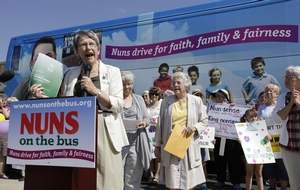
pacified, nor have their supporters.  For example, there is a “Nuns on the Bus” tour traveling around the United States,  prayer services for the Sisters, #nunjustice and #whatthesistersmeantome campaigns on Twitter.  Even the Women’s Ordination Conference delivered a petition containing over 57,000 signatures to the Vatican in support of the Sisters.  Certainly, the support for the sisters and their mission is not dwindling, but growing stronger every day.

As for the Vatican, a change in their position is doubtful, but we can continue to pray.  I am, however, very discouraged by a statement attributed to Pope Benedict that indicates a desire to have a smaller more faithful Church of Catholics then a large Church of people who do not adhere to Church Teaching – seeking out a small, strong, holy community.

Obviously, it is my hope that this statement was taken out of context, but I have to be honest and say

Women’s Ordination Conference delivering Petition
Picture reprinted from WOC’s page on Facebook

that my hope is filled with doubt.  This is not the first time I have heard clergy make this statement. Priests have made this statement in my presence – wanting a more faithful flock and dismissing those that do not adhere to their interpretation of Church teaching. This stance does not bear fruit, but is rather a power play – a play that can be called many things – misogynist, arrogant, non-pastoral, cold-hearted, and frankly un-Christian.  It also plays with a person’s spiritual fate and in many cases their soul.   The psychological impact of something like this is dangerous for some. Some ordained will go so far as to withhold sacraments or even compromise the person’s  status in the Church, including their role in ministry, for the sole purpose of  inducing compliance – a tactic that dates to the medieval period.

Continue reading “Abuse of Power in the Catholic Church Part II – WE are the Church! By Michele Stopera Freyhauf”

“Vaginas are Everywhere!”: The Power of the Female Reproductive System by John Erickson

Nice girls don’t say the word vagina.

I have a beautiful picture of vagina hanging on my wall.  However, for the longest time it was in the back of my closet, with a plastic bag covering it.  I wasn’t ashamed of it but my ex-boyfriend, like most gay men, refused to have it on the wall where he could see it.  He is now long gone; the vagina is now out and proud.

I bid on the picture one fall during a showing of the Vagina Monologues at Claremont School of Theology.  One of my best friends was in the show and I had always loved its powerful message.  I walked out of the theatre, waiting for my friend, and there it was: the picture of the vagina.  I found myself caught up in its beauty.  Its gaze had mesmerized me.  The outlying layers of red, the contours of its shape, they all began to mold into a figure before my eyes.  While I have never thought of myself as a religious person, I realized that at that moment I was no longer looking the old photo but rather I was staring at the outline of the Virgin Mary.  At that moment, I realized that I had to have the picture.

My ex boyfriend was ashamed of the photo.  I let him shame me into putting it in the back of my closet and cast it away like it was nothing.  Like the experience, call it religious or not, had never happened.  When we ended our relationship, I found myself inconsolable and pacing up and down my stairs in a never-ending cycle of sadness and downheartedness.   As I was pilfering through our items, I came about the picture.  I saw it and for a split second, I was no longer sad. Continue reading ““Vaginas are Everywhere!”: The Power of the Female Reproductive System by John Erickson”

Why I Failed Feminism 101: Gender, Sexuality, and the Power of Relationships

I forgot, that relationships, like feminism, are not easy, and that it is a conscious and continual effort of renewal to remind yourself everyday why you love the person you love and more importantly, in the case of feminism, why you fight, “the good fight.”

I was once told by my ardent feminist advisor in undergrad to “not put all my proverbial eggs in one man basket” after discussing my relationship with my boyfriend over a cup of coffee.  Thinking my relationship was different and that we were special, I heeded the warning but thought of it no further.  Now, looking back on it three in a half years later, I wish I would have.

Relationships are a powerful tool.  They help to make you feel special.  They help to bring you joy.  They help you discover the reason why a divine presence may have endowed us with the ability to love and most importantly they help you realize and discover things about yourself you may have never taken the time to notice.

Feminism 101 is more than just the pop culture stereotype of a bunch of women advising the younger generation of girls to be weary of men and the pain they can bring.  Feminism, specifically as what I now call Feminism 101, is the transformative ability to listen to your elders, trust yourself, and ultimately, if you happen to trust in the relationship you have built, knowing deep down that it is built on equality, love, and trust. Continue reading “Why I Failed Feminism 101: Gender, Sexuality, and the Power of Relationships”

JUDGES 19: A BRIEF PAUSE FROM JUSTICE-WORK TO BE WITH HER IN THE SILENCE BY IVY HELMAN

Elie Wiesel, Holocaust survivor and renowned Jewish thinker, believes that no one can ever truly understand the profundity and tragedy of the Shoah unless one experienced it.  For him, silence is the best way to express the events since words fail to do justice.  The principle of letting silence speak, when words no longer can, when pain is so real it debilitates and when tears flow more freely than thoughts, is not original to the twentieth century.  The Bible contains many events and personal stories in which this is the case.

Judges 19 begins with two characters: a Levite and his concubine.  The concubine has recently run away to her father’s house, when her husband decides to visit her there trying to win her back.  He seems to have only good intentions in mind.  After leaving her father’s house with his wife, the Levite discusses his future plans with his servant who apparently accompanied him on the journey.  He still has not spoken a word to his wife.

The servant and the Levite decide to spend the night in Gibeah, a Benjaminite city.  The three of them sit in the city’s square waiting for someone to take them in but no one arrives until evening.  At dusk, an old man comes by and offers to take care of the needs of the entire party, including the donkeys, as long as they promised not to spend the night in the city square. Continue reading “JUDGES 19: A BRIEF PAUSE FROM JUSTICE-WORK TO BE WITH HER IN THE SILENCE BY IVY HELMAN”

Liberalism as Feminist Religious Tradition: Friend or Foe? By Amy Levin

Come, come, my conservative friend, wipe the dew off your spectacles, and see that the world is movingElizabeth Cady Stanton

Whenever I find myself in conversation with a liberal skeptic who assumes that the existence of a liberal Mormon or Catholic is about as likely as aliens walking the planet, I do two things. First, I show them our blog. Second, I attempt to describe the complicated, long, and constantly evolving relationship between American liberalism, religion, and feminism. The roots of this complex triad are planted in a complicated history whereby, on the one hand, religious liberalism helped women gain equal rights and social justice, while on the other hand, it created divisions among some religious women who felt liberalism threatened their theological beliefs. Of course, the term “liberalism” is fraught with its own contemporary meanings. However, religious feminists throughout history have nevertheless engaged in practices we could place under the rubric of liberalism, including the push toward cosmopolitanism, modernism, and political progressivism. The difficulty was (and still is) maintaining their religious practices and beliefs.

Continue reading “Liberalism as Feminist Religious Tradition: Friend or Foe? By Amy Levin”

Do Man-Made Laws Trump the Authority of Jesus? Reflecting on the Meaning of Humility, Priestly Service, and the Issue of Women’s Ordination by Michele Stopera Freyhauf

Maundy Thursday – the imitation of Jesus’ act of service and submission is re-created.  Controversy surrounds the “disciples” – must they be all men?  Are women allowed?  Who steps into Jesus’ role?  Men, women, or both?  Why, when it comes to imitating the act of  humility and priestly service (rooted in our baptismal call), does a distinction of gender need to made at all?

As I progressed towards the intersection, I looked up to witness a grand procession of men dressed in white albs with stoles that often contained subtle hints of gold, worn in a manner to distinguish their role as priests and deacons.  They moved slowly down the sidewalk entering the Cathedral to begin their celebration of the Chrism Mass – a celebration of priesthood and priestly service within the Diocese where all priests and deacons gather to celebrate and re-affirm their commitment to ministry and service to the Church.  It is also during this Mass that the oils used in sacramental celebrations, used by each church, are blessed by the Bishop.

As I continued to watch, I could not help but search the processional line for those with a hair color other than gray.  I wanted to see  how many young priests were in that processional line.  What I found was no surprise –  an aging group of men with the sporadic appearance of younger priests.   The numbers stood as a staunch reminder that we, as a Church, may be faced with a severe shortage of priests in the future.  Something already known and planned for by the Diocese in its campaign to consolidate and close parishes.

Another sad observation was put on public display  –  the absolute absence of women. Continue reading “Do Man-Made Laws Trump the Authority of Jesus? Reflecting on the Meaning of Humility, Priestly Service, and the Issue of Women’s Ordination by Michele Stopera Freyhauf”

“If You Allow Gay Marriage…” by John Erickson

“We need to start examining the underlying questions of counter-cultural relationships that view one man marrying many women to be hip because we begin to see that although a polygamist idea of marriage may be sexy from a popular culture standpoint, the thought of legally recognized gay marriage always then gets likened to bestiality.”

… you have to allow polygamy, bestiality, and everything else!” The title for my post this week is a quote from an individual I used to associate with.  This individual, haling from a conservative evangelical background, tried to explain to several others and myself the reasons why gay marriage would eventually lead to the repeal of anti-polygamy and bestiality laws across the United States.

The problems that I have with this particular argument are conflating gay marriage with religious freedom.  Activists and scholars can draw comparisons to anti-polygamy cases such as the 1878 U.S. Supreme Court case Reynolds v United States and the 1882 Edmunds Act and 1887 Edmunds-Tucker Act that disfranchised and led to the imprisonment of Mormon polygamists. But in the end, gay marriage is not about religious freedom but rather human rights.

I often feel that there is this need both within and outside religious communities to promulgate the idea that LGBTQ individuals want to get married within the sanctified walls of “the church” just as much as heterosexual couples do.  Although I do not want to disqualify those who desire to see LGBTQ equality within their faith based communities, buying into a heternormative ideal of what traditional marriage should look like needs to result in LGBTQ individuals asking why marriage should be performed in sacred spaces in the first place The normative traditions that have often defined marriage have also served as shackles keeping LGBTQ couples in the mindset that to achieve fully marriage equality with their heterosexual counterparts is to fully immerse themselves within the same traditions and practices. Continue reading ““If You Allow Gay Marriage…” by John Erickson”