“Queen Sugar:” Must-See Ecowomanist TV by Elise M. Edwards

elise-edwardsHave you been watching “Queen Sugar”?  It is a thoughtful, compelling, and gorgeous TV show that evokes ecowomanist sensibilities.

“Queen Sugar” is a television drama in its second season on OWN, Oprah Winfrey’s network. It was created by celebrated filmmaker Ava DuVernay, who is also the show’s executive producer.  The show has an all-female directing team and an inclusive crew.  Like many of the original series on OWN, “Queen Sugar” features a predominately African-American cast, and like many other programs on the network, it delivers content intended to stir the viewer’s soul.  But notably, “Queen Sugar”’s soulful messages are not mediated by the cadre of life coaches and inspirational leaders often seen on Oprah’s network.  Instead, it is the fictional Bordelon family who invites us to reflect on their world and ours. The series’ three main characters, Nova, Charley, and Ralph Angel, are siblings who take over their father’s sugar cane farm in Louisiana after his death. Their narrative and the lush cinematography that captures it offers viewers the opportunity to consider the complexity, joy, and hardship of African-American characters who are rarely depicted on screen.  The show’s themes and aesthetics are expressive of ecowomanist spirituality.

Continue reading ““Queen Sugar:” Must-See Ecowomanist TV by Elise M. Edwards”

The Last Time, by Molly Remer

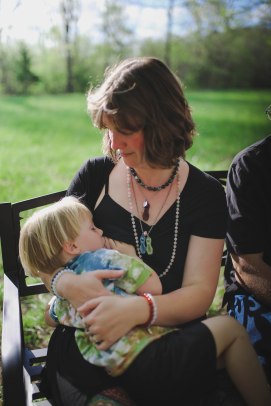
I lie in bed with him, cementing the details in my memory. The way the morning air is heavy and green. The sound of last night’s raindrops continuing to drip from the overfull gutters on the roof. The insistent stab of a single-note bird song in the air. His head nestles in the crook of my arm the way it has done every morning for three years. Blond hair against my nose, breathing in the slightly baby smell of him. “This is the last time,” I whisper softly. “We are all done after this. This is the last time we will have nonnies.”

This is not the first last time for me, but it is the last, last time.  The first baby was born 14 years ago and gathered to my breast with all the tenderness and uncertainty and instinctiveness of a first, first. “Do you want nursies?” I whisper to that new little boy, and we begin the next steps in our bond, nursing for nearly three years, until one day, six weeks away from the birth of the next baby boy, I decide that we truly have to be done. I am a breastfeeding counselor for other nursing mothers and I feel like I should want to tandem nurse my two boys. I fondly envision their hands joining across my body, the easy love and camaraderie between them blossoming through this shared time with their mother. But, I feel an intense irritation with nursing while pregnant, nearly a sense of revulsion and the almost irresistible urge to shove away my sweet little boy as I prepare to greet the life of another. I talk to my midwife about my feelings and she explains that with her own two daughters, the agitated feeling at nursing the older one did not go away with the birth of the second, but instead became dramatically worse. After hearing this, I feel panicky and I decide we do, in fact, have to wean. He is a very verbal and precocious toddler and I am easily able to explain to him that it is time to be finished nursing. One night though, he lies in bed with me crying and begging to nurse. He says he really needs to. I tell him, “remember, we’re all done, but if you really, really need me, if you really, really still need to have nursies, you can.” He doesn’t nurse, but instead falls asleep, reassured that while our nursing relationship might be over, I’m still here.

Continue reading “The Last Time, by Molly Remer”

Feminist Gutter Punk Freedom by Xochitl Alvizo

My brother is, in this own words, an “old school street, squatter, gutter punk.” Indeed, he lives outside the system. He is an anarchist atheist and has lived many nights of his life on the streets – by choice. He has a quick and easy smile and makes friends effortlessly. Recently, while stuck in Seattle during an extended layover on his way back to Europe, where he’s been living the last few years, he passed the time making new friends and exploring the immediate area –

Continue reading “Feminist Gutter Punk Freedom by Xochitl Alvizo”

Gaining Perspective by Natalie Weaver

I don’t know if I could be a deep-sea welder.  I don’t know what the risks of lethal electrocution, broken limbs, or the bends would be.  I suspect it can be a dangerous occupation, like operating heavy equipment on good old dry land or fishing for crab or even collecting garbage from the neighbors’ driveways.  So too is this the case with window washing, paving, disposing of medical waste, brick making, driving a giant tanker truck, and more.  There are aspects of the world I know I take for granted, but the moment I stop to consider what those aspects might be, I am humbled and reminded of the privilege it is to philosophize and ponder the functions of religion in the shaping and making of society.

I have a newfound, barely there insight, both on my privilege and my need to be wiser, derived from the use of (hold your breath) a yardstick.  In what is either a desperate gambit for meaning or the fulfillment of a dream long deferred, I returned to school to take some art classes this fall.  I have my own homework, assignments, a syllabus, and, gasp, grades to worry about for the first time since 2003.  As I drove in the dark and rain for almost an hour this morning at 6:00 am, to a parking lot that sits a solid half hour away from the bus I need to take, which deposits me a fifteen minute walk from the building where I study, in order to make a 7:45 am start time, I wondered briefly what I was doing and why.  But, as soon as I took out my yardstick to measure and represent objects in perspective, I remembered why I undertook such an errand. Continue reading “Gaining Perspective by Natalie Weaver”

Identity and Marriage: Which Christian Conception? by Stephanie Arel

This post explores issues I present in an essay which will be published in the Journal of Theology and Sexuality. In that piece, I consider the term “identity.” I claim that identity and the categories it delineates often present dilemmas when it comes to gender, sex, and sexuality. This is especially the case when considering biological and social data related to sexual fluidity in women. While in the paper I argue that “identity” serves in many ways to stultify, I recognize that we can also interpret the eschewing of identity as something reserved for the privileged – who can afford to discard identity. Marginalized groups, on the other hand, are often at the mercy of identity – it is hoisted as a marker, one that cannot be displaced or removed.

Where I complicate identity relates to its ability to typecast and congeal a self into a definitive configuration. Categorization follows, serving specific ends and bolstering very specific institutions.

Let’s consider marriage. Continue reading “Identity and Marriage: Which Christian Conception? by Stephanie Arel”

Look Up by Natalie Weaver

He said, “Look up.”  So, I looked up, and I saw the most beautiful stars.  They were like Hubble Space Telescope Images, but I could see them with my own unaided eyes.  All the colors were there, close enough to touch, yet glittering and dancing against the black of space, each one twinkling its own unique light.  I was kneeling in the dream, but the sight was so beautiful it knocked me backward, the backs of my thighs now folding onto my calves. I began to cry, and that is when I woke up.

Earlier in the dream, I had been visiting a friend.  When I had meandered outside the walls of a weathered barn where I had been perusing the friend’s library, there were two gentlemen who greeted me, one rocking quietly in an old wooden chair and the other seated in a still chair beside him.  “Hello,” the rocking one said, “I’m Hiram.”  “Hiram,” I replied, pronouncing the name like high-rum.  “That’s an interesting name.” “It’s pronounced ‘hear-em.’ Hear-em Edson,” he followed. Continue reading “Look Up by Natalie Weaver”

Family, Interdependence, and Mutual Support by Chris Ash

Christy CroftOver the past few months, a precious person has come closer into my family’s life in such a way that their presence in my home, among my loved ones, has come to feel natural and easy. This is someone I love, someone who adores my children and appreciates my partner of 18 years and whose sweet spirit and vibrant laughter have added joy and mirth to our family home.

Yesterday, they rode with me to drop my freshly-mohawked teenager off at a farm to help with preparations for an upcoming arts camp. I introduced them by name to the camp assistant and walked over to chat with the camp director for a bit. Later, as we got back into the car to head to lunch, I asked what they thought of the farm.

“It was nice,” they said. “I’m glad your children have a place like that. Also, while I was chatting with the camp assistant, she asked if I was family.”

“What did you say?”

“I said yes.”

They weren’t wrong.

The meaning the word “family” holds for me is something I’ve given much consideration over the years. For generations, many of us have been expected to turn a blind eye to the ways patriarchal domination of women’s and children’s bodies perpetuates abuse in our own family systems. My inability to sweep these abuses under the carpet, to keep silence and pretend all is well, has led to my estrangement from one entire side of my family. It’s an estrangement I feel will be permanent, and while I grieve the loss of an ideal I never had, I welcome the opportunity to live authentically and boldly, confident in my dedication to my ideals, which include honesty, justice, and the unconditional protection of children and vulnerable populations.

For a while, I sat with the gap this estrangement created in my life, unwilling to fill it with harmful relationships with those to whom I am blood-related, yet hesitant to broadly redefine it in a way that negates the importance of those who have chosen to love and raise up a child, however imperfectly. Continue reading “Family, Interdependence, and Mutual Support by Chris Ash”

Mulling over Movies: Moana, Pt. 2 by Elise M. Edwards

elise-edwardsEvery summer in the US, movie theatres show their newest big budget films, hoping to draw in large audiences. While I appreciate an air-conditioned theatre on a hot day, I love the opportunity to go to an outdoor movie screening.  These screenings are usually community-oriented opportunities for social gathering.  In my previous post, I talked about Moana, a Disney film I saw at an outdoor screening earlier this summer.  I enjoyed watching this movie with my friends and their families and I was delighted by the story itself.  It has several religious and spiritual themes and strong female characters. Previously, I spoke of the significance of myths in this movie.  Today, I’m focused on depictions of nature in Moana and their remarkable beauty.

Many feminist and womanist theologians and religion scholars have raised concerns about the interrelated dominations of women and nature, as well as the disproportionate hardships women and children are exposed to with increasing climate change and environmental degradation.  Our changing environment affects all life on the planet, but it is the people who are most vulnerable (physically, economically, politically) who at most at risk.  Obviously, animals and plants are endangered, too. Ethicists like me are interested in finding ways to address these concerns because we are committed the preservation of life.  As feminists, there’s more to it, though.  We recognize the way nature itself is often feminized (“Mother Nature”), which makes it even more troubling when it is cultivated without respect for the wellbeing of existing ecosystems and the life forces dependent upon them.

Continue reading “Mulling over Movies: Moana, Pt. 2 by Elise M. Edwards”

Mulling over Movies: Moana, Pt. 1 by Elise M. Edwards

elise-edwardsI love going to outdoor movie screenings.  Sitting outdoors on a summer evening with good company brings me joy.  Last week, I went to an screening of Moana, the Disney movie about a teenager who goes on a quest through the Pacific Ocean with the demi-god Maui.  Moana goes on this journey to help her people.  The movie came out last year, but I didn’t see it.  I have to admit that I wasn’t even interested in it until Simone Biles performed a dance to one of Moana’s songs on Dancing with the Stars. It was then that I realized that the movie has an empowering message.  I asked my friend Natalie, who is also a feminist religion scholar, about Moana.  She has three young daughters, so I trusted her to be more current than I am.  Her enthusiastic response sold me, as did her remark, “There’s not even a love story in it!”

Ah, Disney princesses and their love stories!  I’m old enough that I didn’t grow up with the Disney culture that children in the past few decades have, but I haven’t been immune to the Disney princess phenomenon.  I childhood pre-dated DVDs and digital downloads, but I still knew and cherished the Disney characterizations of Snow White, Cinderella, and Sleeping Beauty. These young women were kind and virtuous and beautiful (according to Eurocentric standards), but their stories culminate with marriage to a charming prince.  It’s also problematic that so often, the villains in these movies were older women—wicked stepmothers or evil witches—who were motivated by jealousy and hate.

Continue reading “Mulling over Movies: Moana, Pt. 1 by Elise M. Edwards”

Encountering and Countering Self-Disgust by Stephanie N. Arel

In my last post, Trump’s Misogyny – A Case for the Contempt-Oriented Personality, I wrote about disgust, claiming that media diagnosticians failed to identify disgust- contempt as part of Donald Trump’s psychological profile. At the end of the piece, I said that the statement “Make America Great Again” was misogynistic. I maintain this claim but now want to consider disgust a little more closely – particularly when it constitutes self-disgust underlying or complicit in misogyny. Confronting and ameliorating self-disgust provides an entrance into combating misogyny.

Self-disgust interferes with self-love. As a result, self-disgust impedes connection and empathy in human relationships. Self-disgust also attenuates intimacy –self and other directed. Self- disgust manifests in multiple ways – in withdrawal, refusal to engage, self and other directed violence, addictions (including those to negative affect), etc.: the list is a long one. Self-disgust which manifests as hubris motivates the projection of disgust onto others, so that the other becomes the source of disgust; the abject unwanted object present in the self – rejected and discarded –becomes transported, launched to rest on the back of another.

The simple way to describe this mechanism emerges in self-help literature that suggests that the thing that one dislikes most in others is that which one cannot tolerate in oneself. This negatively perceived part of self can also be conceptualized in terms of Carl Jung’s notion of the shadow – the unknown dark side of the personality which we all carry but whose integration into conscious life defines its denseness, or the weight of its impact. The more conscious we are of our shadow, the more we are able to identify that what we recognize as a deficiency in another is actually what we understand as a personal inferiority. Continue reading “Encountering and Countering Self-Disgust by Stephanie N. Arel”