Pope Francis, Complementarity, and US Politics by Gina Messina-Dysert

Gina Messina-Dysert profileA theology of complementarity, referred to by Pope Francis as an “anthropological fact,” has had  a strong influence on American politics.  According to the Vatican teaching, women and men have distinct but complementary roles, meaning that women’s value is found in the home as wife and mother and men are responsible for providing for the family.  Such a teaching is highly problematic in that it demeans women’s value and places women on the underside of dualism.

As a woman with an ongoing struggle with infertility, I find it troubling that my church sees my value as less because my womb is barren. Likewise, do women have less value if they choose a career over motherhood?  What if they choose not to marry?  There are also clear implications for single parents, LGBTQ parents, and so on.  In addition, societal norms make clear that women’s work in the home is not valued as the work of men in society.  Likewise, it is damaging to men in that it refuses to acknowledge the critical role men play in the household, in the lives of their children, and their responsibilities to be partners and co-parents.

The idea of complementarity upheld by Pope Francis greatly contributes to economic injustice for women.  The Vatican’s refusal to value women’s roles outside the home influences US social policy on women’s issues. The continued struggle to close the pay gap, implement paid parental leave, and create viable options for childcare and early childhood education are directly connected to complementarity. If women are supposed to remain in the home and be wives and mothers, then there is no need to address any of these issues. How can we possibly have women in leadership roles if they are supposed to be at home cooking dinner and caring for children? And so, when women do pursue careers the social attitude is that women do not belong. Such an idea is even more problematic for women of color who suffer a lower pay rate – $.64 on the dollar for African American women and $.54 for Latina women. Furthermore, many have have been forced to work outside of the home as a result of economic and racial injustice.  In this secular nation, Christian values dominate our political debates and perpetuate the idea that women are subordinate to men. And to be frank, these are community issues that impact men as well as women; yet they have been deemed women’s issues as a result of the manifestation of theological teachings.

As republicans focus on defunding Planned Parenthood, ending marriage equality, protecting religious freedom, and claiming issues like parental leave are not federal issues, women continue to be relegated to second class status. In a time of turmoil and multiple threats to the progression of our nation, there is greater concern for regulating women’s bodies than guns.

https://www.youtube.com/watch?v=17RJfgsTQUc

Pope Francis has been praised for his commitment to the poor; yet he has been unable to make the connection between poverty and the women’s issues that exist as a result of complementarity.   Likewise, the Church’s stance on reproductive justice continues to perpetuate the very issues that the pope seeks to address.  As Sr. Joan Chittister points out:

I do not believe that just because you’re opposed to abortion, that that makes you pro-life. In fact, I think in many cases, your morality is deeply lacking if all you want is a child born but not a child fed, not a child educated, not a child housed. And why would I think that you don’t? Because you don’t want any tax money to go there. That’s not pro-life. That’s pro-birth. We need a much broader conversation on what the morality of pro-life is.

No doubt, his lack of relationships with women is a major contributing factor to his ignorance when it comes to such issues – by the way, which could be easily fixed by embracing women’s ordination. And so, as Pope Francis has become an international figure deemed a savior to the people, these disconnects fuel ongoing US political debates that keep women in a marginalized position and continue a cycle of poverty and oppression.

Pope Francis has called for a “Year of Mercy” in which he has stated that if a woman confesses having an abortion, she will be forgiven.  Many have praised the pope for taking such a step towards healing; yet, I can’t help but think, “how judgmental and irresponsible.”  Without knowing a woman’s circumstance, her decision making process, her doctor’s concerns, etc., why should one be told to repent? To deny women the right to reproductive justice is to deny women the ability to make decisions about their physical, emotional, and financial health – and we see this play out in the US as a result of the influence of complementarity in our political system. So, in this “Year of Mercy,” I wonder will the Vatican confess its sins against women, LGBTQ persons, and others it has marginalized?

comingspring 2016Portions of this article are excerpts from If Jesus Ran for President coming from the Far Press in Spring, 2016.

Gina Messina-Dysert, Ph.D. is Assistant Professor of Religion and Gender Studies at Ursuline College and Co-founder of Feminism and Religion. She writes for The Huffington Post, has authored multiple publications and is the co-editor of the highly acclaimed Faithfully Feminist: Jewish, Christian, and Muslim Feminists on Why We Stay. Messina-Dysert is a widely sought after speaker and has presented across the US at universities, organizations, conferences and on national platforms including appearances on MSNBC, Tavis Smiley, NPR and the TEDx stage. She has also spoken at the Commission on the Status of Women at the United Nations to discuss matters impacting the lives women around the world. Messina-Dysert is active in movements to end violence against women and explores opportunities for spiritual healing. Connect with her on Twitter @FemTheologian, Facebook, and her website ginamessinadysert.com.

Human Beings, Not Wombs in Waiting by Katey Zeh

drink-1031701_1920

Earlier this month the Center for Disease Control (CDC) released a new infographic on alcohol consumption with some controversial recommendations for women of childbearing age. In short, if a woman is not on birth control, the CDC recommends that she avoid alcohol altogether because she might become pregnant.

My first take on the report was that this was simply another example of how we treat young women as if they are merely wombs in waiting. In her response to the recommendations Rebecca Ruiz wrote this for Mashable.com:

While the original recommendation may have been intended to ensure safe pregnancies and healthy children, its underlying message was unmistakable: Women should consider themselves first a vessel for human life and make decisions about their health and behavior based on that possibility.

Despite severe backlash CDC officials stand by their assertion that the primary goal of this infographic is to alert the public about the dangers of alcohol consumption, particularly for pregnant women. In an interview with the New York Times CDC deputy director Dr. Anne Schuchat said, “We’re really all about empowering women to make good choices and to give them the best information we can so they can decide what they want to do themselves.”

When my husband and I made the decision to have a child, I immediately immersed myself in research. I read Taking Charge of Your Fertility and began tracking my basal temperature. I started taking folic acid and yes, I did cut back on my alcohol consumption. The timing of that decision happened to coincide with attending a bachelorette party. As I nursed my club soda while the rest of our group had cocktails, I told myself that it was a small sacrifice to make. The thing is, I was trying to get pregnant. That decision about my future had shifted the way I thought about my day to day life. I was preparing for the real possibility that everything was about to radically change, so making some minor adjustments ahead of time felt small in comparison.

But the CDC’s recommendations are not intended only for women who are trying to conceive. They apply to any woman of childbearing age who has the possibility of becoming pregnant. The problem isn’t that they encourage women to be careful about how much alcohol they are consuming. The problem is that it reinforces the idea that a woman’s decisions and behaviors should be focused on a potential pregnancy, whether or not she wants one.

The fact that this is being promoted by a government agency is particularly troublesome in an age when the policing of pregnant women’s bodies is becoming more and more stringent. In 2014 Tennessee passed a law that allows the state to criminally charge women who give birth to babies who show signs of drug withdrawal. While this is the most extreme law on the books, other states have similar legislation that considers prenatal drug exposure a form of child abuse. What would stop a state from passing a law that would prosecute a woman for consuming alcohol during her pregnancy?

I’ve grown increasingly fed up with this emphasis on an individual woman’s personal responsibility and decision-making without an equally serious focus on the conditions in which she lives her life. Reproductive justice activists have been saying this for decades. Loretta Ross, co-founder of SisterSong Women of Color Reproductive Justice Collective, writes about the connection in her article “Understanding Reproductive Justice”:

We believe that the ability of any woman to determine her own reproductive destiny is directly linked to the conditions in her community and these conditions are not just a matter of individual choice and access.

As a person of faith committed to justice, I am compelled to take seriously what might appear on the surface to be innocuous and even ridiculous guidelines from the CDC and examine how they contribute to a larger, more dangerous narrative about women’s bodies. I fully support the CDC’s stated goals to reduce fetal alcohol syndrome and to ensure that every pregnancy is healthy. But we shouldn’t do so at the expense of women’s dignity and full humanity.

Katey Zeh, M.Div is a strategist, writer, and educator who inspires intentionalKatey Headshotcommunities to create a more just, compassionate world through building connection, sacred truth telling, and striving for the common good.  She has written for outlets including Huffington Post, Sojourners, Religion Dispatches, Response magazine, the Good Mother Project, the Journal for Feminist Studies in Religion, and the United Methodist News Service.  Find her on Twitter at @ktzeh or on her website www.kateyzeh.com.
The Right to Choose is the Right to Our Lives by Marie Cartier

MarieCartierforKCETa-thumb-300x448-72405Friday, January 22nd marks the 43rd anniversary of the Roe v. Wade decision of 1973 which provided all women nationwide, for the first time, the right to get a legal abortion for any reason–the right to choose. There are celebrations, and actions for visibility planned throughout the nation. Some of them are listed on the Planned Parenthood website.

On this anniversary,  the stakes for women’s access to legal abortion are higher than ever. Politicians threaten to further restrict access and the U.S. Supreme Court soon will  hear the biggest abortion case in decades. What was life was like for women before legal abortion–and what could it again become? Politicians threaten to continue to take women’s health backwards. Continue reading “The Right to Choose is the Right to Our Lives by Marie Cartier”

Wisdom Fiction (Part 2) by Elise M. Edwards

Elise Edwards“There are years that ask questions and years that answer.” from Their Eyes Were Watching God by Zora Neale Hurston

In my previous two posts, I’ve discussed the wisdom that can be found in black women’s literature. Continuing this series, I’m sharing a statement from the most well-known novel written by Zora Neale Hurston. Hurston was an American novelist, folklorist, anthropologist, and cultural critic whose work was first published in the 1920s-1940s. Their Eyes Were Watching God was published in 1937 and has since been reissued and adapted into film.

“There are years that ask questions and years that answer.” This quote is one that has circled around my mind every New Year and every birthday for many years. These times of year are when I’m likely to reflect on the previous year and wonder what has come from it.

Continue reading “Wisdom Fiction (Part 2) by Elise M. Edwards”

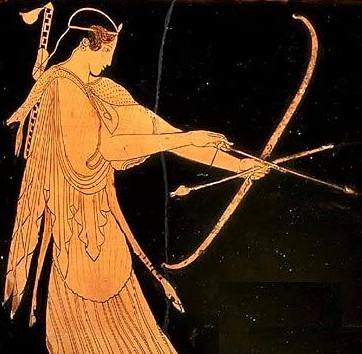
Artemis As Artemisia: Ancient Female Spirituality & Modern Medicine by Stuart Dean

Detail of Artemis from a 5th century BCE Attic Vase
Detail of Artemis from a 5th century BCE Attic Vase  (Museum of Fine Arts (Boston))

The 2015 Nobel Prize for Medicine was awarded in part to a Chinese woman (Tu) for her identification and isolation to treat malaria of a chemical known as Artemisinin.  The name of that chemical derives from the fact that it is found in varying amounts in the ‘family’ (technically, genus) of plants known as Artemisia.  The name of that family derives from its association with the goddess Artemis.

Because Tu’s work began in China in the 1960s it is understandable that even if she knew this about Artemisia (a term I use to refer to any one plant or all of the plants of that family) it would not have been a ‘careerbuilder’ for her to point it out to those for whom she was working.  It was bad enough that she was a woman.  At that place and time, however, if she had said or done something that could be associated with Western culture her name might not even be known today.   

Nevertheless, because those awarding the Nobel Prize are free from discrimination or intimidation, it is startling that in the explanation provided for the award no mention is made of the Western legacy of Artemisia.  To begin with, the very fact that the Prize was being awarded to a woman for a plant named after a goddess should have elicited at a sense of uncanniness that arguably deserved mention.  Be that as it may, the failure to mention that Artemisia has a long history of being used medicinally in the West not only as an insect repellent but also to treat fever–a common symptom of malaria–is simply inexcusable. Continue reading “Artemis As Artemisia: Ancient Female Spirituality & Modern Medicine by Stuart Dean”

Why I’m Not Watching by Katey Zeh

Katey HeadshotI just can’t. The Planned Parenthood sting operation videos. The GOP debates earlier in the month. I can’t bring myself to watch them. I used to jump without hesitation into the thick of the most vitriolic political exchanges and stand my self-righteous ground with the best of them, but I just can’t anymore.

I can’t. And I won’t. I do recognize that when I choose to tune out the noise of public debate, I am opting out of the conversation, at least in part. I shouldn’t be commenting directly on events of which I am not aware and informed. Nor should anyone else for that matter. I do end up relying on a community of commentators to fill in what I’ve missed by not watching. Continue reading “Why I’m Not Watching by Katey Zeh”

What is the F-word Anyway? by Kile Jones

kile jonesSocial justice. Progressive politics. Improper media depictions. What exactly is the F-word (feminism) about?
I have always understood feminism as a project that casts a very wide net, the goals and values of which can keep quite a few people dry under the shade of its umbrella. But more and more, I see a narrowing of who can count as a feminist. There are a few reasons for this constriction. First, the more the F-word becomes a pejorative in contemporary society, the greater the need is to circle the bandwagons and set up camp. Second, when a particular group has elevated levels of in-fighting occurring, it makes sense to start psychologically splitting people into “feminist” and “not feminist.” Or, on a spectrum, “strong feminist” vs. “weak feminist.” Third, there is a pragmatic need for groups to find an optimal tension with society. When social groups are too counter-cultural or revolutionary, they get branded extremist and fanatical, but when they are wishy-washy and lukewarm, they become another extension of the status quo and lose their prophetic fire.

As an atheist, I see all of this occurring in non-believing circles as well. And I’m not really sure how to navigate it. There is also no shortage of men in this social group–from Dawkins to Boghossian–who think of feminism in the negative. All of this has to do with what they think the F-word amounts to. Continue reading “What is the F-word Anyway? by Kile Jones”

Fannie Lou Hamer’s Commitment to Life by Elise M. Edwards

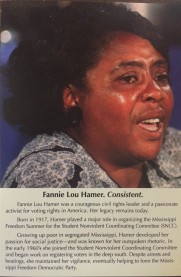
Elise EdwardsA few weeks ago, I came across a postcard that I was given at a conference last year. I got the postcard (advertisement?) because it has a picture of Fannie Lou Hamer on it, and in my home and office, I like to display images and quotes from inspirational women, especially black women. Hamer was a sharecropper from rural Mississippi who became a leader within the civil rights movement in the United States. I was happy to have something with her likeness on it. It was only later that I looked at the text on the front and back of the card, which read in part, ”Often called the ‘spirit of the Civil Rights Movement,” Hamer worked tirelessly on behalf of the rights of others—including the unborn. [She said,] ‘The methods used to take human lives such as abortion, the pill, the ring, etc. amounts to genocide. I believe that abortion is legal murder.’” I realized then that the card was distributed by an organization called Consistent Life, who, in support of a “consistent ethic of life,” is “committed to the protection of life threatened by war, abortion, poverty, racism, capital punishment and euthanasia.”

I was conflicted about the ushamere of Hamer’s image for this organization’s purposes. It is true, Hamer did have those views about abortion and birth control. But I did not know if her image and story was being manipulated for a particular political and religious agenda—one I do not align myself with. I put the card in a box of other images and quotes. I didn’t display it, but I didn’t throw it away, either, which is why I came across it again a couple weeks ago as I was cleaning and decorating my home office. I had the same misgivings about the image as before, and I set it aside again. Continue reading “Fannie Lou Hamer’s Commitment to Life by Elise M. Edwards”

What Feminists of Color Taught Me In the Wake of the Michael Brown Shooting by Grace Yia-Hei Kao

Like many others, I’ve been following the aftermath of the recent shooting death of an 18-year old black teenager by a police officer in Ferguson, Missouri with a mixture of shock and horror. Mainstream news coverage and my Facebook newsfeed have been appropriately flooded with commentary about systemic racism, racial profiling, civil unrest, and the militarization of the police. As several African American thought leaders have noted, Brown’s death was not an aberration but “just the most recent example of police officers killing unarmed black men.” Continue reading “What Feminists of Color Taught Me In the Wake of the Michael Brown Shooting by Grace Yia-Hei Kao”

Hobby Lobby, Not Invited at the Spiritual Negotiating Table by Qumyka Rasheeda Howell

Q HowellSupreme Court Justice Ruth Bader Ginsburg said it best when she quoted Planned Parenthood of Southeastern Pennsylvania vs. Casey court case expressing her dissent on the Hobby Lobby decision made on Monday, June 30, 2014.

“The ability of women to participate equally in the economic and social life of the nation has been facilitated by their ability to control their reproductive lives.”

The Supreme Court ruled 5-4 in Burwell v. Hobby Lobby that closely held companies with religious objections can opt out of providing contraception coverage under the Affordable Care Act. The Supreme Court’s majority also rejected the Obama administration’s argument that for-profit companies cannot assert religious rights under Religious Freedom Restoration Act.  As the RFRA only refers to persons, closely held companies are designating themselves as persons in the case. Closely held companies such as Hobby Lobby are owned by one person or are family owned business and are not a publicly traded company. Justice Sonia Sotomayor agreed with Justice Ruth Ginsburg’s dissent that companies do not have such rights – publicly traded on not.

The Burwell v. Hobby Lobby was about asserting patriarchal power and retaining profit–not about religious freedom. The Obama administration argued that the contraception requirement was not a mandate because companies could have dropped their insurance coverage and offered their employees another insurance option. The truth to Hobby Lobby is they wanted to have the privileged advantage of tax breaks offered under the Affordable Care Act while securing more money by skirting the contraception requirement under the cloth of religious freedom. Continue reading “Hobby Lobby, Not Invited at the Spiritual Negotiating Table by Qumyka Rasheeda Howell”