 This year’s Tibet House Benefit Concert coincided with a snowstorm in Manhattan and though snow is not uncommon in Manhattan (especially this past season), it is particularly associated with Tibet and its high, perennially snow covered peaks. The timing of the snowstorm was thus peculiarly appropriate, leading Robert Thurman, US President of the Tibet House, to muse in his opening remarks about there being Buddhas in the snowflakes.
I was lucky enough to attend that concert thanks to my wife and some of her colleagues being invited by Thurman to attend in appreciation for work they had done on a book consisting of a collection of speeches by the Dalai Lama, My Appeal to the World. Snow had been a topic of conversation at the dinner we had before the concert not just because of the coincidence of the snowstorm and concert, but also because one person in our group had recently broken her wrist slipping on what was left from an earlier snowstorm. She was lamenting being sidelined from her yoga practice, at which point I brought up the topic of the therapeutic benefits of bathing. As is typical of dinner conversations, that quickly morphed into a discussion of other issues; soon it was time for the concert and off we went.
Several weeks later, while taking a bath after my own yoga practice, as I often do, it occurred to me that being in a bathtub was analogous to being in a snowflake–a very large and warmed up snowflake. The basis for the analogy is that ‘buddha’ is not a name but commonly interpreted to be the past participle of a verb, the primary meaning of which is to awaken. The roots of Indo-European (IE) verbs only refer to bare existence or an action and as such can ‘belong’ to any noun (person, place or thing) of any gender (female, male or neuter). Any person of any gender can be ‘awake.’ As a participle ‘buddha’ is a hybrid–part verb and part noun–and thus specifies gender (masculine), but that is an artifact of grammar, a way of speaking, that manifests its interdependence with other elements of language and how that language is used at any particular point in time.
There are a number of fascinating implications in analyzing language in this way (what used to be called ‘speculative grammar’ in Medieval times), but the single most important is that by itself language is not particularly enlightening, but rather quite dependent upon the context in which it is used. It helps explain why the tradition of rejecting textual authority in favor of direct enlightenment, the ‘moment of zen,’ became particularly prominent in Chinese, Korean and Japanese Buddhism. The grammatical differences between Sanskrit and Chinese are relatively substantial compared, for example, to those between any one IE language and another IE language. Grappling with translating and interpreting first Sanskrit and then Chinese and then Korean or Japanese, seems to have heightened the sensitivity to the limitations of language, especially with respect to spiritual beliefs and practices.
This aspect of Buddhism can be readily demonstrated to share roots in an equally ancient tradition of Greek poetic culture. It seems, however, that the guardians of the text based religious traditions emanating primarily from regions controlled directly or indirectly, at one time or another, by Roman emperors, are more than happy to let that aspect of the Western heritage go unnoticed. Instead these guardians seem to emulate the command and control tactics of Roman emperors with what can be fairly characterized as intellectual imperialism.
Because of its importance to all such traditions, Song of Songs (Songs) is a useful example to cite. Only by walling off a substantial amount of evidence is it possible to prevent Songs from being seen to be in part or whole a product of female spirituality that celebrates sexuality in a manner a Buddhist would identify as tantric. Proof that is exactly what the guardians of the text based religious traditions have been doing is not hard to find, for the fact that few women have authoritative positions within any organization associated with such traditions is an artifact of just such a wall.
Such tactics ironically expose the vulnerability of these traditions to decline and fall. One way that might happen can be discerned in what happened to Buddhism as it spread east. It was creatively interpreted in harmony with a far more ancient tradition of nature worship associated with early Taoism, a tradition that privileges individual artistic expression, such as poetry, over textual study or ritualized recitation. That tradition is comparable to the Western philosophy of nature evidenced, for example, in the poetry of the ancient mystic Greek of Sicily, Empedocles.
Though I have referred to this philosophy in previous posts, I hope to discuss it in more detail in upcoming ones as it relates both to ancient traditions such as Taoism and Buddhism as well as to how spirituality might evolve in the future. Suffice it for now to say that what is essential is appreciating that experience itself is the ultimate, authoritative a priori of all spirituality. That can mean doing yoga, meditating upon snowflakes or sloshing about in a tub of water.
Eventually, though, it leads within, to what the poet Holderlin calls ‘Innigkeit,’ a state of inwardness that is itself speechless, but which is the source of poetic/artistic inspiration. That is in an essay on Empedocles, but given what was then known about him, Holderlin was largely projecting onto Empedocles his own beliefs (shared with his friend Schelling) about nature, with “all her melodies,” as the ultimate source of inspiration. Decades after that essay was written, Schelling used Innigkeit in a lecture on mythology to translate a key term from the Bhagavad Gita: yoga, a term that as used there many scholars today think betrays Buddhist influence. Several other translations were then available and it seems likely Schelling’s unprecedented choice of Innigkeit was an homage to Holderlin.
As it happens, substantial new fragments of Empedocles’s poetry were discovered in the 1990s. In 2004, after piecing together those fragments with many of the other previously discovered ones, Richard Janko suggested Empedocles should be thought of as the Greek equivalent of Buddha. Be that as it may, there is no question who Empedocles would say is in snowflakes: Aphrodite.
Stuart Dean has a B.A. (Tulane, 1976) and J.D. (Cornell, 1995) and is currently an independent researcher and writer living in New York City. Previously he worked in a variety of other capacities, including 15 years as a corporate attorney.



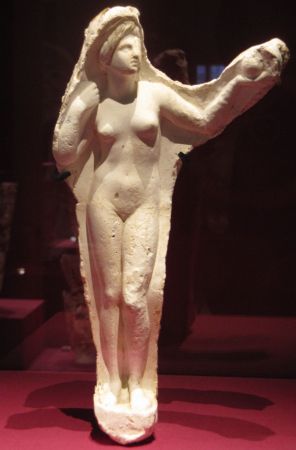 Though it is not known what the motivation originally was for acquiring the Bagram Aphrodite, its presence in Afghanistan arguably evinces an interest in female spirituality–if not in the owner of the storerooms then among some of the people in the market for which she may have been destined. Evidence of such interest among Buddhists is to be found in the Flower Ornament Scripture (FOS), a compendium of sutras dated to approximately the same time (and possibly the same region) as the storeroom containing the Bagram Aphrodite. Female spiritual figures, both mortal and immortal, some portrayed as having official positions, others without any, are prominent in the final chapter of the FOS, so prominent that one scholar suggests Buddhist women of the time in some way influenced its composition (see Douglas Osto, Power, Women and Wealth in Indian Mahayana Buddhism).


 In her comment following


 Originally, in ancient Greek, ‘sphere’ simply meant ‘ball.’ Though its grammatical gender varied, it was primarily a feminine noun. It is in that sense and with that gender that it bounces into Western literature in the episode of the Odyssey where Nausicaa and her companions are playing catch on a beach (
 Feminism and Religion