Gratitude and Sharing: Two Fundamental Principles of Goddess Spirituality by Carol P. Christ

carol p. christThe more I practice the spirituality of the Goddess, the more I understand that earth-based spiritualities are rooted in two fundamental principles:  gratitude and sharing.  We give thanks to the earth for the gift of life. As we recognize our interdependence and interconnection in the web of life, we are moved to share what has been given to us with others. *

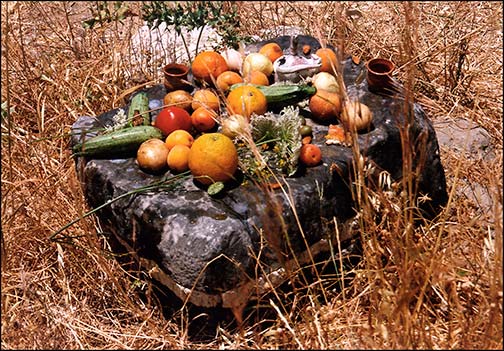
When I first began to lead Goddess Pilgrimages in Crete, I was inspired by a line in Homer to begin a pilgrimage tradition of pouring libations of milk, honey, water, and wine on ancient stones. At first I knew the form, but not its deeper meaning.  It gradually dawned on me as I thought about the large number of pouring vessels in the museums, the altar stones, and the Procession Fresco from Knossos, that an important part of Minoan rituals involved processions in which people offered first fruits back to the Mother whose body had produced them, and poured libations on altars.

kernos stone kay keys

Over twenty years of performing the ritual of pouring libations has convinced me that this was not “a” but “the” central Minoan ritual.  Its purpose is to thank Mother Earth for the bounty She has bestowed on us. Continue reading “Gratitude and Sharing: Two Fundamental Principles of Goddess Spirituality by Carol P. Christ”

Brigid, Goddess of Healing, Poetry, and Smithcraft by Judith Shaw

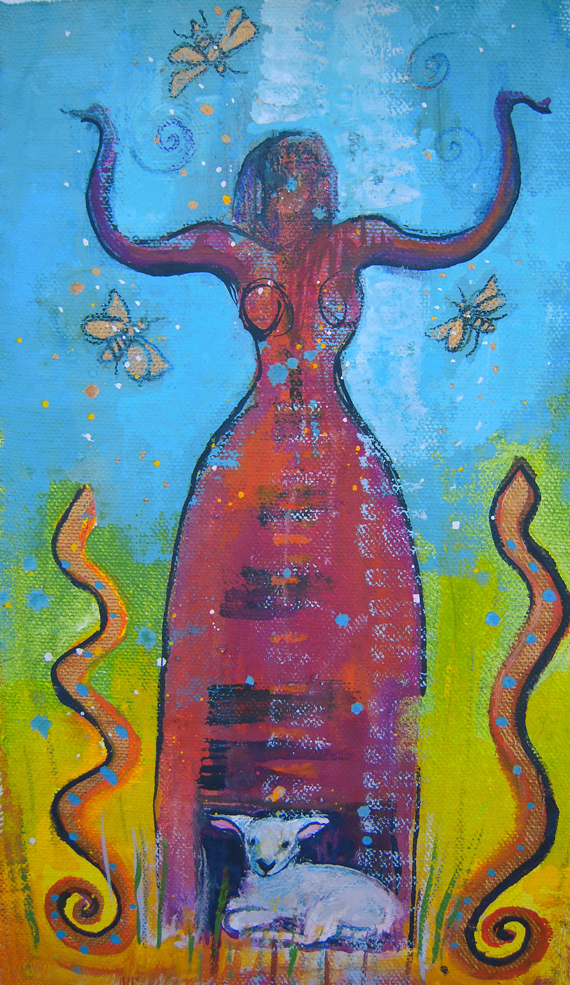
judith Shaw photoBrigid, the Celtic Goddess of Healing, Poetry, and Smithcraft, begins her reign on Imbolic, February 2, the midpoint between winter solstice and spring equinox. On this day the ancient Celts held their Fire Festival in honor of Brigid and the growing light. In Scotland, as recently as the mid-twentieth century, houses were cleaned and the hearth fires rekindled on February 2, to welcome in  Brigid.  Remnants of this festival are found in America today on Groundhog Day.

Like the Cailleach, She existed in many places and  was known by many names.  The Irish called her Brighde; she was Bride in Scotland,  Brigantia in Northern Britain, and Brigandu in France.  Some called her Brid, Brig or Brighid.  Later she was transformed by Christianity into Saint Bridget.  Her older name was BREO SAIGHEAD.   Her name has various interpretations, many relating to fire – “Power,” “Renown” “Fiery Arrow of Power ” “Bright Arrow”, “The Bright One”, “The Powerful One”, “The High One” and “The Exalted One”.

Brigid, Celtic Goddess Continue reading “Brigid, Goddess of Healing, Poetry, and Smithcraft by Judith Shaw”

Sustaining Feminist Spiritualities in the Seeming Absence of Community by Elisabeth Schilling

LaChelle Schilling, Sustaining Feminist SpiritualitiesThe spirituality I cultivated during my teens through evangelistic Pentecostal Christianity was based on possession, hierarchy, and exclusivity, although I would not have said that at the time.

As I gradually moved away from that faith community in my mid-20s, no longer wanting to equate a rewarded closeness to God with being set apart from others, I began finding myself participating in quiet conversations with the readings of Thomas Merton, Elaine Pagels, and with poetry by writers such as Olga Broumas.  The words I was drawn to might not have been expressly or consistently religious, but they offered spiritual nourishment in their eroticism, earthiness, and sacred metaphor.

It was also around that time when I decided that feminist theologies were healing in their questions and re-visions of God and concepts of salvation and sin. To understand that being a spiritual and/or religious person could mean being aware of and pursuing my desires and connections to other people instead of being a gatekeeper was redemptive. Continue reading “Sustaining Feminist Spiritualities in the Seeming Absence of Community by Elisabeth Schilling”

Epona, Celtic Horse Goddess by Judith Shaw

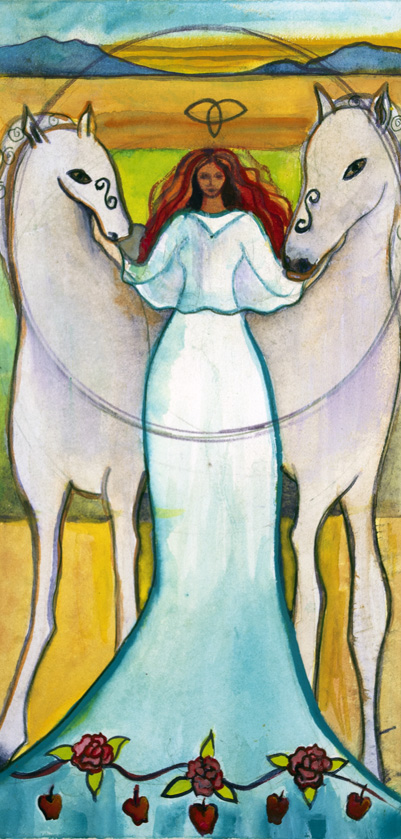
judith shaw photoEpona, Celtic Horse Goddess was worshipped by the Gauls (the Celtic French). Her worship spread to Britain and Rome from Western Europe. Hundreds of statues and shrines dating from between the first and third centuries CE have been found in France alone.

Today we can understand Epona mainly from her images, as few stories of her have survived.  She is often shown either riding a white horse side saddle or standing or sitting between two horses.  Many images show her feeding mares and foals from a cornucopia or a basket of fruit.

Epona, Celtic Horse Goddess Continue reading “Epona, Celtic Horse Goddess by Judith Shaw”

Three Sisters by Deanne Quarrie

From time to time I dive into the idea of seeing the Triple Goddess as Sisters rather than Mother, Maiden, Crone.  I have to confess that the idea of Sister Goddesses, complete in their familial connectedness, representing unity, connection, and interdependency, is very appealing.  We, who practice Goddess Spirituality, strive in our relationships to reflect this in our work together.  Shared power!

If I were to look at the sisterhoods individually, I enjoy the Ananke and the Moirae from Greek mythology.  I like them because they represent a balance.  One side setting the standards and the other, enforcing them!  A perfect example of the laws of cause and effect! Continue reading “Three Sisters by Deanne Quarrie”

Embody the Sacred – Engaging Through the Senses by Deanne Quarrie

The human body is designed to utilize all senses. We, human beings, have drifted away from our natural state through which, at one time, we engaged with all of life through our natural senses, including the intuitive.  This change has come about through our active, stress filled lives in which we seldom slow down to even appreciate what is around us.  We have ignored much of our sensory ability due to a change-over from right brain functioning, which is more imaginative, creative and intuitive, to left brain functioning, which is linear and analytical. Two of our senses are developed out of proportion to the others.  Many people grow up in an environment lacking in exposure to the natural world.  With television, computers and video games we have become residents of an indoor and often sedentary world.

In early civilization, humans and all other animals depended on finely tuned sensory awareness for survival.  We walked the Earth, using those senses for protection, to find food and to move around.  We did not just see and hear our way around but we felt, touched, tasted and smelled in order to survive. Continue reading “Embody the Sacred – Engaging Through the Senses by Deanne Quarrie”

Cancel Christmas? By Elise M. Edwards

Elise EdwardsDespite the time and energy it takes to participate in the religious and social rituals associated with Christmas, the result is that I am spiritually grounded, emotionally provoked, mentally rested, and physically fed.   Advent, Christmas, New Year’s, and the last week of the year are times when I reconnect to what is important to me, and the holiday rituals help me do this.

The “holiday season” is upon us, and I’m still busy and exhausted, as I’m sure many of you are.  Although my life isn’t as stressful as it was in October, I am still juggling multiple commitments while trying to make significant progress on my dissertation.  This past weekend, I spent some time with other dissertation writers in the same predicament, and quite a few of them were thinking of cancelling Christmas in their households in response.

My immediate reaction to canceling Christmas (or another alternative they mentioned, micro-Christmas) was to inwardly scream “THAT’S RIDICULOUS!!!!”  To be honest, I’m not sure my facial expression didn’t make my reaction plain.  But since I value my relationships with these people and I genuinely respect their insights, I decided to keep my reaction to myself and to give the matter more thought.  I realized later on that all of the “cancel Christmas” advocates were women.  So I began to consider what the implications of cancelling Christmas would be for women. Continue reading “Cancel Christmas? By Elise M. Edwards”

Don’t Worry, I Won’t Marry Your Girlfriend: Sexuality, Identity, and the Easy Laugh

No longer having to deconstruct the larger cultural and sexual narratives, heterosexuals who do not support marriage equality or feel threatened by homosexuals return to their one source of power that reinforces the ideology that they are on the right path: the Bible. “Marriage is between a man a woman,” or “A man shall not lie with another man as he would a woman,” becomes the newly reinforced heterosexual rallying cry and the progressive progress that occurred in the past becomes nothing more than a joke.

johnI must say, I will be the first to admit that the recent outbreak of videos promulgating the idea that gay men will marry a straight guy’s girlfriend or lesbians will marry a straight girl’s boyfriend all for the sake of marriage equality left me stifling my laughter as I attempted to pay attention in class.

However, after the calamity died down I took a moment to reflect upon the intrinsically embedded aspects of misdirected norms of sexuality, gender, and misogyny latent within the laugh lines and the guffaws throughout each video. Continue reading “Don’t Worry, I Won’t Marry Your Girlfriend: Sexuality, Identity, and the Easy Laugh”

This is Why I Don’t Pray by Erin Lane

Like most Americans, I hold the overblown belief that a book about my life would be worth reading.  And, like most Americans, I have had the gumption to title it before I’ve even lifted a finger. It’s called “Should I Be Praying Now?”

Erin LaneAs if you’re surprised, it has an obnoxious subtitle that helps marketers at Barnes & Noble know whether to put it on the Christian living shelf with the likes of Beth Moore or drop it behind the David Sedaris memoir with the naked barbie on the cover. It will read, “Moments of indecision during mealtime, bedtime, teeth-brushing, love-making, test-taking, baptisms, funerals, and the opening few minutes of small group.” It’ll be like Anne Lamott’s “doesn’t that make you feel better about  your own spiritual life” kind of writing but more pedestrian. Continue reading “This is Why I Don’t Pray by Erin Lane”

Death of a Priestess by Geraldine Charles

Dusk was falling and mist rising as I drove sadly across the Somerset Levels – a liminal place which once formed the huge marshy lake out of which the Isle of Avalon majestically rose.  When I rounded a bend to see a large swan walking straight up the centre of the road in the same direction I was going, my first thought was for its safety.  I expected it to take flight or veer off at any moment, but the swan continued on its path, seemingly determined to walk just where it was. The road was narrow and all I could do was respectfully follow until it widened a little, eventually managing to squeeze carefully past before starting to flash my headlamps at oncoming traffic to warn them of the swan’s unlikely presence.

Only later that evening did I remember the last time I saw such a stately walk in front of a moving vehicle – when a formally-dressed funeral director led off the hearse which carried my father from his home and on his last journey in this world.  I was thunderstruck. Could the swan be marking this new loss, making me mindful and slowing me down? Continue reading “Death of a Priestess by Geraldine Charles”