We may all remember 2020 as the year when we could no longer look away from death. Our western culture has hidden death away in hospitals and funeral homes for generations. However, in these past months we have all been inundated with daily images of COVID-19 patients dying alone in ICUs, terrified people and wildlife consumed by flames or flood, televised funerals of victims of racial violence, children starving due to droughts, the loss of icons of courage and compassion like Ruth Bader Ginsburg, Elijah Cummings, and John Lewis, and so much more. Even as we seem to be surrounded by death, we risk being inured to its tragedy by the sheer numbers of dead from these and other causes.
How we survive this time as individuals and a society may depend in part on how we are able to answer the question “Were we able to mourn each life lost – human or non-human — as a sacred being, unique and irreplaceable? Did we ignore the suffering of others or did we find deeper compassion?”
It’s true. I don’t mean to make you jealous, but lately, I have at least one long session of really great crying most days. What I call the “lovely cry,” where my face gets all red and swollen and puffy, my nose runs, I drool, and I make all kinds of noises. I’m so proud of my crying, so proud of myself whenever I manage to accomplish a really good cry, and so relieved. I get a bit worried if a few days go by and I haven’t had a proper cry. I try to remind myself how important it is, and give myself time and space for a healthy crying session.
Again, not to blow my own horn, but it has taken some work—decades of practice and effort—to get good at frequent, healthy crying. Mostly, it takes two things: 1) the courage to feel your feelings, and 2) the strength to reject our culture’s toxic sexism.
I’m sorry I can’t provide you with a well researched summary of how our culture decided that tears are shameful, weak, and feminine. It’s been a damned hard time lately, trying to recover from long-term Covid. I could also go on about my past traumas, deaths I am grieving, and fears from this pandemic and the climate apocalypse, etc. I’m sure you could, too. Plenty to cry about! Continue reading “I Don’t Mean to Brag, But I Cry a Lot by Trelawney Grenfell-Muir”
In a recent interview about my current published paper and my life’s-work, Sawbonna, which is a model of both social and restorative justice, I was struck by how being locked down due to this global pandemic not only rips us to the core of our fears and forebodings; but, as well, invites us, if challenges us, to witness with and for each other, as we come to see the depth of resilience that has been a kindred companion throughout the ages. From time immemorial, Gaia delights by firing our hearts of justice with creativity. With love.
My interview took place over Zoom, a virtual bridge of connection and connecting. In this instance, that bridge stretched between Toronto, Canada and Cork, Ireland, where activist and researcher Jane Mulcahy and I spoke about Sawbonna, which is contextualized in the crucible of shared-humanity and human-rights. We discussed therapeutic writing, voice, trauma, poetry. Our conversation [which will be on Jane’s SoundCloud platform later this year] was infused with a crystal clear knowing that trauma and grief are in symbiotic sisterhood with resilience and voice. Continue reading “Gaia Delights: Sawbonna Resilience and the Pandemic by Margot Van Sluytman/Raven Speaks”
My previous post on this site, Trauma Healing through Communal Dance, on February 1, told of a traumatic event and its lingering effects, including insomnia, brain fog, nightmares, tearfulness, migraines, anxiety, and fear. Now I’m hearing reports of similar symptoms from virtually all of my friends who are affected by the trauma of the coronavirus pandemic.
Three months ago, Greek communal dance helped me recover from my traumatised state. Now, nobody has access to communal practices like circle dance to help us get through it.
So how do we heal when we all need healing? When we don’t have access to the things which would normally help us heal?
Circle Dance with Laura Shannon, Germany 2008 (photo: Beate Frey)
There is a lot of talk right now about strategies, small and large, which can keep us sane in this crazy time. Many speak of the ‘silver linings’ we can find in this enforced retreat, and I have found a few myself. But I have also heard from people who aren’t in a safe place, or who just aren’t coping well.
Even if you are blessed with a peaceful home, access to nature, and continuing income, not everyone is made for isolation. The lockdown can be particularly hard on extroverts. And many people may find that high stress levels in this time of separation, loss, and uncertainty awaken old ghosts of unhealed trauma.
My earlier blog named some of the therapeutic aspects of communal circle dance, including connection with others, shared movement synchrony, realignment with ‘my self, my body, my place between heaven and earth, and my home in the human community.’
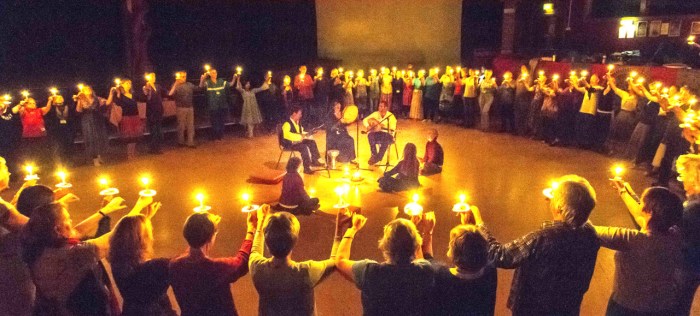
Armenian Candle Dance with Laura Shannon, Findhorn 2015 (photo: Hugo Klip)
As I wrote in Medusa and Athena: Ancient Allies in Healing Women’s Trauma, “Past trauma can be transformed through ‘physical experiences that directly contradict the helplessness, rage and collapse that are part of trauma’ and which foster a renewed sense of self-mastery. Because trauma tends to be experienced in ‘isolated fragments’, treatment particularly needs to engage the entire organism, ‘body, mind, and brain’.”
So, dancing is perfect. Circle dance, particularly, is my ideal method of trauma healing. But how can we dance without a circle?
A lot of us are dancing on platforms including Skype and Zoom, but the slight time lag with this technology means that true synchrony is impossible; everyone’s movement appears slightly off the beat. Nevertheless, I love seeing cherished faces, talking together, and dancing despite the distance.
My favourite way to dance ‘in circle’ is without any online technology, simply connecting in heart and spirit. Since the start of the lockdown, my network of dance students, friends, and colleagues in different countries have been ‘meeting’ at set times twice daily, and it is deeply moving to join together in this way. We light a candle for loved ones, health workers, key workers, and anyone who is unwell or needs extra support at this difficult time. Then we each dance the same sequence of circle dances, plus our personal favourites. Knowing that my friends are all dancing in their own homes, and that we are all thinking of each other at the same time, is very precious.
Candle (photo: Laura Shannon)
If you too are separated from your loved ones, you can choose a time every day to stop what you are doing so you can think of one another, with no need for online technology. You don’t have to dance; just put on your favourite music and know you are connected.
Doing things you love can also provide an antidote to trauma – cooking favourite foods, lovingly repotting houseplants, or embarking on a fun creative project – anything you enjoy can connect you to your own power and experience of mastery as a source of healing. With my housemates here in Canterbury, we created a beautiful Easter feast – twice, first for Western and then for Orthodox Easter – with photos of our missing loved ones on the table. It was such a simple act, but nourishing on so many levels.
Time in nature connects us with the flow of life force which is in each of us. As we walk outdoors, feeling the earth below and the sky above, we can remember when we have come through challenges in the past, and let those memories reassure us that we will come through this now too. It was the same earth under our feet then, and it’s the same sky around us now and so it will be in the future when all of this is behind us.
Trees (photo: public domain)
Sometimes a larger crisis, like this pandemic, can put things in perspective, and bring us closer to forgiveness and healing. To support this inner process, I have found the Hawaiian indigenous practice of ho’oponopono to be very powerful. Hawaiian scholar and educator Mary Kawena Pukui describes it as a practice of forgiveness and reconciliation, for family members to ‘make right’ broken relations and prevent problems from erupting.
What can we do to foster forgiveness, move beyond blame, and focus on what we have in common? One recent story on the Karuna website tells how rival gangs in South Africa are now cooperating to deliver food to the vulnerable in their community. Amazing!
There is always something we can do, for ourselves and for others. And let’s not forget the larger context: life as we knew it has hit the pause button, and we have a chance to make some different choices in preparation for when we once again press ‘play’. Maybe we will find that all of us – and all of humanity – are suddenly dancing to a more beautiful tune.
Laura Shannon has been researching and teaching traditional women’s ritual dances since 1987, and is considered one of the ‘grandmothers’ of the worldwide Sacred / Circle Dance movement. She trained in Intercultural Studies (1986) and Dance Movement Therapy (1990), and is currently pursuing postgraduate studies in Myth, Cosmology, and the Sacred at Canterbury Christ Church University in England. Her primary research in Balkan and Greek villages seeks out songs, dances, rituals and textile patterns which descend from the Goddess cultures of Neolithic Old Europe, and which embody an ancient worldview of sustainability, community, and reverence for the earth. In 2018 Laura was chosen as an Honorary Lifetime Member of the Sacred Dance Guild in recognition of her ‘significant and lasting contribution to dance as a sacred art’. Her articles and essays on women’s ritual dances have appeared in numerous publications, including Re-Enchanting the Academy, Dancing on the Earth: Women’s Stories of Healing Through Dance, She Rises! Vol. 2, Inanna’s Ascent, Revisioning Medusa, and Spiritual Herstories – Call of the Soul in Dance Research. Laura is also Founding Director of the non-profit Athena Institute for Women’s Dance and Culture. She lives in Canterbury, Greece, and the Findhorn community in Scotland.
Medusa and Athena: Ancient Allies in Healing Women’s Trauma in Revisioning Medusa: from Monster to Divine Wisdom, edited by Glenys Livingstone, Trista Hendren and Pat Daly. Girl God Press, 2017, 206-222. www.thegirlgod.com. This excerpt cites Bessel Van der Kolk, The Body Keeps the Score (2014), pp 4, 40, 53.
Mary Kawena Pukui Karuna website: This site collects positive stories in the time of coronavirus. ‘Karuna’ is a Sanksrit word meaning compassion. Their site motto: ‘Karuna spreads faster than corona.’
It should have been a wonderful journey, organized by three dear friends who run a yoga center in Costa Rica. I would be traveling with my husband, these friends, and thirteen other like-minded folk to the Sacred Valley of the Incas in the Andes highlands of southern Peru. We’d be staying at a lovely retreat center just outside Pisac, an ancient market town encircled by imposing mountains. And our itinerary would take us to some of the most important Inca sites, including the iconic, hauntingly beautiful and remote Machu Picchu.
It should have been a wonderful journey, organized by three dear friends who run a yoga center in Costa Rica. I would be traveling with my husband, these friends, and thirteen other like-minded folk to the Sacred Valley of the Incas in the Andes highlands of southern Peru. We’d be staying at a lovely retreat center just outside Pisac, an ancient market town encircled by imposing mountains. And our itinerary would take us to some of the most important Inca sites, including the iconic, hauntingly beautiful and remote Machu Picchu.
We’d made the plans almost a year ago, and I’d been looking forward to the trip. But I fell sick several weeks beforehand and was hesitant to leave my Brooklyn home. Everyone assured me the journey would be magical, and so, feeling better but still uncharacteristically fearful, I reluctantly decided to go. Continue reading ““Para limpiar el corazon”: To Cleanse the Heart by Joyce Zonana”
It may be some of the most redemptive guidance I have ever received. And I share that invitation daily with people in painful situations.
“Be gentle with yourself.”
In a world seemingly hell bent on self-destruction, being gentle even for a moment is a radical act of resistance. A moment of tenderness. A moment of trust. A moment of attentiveness to need.
But really, what good does gentleness do in a world as brutal as ours can be? How does being gentle provide any kind of answer to the assault of being commodified or objectified or betrayed or assaulted or oppressed or erased or abused or discarded or exploited? Continue reading “Gentle Moments in a Violent World by Marcia Mount Shoop”
The phone rings loud on the bedside table near my head, and I wake with that tiny heart attack that only truly jarring things, like middle of the night phone calls, seem to trigger. It takes me a moment to gather myself, to remember who I am, where I am, and what that sound is… and then I grab the phone, hop out of bed and cross the hall into the office where I can finally answer.
It’s a familiar voice, Eli, my colleague and friend from the domestic violence and sexual assault shelter where I volunteer. They’ve just received a call from the emergency room about a sexual assault survivor asking for an advocate and I’m the volunteer on-call this week.
Eli handles himself so very well, knowing that while he is awake working the night shift I am still trying to grasp his words, trying to shake the sleep from my body and my mind. As his words sink in I write down the survivor’s name and start pulling on clothes to head to the hospital.
Though I’ve taken a fair amount of these calls during daylight hours, this middle of the night call is a new experience for me. I live in the upper peninsula of Michigan and while I love it here, this particular night also happens to be yet another night with significant snowfall, and it takes me quite a while to dig my car out enough to get it out of the tiny alley next to our house and up the hill toward the emergency room.
Image of Arawello. Since there is no known portrait of Arawello, this is an artist’s interpretation.
I did not intend to find her. In fact I wasn’t even looking. But there she was, soaring before me, on my last night in Baidoa. This majestic Somali woman reached high into the heavens, engulfed in a glorious wraparound garment that reflected the hues of the world around her: the azure of the Indian Ocean, white sparks of the splendiferous Milky Way, the orange of the clay soil beneath her feet.
The golden snake wrapped around her arm identified her immediately. This was Arawello, the Somali Goddess.
I had only heard hints of this treasured goddess. She was born of her people in the first century. She took the beatings, the whips that scarred her as a child, and escaped to the aromatic fields of myrrh in the northern Somali mountains. Female torture was rampant at that time, an outgrowth of the centuries-old clan wars.
In the fields of myrrh Arawello found many women like herself, women who ran to save their own lives, women who wanted to help their sisters, mothers, aunts and friends left behind.
Several weeks ago, Liam Neeson was doing a press tour for his latest movie. He caused quite a stir by bringing up an event from his life from 40 years ago. Actually, it was an event that happened not to him but to a female friend. She had been raped and characterized the rapist as “a black man.” In typical male bravado, he took offense and set off to act out a what has been called “a racist revenge fantasy” by taking a weapon and looking for a black man to beat up and/or kill.
I am in a fairly unique position to respond as I myself was raped at knifepoint also about 40 years ago. On second thought, and truly sadly, it is unlikely that I am in a unique position. Rape is the coin of violence. It is used in war, arguments, power plays, where our bodies become the battlefield on which such violence is played out. There is truly nothing sexual about it.
Here is what rape does to the psyche. It tells us that our bodies are for someone else’s ephemeral pleasure, not our own. It tells us that we are not safe in the face of someone, usually a male’s violent whims. It tells us that we are objects without full personhood. It slashes a hole in our core selves that fills with rage and pain instead of love and wholeness.
Sitting around the tree watching the kids open presents. Attempting to enjoy a holiday meal with extended and immediate family that you may or may not have traveled thousands of miles to see. Trying with every fiber of your being to not talk about the elephant, or red hat, in the room.
We’ve all been there.
Sitting around the tree watching the kids open presents. Attempting to enjoy a holiday meal with extended and immediate family that you may or may not have traveled thousands of miles to see. Trying with every fiber of your being to not talk about the elephant, or redhat, in the room.
I get it. It is hard to not go home for the holidays. It’s also hard to sit at home and watch every one of your friends post online about their dinners, get-togethers, and other joyous events while you sit at home. I also understand that many of us, as a result of our sexual and/or gender identity, or maybe our political preference, don’t feel comfortable going home or, can’t go home. This is not ok and that is why it is so important that we all have our chosen families to be with during these times of communal gathering or more importantly, ways to cope while we are at home in these uncomfortable situations to make sure we take care of ourselves and make it out the other end.
Because this blog comes out on Christmas Day, I wanted to give you a few tips that I do to self-care in these situations. Remember, there is no right or wrong thing to do. I encourage you all to make your own list. The only thing that matters is you take care of yourself!
John’s Top 5 Tips for Dealing with “Those” People
Your car is your friend – Seriously, I cannot count the # of times that I have found myself driving around for that extra 5 minutes to just collect my thoughts or calm myself down. If you need to, jump out to your car and sit back and relax for a second or drive to a gas station (Kwik Trip in Wisconsin is my go-to) and pick up a soda to drink.
Drink (if you can) – look, I know not everyone drinks (or is from Wisconsin) but sometimes you just need to make yourself a cocktail (responsibly). However, if you are going to drink, remember that old adage: loose lips sink ships. If you get too loose, you may say something you regret (or didn’t plan on saying; I’ve been there).
Bathroom Sanctuary – Sometimes you may not need to use the restroom but you need a place to go and just lock the door, check Facebook, call a friend, or simply breath. The bathroom is the perfect place to do that. Find it. Use it (even if you don’t have to).
Dinner Conversation – Before I go anywhere, I always brush up on a few facts. How are the Packers doing? How about the Milwaukee Bucks? Can you believe they STILL haven’t finished that construction? No matter if you’re traveling somewhere near or far, if you think you need to make sure you can participate in dinner conversation without bringing up the two forbidden topics (Politics and Religion), then do so!
Push Back – Ok, sometimes it is ok to engage. I mean, how are we ever going to get out of this great divide if we don’t talk to each other. Now, that doesn’t mean it will go over or there will be some type of magical aha moment but it is ok to say something, especially when your crazy Aunt/Uncle/Cousin/Second Cousin/Random Friend of Cousin who no one invited starts spouting off some nonsense (like Mexico paying for Trump’s wall because that just isn’t going to happen). If you feel safe enough to push back and say something, especially when someone if being completely and totally rude and inappropriate, always make sure you have an exit strategy. That is either a friend you can call, a room you can go to, or a nap you suddenly want to take. No matter what, if you do choose to engage always remember to a.) Speak calmly and slowly at all times (Republicans are triggered when you yell and provide them with too many facts too fast); b.) Make direct eye contact; c.) Make sure you always have something to take a long sip from afterward to prove you made your point.
I have to admit, I am quite lucky. I know I have written a lot on this site about what has happened to my family since the election of the Fascist-in-Chief. Luckily for me, I surround myself during these times with people who openly love me, my views (for the most part), and allow me to be myself, or simply, we just don’t talk about “it” because they clearly know now that we were right about Trump and his cronies. I don’t have to use these tips because the people they apply to, don’t really come around our holiday gatherings.
However, if there is one thing that I learned, it is that this election has cost us each something. Whether that was a friend, family member, or a part of yourself that you never think you’ll be able to get back, we need to respect these losses and the pain that comes with them. I promise you that it will get better (heck, better starts on January 3, 2019). We have a long way to go until 2020 (I mean, a LONG way to go) but I know we will all get there together, one way or another because there are better Christmas and holidays to come where we won’t have to use these tips and tricks to survive anymore.
So, from my family to yours, Merry Christmas and Happy Holidays! I’m thankful for each and every one of you this holiday season (unless you voted for Trump).
John Erickson is a Ph.D. Candidate in American Religious History and holds two MA’s from Claremont Graduate University. John serves as a commissioner on the California Commission on the Status of Women. He is President of the Hollywood Chapter for the National Organization for Women, a boardmember for the City of West Hollywood’s Lesbian and Gay Advisory Board, a board member for the ACLU of Southern California, the Legislative Action Chair for Stonewall Democratic Club, and a board member for the National Organization for Women.



 In a recent interview about my current published paper and my life’s-work, Sawbonna, which is a model of both social and restorative justice, I was struck by how being locked down due to this global pandemic not only rips us to the core of our fears and forebodings; but, as well, invites us, if challenges us, to witness with and for each other, as we come to see the depth of resilience that has been a kindred companion throughout the ages. From time immemorial, Gaia delights by firing our hearts of justice with creativity. With love.
 My previous post on this site,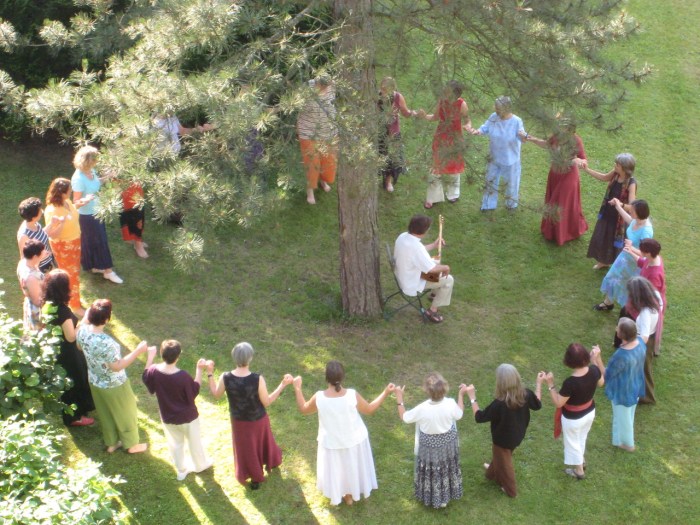


 It should have been a wonderful journey, organized by three dear friends who run a yoga center in Costa Rica. I would be traveling with my husband, these friends, and thirteen other like-minded folk to the
  “Be gentle with yourself.”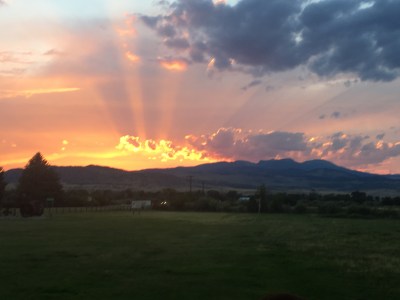

 paying for Trump’s wall because that just isn’t going to happen). If you feel safe enough to push back and say something, especially when someone if being completely and totally rude and inappropriate, always make sure you have an exit strategy. That is either a friend you can call, a room you can go to, or a nap you suddenly want to take. No matter what, if you do choose to engage always remember to a.) Speak calmly and slowly at all times (Republicans are triggered when you yell and provide them with too many facts too fast); b.) Make direct eye contact; c.) Make sure you always have something to take a long sip from afterward to prove you made your point.
 John Erickson is a Ph.D. Candidate in American Religious History and holds two MA’s from Claremont Graduate University. John serves as a commissioner on the California Commission on the Status of Women. He is President of the Hollywood Chapter for the National Organization for Women, a boardmember for the City of West Hollywood’s Lesbian and Gay Advisory Board, a board member for the ACLU of Southern California, the Legislative Action Chair for Stonewall Democratic Club, and a board member for the National Organization for Women.
 Feminism and Religion