Of Snakes, Genocide and Women by Guillermo C. Garcia

On February 23rd 2018, President Trump addressed CPAC (The Conservative Political Action Conference). He put aside his written remarks again and spoke extemporaneously for seventy-five minutes on other issues, including immigration. During that part of his talk, he once more told the story that has become his recurring parable on immigration, one he used on the campaign trail in 2016.[1]

Essentially, it tells the tale of a woman who has pity on a snake she finds in distress. She nurses it back to health, shows compassion and even embraces it. During the embrace, it bites her and as she is dying, she asks “Why?” As Trump told it, the snake answers: “Oh, shut up, silly woman,” said the reptile with a grin. “You knew damn well I was a snake before you took me in.” He continued, “And that’s what we’re doing with our country, folks. We’re letting people in. And it is going to be a lot of trouble. It is only getting worse. But we’re giving you protection like never before.”

What is that protection? A wall, to keep “them” out and “us” in? (In this, The Handmaid’s Tale is prophetic.) Deportation of those who were born before their parents brought them to the U.S.? A media that follows the Trump’s lead in stereotyping immigrants and refugees from the Latin America and other places as illegal aliens, drug dealers, rapists, gang members and terrorists?[2]

Continue reading “Of Snakes, Genocide and Women by Guillermo C. Garcia”

Activism Helps You Heal: #RESIST #NeverAgain by Marie Cartier

Here we are, as I write this,  a week after the horrible shooting of 17 students and teachers in Parkland, Florida. And the beginnings of a new student led movement: #NeverAgain—never another school massacre like what happened in Florida.

Today, one week after this horrific event, you had massive student walk-outs all over the country to protest the government’s refusal to do anything substantive about it. Here are images of student protests.

One of the out spoken survivors of the Parkland shootings, Emma Gonazlez, has turned into a spokeswoman/teen, for the movement, fueled by her fiery speech the day after the shootings.

Emma Gonzalez

She has continued to speak out as have the other students.

And the movement grows. 

I am a college teacher, a college teacher in two public universities. I teach students one to four years older than the students at Parkland. Last week at one of the public schools I teach at there was an active shooter warning that turned into a hoax. I have in the past been on lock down because an active shooter was on campus. This is a very real problem for me.

Today I heard the president of the United States suggest that the solution to the every growing problem of gun violence is to arm teachers or other school officials with weapons. As a black belt in karate, I have had gun training and gun safety as part of my training and it is part of my self-defense resume. I had to learn it. What I can tell you about owning a gun (which I don’t) is that having a gun is not the same as knowing how to us one. I know how to disarm someone, if I am lucky and the fight goes in my favor. Anyone with any experience in self-defense will tell you that the quickest way to escalate a situation is to introduce a gun into the situation.

Continue reading “Activism Helps You Heal: #RESIST #NeverAgain by Marie Cartier”

Exploring Muslimness in the Aftermath of September 11, 2001 by Stephanie Arel

In my last post, I addressed the deeply personal accounts of Haroon Moghul’s self- and religious exploration in his memoir How to be a Muslim: An American Story. This post will broaden that reading to consider an October 2017 interview with Moghul at the 9/11 Memorial & Museum in New York City.

The interview echoes themes relevant to current global crises which implicate religion including how religious rhetoric circulates to support extremist violence and Islamophobia. Exploring how the events of 9/11 intertwine with such crises adds depth to understanding Moghul’s individual experience.

Continue reading “Exploring Muslimness in the Aftermath of September 11, 2001 by Stephanie Arel”

What Happened When I Dared to Wear a Kippah by Ivy Helman

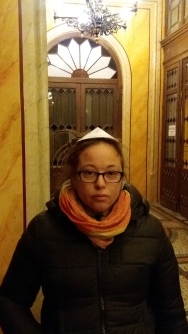
20171203_124919Last week Sunday, my partner and I were in Budapest, Hungary.  We stopped at the Dohany Street Synagogue, the second largest synagogue in the world and the largest in Europe.  After we bought our tickets and proceeded through security, we decided to go into the synagogue first and then the museum.

We walked into the synagogue.  A younger man (maybe 20) was handing out paper kippot (yarmulke in Yiddish).  My partner and I both put our hands out but were refused.  There was an elderly man there who said that the kippot were only for men.  That didn’t surprise me initially as I take my students to the Jewish Museum in Prague and I often argue with the elderly ladies over the right and acceptability of women wearing kippot.  They begrudgingly give my female students kippot saying “only as souvenir,” which boils my blood.  Usually, by the time they give the women kippot even those who traditionally wear them are too shamed to do so.   Continue reading “What Happened When I Dared to Wear a Kippah by Ivy Helman”

“We Say the Silence Has Been Broken” by Carol P. Christ

We treat the physical assault and the silencing after as two separate things, but they are the same, both bent on annihilation. Rebecca Solnit

When I was in my twenties and in therapy I had a recurrent dream in which a strange man was chasing me and caught up with me and started to strangle me and I could not scream. I was asked to act this dream out by my therapist, who told me that this time I would scream. I could not. She got up and came over and put her hands around my neck and started to squeeze. I still could not scream.

Two decades later I had a dream in which I was a baby and suffocating in my crib. I asked my current therapist if she thought someone had tried to suffocate me when I was an infant. Her answer was simple: “There is no need to think about this happening when you were an infant. You have been silenced all your life.” Continue reading ““We Say the Silence Has Been Broken” by Carol P. Christ”

Nobel Peace Prize 2017: ICAN and Those Who Can’t by Elisabeth Schilling

If there is any sanity in the world, it has come from the Nobel Peace Prize of 2017, which was awarded to ICAN, the International Campaign to Abolish Nuclear Weapons. They received the award for the work they have done on the Treaty for the Prohibition of Nuclear Weapons. According to the ICAN site, the agreement was adopted July 2017 and is backed by 122 nations. If signing the Treaty, a nation must agree to refrain from the following:

“[. . .] developing, testing, producing, manufacturing, transferring, possessing, stockpiling, using or threatening to use nuclear weapons, or allowing nuclear weapons to be stationed on their territory. [. . .] A nation that possesses nuclear weapons may join the treaty, so long as it agrees to destroy them in accordance with a legally binding, time-bound plan.”[1] A nation cannot encourage or support another nation to hold them either.

Continue reading “Nobel Peace Prize 2017: ICAN and Those Who Can’t by Elisabeth Schilling”

Moving Toward an End: The Role of the Faith Community in the Struggle to End Domestic Violence by Katie M. Deaver

I have used my last few posts here on Feminism and Religion to begin unpacking the three primary understandings of atonement theology, the feminist critiques of these understandings, and how the relationship between power and violence influences how Christian women view the atonement.  This post will consider the role that faith communities are called to play in situations of domestic violence.

Personal faith often has a huge impact on the lives of survivors of violence.  This impact, unfortunately, as can be seen in the other posts as well as in the comments on those posts, is not always a positive one.  In her book, Redeeming Memories: A Theology of Healing and Transformation, Flora A. Keshgegian envisions communities of faith as communities of remembrance.  A community of remembrance does not ignore or suppress the negative experiences of its members but strives to  enable us to embrace personal identity, form our faith, and to nurture hope in order to heal and transform after such experiences.

One question that my dissertation set out to answer was how we might begin the difficult work of moving our communities of faith in this direction.  Sadly, the biggest difficulty seems to be the lack of awareness, or the downright denial, that domestic violence is an issue for the average faith community.  So many congregation members assume that if their pastor is not talking about an issue then it must not be a problem in their particular community.

Continue reading “Moving Toward an End: The Role of the Faith Community in the Struggle to End Domestic Violence by Katie M. Deaver”

On the Events of Charlottesville, VA by Xochitl Alvizo

It is in our hearts –one’s sense of superiority exists within. We are all and each capable of hate and bigotry.
It is considered the appropriate and necessary response to say that there is no room for it “here” – that we will not tolerate, in this case, white supremacy – here. Except here is exactly where it exists; here in our country, in our cities, in our communities, laws, structures, churches, homes, hearts and mind. The thread of a people’s sense of supremacy (power to dominate or defeat) has been woven into the fabric of this colonialist nation from the very beginning of what has come to be known as the United States of America. Continue reading “On the Events of Charlottesville, VA by Xochitl Alvizo”

A Middle: Understanding the Relationship between Violence and Power by Katie M. Deaver

In my last post here on Feminism and Religion I unpacked the three primary understandings of atonement theology as well as some of the feminist critiques of those understandings.  In this post I’d like to focus a bit more on how the relationship between power and violence influences how Christian women view the atonement.

In her book, On Violence, Hannah Arendt puts forth a new analysis of the relationship between power and violence.  Arendt’s analysis, though primarily focused around concepts of the potential for worldwide destruction and war following major global occurrences such as the Second World War and the struggles for civil and women’s rights within the United States context, supplies an interesting framework with which to consider this relationship as it relates to domestic violence.    Continue reading “A Middle: Understanding the Relationship between Violence and Power by Katie M. Deaver”

Rape, Community and Healing by Vanessa Rivera de la Fuente

During my last months in Cape Town I have been facilitating a series of workshops on Rape, Gender Justice and Culture of Consent. I am blissful for the opportunity to teach and learn with a group of people with whom we have navigated in the approach of Rape and Sexual Assault in their different perspectives, from the socio-political to the intimate tenets.

This has been an exciting journey of healing and soul blooming. I have realized the critical role that Cape Town has played in pushing me towards empowerment and thriving, enhancing my taking back ownership of my body and all the experiences happening through it.

This journey started few years ago when I decided to come out of the closet as a rape survivor. I wrote about it on Feminism and Religion. This was the first step of my breakthrough. Little by little I became confident and shameless about saying: “Yes, I was raped”.

Continue reading “Rape, Community and Healing by Vanessa Rivera de la Fuente”