
A Middle: Understanding the Relationship between Violence and Power by Katie M. Deaver

In my last post here on Feminism and Religion I unpacked the three primary understandings of atonement theology as well as some of the feminist critiques of those understandings.  In this post I’d like to focus a bit more on how the relationship between power and violence influences how Christian women view the atonement.

In her book, On Violence, Hannah Arendt puts forth a new analysis of the relationship between power and violence.  Arendt’s analysis, though primarily focused around concepts of the potential for worldwide destruction and war following major global occurrences such as the Second World War and the struggles for civil and women’s rights within the United States context, supplies an interesting framework with which to consider this relationship as it relates to domestic violence.    Continue reading “A Middle: Understanding the Relationship between Violence and Power by Katie M. Deaver”

Rape, Community and Healing by Vanessa Rivera de la Fuente

During my last months in Cape Town I have been facilitating a series of workshops on Rape, Gender Justice and Culture of Consent. I am blissful for the opportunity to teach and learn with a group of people with whom we have navigated in the approach of Rape and Sexual Assault in their different perspectives, from the socio-political to the intimate tenets.

This has been an exciting journey of healing and soul blooming. I have realized the critical role that Cape Town has played in pushing me towards empowerment and thriving, enhancing my taking back ownership of my body and all the experiences happening through it.

This journey started few years ago when I decided to come out of the closet as a rape survivor. I wrote about it on Feminism and Religion. This was the first step of my breakthrough. Little by little I became confident and shameless about saying: “Yes, I was raped”.

Continue reading “Rape, Community and Healing by Vanessa Rivera de la Fuente”

The Pull of Mara by Oxana Poberejnaia

Recently I need to take a deep breath every time I glance at the news headlines. There are terror attacks and military conflicts. People kill each other and cause each other immense suffering. The worst thing is that so many of these conflicts are between people who have lived side by side for centuries: between related ethnic groups or neighbouring people.
I have found that often, while reading news items about tragedies and injustices, I often take sides. I seem to “naturally” support one warring party. This would depend on ideology, ethnicity, or culture that I share with one of the rivals. This is nothing new. People have been joining their brethren in war for the history of humanity.

However, our time is interesting in that we have access to many opposing views. In my life, every time I take a side, eventually I manage to find information or discover a point of view, which supports the opposite side.

Continue reading “The Pull of Mara by Oxana Poberejnaia”

The Trees and We Breathe Bombs Long Gone by Elisabeth Schilling

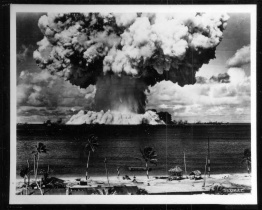
bikini atoll bombI wish that in our pursuit of finding cures for illnesses we would do more as a collective species to prevent the causes, sometimes environmental ones. Why do we vote for people to make decisions that represent us but that we would never in a million years agree to? Bombs and the consequences of them raise questions of health and power. In the Yoga Sutras, 2.30, we read that “Yama consists of non-violence, non-lying, non-stealing, appropriate use of vital energy, and non-possessiveness.” The yamas are our social restraints. They are a negation of behaviors we might usually partake in.

Ahimsā, or non-violence, is listed first. It is the first element of the first limb of yoga; it is the basis for every other ethical aspect of our lives. Bombs are an example of a common and frequent behavior of violence that make the land, water, and sky increasingly uninhabitable. According to Micah Zenko of the Council on Foreign Relations, in 2016 alone, the U.S. is estimated to have dropped 26,172 bombs. Zenko says that this estimate is “undoubtedly low.” (1) This is one year and the bombs from one nation. (2) What is the environmental impact of all of the bombs dropped from every nation since the beginning of bombing history?

When a bomb is detonated, there is not only harm to the immediate life in that vicinity but life in the future and far away. According to the International Campaign to Abolish Weapons (ICAN) website, “the International Physicians for the Prevention of Nuclear War has estimated that roughly 2.4 million people will eventually die as a result of the atmospheric nuclear tests conducted between 1945 and 1980, which were equal in force to 29,000 Hiroshima bombs.” (5)

According to a statistic updated March 2016 on the Ploughshares Fund website, nine countries in the world have a total of 14,900 nuclear weapons, the U.S. and Russia holding 93% of them. (3) They have been used twice, both times by the United States, in war, but additionally they have been used in tests over 2,000 times in more than 60 locations over the globe, according to ICAN. (4) There are already unavoidable consequences to the earth and humans because of this irresponsible behavior that is ongoing.  These tests occur in the atmosphere, under the earth, and under water. (6) Continue reading “The Trees and We Breathe Bombs Long Gone by Elisabeth Schilling”

A Beginning: Atonement Theology and the Feminist Critique by Katie M. Deaver

Since many of the comments on my last post expressed interest in my dissertation topic I will use my next couple of posts to talk a little bit more about my work and research in that area.  When we talk about theories of the atonement we are trying to describe a narrative structure of what took place within the Christian cross event.  Generally speaking, Christians believe that atonement serves at the reconciliation between God and humanity and that this reconciliation is realized through the person of Jesus Christ.  The three primary theories that try to explain this event are Substitutionary/Satisfaction, Moral Influence, and Christus Victor.

The Substitutionary/Satisfaction theory of atonement suggests that Christ takes on the guilt and punishment that humanity deserves because of our sinfulness and so becomes our substitute, paying the debt we owe for our sins.  Because of humanity’s sinfulness we deserve death, but instead of giving us what we deserve God instead offers God’s son as a sacrifice to pay our debt, to atone for our sinfulness, and to save us from the eternal punishment of death.

The Moral Influence theory of the atonement focuses primarily on the life and ministry of Christ rather than on his suffering and death.  This theory is centered on the belief that God loves God’s creation so much that God would hold back nothing from us, God would even give God’s own Son in order to save us and remain in relationship with us.  As a result this theory encourages Christians to live as Christ lived and focuses on imitating his life and ministry in order to bring about justice in our own world.

Continue reading “A Beginning: Atonement Theology and the Feminist Critique by Katie M. Deaver”

Becoming Myself by Katie M. Deaver

Last weekend was a special one for me.  After many years of study and dedication I graduated with my Ph.D. and am now, officially, Dr. Katie Deaver.  The weekend was filled with celebrations to mark the completion of a milestone that I have spent years working toward.  The amazing outpourings of love, support, and care that I have experienced throughout the last few days is quite humbling.  The happiness and pure joy of my family, friends, professors, mentors, and multiple church communities have left me in awe.  As I reflect on this love and support it helps to heal the wounds and scars that have accumulated throughout the process of earning this degree.

The undertaking of a Ph.D. program is significantly more difficult than anyone tells you.  This difficultly lies not necessarily in the course work or the dedication to constant reading, writing, and learning but rather in the personal growth and vocational affirmation that takes place within the process.  My dissertation explored the primary understandings of the doctrine of atonement and addressed how this doctrine can, and has, been used in ways that perpetuate, and in some cases even encourage, domestic violence.

My own fascination with the topic of atonement and its links to domestic violence was brought about at the suggestion of one of my undergraduate professors at Luther College, Dr. Jim Martin-Schramm.  From the moment that Dr. Martin-Schramm explained the links between theologies of the cross and domestic violence I knew that I had found my new passion.  Writing a dissertation on the topics of domestic violence, theology and women of faith was an extremely personal, and intimate experience for me.  This topic forced me to accept my own lived experience.  To claim myself… out loud… as a survivor of domestic violence. As a result the writing of my dissertation was particularly personal, and painful, as well as extremely life giving.

Continue reading “Becoming Myself by Katie M. Deaver”

Reflections on Trauma, Part I: Pink Pussyhats by Stephanie N. Arel

stephanie-arelI have been thinking frequently about trauma, about what perpetuates suffering and what supports the arduous journey of transforming traumatic experiences, especially in the aftermath of traumas of human design. The violation of bodies lies at the heart of such traumas. Thus, how we practice behaviors that refuse to denigrate bodies are critical and necessary to alleviating suffering and promoting the body’s dignity.

This idea of restoring the body’s dignity after trauma is magnified by the reality that trauma remains, stored in our bodies as a residual reminder of the traumatic event (s). Bessel van der Kolk reminds us, “The body keeps the score.” Continue reading “Reflections on Trauma, Part I: Pink Pussyhats by Stephanie N. Arel”

What My Mothers and Mentors Taught Me about Self-Care by Elise M. Edwards

Elise EdwardsDuring another week of killings, war, protests, and debates about whether Black Lives Matter or Blue Lives Matter, I’m concerned about the toll it takes on those who are witnessing the violence and fighting for justice.

I’m not on the front lines of these battles, but I can feel my energy draining, nonetheless. Over the past few days, while I’ve stayed informed about the latest tragedies and conflicts, I’ve intentionally limited my exposure to most news and social media outlets. I’ve begun preparing for a contemplative retreat with other women who also care about justice.  For me to continue to participate in any effort of transforming society, culture, or the church, I must nurture my mind, spirit, and body.

Audre Lorde put it like this:

“Caring for myself Is not self-indulgence.  It is self-preservation, and that is an act of political warfare.”

Self-care is a radical practice of self-love. It is absolutely necessary when engaged in conflict against those who do not show love to you, or worse, those who seek to destroy you.  Your survival and your flourishing are defiantly brave.  Self-care honors the God who created you, the One who loves you, and the Spirit who sustains you. Continue reading “What My Mothers and Mentors Taught Me about Self-Care by Elise M. Edwards”

Sorrow Filled Solidarity by Anjeanette LeBoeuf

AnjeanetteOn an unexpected weekend in June, the city of Orlando was rocked with a string of violent attacks that created an earthquake of shock, grief, fear, hurt, and a sadness too terrible to name, that all ends of our globe have felt. It started with the shocking shooting of the young YouTube celebrity, The Voice reality contestant and established musician 22-year-old Christina Grimmie, gunned down by a deranged young man before he in turn killed himself. It ended with the horrific mass shooting at the gay bar Pulse, where 49 men and women lost their lives, and countless more saw their lives forever altered, shaken, and shattered.

Continue reading “Sorrow Filled Solidarity by Anjeanette LeBoeuf”

#OrlandoStrong: Yes, Baby, the Gay Bar is Still Our Church – Still Our Religion by Marie Cartier

Marie Cartier photo by: Greg Zabilski

The worst gun massacre in United States history happened in a gay bar, PULSE, Sunday, June 12, 2016 in Orlando, CA.

It happened during the United States Pride month of June which commemorates the Stonewall riots of June 1969. The Stonewall riot was the first televised riot over a period of time (approximately one week) allowing members and supporters of the LGBTQ community to join the protests against police violence and harassment.

Today’s many social media platforms allow us to respond more quickly than they were able to in 1969. By the eve of June 12, 2016 memorials and vigils were happening around the country. I attended one in Long Beach, CA, at which a couple hundred folks lit candles, sang and mourned. By the following evening I was at a vigil for Orlando in Los Angeles attended by many thousands at which, in Los Angeles style, the reading of the victims’ names began with an emotional tribute to the victims by Lady Gaga. I have included here a video of the reading of the names.

Long Beach vigil
Long Beach vigil

Continue reading “#OrlandoStrong: Yes, Baby, the Gay Bar is Still Our Church – Still Our Religion by Marie Cartier”