This information was originally distributed by WATER:
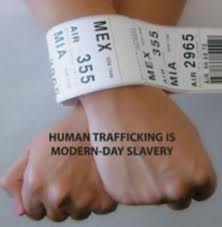
January 11th is National Human Trafficking Awareness Day. Human trafficking, referred to as modern-day slavery, is the fastest growing and second most profitable criminal industry in the world. More than 27 million women, men, and children have become victims of human trafficking for labor and sexual exploitation. Trafficking can and does occur in all parts of the world, including the U.S. Large sporting events like the Super Bowl attract human trafficking, especially for sexual exploitation of women. Read Mary E. Hunt’s new article on human trafficking entitled “Women and Children First.”
The other day when Paula McGee asked on this blog how Penn State students could rally in support of Sandusky, I was also reading a student paper quoting Rianne Eisler’s opinion that peace and environmental justice cannot be achieved in dominator cultures. Xochitl Alvizo commented that we should not be surprised by the reactions of the students as we live in a “rape” culture. I would add that we must examine the culture of male domination through force that is “football,” one of the “sacred cows” of American patriarchy, just as we need to examine the culture of hierarchical male domination of the Vatican in the context of child-rape by priests. Continue reading “Football as a Ritual Re-enacting Male Domination Through Force and Violence By Carol P. Christ”
Dr. Mercy Oduyoye is the Ninth Annual Patricia Reif Lecture speaker and will present “Women and Violence in Africa: the Plight of Widows and the Churches Response” on Monday, November 14, 2011 at 7pm at the Mudd Theater on the Claremont School of Theology campus. Oduyoye is Africa’s foremost feminist theologian whose contributions have greatly impacted worldviews on gender and religion. I am familiar with Oduyoye’s work and today had the honor to meet her in person and have a one on one conversation about violence against women, feminism, and religion.
Oduyoye was incredibly gracious and entertained all my questions about her work, her insights in regards to violence against women, and her thoughts about feminism and religion and where the field is going. She explained that although some believe feminism is dead, the marginalization of women continues to be a serious issue. Although the issues women face change over time, women continue to be oppressed. According to Oduyoye, we must recognize that the issues women faced 50 years ago are different from the issues women face today; however this does not mean that gender-based inequalities have seized to exist. Rather, it means that the culture has manifested itself in a new way. We must come to recognize this and continue to work towards the eradication of gender-based violence. Continue reading “Dr. Mercy Oduyoye and the Ninth Annual Patricia Reif Lecture By Gina Messina-Dysert”
Much of my research and activism thus far has centered on rape culture*, sexual violence, and spiritual wounding. This being said, I have given little consideration, and have shared even less, of my own experience of sexual harassment perpetrated by a professor at the end of my undergraduate career. Although I had called myself an advocate for women who had been victimized by various forms of violence, sexual included, I was unable to advocate for myself when confronted with my experience. What’s more, although I have called for a speaking out of one’s experience of sexual violence in order to challenge the rape culture and begin the healing process, I have not been able to do this myself.
My professor sexually harassed me during my final semester of college in the very last course I needed to graduate. The first time he approached me he asked me to stay after class. Initially I was nervous thinking I had done something wrong; however I was surprised when he began to ask me personal questions. I was engaged at the time and Dr. X commented how lucky my now husband was. He then reached out, hugged me, and stroked my hair. I didn’t move, I was scared and wondered what was happening. After a few moments, I forced myself out of his arms and with my head down, unable to look him in the eye, I said I had to leave and darted out the door. My initial reaction was to downplay his inappropriate behavior and I convinced myself that I must have misinterpreted the situation. Continue reading “Confronting Sexual Harassment Ten Years Later: Speaking Out, Empowerment, and Refusing to Accept Defeat By Gina Messina-Dysert”
Jaji Crocker received her MFA in Creative Writing from Northwestern University, and is now pursuing a dual degree at Claremont Graduate University, studying for her PhD in English and MA in Religion. Her research interests and approach are innately interdisciplinary as she explores the evolution of the ethics buttressing and changing religious philosophies and practices in North America and the Middle East, as well as the evolution of the theological imagination and feminist influences in post WWII American literature. Jaji continues to write fiction and teach creative writing.
“Are you going to the Vagina Monologues try-outs tonight?” my friend asked me last year after class.
“I hadn’t planned on it,” I replied cautiously. Truth be told, the word ‘vagina’ made me uncomfortable. There were yearly productions of the Vagina Monologues at my undergraduate institution, but I never went. I thought it was a time when women gathered and performed monologues they had written, and I thought it demeaning to have these monologues named metonymically. I did not want to be associated with the Monologues: I was in favor of women’s equality, but I did not want to claim my sexuality in so visceral a manner. In my mind, the ‘Vagina’ of Vagina Monologues just referred to the actresses, not the content.
Imagine suffering a miscarriage. All of us have or know someone who has suffered one; I had two. For me it was a terrible time and I still remember the day of loss and the expected due date. We all cope differently with this loss, but it is just that – a physical and/or emotional loss. Statistically 15-25% of women in childbearing years will suffer a miscarriage anywhere from 5 to 20 weeks gestation. In the United States, when we suffer a miscarriage we go to the hospital. Often times the visit results in a dilation and curettage (or D&C) to stop bleeding and possible infection. For me this was also done after the doctors removed the baby girl that was dead inside of my womb.
If this would have occurred in certain Latin American countries, especially in El Salvador, Chile, Colombia, Malta, Nicaragua, and even Mexico, the emergency room doctor would notify the authorities of my miscarriage and I would be arrested and jailed anywhere from 3-50 years for having an “abortion.” El Salvador even has a prosecutor’s office responsible for crimes against minors and women whose responsibilities are capturing, trying, and incarcerating women who have abortions and miscarriages. In this office, there are police, investigators, medical spies, and forensic vagina inspectors. Medical providers have an obligation to report abortions; this is focused more on young uneducated and impoverished women. For these women, there is no presumption of innocence; they are guilty. Continue reading “Criminalizing Miscarriages: Latin America’s Zero Tolerance Policy on Abortion By Michele Stopera Freyhauf”
Terrorism is a worldwide issue, not specific to one religion. While we attribute the atrocities of 9/11 to Islamic extremists, Christianity has a long history of imposing terror, especially on women. Phyllis Trible’s book Texts of Terrordescribes texts in the Old Testament that causes harm to women, i.e. abuse, betrayal, torture, rape/gang rape, and mutilation (See Genesis 16, 21; 2 Samuel 13:1-22, Judges 11:29-40, 19:1-30). Texts such as these are used to validate violence against women, because of the fundamental view that the text is divinely revealed or God’s own words.
This phenomenon is not specific to the Old Testament. Writings in the New Testament are used to put women in their place, define their role in church, family, and society. The remedy for disobedience allows for violence to be committed against the offender. The most damning of these texts are derived from the Pastoral Epistles (1 Timothy, 2 Timothy, and Titus). Here, women’s place and role in society is defined. Women should be silent, submissive, and subservient to men. Women are to be veiled, dress modestly without adornment, no gold or pearls. Finally women are not permitted to teach and have no authority over men (See 1 Timothy 2:9-15). Continue reading “Using the Bible to Promote and Impose Terror on Women By Michele Stopera Freyhauf”
The following is a guest post written by Rev. Kittredge Cherry, lesbian Christian author and art historian who blogs about LGBT spirituality and the arts at the Jesus in Love Blog. Her books include “Equal Rites” and “Art That Dares: Gay Jesus, Woman Christ, and More“.
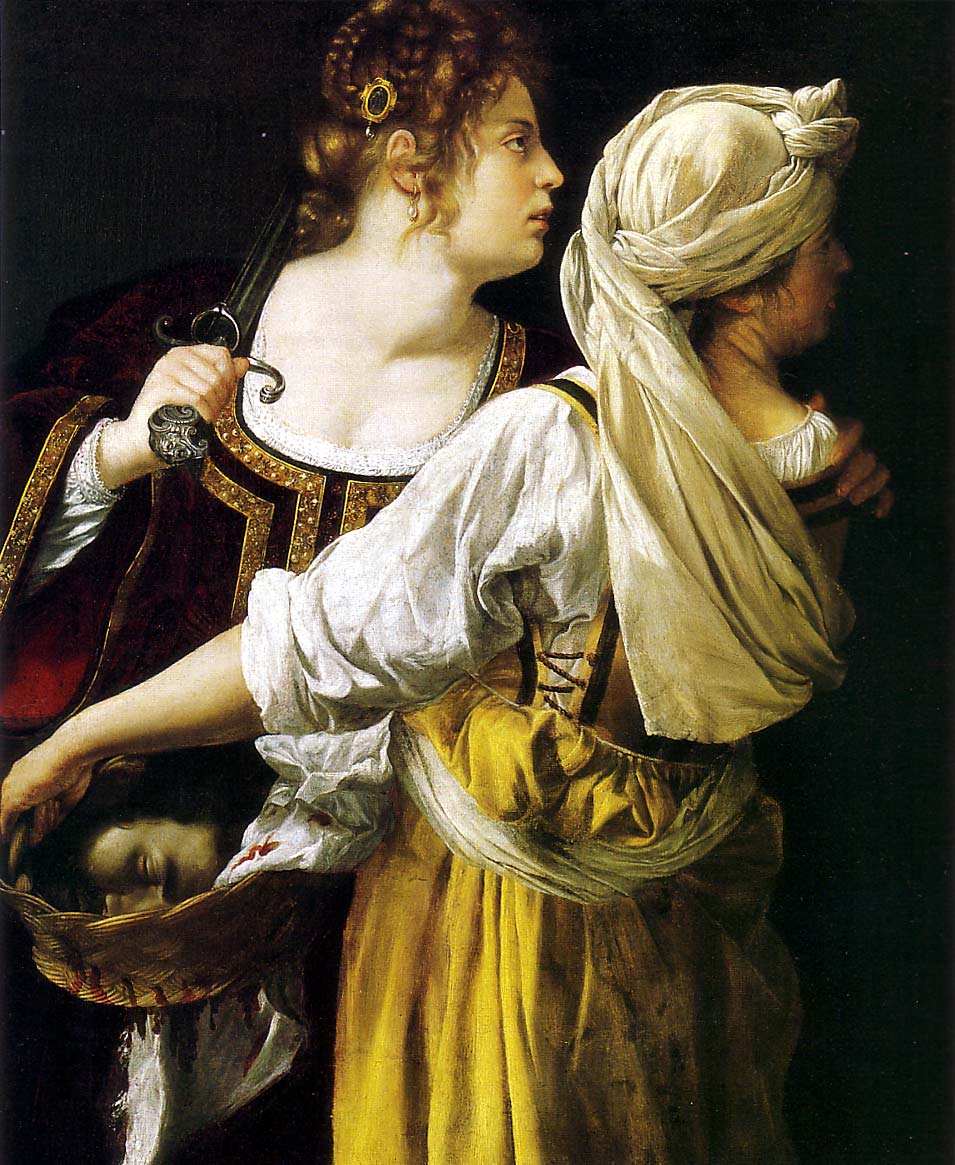
Baroque artist Artemisia Gentileschi inspires many with her paintings of strong Biblical women — created despite the discrimination and sexual violence that she faced as a woman in 17th-century Italy.
Gentileschi (1593–1652) was successful in her own day, but was mostly written out of art history until the 1970s, when feminist scholars rediscovered her work. Now she is celebrated in many books, films and plays, and her work is widely reproduced. Her greatest paintings include “Judith Beheading Holofernes” and “Susanna and the Elders.”
Many women and queer people can relate to her battles against prejudice and sexual violence, documented in her rape trial in 1612. She could be considered the patron saint of women artists.
"Judith and Her Maidservant" by Artemisia Gentileschi
Although Gentileschi was apparently heterosexual, lesbians have drawn energy from her life and art.
Lesbians who have created tributes to Gentileschi include painter Becki Jayne Harrelson and playwright Carolyn Gage. In the play “Artemisia and Hildegard,” Gage has two of history’s great women artists debate their contrasting survival strategies: Gentileschi battled to achieve in the male-dominated art world while Hildegard of Bingen found support for her art in the women-only community of a medieval German nunnery.
The daughter of a painter, Gentileschi was born in Rome and trained as a painter in her father’s workshop there. She was refused admission to the art academy because she was a woman, so her father arranged for her to have a private painting teacher — who raped her when she was about 19. Gentileschi herself was tortured by thumbscrews during the seven-month rape trial, but she stuck to her testimony. The teacher was convicted, but received a suspended sentence. Continue reading “Artemisia Gentileschi: Baroque artist and rape survivor painted strong Biblical women, By Kittredge Cherry”
Recently Gina Messina-Dysert, on this blog, wrote about rape culture and the church’s role in preserving it instead of challenging the norm of violence against women and victim blaming. And in my last post, after having just watched the last installment of the Harry Potter movies, I wrote about Lily’s love for Harry as being what saves Harry and not the sacrifice of Lily’s life; my point being that we need to give more credit to love as salvific and redemptive and not to sacrifice or suffering. For too long within Christianity, Jesus’ death and ‘sacrifice’ have been held up as the core, the essence, the heart of Christianity – wrongly giving it a necrophilic emphasis that I do not believe is actually faithful to the Christian tradition. All this reminds me of why feminism is critical to my ability to stay within Christianity and that without feminism I would not be able to be a Christian-identified woman.
Every day in both small and enormous ways I see the effects and embedded patterns that result from the long history and dominance of patriarchy/kyriarchy. Everything from sexism and racism, to capitalism and the destruction of our world, these destructive systems are part of our daily environment and affect the quality of all our lives in devastating ways. And perhaps it is because I am a woman and I am directly and existentially affected, but, sexism, misogyny and violence against women are the things that most crush my spirit and break my heart. As I see these insidiously at work in many aspects of our society, and see the effects these have on us, women and men alike, I am saddened and angered to a level for which I have yet to find words to express. I feel it, the insidious trauma of sexism, misogyny, and violence against women, I feel their effects on me and others, but do so usually in silence or in tears. Lump in my throat. No words to speak. All I can do is continue in my commitment to live in a way that is different from these – in a way that is biophilic and affirming of all people as sacred and divinely in-Spirited. Continue reading “Speaking of Sacrifice and Rape Culture…by Xochitl Alvizo”


 This information was originally distributed by WATER: