Who Gets to Define What it Means to be Pro-Life? by Janet Maika’i Rudolph

The sky and sun on June 7th in the afternoon on Long Island.

Today I am coughing and choking here on Long Island because of our unhealthy air quality.  The smoke from the wildfires of Canada have reached us. We, here in NY, are not alone in dealing with air so polluted that breathing is at risk. I think of the CA wildfires, the SpaceX rocket that exploded in April, the Ohio train derailment in Feb. No place is safe.

While coughing and thinking about this, two bits of news came into my consciousness, The first was the Supreme Court ruling narrowing the scope of the Clean Water Act.

My first thought was, do they and their children not have to live in this world too?  Do they think they can buy a clean environment for themselves and their families and the rest of us be damned? 

The next report I heard was from a prominent conservative commentator who explained how “prolife” he is and went on to describe his “deep concern” for life.

Continue reading “Who Gets to Define What it Means to be Pro-Life? by Janet Maika’i Rudolph”

Women’s March in CA 1/22/23 by Marie Cartier

WOMENS MARCH, Long Beach, California on the 50th anniversary of the passing of Roe v Wade,
January 22, 2023

Continue reading “Women’s March in CA 1/22/23 by Marie Cartier”

Why Feminism Needs the Fierce Goddesses by Susan Foster

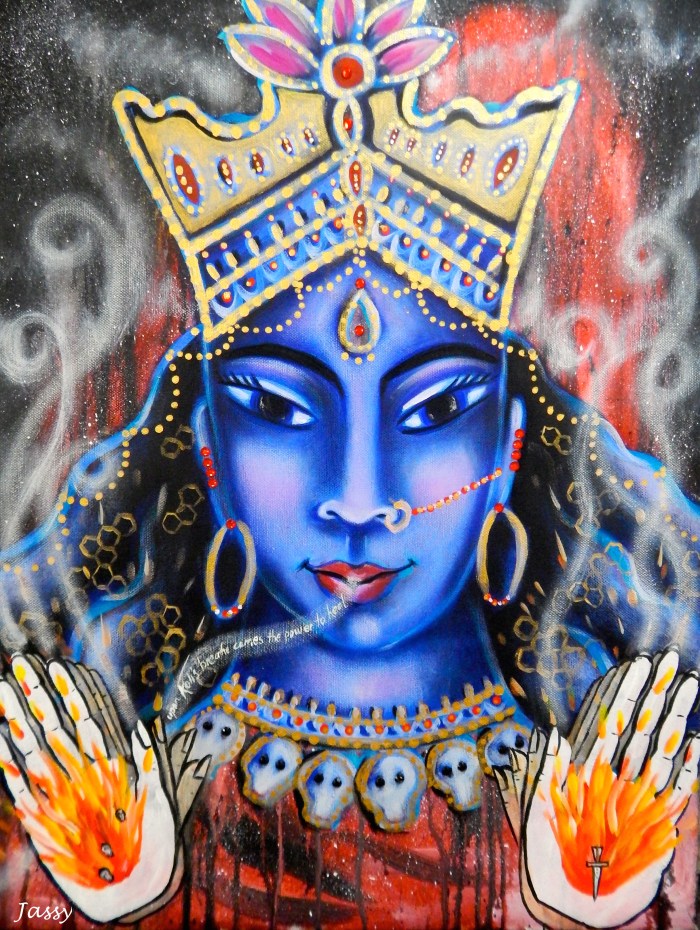
Kali Ma – She who carries transformation upon Her breath.

The recent backlash against women and feminism, highlighted by the Supreme Court decision overturning Roe v. Wade, has left many people asking: Is feminism dead? Or if it isn’t dead, is it lost? The decision dealt a blow to one of the most basic freedoms of women—control over their own bodies. In the rush to protect the life of embryos and fetuses, the lives of millions of women will be compromised if not lost altogether, especially poor and BIPOC women.

The Court is inflicting its right-wing views on a country that does not share its values; a majority of Americans support a woman’s right to abortion. “The “triumphal right,” says Susan Faludi in an interview with Michelle Goldberg, “has taken the gloves off and is pursuing a scorched-earth campaign against women’s most fundamental rights.” [i] And although the feminist movement cannot be reduced to the fight for reproductive justice (with issues such as maternity leave, equal pay, childcare, healthcare, etc., still on the table), banning abortion has become the tip of the patriarchal iceberg.

Continue reading “Why Feminism Needs the Fierce Goddesses by Susan Foster”

Women, Life, Freedom زن زندگی آزادی : Let’s talk about the protests in Iran by Anjeanette LeBoeuf

Trigger Warning: This post deals with violence towards women, violence towards humans, and egregious abuses of power.

Women, Life, Freedom; Zan, Zendegī, Āzādī;  زن زندگی آزادی has become one of the main slogans for an incredibly important and crucial global protest that is taking place right now. For over 2 months, life and death protests are taking place in Iran. The protests are focusing on the perpetual degradation of human rights with women bearing a large brunt. Many have declared the current state affairs as gender apartheid. We need to be talking more about what is happening with the people of Iran and how best to support them. The protests were started after the brutal murder of a woman due to a portion of her hair being visible outside of her hijab.

Continue reading “Women, Life, Freedom زن زندگی آزادی : Let’s talk about the protests in Iran by Anjeanette LeBoeuf”

For Mahsa by Lori Stewart

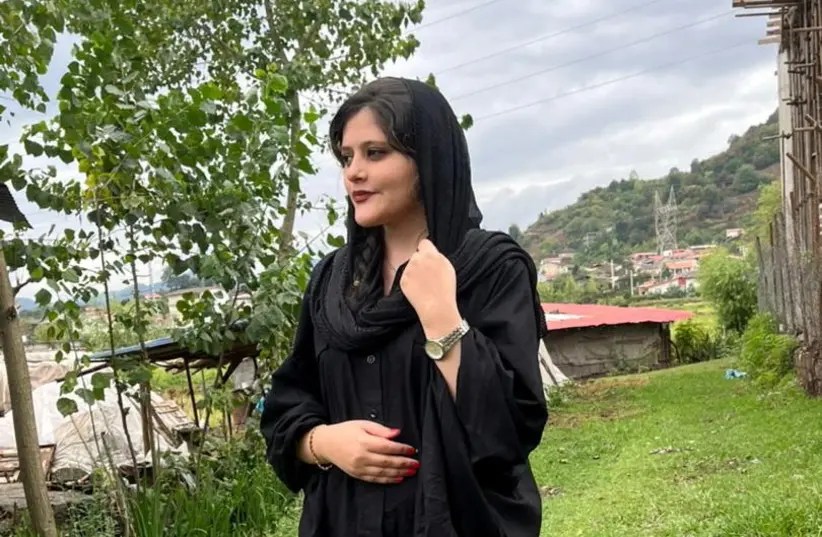
On Friday, September 16, 2022 Mahsa Amini died in a Tehran hospital having been arrested by Iranian morality police on September 13 for wearing “inappropriate attire”. She was 22. Mahsa’s family claims she had bruises to her head and limbs from being beaten. The Iranian police dispute that claim saying Mahsa died from a pre-existing health condition.

Mahsa’s death sparked major protests against the Islamic Republic in Iran and protests of support are occurring around the world. Women are burning their hijabs, which they are mandated by Iranian law to wear, chanting, “Women, life, freedom”. They are cutting their hair which is a longstanding symbol of protest and loss in Iran’s history. This action harkens back to the epic Persian poem “Shahnameh” by Ferdowsi in which hair is a theme and the cutting of hair a symbol of mourning. Around the world, people have followed suit by cutting their hair in solidarity with the protesters in Iran. A recent chant by the protesters is “it’s the beginning of the end” as they challenge their theocratic government.

Continue reading “For Mahsa by Lori Stewart”

Death By Drowning: A Poem Written the Day After The Supreme Court Overturned Roe v. Wade by Marcia W. Mount Shoop

Today at 10:06am
I found him
belly up
only a little bloated
water his deep
dark grave.

Turn the bucket
over
Talk gently
“How long have you been
in here, friend?”

Turn him over
his final rest
decomposing leaves,
Poison Ivy canopy
Sets off the blue

Continue reading “Death By Drowning: A Poem Written the Day After The Supreme Court Overturned Roe v. Wade by Marcia W. Mount Shoop”

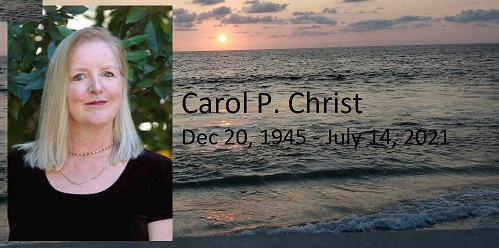
The Legacy of Carol P. Christ: “We Say the Silence Has Been Broken”

We treat the physical assault and the silencing after as two separate things, but they are the same, both bent on annihilation. Rebecca Solnit

When I was in my twenties and in therapy I had a recurrent dream in which a strange man was chasing me and caught up with me and started to strangle me and I could not scream. I was asked to act this dream out by my therapist, who told me that this time I would scream. I could not. She got up and came over and put her hands around my neck and started to squeeze. I still could not scream.

Two decades later I had a dream in which I was a baby and suffocating in my crib. I asked my current therapist if she thought someone had tried to suffocate me when I was an infant. Her answer was simple: “There is no need to think about this happening when you were an infant. You have been silenced all your life.”

When I was a child, my father used to punish us by taking off his belt, sitting down, asking us to pull down our pants and lie across his lap, and then lashing our bare bottoms with his belt. This was typical child-rearing practice in the 1950s and 1960s. Rita Nakashima Brock was the first to name it for me as child abuse. Nonetheless, when we got older, my brother and I preferred to be spanked, rather than to have our 25 cents a week allowance taken away from us. At least, we thought, being spanked was over in a minute, while losing your allowance was something you would suffer for a long time.

Continue reading “The Legacy of Carol P. Christ: “We Say the Silence Has Been Broken””

From Footbinding to Abortion and Beyond – This Has to Stop! by Janet Maika’i Rudolph

Children’s Museum of Indianapolis

My husband, Marty, is a retired podiatrist.  He worked in pockets of New York City that were poor and largely immigrant. When he first started his practice, he treated women from China whose feet had been bound. Despite being officially outlawed 1912, footbinding was still being practiced well into modern times. He saw these patients in the 1970s and 80s.

For those who don’t know what it is, young girls, as young as 3-5 would have the bones in their feet broken and then the feet bound with cloth strips. Every few years, the feet would be broken again until the desired result was created. To create that affect, the toes would be flattened against the bottom of the foot and arch would be so broken and damaged that the heel would curl back to the front of the foot. At each of the breakings the girl would need to learn to walk again.  One can only imagine that pain of walking on foot bones that had been repeatedly broken. And here is an especially chilling part. The mothers would do it to their own daughters. I won’t go into further gruesome details because they can be easily looked up on the internet.  It left the girls crippled for life.

Continue reading “From Footbinding to Abortion and Beyond – This Has to Stop! by Janet Maika’i Rudolph”

Patriarchy and the Supreme Court by Janet Maika’i Rudolph

I am pissed! I wrote this blogpost the day after Beltane when the leaked draft of the Supreme Court majority opinion regarding Roe v. Wade was leaked to the public. I was up anyway feeling the effects of PTSD. Lessons that Carol P. Christ wrote about and brought to my own consciousness were rattling around my head. The first is her definition of patriarchy: “patriarchy is a system of male domination in which men dominate women through the control of female sexuality with the intent of passing property to male heirs.” This definition was part of a 3-part series she wrote (and we recently re-posed in her legacy posts) beginning here.

They are all well worth reading.

I was raped in 1977 when I was 22 years old. This after being abused by my father. I never got pregnant, but I was suicidal after the rape. Had I been pregnant without recourse to ending it, I would without a doubt have stabbed myself in the stomach or reached for that metal coat hanger. (I was too young to face pregnancy when my father abused me.) Had the result been my own death, that would have been warmly welcomed on my part. To this day, I still self-mutilate at times when stress becomes too much.    

Continue reading “Patriarchy and the Supreme Court by Janet Maika’i Rudolph”

Walking With Aletheia by Jean Hargadon Wehner – Book Review by Janet Maika’i Rudolph

Trigger Alert: There is discussion of sexual violence.

“I transformed from terrified victim to a courageous survivor . . .Different than an ‘out of body’ experience, this felt more like an ‘in-body’ experience. I stood my ground and did what I had to do to get the hell out of there.” Jean Hargadon Wehner (pg 89).

In 2017, a Netflix documentary came out called The Keepers. It is the story of abuse and torture that was not only allowed but protected by the Catholic Church. Jean was featured in the series as the linchpin who helped to uncover and bring to light the atrocities. Our own Carol Christ watched the seven-episode series when it came out and wrote a blogpost about it. FAR reposted that blog at the end of February to honor Jean who has now written her own book, Walking with Aletheia. In it she describes her own healing journey or as she calls it her “health walk” out of the wreckage of that horror. For more on The Keepers, you can read Carol’s post here (which also includes Jean answering some questions about her story). This book is Jean’s story which, while intricately intertwined with the Church, is ultimately about her own pathway to spirituality and healing.

It’s hard to imagine the emotional weight of the authority figures that bore down on Jean when she was a student at Baltimore’s Archbishop Keough High School in the late 1960s. Not only did two priests torture and abuse her but they drew in other Church officiants as well as the police. The legal system actively turned its collective back to her. It is a great gift that she has survived and a testament to her strength, inner creativity, and the love in her heart that she was able to navigate such an apocalyptic terrain. The instruments of the torture were horrendous including rape, sex trafficking, drugs, and mind control techniques.

Continue reading “Walking With Aletheia by Jean Hargadon Wehner – Book Review by Janet Maika’i Rudolph”