Born two-hundred years ago in 1821, Mary Baker was raised by a doting mother and strict father. By the age of twenty-eight, she endured personal crises typical to privileged white girls. Lost lovers and unfulfilled dreams. Mary wed her second husband, Daniel Patterson, in 1853, fancying he would make things better. But in 1857, while ill in bed a few weeks, forlornly pining her dead mother, Mary noted in her scrapbook, “My dear dear…Mother waits for me in the far beyond and through the discipline, the darkness and the trials of life, I am walking unto her.”
In 1861, Daniel urged Mary to investigate mind-cure and wrote a letter to practitioner, Dr. Phineas Quimby, to request treatment for Mary’s periodic spinal and emotional challenges.
But the plan was interrupted by another crisis. The American Civil War (1861-1865).
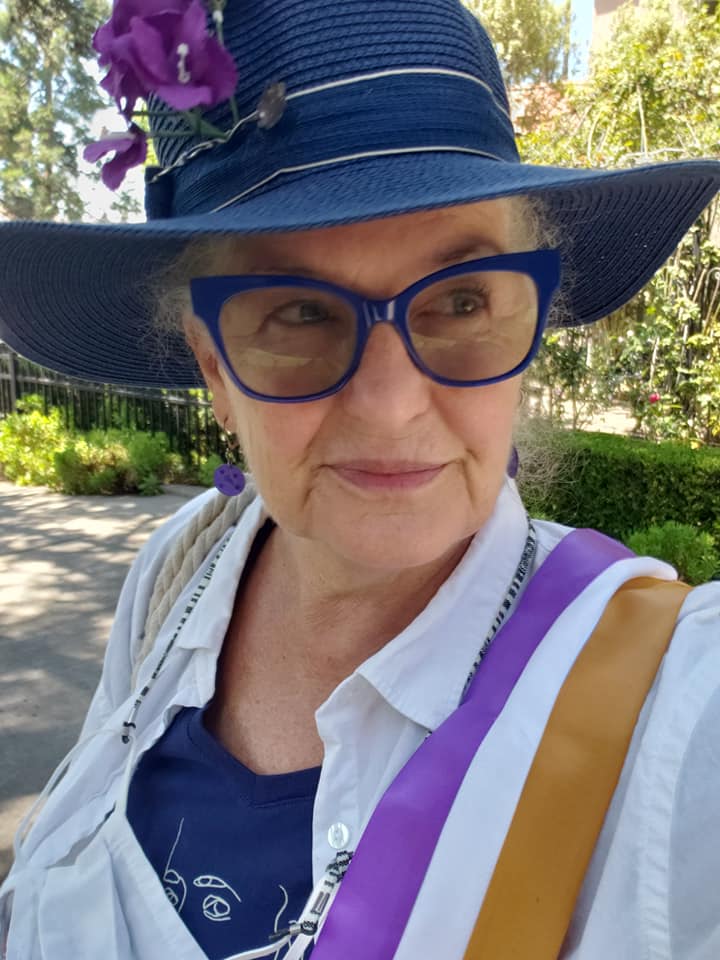
Dear FAR readers – please find photos from a celebration of the 101 anniversary of women’s suffrage, the 19th Amendment, that I attended August 26, 2021. That day marks the end of the 100th year of women having the right to vote.
The third day dawns under a cloud. Mourning doves spread their wings across leaden skies. I am walking on air. Two restless nights – a huge truck in the yard – Blocked, my stomach lurches. I read Tributes in a daze. Fierce Little Flower Warrior Woman fights a torrent of waves. She is bridging raging waters forging a New Story.
“Weaving the Visions.” Oh, now I remember where it all began.
She hugged a tree. I plant a seed. Listening to rounds of “light and darkness” I let my body lead.
A serpentine path guides me back to Her Garden. Cradled by Ancestors Rooted in Body I shed another patriarchal skin.
Carol P. Christ A Symposium in Celebration of Her Spiritual-Feminist Activism and Women’s Spirituality Scholarship
“The Goddess is the intelligent embodied love that is in all being.” ~ Carol P. Christ
Free Symposium via Zoom hosted by Women’s Spirituality Graduate Studies ProgramCalifornia Institute of Integral Studies October 22, 2021. 10:00 am to 4:00 pm
Call for papers focusing on Carol P. Christ’s scholarship and activism in the key areas of Women’s Spirituality, Goddess Studies, Ecofeminism, and Women and Religion.*
Please speak to what you think and feel are Carol P. Christ’s most important contributions to one of the academic fields listed below, and then also, to how her writings are important to you personally. We will arrange papers into the following six panels of 3-4 presenters.
Ecofeminist Philosophy and Activism
Goddess Studies and Egalitarian Matriarchal Studies
Spiritual Feminism and Peace Activism
Spiritual Feminist Literary Criticism
Women and Religion
Women’s Spiritual Pilgrimage
Please send an abstract of your proposed paper (in 300 words or less) to Mara Lynn Keller at mkeller@ciis.edu, by Wednesday, September 16, 2021. Acceptances will be sent out Friday-Monday, 9/24-27/2021. Papers are to be 12 minutes in length.
*Primary Sources include:
Diving Deep and Surfacing: Women Writers on Spiritual Quest (1986)
Woman Spirit Rising: A Feminist Reader in Religion, anthology co-edited with Judith Plaskow (1992)
Odyssey with the Goddess: A Spiritual Quest in Crete (1995)
Weaving the Visions: New Patterns in Feminist Spirituality. Anthology co-edited with Judith Plaskow (1989)
Laughter of Aphrodite: Reflections on a Journey to the Goddess (1987)
Rebirth of the Goddess: Finding Meaning in Feminist Spirituality (1998)
She Who Changes: Re-imaging the Divine in the World (2004)
Goddess and God in the World: Conversations in Embodied Theology. Co-authored with Judith Plaskow (2016)
In addition to the panels, the Symposium will include: In Memoriam: Ritual Honoring Carol’s Life and Death (1946-2021) Circle of Remembrance: Personal reminiscences and reflections on Carol’s life and work.
A horizon belching sooty smoke pollutes once pure air pressing invisible particles, ozone into granite – lichen covered mountains – plant/animal lungs are coated in filth just as ours are. Death hangs over a leaden sky, the sweet scent of moisture is absent. Tomorrow’s bitter orange sunrise signals what many still refuse to believe: The Earth is on Fire. Those of us capable of Love – Animals, plants, Humans, who suffer, those who fought for justice continue to grieve in a Silence impossible to break. Change, if it comes at all will come too late. Humans have had 40 years to prepare… The age of the Anthropocene will not survive a species gone insane.
Long a fan of Surrealist artist Leonora Carrington, I was initially hesitant when the New York Review of Books reissued her 1974 novel, The Hearing Trumpet. I didn’t know what to expect when this extraordinary painter picked up a pen.
To my delight and surprise, Carrington shows the same artistry and whimsy in her writing that she does in her painting. She also reveals herself to be an astute feminist and aficionado of the Goddess, well-versed in arcane lore, with which she accents her fantastical world. The Hearing Trumpet is full of British humor and eccentricity, set in a finely spun, other-worldly landscape.
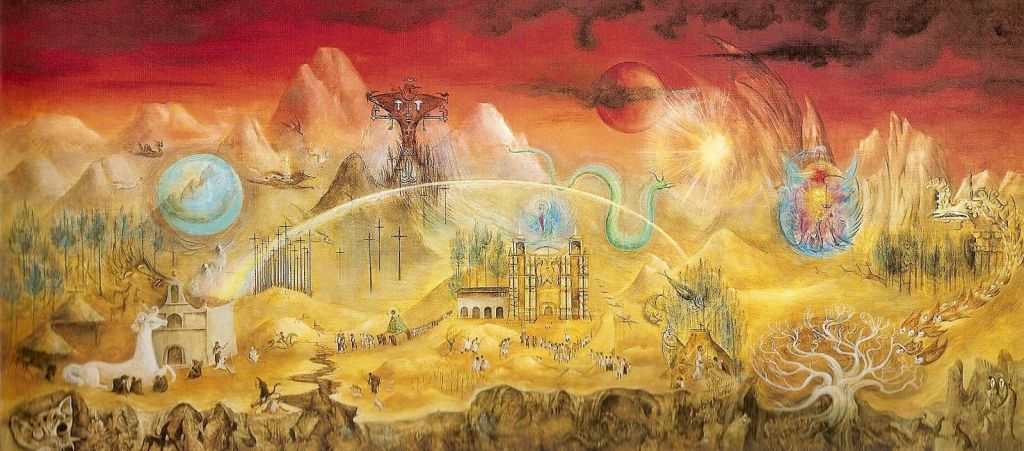
The World of the Maya
Her heroine Marian Leatherby is a 92-year-old, who lacks teeth, is hard of hearing, and sports a beard–a whimsical, endearing character who loves cats. She has been given a hearing trumpet by her great friend Carmella, and thereby learns that her son and his wife plan to send her away to an old folks’ home run by a Dr. Gambit and the Well of Light Brotherhood.
The move to Portugal all but forced me to heal my relationship with time and productivity, to create a life that was sustainable and nurturing.
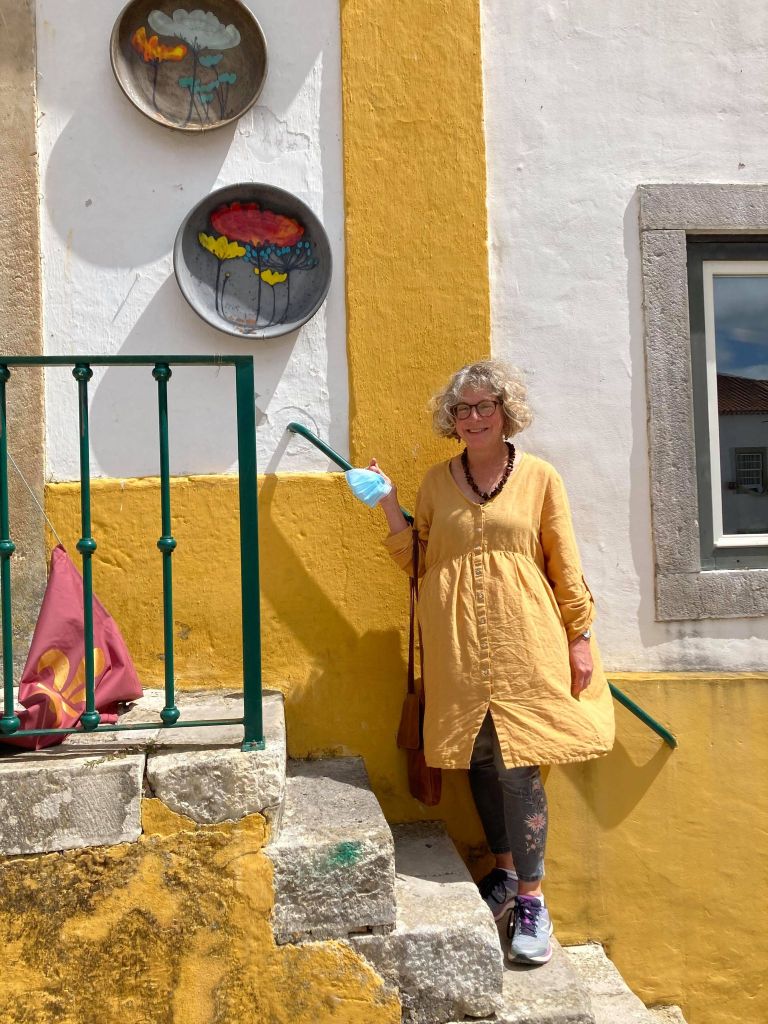
Hanging out in Obidos, the closest town to my village. Photo by Erika Mailman.
One year ago, I published my essay, The Grace of Letting Things End, about my bittersweet experience of leaving England in the wake of Brexit for a new life in Portugal.
One year later, my life in Portugal still feels radically new.
Time passes differently in Portugal. I set my intention, from the outset, to embrace this move as an opportunity to slow down and live a more authentic life.
My day-to-day life has irrevocably changed.
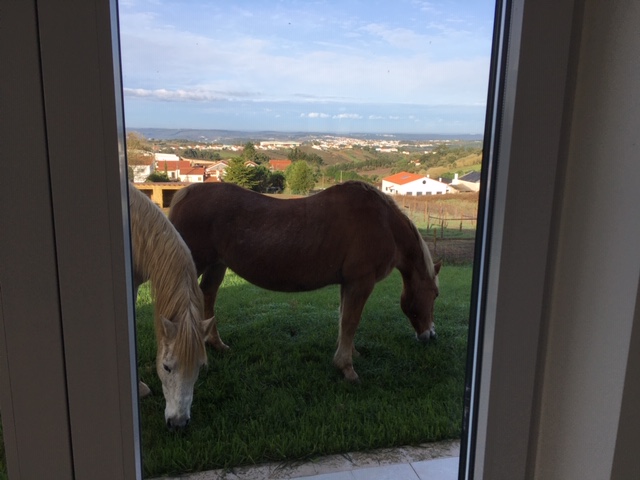
I’ve gone from being a livery yard customer in England, with all the drama and conflict this sometimes entailed, to becoming an independent small holder with two horses on my property to care for all by myself. Practically, this has translated into a lot more work, but also a lot more peace.
The ponies decided to help with the lawn mowing
I’ve also been devoting considerable time and energy into learning Portuguese. My husband and I have been taking classes once or twice a week for nearly a year now and are making slow but steady progress.
But the most deep-seated change has been to my whole relationship to work and life. In the UK, I led a very productivity-centered life, existing from deadline to deadline with barely any time to breathe in between. I often felt too busy and wrapped up in my projects to meet friends for lunch.
For years I have struggled to heal my dysfunctional relationship with time management, embracing lifehack after lifehack. I’ve all but abandoned social media. I’ve done my utmost to milk every single hour of the day in order to become more productive. This pattern led to disillusionment and epic burn out, something more and more women are facing, particularly those who balance the demands of their careers with childcare and other care-taking duties.
Even writers and artists can fall down the hole of the Cult of Productivity, taking the creative process, which is at its essence slow and organic, and trying to force it into an industrial process with regular, reliable yields that are judged on how well they can be monetized. Even the refuge of spirituality can be compromised if it’s just another task on a never-ending to-do list.
Thus, despite my official intention to slow down, I found myself trying doggedly to replicate my old hectic, tunnel-vision working schedule in Portugal only to discover that it just didn’t work here. I hit a brick wall. Because I couldn’t sustain the same level of busyness AND care for two horses AND learn a challenging new language AND keep my initial intention of slowing down and enjoying the life I moved here to experience.
Something had to give. The move to Portugal all but forced me to heal my relationship with time and productivity, to create a life that was sustainable and nurturing. No lifehack could help me anymore, because I’d already given up television. I don’t even watch Netflix.
We hear a lot about the Slow Living Movement, but actually slowing down involves so much more than decluttering your closet or posting pictures of photogenic hipsters in hammocks on Instagram.
Moving to Portugal forced me to slow down. Because life is slow here. It’s no accident that the Slow Food Movement had its birth in Italy, another slow country in southern Europe. Food is also big in Portugal. In fact, I like to joke that LUNCH is the national religion. No matter how busy or important you think you are, the whole world stops for lunch. Shops close. People pour out of offices and go to restaurants for beautiful, affordable meals. Proper, cooked meals, mind you. Not a sandwich or salad to be inhaled at speed. To say you are too busy to meet your friends for lunch in Portugal would be sacrilege. Even in the height of the pandemic when all the restaurants were closed, people went home for lunch and ate with their families.
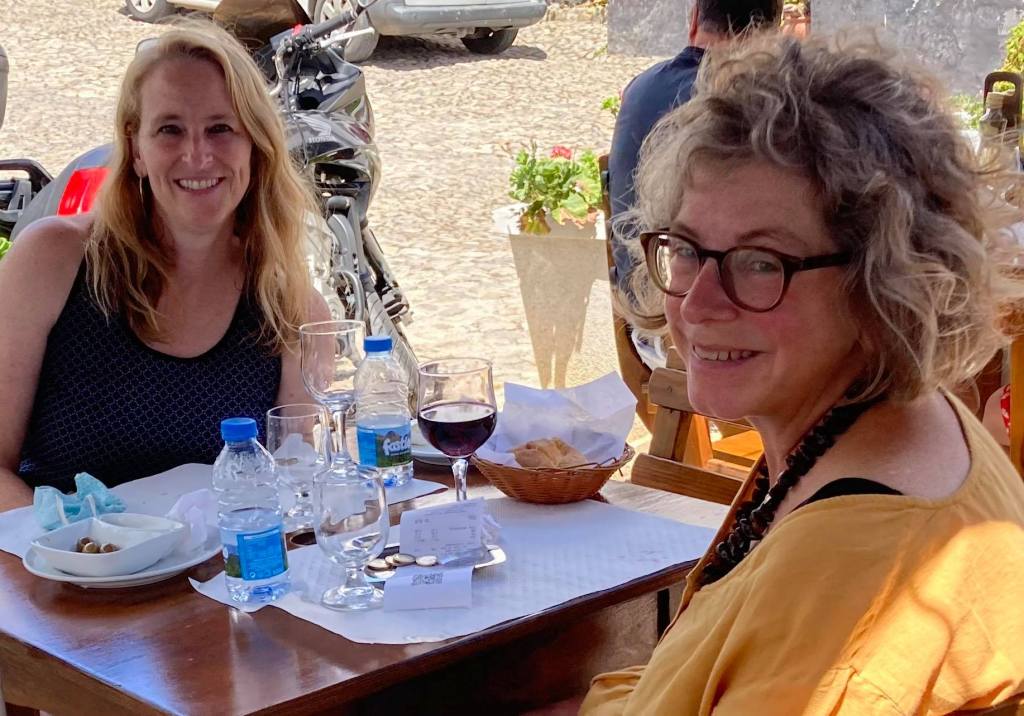
Converting my visiting writer friend Erika Mailman to the religion of LUNCH!
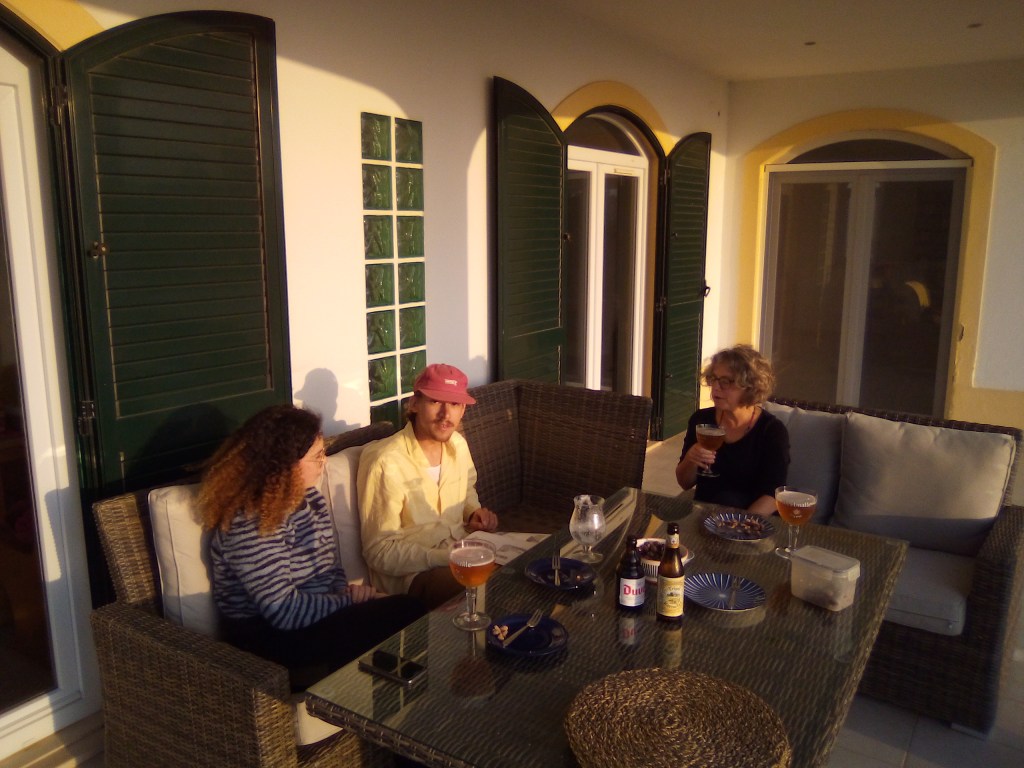
Any culture that prioritizes good food also prioritizes human relationships. My social life here is unlike anything I’ve experienced anywhere in the world. I’ve met wonderful Portuguese people, such as our local Priestess, Luiza Frazao, as well as new friends from the U.S., the U.K., Canada, Columbia, the Netherlands, Israel, Russia, Germany, Spain, Poland, Hong Kong, and Belgium. My husband and I have made so many friends in our village. We can walk to each other’s houses and invite each other for dinner or go on long walks together. The other foreigners who move to Portugal have made the conscious decision to make time for friendship, not just shove it into a twenty minute “let’s meet for coffee” slot. I haven’t had this much fun since I was a student.
Other things are slow here, too. The post office can be painfully slow. My New Yorker subscription has gone AWOL and I’ve resigned myself to reading the digital version. Plumbers and technicians come when they come. Just when you think they’ve forsaken you, they manifest at your door. But then again neighbors I’ve never met before also show up unexpectedly with gifts of apples for the horses. One day an old man pulled his tractor up in front of our house and presented me with two sapling banana trees.
What I’ve discovered is if I give up any notion of trying to control the clock or manage time, it becomes more expansive. When I’m with my horses or laughing with friends, time disappears and I’m living in an eternal now. The same is true when I’m deep in my writing flow or trying to speak my best Portuguese to thank my neighbor for the banana trees. In a rich and authentic life, there is time for everything.
Life Balance is a feminist issue, because too many women have been brainwashed by the Cult of Productivity for far too long and this has kept too many of us chained to a patriarchal machine that eats us up and spits us out when we’re too broken to go on doing anymore. Let’s rebel and meet our sisters for lunch!
Mary Sharratt is on a mission to write women back into history. Her acclaimed novel Illuminations, drawn from the dramatic life of Hildegard von Bingen, is published by Mariner.Her new novelRevelations, about the mystical pilgrim Margery Kempe and her friendship with Julian of Norwich, is now available wherever books and ebooks are sold. Visit her website.
For as long as I can remember, I’ve been looking for home—home being both a beautiful, comfortable, geographic space as well as a peaceful state of mind/being. For most of my life, I’ve “made do,” settling for wherever or whatever appeared before me. I thought that was “good” and selfless behavior—shrinking my desires and wants to a size that made other people happy. For women in our patriarchal society, shrinkage is a highly-prized quality, useful not just as a survival skill, but as a way of being in the world that allows things to run smoothly for somebody other than yourself.
Recently, I’ve been trying to find some kind of balance while slogging through several major changes in my life that include loss of family, friends, and job. Part of that balancing act involves looking for an esthetically-pleasing shelter/home in a place surrounded with natural beauty. In addition, I would like to live in community with people who are adventurous, open to new ideas, and kind.
Last weekend I watched the 2019 movie Bombshell. I had not heard about it, and I ended up seeing it for the suggestion of Prime’s “you might enjoy this” algorithm. I had no idea about the story of Gretchen Carlson and Megyn Kelly’s legal battle for sexual harassment against Fox News’ master Roger Ailes. The movie was not very long, but it was intense. It portrayed really well the misogyny expected to be found in such a workplace led by a mighty, egotistic man like Roger Ailes.
Bombshell – 2019
A good part of the movie, we join Kayla Pospisil, Margot Robbie’s fictional character, in her quest to become a host in the news. So we go with her into Roger’s office and witness what an interview with that man was. It was about “loyalty” and intended to “prove” that she had what it took to earn a place in one of the most competitive work environments. **Content warning: description of workplace sexual harassmentto follow** Obviously, it meant that she had to sleep with him because how else could a woman with a hot body prove she is competent? Immediately she was forced to show him her legs because legs sell good on T.V., and then we get to see her underwear because he was too turned on and couldn’t stop himself. **End Content Warning** Thanks to Robbie, we also feel the panic, surprise, and horror of a naïve girl trying to get a dream job in the real world.
This blogpost is a rewrite and an update from one I wrote on Jan 26, 2020 (I’m Getting Triggered by the Impeachment Trial and I Bet I am Not Alone). I was writing about The Former Guy’s 2nd impeachment trial which rattled my bones and hurt my heart. How often have we seen angry men (and sometimes women) abusing women, abusing the earth, abusing the vulnerable, abusing immigrants, abusing power? And yet the pattern never seems to end. In many cases, they not only get away with it, it is actually celebrated.
In that 2020 blogpost I included Bill Cosby’s case as a success story. Look how hard it had been, how many years, how many accusers it took for justice to give us the illusion of being meted out. And now pulled away.
In January 2020 there was a blunder (or so they called it) at the National Archives’ in their exhibit titled “Rightfully Hers.” They put up an image of the 2017 Women’s March and blurred out the protest signs. Oh, the irony to blur out women’s voices in an exhibit named Rightfully Hers. Yes, they apologized. But they had to get caught first.






 Feminism and Religion