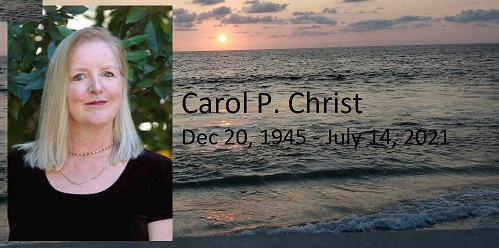
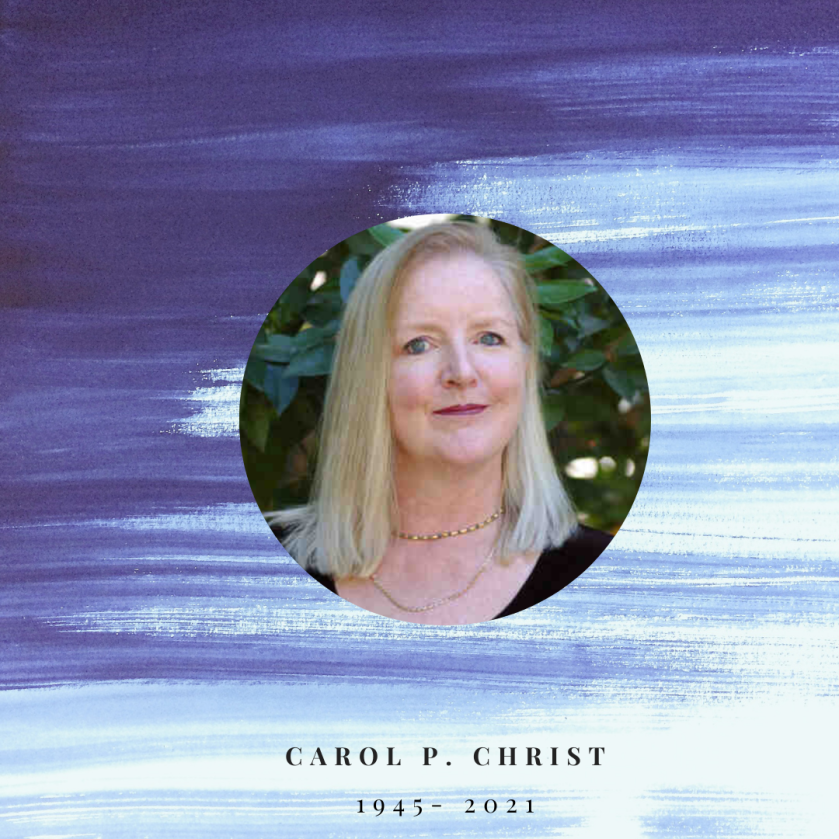
Legacy of Carol P. Christ: Reading Plato’s Allegory of the Cave as Matricide and Theacide

This was originally posted on October 22, 2012

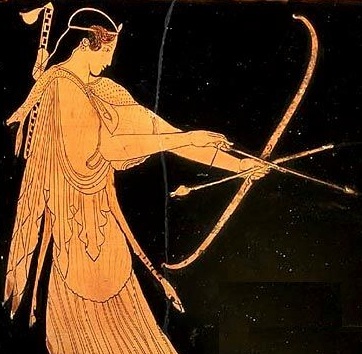
When I read Plato’s allegory of the cave as an undergraduate, I was told it had something to do with the idea that the “form” of a table is more “real” than the table itself. I must confess that I had no idea what this could possibly mean.

As a graduate student, I struggled with philosophical and theological ideas rooted in Platonism.  Rosemary Radford Ruether named the flawed worldview created by a “classical dualism” that separates mind from body, spirit from the world, rationality from emotion, and male from female.  Her ground-breaking essay “Mother Earth and the Megamachine” clarified the difficulties I was having.

Continue reading “Legacy of Carol P. Christ: Reading Plato’s Allegory of the Cave as Matricide and Theacide”

Upgrade Complete – Reopened!

We are excited to have our new format and hope you enjoy it.

Thanks to Xochitl, we are back up and running in only two days. We needed to upgrade our site because our old theme was no longer being supported. We are hopeful that this will solve the issues people have been having in posting comments.

Change always involves new challenges and we assume this will be no different. If you notice any problems or would like to comment, please let us know by responding to this post or by email /feminismandreligionblog@gmail.com/.

We are excited to have our new format and hope you enjoy it. As always we are so grateful to the FAR community for supporting this important work.

And thank you for your patience.

Janet (with Xochitl) FAR co-weavers

Closing for Upgrade

Dear Community,

As many of you know leaving comments on our site has often been a trial with the WordPress format that we use. We believe that leaving comments and having active discussions is one of the many gifts of FAR, and so this issue has been particularly frustrating.

Continue reading “Closing for Upgrade”

Rainbow Crow – A Native American Story Retold by Judith Shaw

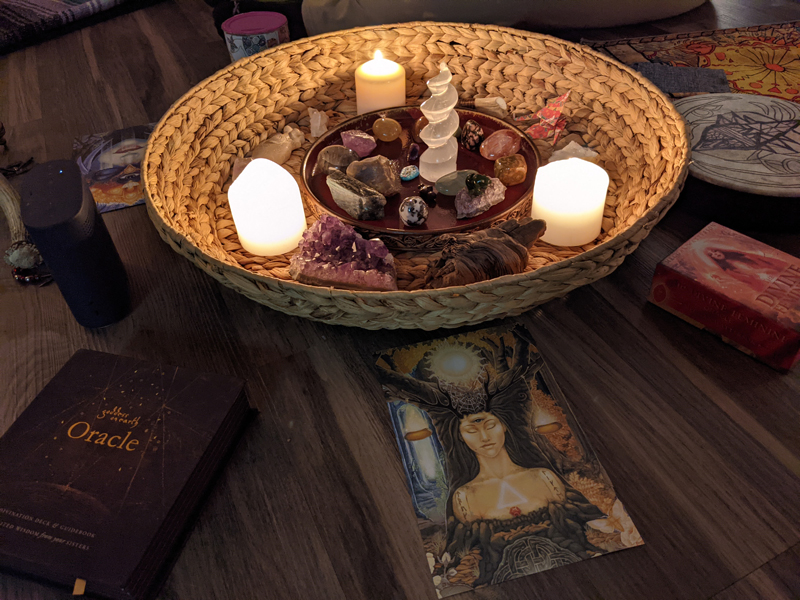
Now that my Animal Wisdom Oracle is out in the world I’m delving more deeply into the stories and legends associated with the animals I’ve learned about. Though many legends of animals are strongly associated with goddesses and gods, there are also many that focus solely on animals themselves. In both cases these stories help us understand our place in the world and teach about living in balance and harmony with all beings – a cornerstone of feminism and goddess spirituality.  

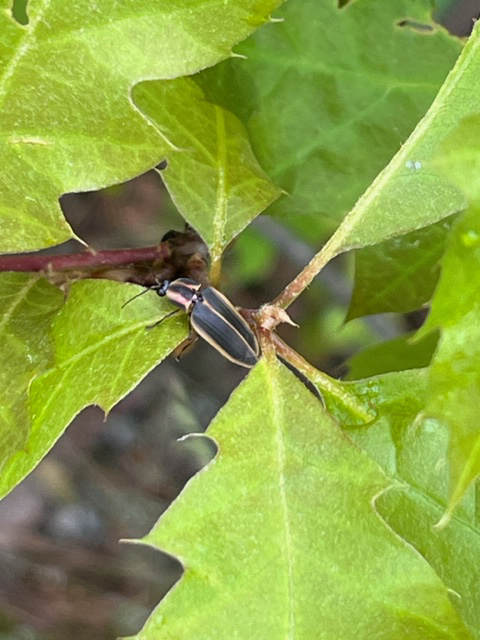
As winter nears its end, I’d like to share my re-telling of a story with you about Crow. It comes from the storytelling tradition of the Lenni Lenape – a Native American tribe whose traditional territory spanned what is now eastern Pennsylvania, New Jersey, lower New York, and eastern Delaware. This is a different kind of crow from the one we know today. It goes like this….

Continue reading “Rainbow Crow – A Native American Story Retold by Judith Shaw”

That Old, Old, OLD Story – The Warts and Wisdom of the Ancient

My grandmother Clarine was an incredible human being. I absolutely could not be more proud to be her granddaughter. She started her first teaching position in 1927 at age 17. She met my grandfather in seminary; but despite her clear talent and call, the church apparently felt one minister was enough for the family and refused to ordain her. Undaunted, she famously wrote a one line reply to the bishop: Well, Moses got along fine without it, and Jesus got along fine without it, so I’ll be fine without it, too.

Continue reading “That Old, Old, OLD Story – The Warts and Wisdom of the Ancient”

Rethinking Church Communally and Creatively by Xochitl Alvizo

I spend a curious amount of time discussing, studying, and writing about polity – the structures and procedures of congregational/denominational governance (my previous post about communion reflects one kind of polity). Amid theological and sociological research about the decline, revival, or re-emergence of Christianity and the church, my research specifically focused on how emerging congregations organized and structured their decision-making processes. As a “body” – ecclesial, social, political – what are the new and creative ways that congregations structure and organize their collective living and relating?

Continue reading “Rethinking Church Communally and Creatively by Xochitl Alvizo”

Aging and Kinship by Sara Wright

When I moved to the mountains my children were grown and gone…

Finally I had land of ‘my’ own with a brook and mountains that was surrounded by forests. I felt protected by something I could not name. I was living on the edge of wilderness and a hunger I had been carrying for all of my adult life was finally appeased.

Although I had a vegetable and flower garden I felt a deep reluctance to cut trees and eventually lost most of my field to pines. When I finally built my log cabin, I did plant fruit trees, but every action was predicated on my need to give back to nature what she had given to me.

Continue reading “Aging and Kinship by Sara Wright”

Legacy of Carol P. Christ: Religions and the Abuse of Women and Girls: God Is the Problem

This was originally posted on November 12, 2018

At the 2009 meeting of the Parliament of World Religions, former US President Jimmy Carter called the worldwide abuse of girls and women the greatest unaddressed human rights crisis of our time. In the book that followed the speech, he compared sexism to the racism he witnessed in the US South, stating:

There is a similar system of discrimination, extending far beyond a small geographical region to the entire globe; it touches every nation, perpetuating and expanding the trafficking in human slaves, body mutilation, and even legitimized murder on a massive scale. This system is based on the presumption that men and boys are superior to women and girls.

Continue reading “Legacy of Carol P. Christ: Religions and the Abuse of Women and Girls: God Is the Problem”

Herstory Profiles: Activist Preacher Fannie Lou Hamer by Anjeanette LeBoeuf

Throughout the course of this year my monthly posts are going to spotlight extraordinary women; a FAR Herstory Journey. Our first Herstory profile will be Fannie Lou Hamer (1917-1977): a staunch Civil Rights, Voter Rights Singing Activist, Preacher.  

Continue reading “Herstory Profiles: Activist Preacher Fannie Lou Hamer by Anjeanette LeBoeuf”

The Fifth Wound by Aurora Mattia, Book Review by Janet Maika’i Rudolph

Dreams are a confluence of lifefragments, swelling and dissolving in waves, perpetually on the verge of meanings. What in Physics is called ‘potential energy,’ I refer to as ‘potential meaning,’ the maximum of which is dreaming.

The Fifth Wound, pg 34

There is so much to like about this book even as it is painful to witness Mattia’s journey. It is also confusing at times which might be by design because life, itself, is so confusing. The prepublication material describes this book as a love story between Aurora and Ezekiel. Both Ezekiel and Aurora begin by describing themselves as “fairies.” Ezekiel remains so, Aurora transitions. She calls herself a tgirl or a transgirl.

Mattia leads a life that refuses to be boxed into any “norm.” The vulnerable wounds that she collects as she navigates this challenging path are both internal and external. Ezekiel and Aurora know and love each other both before and after Mattia’s gender confirmation surgery. It takes some work to understand the hardships of those who don’t fit into societies’ norms; these are norms that too often float through our consciousness often without our even being aware. I believe that wrestling with such issues expands our humanity and for this (but not this alone), The Fifth Wound is an important book.


Continue reading “The Fifth Wound by Aurora Mattia, Book Review by Janet Maika’i Rudolph”