Spruce towers
over weeping hemlock
balsam and pine.
Pale peach clouds
paint the sky circling
fringed spires.
Trees
our first cathedrals…
Some still gather
under these boughs.
Her Voice
is being Silenced.
The Spirit of
the Forest
Departs…
Exploring the F-word in religion at the intersection of scholarship, activism, and community.

Spruce towers
over weeping hemlock
balsam and pine.
Pale peach clouds
paint the sky circling
fringed spires.
Trees
our first cathedrals…
Some still gather
under these boughs.
Her Voice
is being Silenced.
The Spirit of
the Forest
Departs…
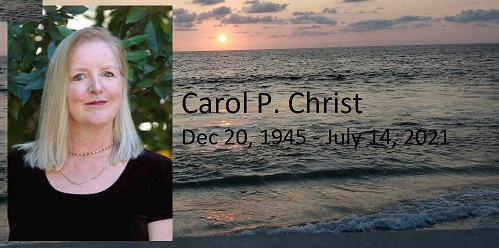
Moderator’s Note: We here at FAR have been so fortunate to work along side Carol Christ for many years. She died from cancer in July, 2021. Her work continues through her non-profit foundation, the Ariadne Institute for the Study of Myth and Ritual and the Goddess Pilgrimage to Crete. To honor her legacy, as well as allow as many people as possible to read her thought-provoking and important blogs, we are pleased to offer this new column to highlight her work. We will be picking out special blogs for reposting. This blog was originally posted February 10, 2014. You can read it long with its original comments here.

Mary, Mary, quite contrary, how does your garden grow? With silver bells and cockle shells, and pretty little maids all in a row.
From the beginning of horticulture about 8000 BCE or earlier to the present day, weeding has been women’s work. Women, who were the gatherers and preparers of food in traditional nomadic societies, no doubt were the first to discover that seeds dropped at a campsite one year sometimes sprung up as plants the next year. When this discovery was systematized, agriculture was invented, and human beings began to settle down in the first villages and towns.
Continue reading “Carol P. Christ’s Legacy: Women And Weeding, The First 10,000 Years* by Carol P. Christ”
This week’s Torah portion is Ki Tisa, Exodus 30:11-34:35. Its events revolve around the theme of creation, destruction, and recreation. From a feminist perspective, it is quite clear that this cyclical process is a result of a patriarchal understanding of the divine as jealous, distant, and rage-filled.
Ki Tisa begins soon after the Israelites have been delivered from Egyptain slavery. This delivery creates a new people devoted to this divine liberator. Yet, Ki Tisa starts with both that deity and their leader, Moses, nowhere to be found. So, what do the Israelites do being in such a vulnerable spot? They create a golden calf in order to have a spiritual connection to something.
Continue reading “The Patriarchy of Ki Tisa and a Call to Reimagine Divinity by Ivy Helman.”Your ex-boyfriend gave you a solid brass Buddha, one foot high. You hate to think what he had to pay for it. Not knowing what else to do with it, you place it on your bookcase. You must admit that it’s a beautiful object, that it inspires a certain peace. But it leaves you cold, just like the crucifix hanging in your parents’ bedroom always left you cold.

Your ex-boyfriend gave you a solid brass Buddha, one foot high. You hate to think what he had to pay for it. Not knowing what else to do with it, you place it on your bookcase. You must admit that it’s a beautiful object, that it inspires a certain peace. But it leaves you cold, just like the crucifix hanging in your parents’ bedroom always left you cold. Only when you sit in your dead grandmother’s chair and rock yourself into a trance can you reach your world of wonder, that green and gold place where May sunshine washes through newly unfurled birch leaves, where shadow and light dance on the white bark you peel off like onionskin. Long ago, you think, people worshipped their ancestors.
You wake up to cold and gray, to a day so drab that it hurts like a permanent migraine. On the bus ride to the office, the commuters in their career clothes are scrying into their phones. No free seats so you grab the handrail and gaze out the window. Instead of city buildings and dirty snow, you see an old farmhouse at the edge of an apple orchard. A gaggle of geese guards that house. They rush towards you, flapping their wings and hissing. But you walk resolutely on until you reach the veranda, and then the front door, propped open by a pair of gardening shoes. Stepping into the hall, you breathe in the mixture of baking bread and boiled coffee. A woman comes to you, a woman like your grandmother, but older. Her thin silver hair reaches her knees. Her face is so wrinkled, you can hardly see where her glittering eyes end and her crow’s feet begin.
Cocking her head, she says, “What took you so long?” And taking your hand, she marches you into her kitchen where a cat sleeps on the windowsill. She sits you down and serves you elderflower wine in an old jam jar. You take one sip and the kitchen reels around you.
You hear a rushing sound, a pounding, and then you are alone on a beach holding a piece of driftwood shaped like a goose in flight. A strange new weight pulls at your shoulder blades. Craning your neck to investigate, you see the wings sprouting there, blue-black crow wings. Of their own volition, they stretch and flap until you are airborne. Heading out over the waves, the tips of your bare toes graze the water.

“You dream too much,” your ex informs you. “You live on another planet. When’s the last time you watched the news? When’s the last time you voted? You can’t just spend your whole life with your head in the sand.”
Your ex is an activist. He majored in queer theory. He worked on Bernie Sander’s election campaign. He buys everything organic and volunteers one day a month at the soup kitchen. You are humbled by his social engagement, but when he sends you links to articles and videos overflowing with the world’s misery, the weight is too heavy for you to bear. You find yourself wondering how many homeless people he could have fed for the price of that solid brass Buddha.
Your grandmother lived until she was ninety-nine. She quarreled bitterly with everyone who came to visit and expressed concern about the farm falling into disrepair around her. She told them she just wanted to be left in peace. Then one day she died of a stroke while chopping wood on that old farm where she had lived alone for fifty-six years. She died instantly—no lingering pain, hospital gowns, or stench of bedpans or disinfectant. That’s how it is on your mother’s side of the family—the women are widowed early and seem to live forever until the day they suddenly drop dead.
After her death, her children sold her farm to a developer, who tore down her Victorian house to build rows and rows of condos. They left only three of her apple trees standing. Those trees are as old and gnarled as she was when she died. Like old women, they no longer bear fruit but stand and bear witness to what once was, but is no longer.

You pack the brass Buddha away in old newspapers, stick it in a cardboard box. You’ve decided to donate it to a drug rehabilitation center. Maybe it will bring the people there peace and clarity. Then you brew a pot of tea and sit in the rocking chair, huddled in an afghan your grandmother crocheted before you were born. You close your eyes and you are far out over the ocean, sometimes floating, sometimes flying. A blast of salt wind fills your shiny black wings, lifting you even higher. Opening your beak wide, you cackle and caw.

Mary Sharratt is committed to telling women’s stories. If you enjoyed this short piece, please check out her acclaimed novel Illuminations, drawn from the dramatic life of Hildegard von Bingen, and her new novel Revelations, about the mystical pilgrim Margery Kempe and her friendship with Julian of Norwich. Visit her website.

I was brought up in a household where attitudes to God and church were quite negative. My Nanna, however, was deeply religious, and I can still remember sitting in her dining room as a very young child staring up in awe at a painting of ‘The Last Supper.’ I was completely mesmerised, there was something haunting about that painting that left a lifelong impression. Art became a passion very early on in life, and whenever I came into contact with images of a religious nature emotions stirred. I was spellbound by divine mystery. The most profound feelings were engendered when I met with images of Mother Mary and the infant Jesus.
Continue reading “From the Archives: Miracles Of The Great Mother by Jassy Watson”
“The beauty of the planet from 100,000 miles should be a goal for all of us, to help in our struggle to make it as it appears to be.” Astronaut Michael Collins said these words reflecting on seeing the Earth from space. To me, he is expressing the truth that the Earth is our community that we share with all other beings on the planet, our home base. But what does this really mean in its most profound perspective?
Over the years, I have heard people express over and over how they desire “community,” whether that means a neighborhood café or an ongoing circle to share our deepest lives over decades, or any of many other expressions. The emotional and physical impact of isolation and divisiveness over the past months of the pandemic has shown how essential “community” is to our well being, and how we need to think of it as more than just a sense of being part of a group. True community provides us with a sense of belonging and relationship, of being part of a vibrant, interdependent web, of assuming everyone will act in the best interests of all.
Continue reading “Earth Is Our Community by Carolyn Lee Boyd”Sometimes the best rituals
are those we cannot plan,
requiring only pine needles and wind,
open eyes
and a long, slow-sinking sun
settling gently into shadows.
Sometimes the best magic
of all is made with
what is exactly right now,
bluestem grass and gray feathers,
raccoon footsteps
between the trees,
laughter and joined hands,
a faith in the cycles of retreat
and renewal.
This is what we are here for,
days like these.
One crow behind the house greeted me on a frosty solstice morning. Five more slid across the road in front of me as I reluctantly left home to go to the dentist. A red-shouldered hawk glided across the road next and I spotted a kestrel perched on a wire. I drove and sang, memories of our bright candles and solstice spiral the night before behind my eyes, sun bread left rising golden on the counter at home. The dentist has devised a pulley system to hang bird feeders by each of his second story windows and I watch house finches collect sunflower seeds as I lie in the chair. I spot a vulture circling in the distance slow and graceful above the trees. The sky is blue. When I leave the office, I hear a crow’s voice call from across the street and as I drive back home to my family and our winter holiday celebrations, another red-shouldered hawk swoops in front of me, while a red-tailed hawk sits solemnly in a tree by the field, watching the ground. I’m amazed how birds, so unbound, tether me so reliably to the magic of place, to being present with the ensouled and singing world as I move within it and I am grateful.
In the late afternoon on the solstice, my family and I carry the sun bread we have made out to the field by our studio. We join hands and sing and then toss small bits of our golden bread to the sun, calling out our wishes for the year to come and offering our thanks to the spinning world we walk on, beneath this burning sun.
The kids go inside and my husband, Mark, and I walk down the road to finish watching the sun set. It sinks low and slow behind the bare oak trees, growing larger and redder as it goes. It seems to be one of the most drawn out sunsets of this year and we sit down in the frost-crisped dittany by the side of the road, our backs against the oak trees, watching. I turn to look at Mark smiling and say: this is what I am here for, days like these.
I decided to take social media break as 2021 drew to a close, something I’ve wanted to do for a long time, something I’ve needed to do for a long time, and yet, something I’ve always talked myself out of. I need this for our business, I think. It is part of my work. How else will I reach people? I will just post a few more things. While, inside, the hunger to really listen, to de-fragment my mind and re-collect my soul continued to build to a peak of fervency and desire. The blessing and the curse of social media is that everything is in one place. Convenient, yes. Holds you hostage, also yes. Exposes you to more information than you can reasonably hold and process, also yes. The first day of my break, I was amazed how often I was tempted to cheat, how many ways I came up with to sneak around the limit and to just do one little thing anyway. I was also surprised to discover how much extra space there is in my mind and how liberating it is to step away from the clamor of so many other voices. As Cal Newport explains, we all need time each day when we are outside of the influence of other minds. And, I was surprised by how invisible I felt, how unseen and unheard. As the days passed, I felt it though, my scattered pieces coming home. I knew that social media was affecting my focus and my brain functioning, could feel it fragmenting my thoughts, and making my focus and attention jumpy and scattered. In these days of silence, something began to heal inside. I feel a bit invisible, yes, but I also feel whole. I feel like I am coming back online, to my own life.
What was intended only as a ten day break over the winter solstice, extended through the first month of new year and while I’m not saying I’m never going back, I find I am in no rush to re-engage, certainly not in the way I had before.
In the reclaimed attentional space within, I discovered the soulsong of a new book walking up to me, hands extended and eyes wide.
We walk again under long wings of twilight, last vestiges of day sinking purple and mauve into the horizon. Somehow we end up talking about cryptocurrency and NFTs.
Give me dirt and give me stars, I say, as our feet crunch across the brown gravel, our shoulders hunched slightly against the wind. Give me life, right here, where it is.
As we come back up our driveway, we spot a doe at the compost pile, she watches us silently as we turn to make one more lap down the dusky gravel road.
Molly Remer, MSW, D.Min, is a priestess facilitating women’s circles, seasonal rituals, and family ceremonies in central Missouri. Molly and her husband Mark co-create Story Goddesses at Brigid’s Grove. Molly is the author of nine books, including Walking with Persephone, Whole and Holy, Womanrunes, and the Goddess Devotional. She is the creator of the devotional experience #30DaysofGoddess and she loves savoring small magic and everyday enchantment.
Note: this essay is excerpted in part from a book in progress, tentatively titled Walking with the Goddess.


My habit has been to hide
once I know he’s around,
to deny his presence, the fright that
springs from every cell,
my body on scream.
I harm myself forcing me
to do his will – ‘Keep going’
I screech cruelly, soundlessly,
‘so what if it hurts,
You cannot afford to feel’.
At 3 AM I shoveled ice
with strength I no longer have
driven by his demonic voice.
He’d already murdered the day before.
My grouse whose delicate spiral
footprints brought joy to
my heart became his first kill.
Continue reading “Father Root by Sara Wright”Moderator’s Note: We here at FAR have been so fortunate to work along side Carol Christ for many years. She died from cancer in July, 2021. Her work continues through her non-profit foundation, the Ariadne Institute for the Study of Myth and Ritual and the Goddess Pilgrimage to Crete. To honor her legacy, as well as allow as many people as possible to read her thought-provoking and important blogs, we are pleased to offer this new column to highlight her work. We will be picking out special blogs for reposting. This blog was originally posted March 23, 2013. You can read it long with its original comments here. Carol provides links to the three posts of hers that we have reposted recently.

There are many reasons for women, slaves, and the poor to rebel against domination and unjust authorities in patriarchal societies. But we should not assume that there are any reasons to rebel against domination where no domination exists or to rebel against unjust authority in societies where there are no unjust authorities.
In response to my recent series of blogs on patriarchy as a system of male dominance created at the intersection of the control of female sexuality, private property, and war (Part 1, Part 2, Part 3), I was asked if there is an injustice inherent in matriarchal societies that caused men to rebel and create patriarchy.
Continue reading “Carol P Christ’s Legacy: What Might It Be Like To Live In A Matriarchal Society Of Peace? Can You Imagine?”Moderator’s note: This marvelous FAR site has been running for 10 years and has had more than 3,600 posts in that time. There are so many treasures that have been posted in this decade that they tend to get lost in the archives. We have created this column so that we can all revisit some of these gems. Today’s blogpost was originally posted July 1, 2018. You can visit the original post here to see the comments.

I bet almost no one knows this secret: the United States is being watched over by two goddesses! One of them stands on top of the Capitol dome in Washington, D.C. The other stands on an island in New York harbor.
The goddess standing above our congressional building is named Libertas, or Freedom. She’s a Roman civic goddess whose sisters are Concordia and Pax. Although the Romans hardly ever experienced freedom, civic harmony, or peace, they always kept their eyes on the possibilities. Libertas was sometimes merged with Jupiter, sometimes with Feronia, who was originally an Etruscan or Sabine goddess of agriculture or fire. In Rome, Feronia became the goddess of freed slaves. Libertas is shown on Roman coins as a matron in flowing dress and wearing either a wreath of laurel leaves or a tall pilleus, which is called a “liberty cap” and looks like a witch hat without the brim. And there’s also a bird—is it a raven?? She holds either a liberty pole (vindicta) or a spear, and in some paintings of her (she was a popular subject in the 19th century) there is a cat at her feet.

Because the late 18th century is sometimes referred to as the Augustan Age (for classicism in architecture, literature, and art and named after the first Roman emperor, Caesar Augustus), the Roman Libertas became Lady Liberty during the American Revolution. To celebrate the repeal of the Stamp Act in 1766, Paul Revere created an obelisk with an image of Lady Liberty on it, and a short time later, Tom Paine addressed her in his poem, “The Liberty Tree.” An enormous bronze statue of Lady Liberty was commissioned in 1855 for the top of the Capitol building, and she was hoisted up there in 1863, where she stands, hardly visible, to this day.
Here’s my idea. This FAR community has lots of power. We—and at least two thirds of the U.S. population—are very unhappy with the antics of the Lyin’ King and his court…excuse me, the executive and legislative branches of our national government. So let’s visualize Libertas coming to life. Watch her stomp her heavy bronze feet so hard she breaks a hole in the top of the dome. Watch her fly down into the main lobby of the Capitol. Now she turns in one direction and stalks into the Senate. “Gentlemen and Ladies,” she begins, “you were sent here to do a job. You’re not doing your jobs. Work together! Learn to compromise. Stop talking so much. Get to work!” And then she marches into the House. “Why are you here?” she asks. “And why are you here only three or four days a week, and why aren’t you working for the benefit of all the citizens of the United States?” I suspect that Libertas, who is 19 feet 6 inches tall and weighs approximately 15,000 pounds, could indeed put a scare into Congress, not to mention all the lobbyists. Remember, she also carries that spear. And she no doubt knows how to use it.
Our second national goddess? “Liberty Enlightening the World,” whom we call the Statue of Liberty, was a gift from France to the U.S. circa 1886 on the occasion of our centennial. Designed by Frederic-Auguste Bartoldi and Alexandre Eiffel (who also built a famous tower in Paris), Lady Liberty holds a tabula ansata (a tablet evoking the law) in one arm and with her other hand raises a torch, a common symbol of truth and purification through illumination. She wears a crown of solar rays similar to the crown worn by the Colossus of Rhodes, one of the seven wonders of the ancient world.

For almost a century and a half, Liberty has welcomed immigrants to our Atlantic shore. Those immigrants were the grandparents and great grandparents of nearly all of us. Now let’s visualize Liberty taking action. Goddesses can perform magic; let’s visualize Liberty multiplying herself into 10,000 Liberties, and then let them travel to Texas, New Mexico, Arizona, and California and—you guessed it—let them stand facing south. Let these 10,000 goddesses with torches of purification replace the Xenophobe-in-Chief’s wall/fence/border army. Let’s ask Liberty to welcome people into the U.S. Because she’s smart (and the flames of that torch can reveal a lot) and there are indeed drug smugglers traveling in addition to men, women, and children who are coming for sanctuary or safety or work, let her use her torch to reveal the small proportion of criminals trying to sneak in. And let her welcome and protect everyone else and keep families together. (Maybe she could send all the ICE agents off hunting coyotes, who are no doubt smarter and more humane than they are.)
Here is the full text of “The New Colossus” the poem by Emma Lazarus that Lady Liberty proclaims to the world. Maybe our senators and representatives should read it—for the first time, I bet. They should pay attention to what it says and obey the words and principles of this goddess.
Not like the brazen giant of Greek fame,
With conquering limbs astride from land to land;
Here at our sea-washed, sunset gates shall stand
A mighty woman with a torch, whose flame
Is the imprisoned lightning, and her name
Mother of Exiles. From her beacon-hand
Glows world-wide welcome; her mild eyes command
The air-bridged harbor that twin cities frame.
“Keep, ancient lands, your storied pomp!” cries she
With silent lips. “Give me your tired, your poor,
Your huddled masses yearning to breathe free,
The wretched refuse of your teeming shore.
Send these, the homeless, tempest-tost to me,
I lift my lamp beside the golden door!”
Let us visualize both of these American goddesses doing their work and protecting the hard-won rights of everyone who lives in the United States.
BIO: BIO: Barbara Ardinger, Ph.D. (barbaraardinger.com), is the author of Secret Lives, a novel about crones and other magical folks, Pagan Every Day, a unique daybook of daily meditations, and other books. She really enjoys writing her monthly blogs for FAR. Her work has also been published in devotionals to Isis, Athena, and Brigid. Barbara’s day job is freelance editing for people who have good ideas but don’t want to embarrass themselves in print. To date, she has edited more than 400 books, both fiction and nonfiction, on a wide range of topics. She lives in Long Beach, California, with her rescued calico cat, Schroedinger.