

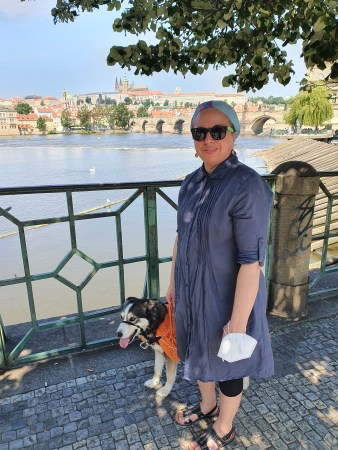
 This month more than most, I feel like I have so much to say that I don’t really know where to begin. It doesn’t help that next door they are remodelling an apartment and, outside my window, there is a crew drilling up the sidewalk and another roofing the house across the street. The noise and its echoing are overwhelming on Prague’s narrow streets.
Perhaps the best place to start is with a similarly loud occurrence. On June 27th, Prague commemorated the 70th anniversary of the execution of Milada Horáková using the city-wide intercom system. Minute-long excerpts from her trial and execution were broadcast throughout the day. Horáková, the only woman to be executed during the Communist regime in Czechoslovakia, was a long-time proponent of democracy and women’s rights. In the field of women’s rights, she focused on the status of women and children, spending considerable effort on women in the workplace and reconciling their work with family responsibilities. She was also an outspoken critic of the Nazi Regime, having spent time as a political prisoner in Terezin. When the war ended, she joined parliament, but resigned right after the communist take-over. After continuing to speak out against the Communists, she was arrested in September of 1949 and charged with attempting to overthrown the government. She along with 12 others were interrogated and tried. Four of them, including Horáková were sentenced to death. She was publicly hanged on the 27th of June 1950. Eighteen long years later, she was posthumously exonerated, and in 2000, the Czech Republic unveiled a commemorative tombstone for her in the National Cemetery at Vyšehrad Castle. In 2017, a film was made about her life and legacy. Continue reading “Listening to the Noise: The Connections between Milada Horáková, Anti-Semitism, and the Black Lives Matter Movement by Ivy Helman.”
 The Predator
 Every year I bring back wood frogs, peepers or toads to this property to increase my amphibian population… this year with a drought underway the peepers captured my heart because a bizarre heat wave hit Maine just after the coldest freeze I ever remember. The poor peepers froze and then steamed and fried under a relentless solstice sun, their vernal pools rapidly disappearing from under them.
 A few years ago, I visited the family farm founded by ancestors from Germany in the Pokonos with a newly discovered cousin. The woman I met was delightful: warm and friendly and very much connected to family still living in the area. Her mother had vivid memories of the farm. In contrast, my great-grandmother left home to marry in Brooklyn. My father had fond memories of visiting the farm as a child, but lost touch with the relatives there when his family moved to California in the 1930s.
 (With apologies to Jean de La Fontaine for significant changes to his fable)
 I woke up this morning with a terrible itch in my mind. I want to sue the government. I’m not a lawyer, at least not yet, and I know that governments have sovereign immunity that typically prevents them from being sued. But, it didn’t and doesn’t seem right that I feel so lied to and unprotected during this pandemic. What is more, I know I am not deluded. Either it is bad or it isn’t. Either it is spreading and lethal, or it isn’t. Either precautions help, or they don’t. It can’t be that ambiguous from a viral-behavioral perspective. Government leadership refuses to speak or model a consistent, truthful, and accountable model for the social welfare, leading to such absurd reductions (in Ohio, for example) as that each individual school child can decide whether s/he wants to wear a face-covering this fall. So, what gives? Why all the half-, mixed, mis-, and disinformation?
 For the past four Sunday afternoons, I’ve walked along Monument Avenue in Richmond, Virginia, to observe firsthand the changes happening to the statues of Confederate generals placed there a century or so ago. I focus here on the Robert E. Lee statue. Robert E. Lee (1807-1870) “…was an American Confederate general best known as a commander of the Confederate States Army during the American Civil War” (Wikipedia). These days, Lee’s statue seems to be home base for activists who are working diligently to keep protests and demonstrations ongoing, yet peaceful.
 “I think you should take medication for anxiety.”
 It is past “midsummer” and we are moving into the hottest time of the year without a drop of nourishing, healing rain… When I walk around outdoors I find myself focusing on the many different ferns that grace the forest edges – ferns that hold in precious moisture creating damp places for toads and frogs to hide, places for young trees to sprout, places for the grouse and turkey to hide their nestlings, ferns whose lacy fronds bow low as if in in prayer. Sweet fern covers the hill above and around the brook.
 I arrived to Crete on June 6. Movers were in my house in Lesbos on the 4th and 5th. I put myself, my car, and my cat on an overnight ferry from Lesbos to Athens on June 5, and, after a day, took a second overnight ferry from Athens to Heraklion. Then another day moving my furniture and belongings up to my 5th floor apartment using a crane. The agreement was that the moving company would put all of the furniture in its place, while I would unpack over the next few days.
