Mid-Life Genesis by Natalie Weaver

Natalie Weaver

My mother-in-law, quoting her mother, has often said, “a woman who tells her age will tell you anything.”  I think the “anything” here she is referring to is sexual disclosure.  She may be correct because I am not above or below talking about that, but that is not what I am talking about today.  Today, I am talking about age, since I am on the cusp of my fortieth birthday.

Still two months out, I am surprised that this birthday registers for me as much as it does.  The experience has caused me to plumb my mind in search for vanities that I had not previously noticed.  In the depths as on the surface, I have observed, for example, subtle changes in my skin and muscle tone.   I will catch a glimpse of my profile and see my mother or my sister, occasionally even one of my grandmothers.  My feet look a little, well, bonier somehow.  I had to buy glasses recently.  However, when I go spelunking, it is not really these things that trouble me.  I actually like myself more as an adult than I did as a child or very young woman.  I developed a wonderful sense of my body’s strength when I bore and nursed children as well as a compassion for its limitations when I had surgery.  I seem more suited to my own flesh these days, and sometimes I actually feel sorry for my younger self who did not know how to appreciate herself.  In twilight moments, I occasionally drift backward mentally to a previous iteration just to offer her a little affirmation.  It is not really the getting older that I find myself snagging upon nor (and I think I am being honest here) the loss of youth per se.  What is it then? Continue reading “Mid-Life Genesis by Natalie Weaver”

Enlivened Truth by Safa Plenty

aqua and red


My joy is rebellion, and so is my passion,
my excitement, and even my sexuality,
but only here where truth is kept secret.

Where joy exploding in my vocal cords
and coursing through my limbs is
silenced or censored looked upon as foreign
in this house haunted by sad spirits.


Where my passion rising above the lull
of everyday existence, more in tune with
childlike exuberance is drowned out by
the endless buzz of television noise.

Where my excitement for learning is
relegated to four walls of my blue bedroom,
and conversation and connection propels
me from our first floor to my sister’s
basement apartment.

Where my sexuality is cloistered inciting
fear that even its refined expression would
lead to some mythical disaster in which
men would prey on my delicate femininity.

Where my mind has constricted from being,
asked why I can’t force myself to be satisfied
with a linear spiritual existence or someone’s else
fears and expectations for my life.

My joy is rebellion, and so is my passion,
my excitement, and even my sexuality,
but with love as my fuel, I will be
a rebel with a cause and that cause
will be enlivened truth.

Safa N. Plenty ©2014


Postlude:
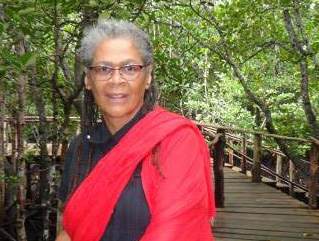
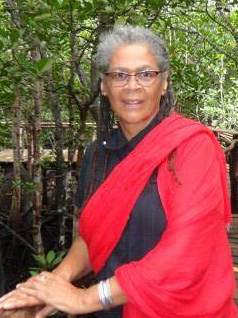
As an American Muslim women of African Caribbean, Native American, and European decent, this poem is a reflection on the remnants of both historical trauma and being partially raised in an ultra-conservative community . An experience I am still continuing to heal from. In essence, this is a deeply personal and poetic reflection on my own experience of how intergenerational trauma is often compounded by the practice of literalist interpretations of religion, particularly in my case, Islam. I am continuing a ten year journey in rediscovering my true cultural and spiritual heritage that had been partly denied me.  In writing this piece, I hoped to gain clarity on my path to heal and becoming a healer through a more fluid engagement with my own faith, while learning and benefiting from other faith traditions. Through a full engagement with  Sufism, an integral part of Islam’s sacred tradition, also known as the science of purification (Ihsan), I hope to continue on my journey of spiritual renewal and healing and to aid the world in healing from the fear and numbness that plagues us as moderns.

Safa N. Plenty is an educator and mental health counselor, who will be pursuing a Ph.D at Claremont Lincoln School of Theology with a focus in spiritual formation and peacebuilding.  She holds a Masters of Social Work from Columbia University and an undergraduate degree in interdisciplinary studies with a minor in Africana Studies. For the past two years, she has worked as a K-12 educational contractor and assistant counselor at a local community college. Her research interest include Sufism, Attachment to God, indigenous cosmology, particularly Native American and Somatic psychology. She is also interested in religious mysticism, mindfulness practice in Buddhism and the role of feminism and religion in cultivating a peacebuilding capacity among young Muslim women. She is currently working to develop a faith based healthy relationships program for Mothers and daughters. She enjoys writing poetry, research, and contemplative practice in art.


“THE OLD RELIGION” OR A “NEW CREATIVE SYNTHESIS”? by Carol P. Christ

carol christIs Goddess feminism an old religion or a new creative synthesis? Can it be both?  Goddess feminism draws on the feminist affirmation of women’s experiences, women’s bodies, and women’s connection to nature; the feminist critique of transcendent male monotheism as the symbolic expression of male domination of women and nature; and 19th and early 20th century discussions of Goddesses and matriarchy.

Most Goddess and other spiritual feminists have experienced Wiccan rituals, which are often simply called Goddess rituals.  For many of us, elements of Wiccan practice strike a chord of knowing, while other aspects seem odd or strange or even just plain weird.  What are the roots of Wiccan ritual?

In their syntheses of women’s experiences, ancient Goddess religions, and feminism, Z Budapest and Starhawk drew upon the earlier creative synthesis of the Englishman Gerald Gardner which he variously called “the Old Religion,” “Witchcraft,” and “Wicca.” Continue reading ““THE OLD RELIGION” OR A “NEW CREATIVE SYNTHESIS”? by Carol P. Christ”

Pride: Honoring the Immigrants and the Helpers by Laury Silvers

578543_102588929933471_2064577910_nIt is World Pride in Toronto this year. The city is filled with people from everywhere celebrating the gorgeous spectrum of humanity and the right of all human beings to live with dignity.  In honor of World Pride and happy coincidence of the beginning of Ramadan, I would like to share one of the earliest sermons I gave at Toronto Unity Mosque reflecting on the struggles of our LGBTQ refugee congregants. I share this to honor those refugees, as well as our other congregants whose journey is no less significant, and also to honor my friends and co-founders of the Toronto Unity Mosque, El-Farouk Khaki and Troy Jackson, as well as Adnan Hussein who was with us from the early days.

Continue reading “Pride: Honoring the Immigrants and the Helpers by Laury Silvers”

Linden – Taste the Sweetness of Summer by Deanne Quarrie

Deanne QuarrieWe are in the season of the summer and have just celebrated the Solstice.  I work with Ogham in my spiritual practice because it brings nature into my life so effectively.  It helps me listen to the many messages available to me from my kindred in nature.  In Celtic tradition, the tree for the Summer Solstice is Heather, something we can all associate with Scotland and Ireland, but the alternate tree for this season is the Linden, actually much more prevalent all over Europe.

Let’s take a look at the linden tree, its botanical profile as well as the messages it shares with us.

lindenCalled lime trees in the British Isles, (not closely related to the lime fruit) and linden, lime, or basswood in North America.  Lindens are hermaphroditic and have perfect flowers with both male and female parts.

The wood of linden trees is soft and easily worked. Throughout history it has been used for sculpture, model building, shields, altar pieces, marionettes and puppets. Having a fine light grain and being comparatively light in weight it has been used for carving, even though more modern alternatives are available.

Both the European and American Lindens flower in early summer, and the flowers have a wonderful heady sweet scent. Continue reading “Linden – Taste the Sweetness of Summer by Deanne Quarrie”

The Fault is in Our Stars: Feminism, Sisterhood, and the Fight for Awesome by Marie Cartier

If you haven’t yet read the book The Fault is in Our Stars (or seen the movie) I guess I should begin by saying this blog will contain spoilers.

This story is about having cancer as a teen and dying from it. It’s also about a young woman, Hazel Grace, having cancer, a sense of humor, belief in her ability to have her life on her own terms, fall in love and claim her independence. It’s about a young man, Augustus Waters, falling in love, being insecure as a young man, yet secure enough to cry, and his belief  in making life better for those around him for as long as he can—even after death.

It’s quite remarkable and…its aftermath is also remarkable.  This book and its film and following have created some remarkable trends.

The author, John Green has coined a few phrases that deserve coinage in my every day usage. Among them, Green has proposed we use the phrase: “nerd fighter.” Nerd fighters fight to “increase awesome and decrease suck.”

We fight against suck….we fight for awesome. We fight using our brains, our hearts, our calculators and our trombones.

Continue reading “The Fault is in Our Stars: Feminism, Sisterhood, and the Fight for Awesome by Marie Cartier”

Wrestling with Jewish Learning By Casey Tova Markenson

TOVA_01You will be handed a sheet of paper. The paper will have a quote from the Torah or the Gemara or Abraham Joshua Heschel. The ‘what’ and ‘who’ and ‘why’ behind those sources will not be explained. You will read the passage and reflect on it with a partner. In ten minutes, you will share a piece of your conversation with the rest of the group. Then, the Jewish part of the Jewish social justice program you’re about to experience will be complete.

I have read and reflected on countless texts as part of that ritual. I don’t remember any of them. I do remember being embarrassed that I didn’t know who Rebbe Nachman was. I remember sensing that my training in literary criticism didn’t “count” as Jewish knowledge. I do remember every time I revealed that I misunderstood a detail or a Hebrew word, and all of the times that a (usually male identified) peer excessively explained it.  I remember feeling left out of an exclusive club, one that I was embarrassed to want to join to begin with. Continue reading “Wrestling with Jewish Learning By Casey Tova Markenson”

Anne Hutchinson, Sor Juana, and Kate Kelly: Reflections on Equality and Excommunication by Erin Seaward-Hiatt

Erin-Close-Up-BW On June 11, 2014 the New York Times made waves in the world of Mormondom with their breaking news that two members of the Church of Jesus Christ of Latter-day Saints (LDS) are facing excommunication on the grounds of apostasy. Active Church members Kate Kelly and John P. Dehlin both received letters from their local church officials in early June summoning them to participate in scheduled Church hearings to discuss their so-called heretical public activism. By many accounts, this appears to be Dehlin’s first notice of formal disciplinary action for his faith-mending work with Mormon Stories, but Kelly has been under official fire from the LDS Church since late May for her efforts in founding and operating Ordain Women (OW)—a pro-women’s ordination group of active believers—more than a year prior. The excommunication threats came on the heels of a church-wide trend that preaches acceptance and diversity among members and beyond, but sends a mixed message to those who, like Kate Kelly, find themselves asking sincere questions only to be either silenced or rejected by their Church and cut off from communal worship of their God.

Ever since the New York Times story broke, the web has seen a swarm of responses in the form of news, interviews, blog posts, and social media discussion; watching everything unfold has been a fascinating study in feminist thought. Kelly herself responded publicly to her disciplinary letter here, saying that she had been transparent about Ordain Women with her bishop from the group’s inception and that not once had she been called in to discuss her work. The formal letter came only after Kelly had moved across the country, and the disciplinary hearing is scheduled to occur with or without her on June 22, 2014. On June 23, Kelly received the word that the trial had resulted in her excommunication.

As I’ve read through the slew of ideas and arguments surrounding what amounts to Kate Kelly’s spiritual fate, I can’t help but notice a strong underlying theme of patriarchy at work in squelching what Kelly believes are sincere questions about the lives of Mormon women. Commentators have tried hard—in classic anti-feminist fashion—to discredit Kelly’s work with Ordain Women, making certain that readers see her as a disingenuous religious deviant worthy of silencing. Throughout the spill of voices about Kelly’s Church standing the underlying point seems to be that as a Latter-day Saint she has no right to contest her Church’s doctrine or its patriarchy, that she is imagining inequality into the Church, that the Church’s discipline will be for her own spiritual good, and even that her group, Ordain Women, is lying in its claims about inequality. Continue reading “Anne Hutchinson, Sor Juana, and Kate Kelly: Reflections on Equality and Excommunication by Erin Seaward-Hiatt”

#YesAllWomen, the Darwin Debate, and the God Complex by John Erickson

#YesAllWomen proved that although not all men commit horrible crimes against women, the men that often get the headlines and create the most controversy are the ones that need to be watched out for.

John EricksonThe one thing I typically will choose to do on the rare occasion that I’m able to sit down and relax is to watch a documentary.  While some people may go to the gym, read a book, or hang with friends, I typically choose to stay in, nestle up on my couch, and learn.  While on my last bout of relaxation, I chose to watch the HBO documentary Questioning Darwin. Although it offers very little new insight into the evolution vs. creationism debate, it does offer an interesting new way to look at the recent social media hashtag war feminists, allies, and supporters found themselves in over the #YesAllWomen movement that took the world by storm.

yesallwomen

Now, before I discuss #YesAllWomen, I have to admit that I did not enter into the safe space women created for themselves to tell tales of the horrible things they have and have had to face on a daily basis.  I firmly believe that men should not have entered into the digital space Continue reading “#YesAllWomen, the Darwin Debate, and the God Complex by John Erickson”

BARBARA LEE SPEAKS FOR ME by Carol P. Christ

carol christWhile I was in Crete on the Goddess Pilgrimage teaching about and experiencing a Society of Peace where violence and domination were neither celebrated nor encouraged, another war broke out in Iraq, breaking my heart, breaking all of our hearts—yet again. When will we ever learn, oh when will we ever learn?

Barbara Lee was the only member of Congress to vote against the US war powers authorized after 9/11 which were used to launch war in Afghanistan; she also voted against authorization for the Iraq war in 2002. Hillary Clinton voted for the Iraq war, despite clear indications that the US administration was lying about weapons of mass destruction—which were never found in Iraq. I voted for Barack Obama because he opposed this war. Then he listened to General Petraeus and expanded the war in Iraq. Barbara Lee speaks for me. Hillary Clinton and Barack Obama do not.

The Iraqi people are once again living in fear of their lives as reports surface that armies and militias are engaging in mass executions of their so-called “rivals.” Is there any cause that could justify this? Continue reading “BARBARA LEE SPEAKS FOR ME by Carol P. Christ”