I am a child of the Earth.
I live and breathe, walk and dance upon Her face.
She is my source and I learn from Her each day. This I know…Life begins in the dark as Desire.
Deep in that dark place life begins to form, taking root and becoming…..As life stirs…… deep in the Mother’s Belly,
there is a gentle quickening, movement
that alerts us to a “knowing”
of the presence of something yet to come.As the Earth prepares Herself with warmth,
the rains and waters come to flood the land,
nourishing the soil in which She is creating new life.Earth and Water and Fire
come together and Form continues to take shape.One last thing is needed.
Just as new form emerges,
She breathes Air upon it.
Her Breath, giving Life to all. Continue reading “The Breath of Goddess by Deanne Quarrie”
Over the Rainbow or…“Over” the Rainbow? by Marie Cartier
What are the dreams that we dare to dream today?
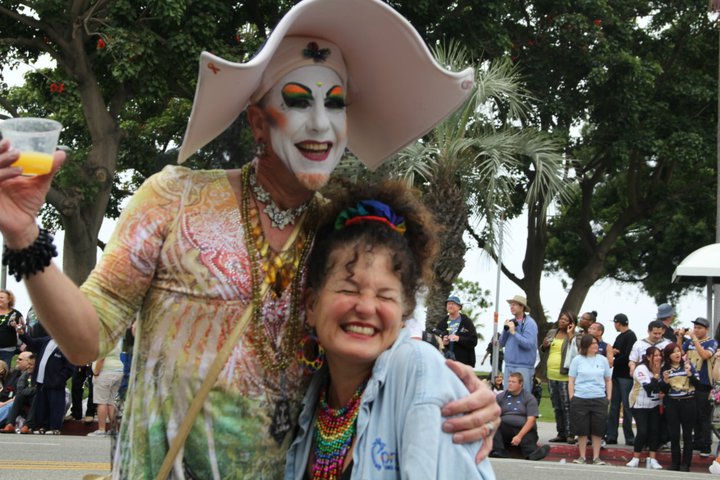
I was sitting with a young queer student from my Gender Women’s Studies class at the gay coffee shop in Long Beach, California. I offer this option to my students—meet in
Long Beach on Friday of finals week if it helps — realize that I teach in Northridge, so on a Friday afternoon this means perhaps a 2 hour drive to do this. But many students do it—this one student included. It happened that he made this trek on the first day of Gay Pride activities in Long Beach—the Dyke March was that night.

I asked if he was going to any Gay Pride events while he was in Long Beach—perhaps even attending the Dyke March. He said, “I’m over Pride.” It felt like a game changing statement for a young queer activist. I asked, “Why?” He said, “Why do I want to go somewhere and have someone try to sell me sheets or …a condo ….or buy pillows…it’s just about money, Professor. It’s got nothing to do with… what it was supposed to be about…?
I said, “Stonewall.” Continue reading “Over the Rainbow or…“Over” the Rainbow? by Marie Cartier”
It Was a Rainbow Graduation by Grace Yia-Hei Kao
I have the privilege of serving as Co-director of the Center for Sexuality, Gender, and Religion at Claremont School of Theology. I am ecstatic that we just hosted our version of a “rainbow graduation” at this year’s Commencement.
Continue reading “It Was a Rainbow Graduation by Grace Yia-Hei Kao”
Third Time’s the Charm by Kecia Ali
In the space of a week, three obtuse remarks by non-Muslim men about Muslim women ticked me off.
First was a letter to the editor by Rabbi Howard Berman, published in the Boston Globe on April 21. The title (“Women’s Strides set Judaism apart”) was telling. According to Berman, strict religious hierarchy means that only in (his branch of) Judaism have women’s rights and roles advanced. Mormons and Catholics have no shot – never mind that Mormon women had recently raised the issue of women’s priesthood, or that lay and religious women among Catholics have long been fighting the good fight, sometimes with male allies. He then contradicts himself on the role of official hierarchy: Islam, where there is less centralization than in American or world Judaism, also gives women no chance of gaining authority.
I fumed and mentally composed a pithy refutation, which I never actually wrote. Continue reading “Third Time’s the Charm by Kecia Ali”
Betraying Bodies by Kelly Brown Douglas
Her name was Tricia Meili. Their names were Yusef Salaam, Raymond Santana, Antron McCray, Korey Wise and Kevin Richardson. On April 19, 1989 all of their lives were irrevocably changed. They would never meet, but their lives would become forever linked. When they entered into Central Park on that night, did they know that they were stepping into a haunting history of dismembered bodies? Tragically, their bodies would become another story to be told in that history.
On that April day in history some 34 years ago one white female body went into Central Park for her routine jog. Five black and brown male teenage bodies went into Central Park to hang out, but soon became a part of a crowd engaged in mischievous if not dangerous and out-of-control harassment of other park visitors. As the night wore on, police were called and arrests were made. It would later be discovered that Tricia was brutally and sadistically raped, but not by Yusef, Raymond, Antron, Korey or Kevin. Yet, the five young teenagers were badgered into confessions, charged with the rape and sentenced to prison. Continue reading “Betraying Bodies by Kelly Brown Douglas”
Deciding to Leave or Remain in the Religion of Your Birth – Part II by Judith Plaskow
This is a response to Carol P. Christ’s blog of April 29, 2013 on why she decided to leave the Christian tradition. Carol and I discuss these questions further in our forthcoming book Goddess and God in the World: Conversations in Embodied Theology.
You raise the important question of what factors lead feminists to leave or remain within the religion of their birth. Your central challenge to me is how I can commit myself to a tradition in which God is imagined as a violent warrior when these images have harmed and continue to harm women and the world. How can I not recoil from using such images in worship? Why is the power of symbols less important to me than to you?
The first thing I would say is that, like you, I find these images profoundly problematic. One of the projects I have taken on in my retirement is reading the Bible from cover to cover, and I was appalled in going through all the prophets together at the amount of violence in their teachings. When I have spoken on the topic of dealing with difficult texts in the Jewish and Christian traditions—a subject that is dear to my heart—I always talk about God’s violence in addition to texts that demean women. And, yes, I have sometimes asked myself how I can remain part of a tradition in which God is depicted in this way. So I do not disagree with your critique of this imagery, but obviously for me, it is not decisive. Why not? Continue reading “Deciding to Leave or Remain in the Religion of Your Birth – Part II by Judith Plaskow”
The Cooptation of Relational Theology: Another Example of the Erasure of Women’s Contributions to Theology by Dirk von der Horst
The meaning of relational theology has changed, and not for the better.
Over the last couple of years, I started to notice “relational theology” crop up in what I considered unlikely contexts. I had previously associated the term primarily with the feminist and womanist work of Carter Heyward, Catherine Keller, Rita Nakashima Brock, Katie Geneva Canon, Karen Baker-Fletcher, Kelly Brown Douglas, and Sharon Welch, as well as the gay/feminist work of Gary David Comstock. In each of these thinkers, the pursuit of relationality as divinity was always linked to a profound wrestling with suffering and oppression. Furthermore, a clear diagnosis of individualism, transcendence, and other forms of disconnection as manifestations of patriarchal/hierarchal forms of subjectivity was central to the rationale for doing relational theology. As I experienced it in the 1990s, relational theology was simply a dimension of feminist theology. Forging through the searing pain of oppression to the roots of problems in order to propose radical solutions to real social evil, not general ruminations on divine being, was the first step. Continue reading “The Cooptation of Relational Theology: Another Example of the Erasure of Women’s Contributions to Theology by Dirk von der Horst”
Are Buddhist Women Happy? Part II by Oxana Poberejnaia
In Part I of this post I started asking questions about whether Buddhism in the West is part of patriarchy. Today I offer a possible link between practices of men’s Initiation Rites and some of the elements of Buddhism.
Men’s Initiation Rites
When we consider principle practices of Western Buddhists, primarily daily meditation and meditation retreats we might enquire something like this: since monastic practice is a model for our Western lay practice, do Buddhist monasteries constitute an extension and continuation of men’s long houses, places of men’s initiation rites?
Continue reading “Are Buddhist Women Happy? Part II by Oxana Poberejnaia”
The Catholic Church: Love Story or Scold Story? by Dawn Morais Webster
“We, the women and men of the church, we are in the middle of a love story: each of us is a link in this chain of love. And if we do not understand this, we have understood nothing of what the Church is.” Pope Francis
Welcome words of love and acceptance.
Not so the words and actions of Cardinal Tim Dolan who shut of the doors of St. Patrick’s Cathedral in the faces of LGBT Catholics and their supporters on Sunday, May 5.
Leading a silent—but eloquent—protest in New York in response to the Cardinal’s recent likening of LGBT Catholics to “dirty hands” that needed to be washed clean, Joseph Amodeo describes what happened when the group tried to quietly enter the Cathedral with symbolically charcoal-blackened palms:
We were greeted by four police cars, a captain, and eight uniformed officers. We were informed by the NYPD’s LGBT liaison that the Archdiocese was prohibiting us from entering the Cathedral, because of our dirty hands. When we tried to enter the Cathedral, security advised us that we could not enter. The representative for the Cathedral said that we could only enter the church if we washed our hands. I truly believe that Christ would have welcomed and embraced us. Instead, we stood vigil in front of the Cathedral for an hour. The Archdiocese’s response further reinforces the feeling of spiritual homelessness that many LGBT Catholics and their friends feel. Continue reading “The Catholic Church: Love Story or Scold Story? by Dawn Morais Webster”
Appreciating the Sacrament of the Present Moment by Michele Stopera Freyhauf
In order to be at peace, it is necessary to find a sense of history – that you are both part of what has come before and part of what is yet to come. Being thus surrounded, you are not alone; and the sense of urgency that pervades the present is put in perspective. Do not frivolously use the time that is yours to spend. Cherish it, that each day may bring new growth, insight, and awareness. Use this growth not selfishly, but rather in service of what may be, in the future tide of time. Never allow a day to pass that did not add to what was understood before. Let each day be a stone in the path of growth. Do not rest until what was intended has been done. But remember – go as slowly as is necessary in order to sustain a steady pace; do not expend energy in waste. Finally, do not allow the illusory urgencies of the immediate to distract you from your vision of the eternal.
(Elisabeth Kubler-Ross, The Final Stage of Growth, 167)
Last month we lost a good friend unexpectedly. His death, just days after his 49th birthday caused me to confront my own mortality. His death also makes me think about that void in life that we leave as well as the legacies we leave behind. How will I be remembered? Did I make a difference while on earth? Have I served and given back enough? Continue reading “Appreciating the Sacrament of the Present Moment by Michele Stopera Freyhauf”