Cells in The Body Of Earth: Living with Violence, Part 1 by Candice Valenzuela

Candice Rose Valenzuela teaches English Literature at Castlemont High School in East Oakland, California, and she has been teaching and organizing inner-city youth for the past eight years. She is currently pursuing a Masters in East-West Psychology at the California Institute for Integral Studies, and desires to bring indigenous healing methodologies into teaching and learning in the inner-city.This week has been especially hard. At the high school where I teach, the youth and staff are facing a level of heightened violence, the likes of which, I have not myself personally seen before. Two weeks ago, a young woman was shot in front of the youth center next door, and two days later there was a drive-by in front of the campus targeting one of our young men. Shots flew through the building as youth and teachers hid under desks. I am writing this now as I process the knowledge that one of my own, Olajuwon Clayborn, was shot and murdered this past Sunday around midnight in front of his home while his mother watched.

I’ve been teaching in urban schools for the past eight years (for one of those years I was a sex educator, two a special ed teacher, and the last five an English instructor). In this time I’ve grown tremendously, through having to face the severe struggles of inner-city youth, face what their struggles trigger in me, and then channel that into something that can be helpful, useful, or inspiring to them. What has resulted are new lesson plans, deep relationships, and a constantly transforming work ethic. Above all, I continue to grow into a person who is greater and wiser than I could have ever imagined, all due to the trust and love of the youth, who literally, often give me more than I give them. Continue reading “Cells in The Body Of Earth: Living with Violence, Part 1 by Candice Valenzuela”

Making Mormon Feminist Progress: Writing for Change by Caroline Kline

Kline, CarolineOver the last five months, Mormon feminist activism has been on the rise. Wear Pants to Church Day in December garnered national press coverage, and the Ordain Women movement, launched in March, boldly called for Mormon leaders to change Church policy against ordaining women. Another activist project launched in January, Let Women Pray, gathered 300 letters from Mormons asking Church leaders to invite a woman to pray for the first time in LDS General Conference. This was a strategic request: organizers of the project deliberately targeted breaking down a traditional practice that excluded women, not a formal rule. There is no policy stating that women can’t pray in General Conference – it’s simply been the tradition throughout the Mormonism’s history that men give these prayers.

I was skeptical of the Let Women Pray project, I admit. Grassroots agitation does not often lead to quick changes in the LDS Church. There is also something about writing to ask for change (begging?) that makes me feel uncomfortable and powerless. But raising my voice to agitate, no matter the form, ultimately seemed preferable to remaining silent, so in February I sat down to write my letter. Continue reading “Making Mormon Feminist Progress: Writing for Change by Caroline Kline”

The Myth of Teen Violence and Spiritual Paths by Kelley Harrell

What does it take to decode teenage America? How can we understand the confluence of factors behind rising crime rates involving our youth, changing sensibilities toward bullying, and violence in our society? Better yet, how do we inform ourselves and support young people in finding the facts? Every day I read articles asking these questions, and a San Francisco woman has devoted the last few years researching their answers.

2013-05-13-BethWinegarner.jpg  David Kinnaman and Gabe Lyons in their book unChristian, of the majority religion, Beth Winegarner noted that a lot of teens have "lost respect, because they find [Christianity] anti-homosexual, judgmental, or hypocritical."A passionate supporter of social causes, a civic voice sounding our shifting cultural landscape, a wonderful mother, and a brilliant writer — meet Beth Winegarner. Creator of Backward Messages, a forum openly discussing social elements that feed violence in teen culture, and the media that perpetuates myths around them, Winegarner doesn’t hold back. She takes on sacred cows that have always clouded adult judgment where youth behavior is concerned — heavy metal, video games, the entertainment industry, and the occult. Her work deconstructs every façade that informs our policy, parenting, and perspectives on teens. Not stopping to just debunk socially accepted truths about teens behaving badly, her platform goes on to highlight the real issues creating problems. Among them she cites lack of mental health support, parenting, and in some cases, healthy social communities. Continue reading “The Myth of Teen Violence and Spiritual Paths by Kelley Harrell”

Tug-of-Warring over the Female Body (Part 1 of 2) by Jameelah X. Medina

Cover up! No, get naked!

Haraam [Sin]; cover yourself! Be free; show some skin!

AstaghfirAllah [seeking forgiveness from God]; aren’t you ashamed?! Damn, aren’t you hot in that?!

The Muslim woman’s body feels like a battleground, especially during times like last month (April) with the whole FEMEN “topless jihad” controversy sparked by the Tunisian woman who protested the female body as a source a familial honor. On one side is essentialized feminism and patriarchy on the other end with both sides pulling hard. Both sides have Muslim women on their team, but both sides also harm them. Let’s start with “Team Femesential.”

Questioning the headscarf and certain covering practices is mostly a healthy endeavor in which many Muslim girls and women engage before and after deciding (if they do) to wear a headscarf. However, questioning the headscarf can also be an oppressive and even dismissive strategy that is disrespectful to Muslim women and to all women in general. Continue reading “Tug-of-Warring over the Female Body (Part 1 of 2) by Jameelah X. Medina”

The Breath of Goddess by Deanne Quarrie

Deanne Quarrie

I am a child of the Earth.
I live and breathe, walk and dance upon Her face.
She is my source and I learn from Her each day. This I know…

Life begins in the dark as Desire.
Deep in that dark place life begins to form, taking root and becoming…..

As life stirs…… deep in the Mother’s Belly,
there is a gentle quickening, movement
that alerts us to a “knowing”
of the presence of something yet to come.

As the Earth prepares Herself with warmth,
the rains and waters come to flood the land,
nourishing the soil in which She is creating new life.

Earth and Water and Fire
come together and Form continues to take shape.

One last thing is needed.
Just as new form emerges,
She breathes Air upon it.
Her Breath, giving Life to all. Continue reading “The Breath of Goddess by Deanne Quarrie”

Over the Rainbow or…“Over” the Rainbow? by Marie Cartier

What are the dreams that we dare to dream today?

I was sitting with a young queer student from my Gender Women’s Studies class at the gay coffee shop in Long Beach, California. I offer this option to my students—meet in

Long Beach on Friday of finals week if it helps — realize that I teach in Northridge, so on a Friday afternoon this means perhaps a 2 hour drive to do this. But many students do it—this one student included. It happened that he made this trek on the first day of Gay Pride activities in Long Beach—the Dyke March was that night.

of Gay Pride activities in Long Beach—the Dyke March, marie Cartier, feminism and religion, stonewall
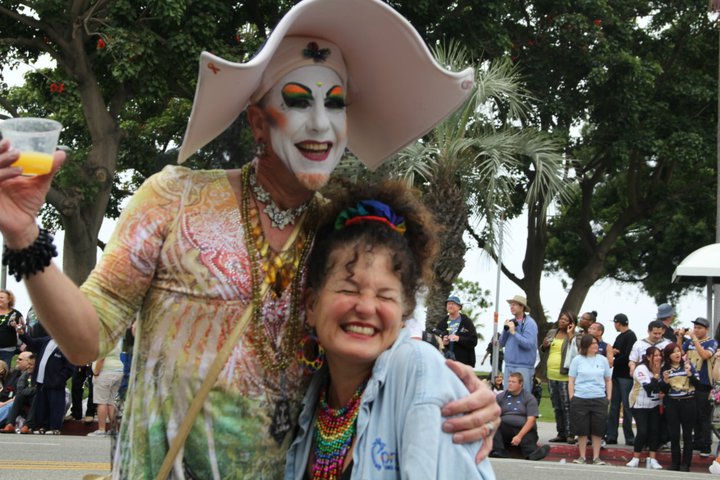
Marie with sister of perpetual indulgence—tippy tappy toes

I asked if he was going to any Gay Pride events while he was in Long Beach—perhaps even attending the Dyke March. He said, “I’m over Pride.” It felt like a game changing statement for a young queer activist.  I asked, “Why?” He said, “Why do I want to go somewhere and have someone try to sell me sheets or …a condo ….or buy pillows…it’s just about money, Professor. It’s got nothing to do with… what it was supposed to be about…?

I said, “Stonewall.” Continue reading “Over the Rainbow or…“Over” the Rainbow? by Marie Cartier”

It Was a Rainbow Graduation by Grace Yia-Hei Kao

Distributing rainbow tasselsI have the privilege of serving as Co-director of the Center for Sexuality, Gender, and Religion at Claremont School of Theology. I am ecstatic that we just hosted our version of a “rainbow graduation” at this year’s Commencement.

Continue reading “It Was a Rainbow Graduation by Grace Yia-Hei Kao”

Third Time’s the Charm by Kecia Ali

dissertation, Advising, feminism and religionIn the space of a week, three obtuse remarks by non-Muslim men about Muslim women ticked me off.

First was a letter to the editor by Rabbi Howard Berman, published in the Boston Globe on April 21. The title (“Women’s Strides set Judaism apart”) was telling. According to Berman, strict religious hierarchy means that only in (his branch of) Judaism have women’s rights and roles advanced. Mormons and Catholics have no shot – never mind that Mormon women had recently raised the issue of women’s priesthood, or that lay and religious women among Catholics have long been fighting the good fight, sometimes with male allies. He then contradicts himself on the role of official hierarchy: Islam, where there is less centralization than in American or world Judaism, also gives women no chance of gaining authority.

I fumed and mentally composed a pithy refutation, which I never actually wrote. Continue reading “Third Time’s the Charm by Kecia Ali”

Betraying Bodies by Kelly Brown Douglas

Her name was Tricia Meili. Their names were Yusef Salaam, Raymond Santana, Antron McCray, Korey Wise and Kevin Richardson.  On April 19, 1989 all of their lives were irrevocably changed. They would never meet, but their lives would become forever linked.  When they entered into Central Park on that night, did they know that they were stepping into a haunting history of dismembered bodies?  Tragically, their bodies would become another story to be told in that history.

On that April day in history some 34 years ago one white female body went into Central Park for her routine jog. Five black and brown male teenage bodies went into Central Park to hang out, but soon became a part of a crowd engaged in mischievous if not dangerous and out-of-control harassment of other park visitors. As the night wore on, police were called and arrests were made. It would later be discovered that Tricia was brutally and sadistically raped, but not by Yusef, Raymond, Antron, Korey or Kevin. Yet, the five young teenagers were badgered into confessions, charged with the rape and sentenced to prison. Continue reading “Betraying Bodies by Kelly Brown Douglas”

Deciding to Leave or Remain in the Religion of Your Birth – Part II by Judith Plaskow

Photo by Manhattan College

This is a response to Carol P. Christ’s blog of April 29, 2013 on why she decided to leave the Christian tradition. Carol and I discuss these questions further in our forthcoming book Goddess and God in the World: Conversations in Embodied Theology.

You raise the important question of what factors lead feminists to leave or remain within the religion of their birth. Your central challenge to me is how I can commit myself to a tradition in which God is imagined as a violent warrior when these images have harmed and continue to harm women and the world. How can I not recoil from using such images in worship? Why is the power of symbols less important to me than to you?

The first thing I would say is that, like you, I find these images profoundly problematic. One of the projects I have taken on in my retirement is reading the Bible from cover to cover, and I was appalled in going through all the prophets together at the amount of violence in their teachings. When I have spoken on the topic of dealing with difficult texts in the Jewish and Christian traditions—a subject that is dear to my heart—I always talk about God’s violence in addition to texts that demean women. And, yes, I have sometimes asked myself how I can remain part of a tradition in which God is depicted in this way. So I do not disagree with your critique of this imagery, but obviously for me, it is not decisive. Why not? Continue reading “Deciding to Leave or Remain in the Religion of Your Birth – Part II by Judith Plaskow”