A Gift Economy: Could It Be Better To Give Than To Receive? by Carol P. Christ

carol p. christ 2002 colorIn a gift economy inequalities are balanced out by the cultural practice of gift-giving. If you have more, then you give more, if you have little, you still feel it is better to give than to receive.  A person who hoards wealth is not viewed positively.

The worldview of a gift-giving economy is so far from our own that we can barely comprehend it.

marika's rakiIn Skoteino, Crete, eighty-seven year old Marika awaits eagerly for the arrival of our group. She does not come empty-handed to join us after we have finished a meal lovingly prepared by Christina.  Marika brings a bottle of raki and urges us all to join her in downing a small glass of her homemade moonshine.  Often she offers us nuts she has cracked or raisins she has prepared as well .  She has almost nothing and lives without many modern conveniences, but she would not consider joining us without bringing a gift.

In Zaros, we arrive at our favorite hotel only to be told that the taverna that serves fresh trout is closed because the owner’s son will be getting married in the evening. When I complain that we have come to eat the special trout, our whole group is invited to the wedding.  Outside the taverna the grandmothers light fires under massive copper pots where they prepare the food. Over 600 people have been invited to the wedding. We are first served macaroni with virgin olive oil and goat cheese, then lamb, then goat, and salad. When the wine runs out, bottles of raki are brought to the tables. We dance all night long in a kind of a frenzy. Continue reading “A Gift Economy: Could It Be Better To Give Than To Receive? by Carol P. Christ”
The Roman Catholic Theology of Womanhood by Ivy Helman

The Vatican has creIvy Helmanated an entire theology of womanhood without the input of a single woman!  Searching the Vatican archives reveals a wide range of documents pertaining to women, some of which mention women tersely only in their capacity as workers needing protection (Rerum novarum, 1891) and others are fully dedicated to describing the status, role and mission of women in the family, society and the world (Mulieris dignitatem, 1988).  Within the documents, as time passes, women become their own category of theological importance.  This is due to the influence of feminism on the status and roles of women across the globe.  Yet, there is vehement anti-feminism in the documents as well.

I searched the documents myself, curious as to what the Vatican had to say about womanhood and wrote a book on the topic published by Orbis in Febrary 2012 entitled, Women and the Vatican: An Explanation of Official Documents.  I would like to lay out that theology now.  Continue reading “The Roman Catholic Theology of Womanhood by Ivy Helman”

Painting Jarena Lee By Angela Yarber

When we gender the pulpit in the direction of justice, we ordain her spirit with gratitude for the many miles she walked and the countless sermons she preached.

This month I celebrate the release of my second book, The Gendered Pulpit: Sex, Body, and Desire in Preaching and WorshipAs I celebrate the privilege I have as queer feminist to stand behind the pulpit each Sunday—to gender the space in the direction of justice—I must also recall the myriad holy women who have gone before me.  I think of many of my Holy Women Icons with a folk feminist twist: Virginia Woolf , the Shulamite, Mary Daly, Baby Suggs, Pachamama and Gaia, Frida Kahlo, Salome, Guadalupe and Mary, Fatima, Sojourner Truth, Saraswati, and so many others.  And this month I think specifically of my sister preachers, those who raised their voices in bold proclamations when the road was long and unimaginably difficult.  I think of preachers like Jarena Lee.

Jarena leeLee spent thirty years as an itinerant preacher and was the first black woman to be licensed to preach through the African Methodist Episcopal (AME) church.  Despite the fact that the AME issued a definitive ruling that women were not permitted to preach in 1852, Lee spent the bulk of her adult life preaching.  Jarena Lee’s struggle to preach is a familiar story in nineteenth-century American Protestantism, even though the Second Awakening ushered in a period of intense religious revival; with camp meetings around every corner, there was an unprecedented opportunity for women to preach.  Like Jarena Lee, though, they weren’t paid, ordained, or protected. Continue reading “Painting Jarena Lee By Angela Yarber”

Orientations: Body, Space, Authority by Linn Marie Tonstad

Linn Marie TonstadIn her book Queer Phenomenology, Sara Ahmed investigates how we orient ourselves in space with respect to tables – the tables around which we sit, at which we eat with friends and families of choice and birth, and at which we write. She describes moving into a new place and arranging the furniture. “After the kitchen, the room I hope to inhabit is always the study. Or the place that I have decided is the place where I will write. There, that will be my desk. Or it could just be the writing table. It is here that I will gather my thoughts. It is here that I will write, and even write about writing. … Making a place feel like home, or becoming at home in a space, is for me about being at my table. I think fondly of Virginia Woolf’s A Room of One’s Own. How important it is, especially for women, to claim that space, to take up that space through what one does with one’s body. And so when I am at my table, I am also claiming that space, I am becoming a writer by taking up that space.” (11) Ahmed goes on to discuss how certain possibilities are opened up, and others foreclosed, by the way we orient ourselves (or find ourselves oriented) to others and to objects. She describes the bodily postures that result from orienting oneself to the writing table – the way one might hunch over one’s computer, or find oneself with ink-stained fingers.

In a very different context, the queer theologian Marcella Althaus-Reid describes a scene from her childhood in Argentina. She kneels in front of a priest for confession. But instead of kneeling to the side, aslant, as she ‘ought’ to have done, being a girl, she kneels directly in front of the priest, as if she were a boy. Kneeling here too is a form of orientation, a form of direction, a bodily habit of becoming. “Kneeling is troublesome and it has a theological referent in the church’s also troubled waters of sexuality and power. A whole symbolic sexual order is obviously manifested in kneelings as positions of subordination and sites of possible homo- and hetero- seductions, because these are theologically distributed around the axis of the priesthood’s male genitalia. The priest’s penis carries the sacred connotations of the phallus as a transcendental signifier of the theological discourses to everyday Christianity, and kneeling is a liturgical positing designed to centralise and highlight this.” (The Queer God, 11) To kneel in the right (gendered) position in relation to the priest is also to kneel in the right relation to God. Continue reading “Orientations: Body, Space, Authority by Linn Marie Tonstad”

The Feminist Influence by Elise M. Edwards

Elise Edwards

In these past few months, as I’ve been finishing my dissertation about a theological and ethical perspective on architecture, I’ve had the pleasure of speaking often about my work.  In March, I was invited to give a talk at a symposium titled “On Christ and Architecture” at Judson University.  As they introduced me, the speakers noted that I am a black feminist.  Because of the brevity of my presentation, I didn’t speak about things that most people associate with feminism. So I was especially excited when at the end, one of the organizers complimented me by saying, “I really see the feminist influence in your work and I thank you for bringing that to us.” So exactly what does a feminist perspective bring to a theological study of architecture?

Perhaps first I should explain what my theological study of architecture is.  The purpose of architecture is sometimes understood as aesthetic or functional—to either make buildings that look nice or serve their purposes well (or both).  However, I discuss an ethical approach that expands this common understanding of architecture.  Grounding my research in philosopher Karsten Harries’ The Ethical Function of Architecture and theologian Timothy Gorringe’s A Theology of the Built Environment, I argue that architecture presents interpretations of a community ethos, or way of life, for its specific time and place.  These representations can either promote or inhibit human flourishing, and therefore, are the proper concern of Christian theology and ethics, which is concerned with questions about how Christians and those in the broader society are to live rightly in the world. Continue reading “The Feminist Influence by Elise M. Edwards”

Goddess Mother by Molly

Mamapriestess

She who changes
She who expands and contracts
She who stretches her limits
She who digs deep
She who triumphs and fails
Every day
Sometimes both within a single hour
She who tends her own hearth
She who comforts and connects and enfolds
She who opens wide

She whose heart cracks open at birth
She who tension bunches her shoulders
And lines her face
She who laughs
She who carries the world
She who sings with her sisters
Molly Remer mamapriestess Triple goddessAnd circles in ceremony
She who holds precious her daughters and her sons

She who defends and protects
She who opens her heart just a little wider
She who trusts
She who tries again
She who gathers to her breast
She who gathers women in ritual
She who hopes
Prays
Fears
She who loves so deeply
That it crosses all boundaries
To eternity. Continue reading “Goddess Mother by Molly”

Incarnating the Mystery with Psychological Awareness by Jean Benedict Raffa

image010As a college professor I taught Children’s Literature. Mythology, stories about humanity’s relationship with the gods, always raised a few eyebrows. Students tended to feel uncomfortable when this term was applied to their own faith traditions since it generally connotes “untrue.” So I found it helpful to note up front that myths are not necessarily literally or historically true, but they’re always psychologically and spiritually true.

From his extensive study of myths, psychologist Carl Jung concluded that we are all born with a “religious function,” an inherent sense of awe about, and longing to connect with the Sacred Mystery of life. He saw it as a faculty of our central archetype, the Self: our core and circumference, our god-image.  Myths, rituals and religious symbols are our attempts to incarnate the Self so that we can be infused with love, hope and holy wonder. Some myths are helpful in this endeavor. Others are dysfunctional; for example, myths which justify the dominance, exclusion or destruction of others considered less worthy or entitled.

When our primitive ancestors reflected on the miracle of life, the Self prompted the thought that because humanity is gendered, the Mystery must be as well.  Since Earth was the foundation of existence and had an inexhaustible fruitfulness, it felt like a Mother. This shaped our earliest images of God. Mircea Eliade noted: “In some cases, the sex of this earth divinity, this universal procreatrix—does not even have to be defined. A great many earth divinities…are bisexual. In such cases the divinity contains all the forces of creation—and this formula of polarity, of the coexistence of opposites, was to be taken up again in the loftiest of later speculation.” Continue reading “Incarnating the Mystery with Psychological Awareness by Jean Benedict Raffa”

The Flesh Made Word: Colm Toibin’s “The Testament of Mary” on stage and in print By Joyce Zonana

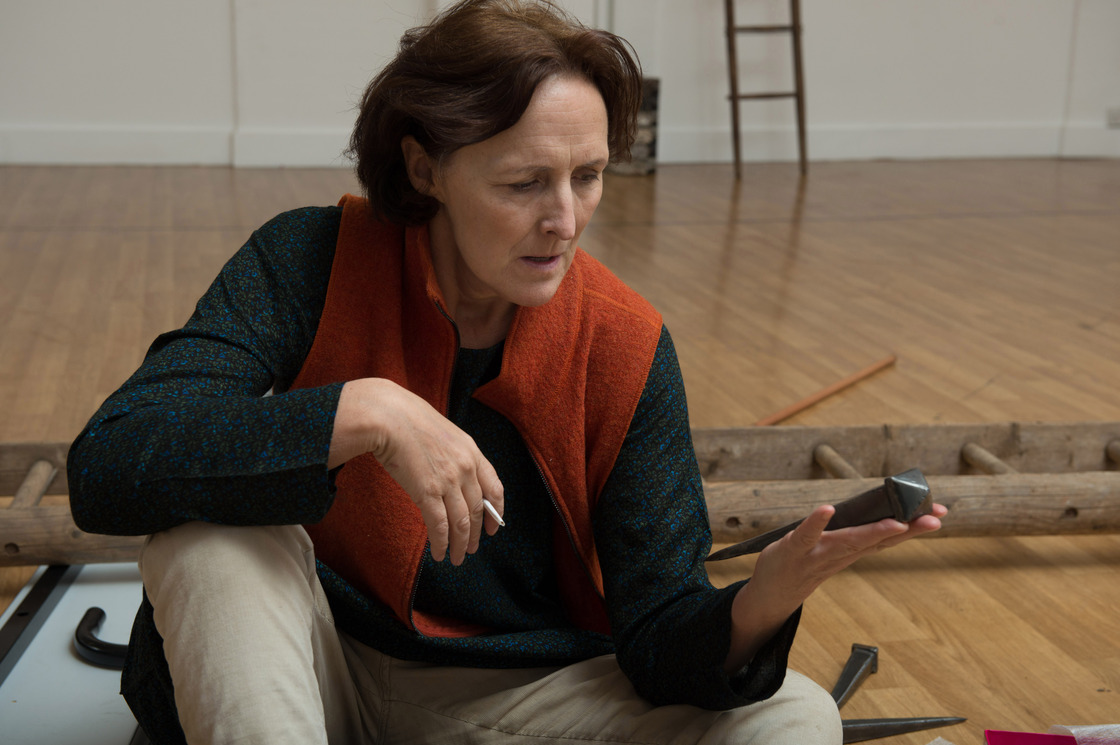
Colm Toibin Fiona Shaw Testament of Mary Ephesus Artemis House of the VirginBefore the play begins, the audience is invited on stage; we walk around, not quite knowing what to do, gazing at the props, uncertain.  A few chairs, scattered jars of honey, jugs of water beside a free-standing waist-high faucet, a tall ladder, a long table, a stripped tree trunk with a wooden wheel at the top suspended from the rafters, a menacing roll of barbed wire, and a live turkey vulture occasionally spreading wide its iridescent blue-black wings: such is the set for Deborah Warner’s searing production of Colm Toibin’s The Testament of Mary, a one-woman show currently in previews at the Walter Kerr Theater in New York.  In a large open-sided box, stage left, the actress Fiona Shaw, draped in blue from head to toe, arranges herself, then sits perfectly still, holding a lily and an apple.  We know this woman.  The Virgin Mary.  The Icon.  Incarnate.

Fiona Shaw rehearses for her role as the Virgin Mary in The Testament of Mary. Irish novelist Colm Toibin's one-woman play opens April 22 at Broadway's Walter Kerr Theater.
Shaw in rehearsal. Photo by Hugo Glendinning

But when we are all back in our seats, Mary casts off her robe to stand before us in a simple black shift, flowing easily over narrow brown pants. Her hair is cropped, her face haunted; wearing short leather boots, she fumbles as she searches for a hand-rolled cigarette to steady herself.   “I remember everything.  Memory fills my body as much as blood and bones.”  No longer an icon, hardly a virgin, this Mary addresses us with the piercing directness of the passion she has suffered: to have seen her only son crucified despite her efforts to save him. Now, interrogated by two unnamed apostles (John and Luke?) who want to fix the story of her son’s life and death and resurrection, Mary insists on reporting only what she knows:  “I was there.  I fled before it was over but if you want witnesses then I am one and I can tell you now, when you say that he redeemed the world, I will say that it was not worth it.  It was not worth it.”

Continue reading “The Flesh Made Word: Colm Toibin’s “The Testament of Mary” on stage and in print By Joyce Zonana”

The Green Man By Barbara Ardinger

The Green Man’s message about rebirth is why he is so popular today. He’s come to symbolize the green movement. He’s a friend of the earth who is whispering to us to wake up and grow up, to march and dance with him in celebration of our relationship with nature. What green thing can we do today?

The Green Man’s message about rebirth is why he is so popular today. He’s come to symbolize the green movement. He’s a friend of the earth who is whispering to us to wake up and grow up, to march and dance with him in celebration of our relationship with nature. What green thing can we do today?
The Green Man

Spring has, as they say, has  sprung, and we who live in the Northern Hemisphere are witnessing the annual greening of the earth. Grasses and grains are growing, trees are leafing, flowers are budding. I like to imagine the goddesses who rule the springtime—Anna Perenna (classical Roman, probably Etruscan), Butterfly Maiden (Hopi), Freya (Norse), Hu-Tu (Chinese), the Rusalky (Russian), and others—calling their worshippers and gatheringthem on the village green to dance and celebrate the revival of the earth. Continue reading “The Green Man By Barbara Ardinger”

Grief Beyond Belief and Rebecca Hensler by Kile Jones

Kile Jones, atheistIn my last post, “A Pro-Science, Skeptical Woman Speaks” I interviewed a woman with whom I share many views in common.  One of my goals here at Feminism and Religion is to introduce different secular, atheistic, liberal feminists who share many of the same ethical views as regular contributors and readers, but not the same “religious” or “spiritual” ideas.  In this post I examine an online support network for unbelievers, Grief Beyond Belief, and ask a few questions to its founder, Rebecca Hensler.

I met Rebecca in February in San Francisco while on a visit I made to meet with the Unitarian Universalist Association in regards to my ordination.  My girlfriend and I met Rebecca in North Beach, San Francisco for dinner and drinks.  I experienced her as a compassionate, friendly, and genuine person.  Her experiences and insights inspired me to think more about the role of grief and pain among unbelievers.  I mean, atheists cry, agnostics experience loss, skeptics lose family members, and we do it all without a “God” or “spirit” to help us.  And if we were to meet C.S. Lewis, we would make

sure to exclaim, “No…pain is not some megaphone for God to rouse a deaf world.”

R Hensler

Why did you start Grief Beyond Belief?

The original idea was born of my own grief.  After my son died, I found a group in which to share comfort and compassion with other grieving parents: The Compassionate Friends, a mainstream parental grief support organization with a strong online presence.  It was so close to exactly what I needed, but I frequently felt alienated by the religious and spiritual content — not just the offers of comfort that depended on beliefs I do not hold, but the assumption that everyone there held some sort of belief in life after death. And the assumption, so common in mainstream grief support, that even if I am not the same religion as you are, I have a religion, and I believe in some sort of afterlife was equally alienating and hurtful. Continue reading “Grief Beyond Belief and Rebecca Hensler by Kile Jones”