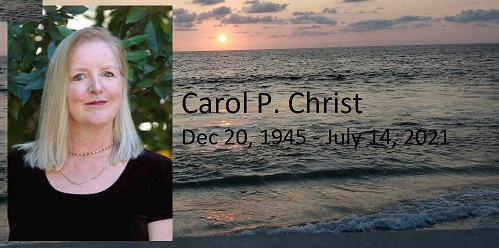
In Memoriam – Carol P. Christ by Joyce Zonana

“thea-logy begins in experience” –  Rebirth of the Goddess

It is hard to believe that Carol P. Christ – Karolina as she dubbed herself in her beloved Greece—has been gone for a year. She remains such a vivid presence in my life—in all of our lives. I think of her and draw strength from those thoughts daily, the way so many women say they think of and feel close to their deceased mothers. For Karolina was indeed a mother to me—a nurturing spiritual mother who initiated me into the ways of the Goddess she adored and, whom she so beautifully defined as “the power of intelligent love that is the ground of all being.”

I first met Karolina in June of 1995 on a bare hotel rooftop in Athens. I had just flown there from New Orleans to join the Ariadne Institute’s Goddess Pilgrimage Tour, a leap of faith inspired by my reading the previous year of Weaving the Visions: Patterns in Feminist Spirituality, a pioneering anthology edited by Carol and her long-time friend and collaborator, Judith Plaskow. That book, along with Carol’s Diving Deep and Surfacing and Judith’s Standing Again at Sinai had spoken to me more deeply than anything I had ever read before. I had grown up in a Middle Eastern Orthodox Jewish family. drawn to spirituality, I had never able to find a place for myself in the deeply patriarchal structures of synagogue or even family rituals … Carol and Judith offered me a way in, and I wanted immediately to embark on the paths they were clearing. I wanted to meet them, to know them,  to learn from them, to share with them. Boldly, I decided to join the Pilgrimage, signing up for my first trip overseas trip, the most costly vacation I had ever granted myself. How could I have known that it would transform my life and bless me with a miraculous, deep friendship?

Continue reading “In Memoriam – Carol P. Christ by Joyce Zonana”
The Legacy of Carol P. Christ: Dance of the Bees: Reading the Language of the Goddess

This blog was originally posted on December 1, 2014

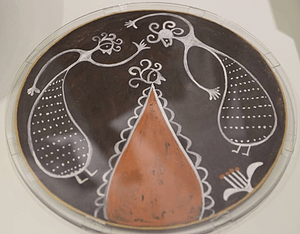
The image from an ancient Cretan bowl (c.1700 BCE) from the Sacred Center of Phaistos pictured here has often been interpreted as an early depiction of Persephone’s descent or rising. But are clues from later Greek mythology pointing in the right direction in this case?

Recently, my colleague Mika Scott posted the Phaistos bowl image on our Goddess Pilgrimage Facebook site in conjunction with the bee pendant from Mallia. This juxtaposition led me to think again about the importance of bees and pollination in agricultural societies and to offer an alternative reading of the symbolism on the bowl.

Continue reading “The Legacy of Carol P. Christ: Dance of the Bees: Reading the Language of the Goddess”

The Legacy of Carol P. Christ: Weaving and Spinning Women: Witches and Pagans by Max Dashu A Review

Moderator’s Note: This was originally posted on September 19, 2016

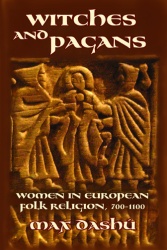
Max Dashu’s  Witches and Pagans: Women in European Folk Religion 700-1000 challenges the assumption that Europe was fully Christianized within a few short centuries as traditional historians tell us. Most of us were taught not only that Europe became Christian very rapidly, but also that Europeans were more than willing to adopt a new religion that was “superior” to “paganism” in every way. Careful readers of Dashu’s important new work will be challenged to revise their views. When the full 15 volumes of the projected series are in print, historians may be forced to hang their heads in shame. This of course assumes that scholars will read Dashu’s work. More likely they will ignore or dismiss it, but sooner or later–I dare to hope–the truth will out.

witches-and-pagans-cover

History has been written by the victors—in the case of Europe by elite Christian men. These men may have wanted to believe that their views were widely held, but Dashu suggests that they were not. Combing artistic and archaeological records, Dashu finds (to give one example) that images of Mother Earth nursing a snake are far from uncommon and can even be found as illustrations in Christian documents and on Christian monuments. Clerics rage against people—particularly women–who continue to visit holy wells and sacred trees and to practice divination and healing rituals invoking pagan powers. To paraphrase Shakespeare: “Methinks the cleric doth protest too much.” Were these things not happening and happening often, there would have been no need to condemn them.  Using these clues, Dashu provides intriguing new readings of the Poetic Edda and Norse sagas.

Continue reading “The Legacy of Carol P. Christ: Weaving and Spinning Women: Witches and Pagans by Max Dashu A Review”

FREE OUR CHILDREN by Esther Nelson

I remember a poignant conversation with my sister when our children were young.  Our biggest fear at the time? How would we ever manage if one (or several) of our children refused to speak to us as they grew into young adulthood? Stories swirled around our social circles about a son or daughter who wanted nothing to do with their family of origin. These estranged children frequently put physical distance between themselves and their parents.

That fear eventually became my reality.  I despaired.

Like many parents, I lacked experience and maturity while raising my children. I didn’t have the wisdom to understand, trust, and apply the message of the Lebanese-American writer/poet, Kahlil Gibran (1883-1931). Had I done so, not only would I have avoided a lot of grief, but my children would probably have had an easier transition from childhood towards independent adulthood.

Continue reading “FREE OUR CHILDREN by Esther Nelson”

The Legacy of Carol P. Christ: June 25th or “June Unteenth”: A Sad Day For All Americans

This was originally posted on July 1, 2013

Kelly Brown Douglas wrote recently on Feminism and Religion about the celebrations in black communities on Juneteeth when the emancipation of slaves became a reality in the formerly Confederate states.  Sadly, on June 25th 2013 the Supreme Court announced its decision striking down section 4 of the Voting Rights act of 1965, the most important Civil Rights legislation of the 20th century.  The Supreme Court gave a “green light” to states with previous and on-going records of introducing laws with the effect of preventing minority voters from voting to “proceed straight ahead.”  I name this day June Unteenth and call on all Americans to mourn it in sackcloth and ashes.

For every American concerned with Civil Rights this indeed is a sad day. It means states and municipalities—particularly those in the former Confederacy—will in the days following the decision be introducing new legislation which will have the effect of disenfranchising black voters.  Those of us who consider the right to vote fundamental in a democracy must rise up, with time, with money, and if necessary with our bodies in peaceful protest.

Continue reading “The Legacy of Carol P. Christ: June 25th or “June Unteenth”: A Sad Day For All Americans”

The Legacy of Carol P. Christ: GOD AND WOMAN AT YALE*

This was originally posted on June 25, 2012

As a graduate student, I was told in every way possible that I could not be a woman and a theologian.

When I was studying for my Ph.D. at Yale in theology in the late 1960s and early 1970s, my skirts were short as was the fashion of the day.  The male faculty and students and their wives dressed in ways that would not call attention to themselves or their sexuality.  I was also over 6’ tall.  When I walked into a room, I was consciously and unconsciously perceived as a threat to a world which these men had simply assumed was “theirs.”  Their response was to categorize me as a sexual being (I was once introduced as “our department bunny”) and to erase my mind.  I was to discover that the male graduate students were making bets in the dining hall about “where she will sit today.”  One of my friends frequently fell down and feigned to “worship” me when I passed him in the hallways.  I had never received so much attention from men before and it was flattering.

Continue reading “The Legacy of Carol P. Christ: GOD AND WOMAN AT YALE*”

Carol P. Christ’s Legacy: Are Most of Us Abused Children? And is Child Abuse the Root of Evil?

This was originally posted on July 16, 2012

Child abuse does not have to be physical or sexual. The most widespread forms of child abuse are psychological, and therefore harder to see, acknowledge, and eradicate. As abused children, we unconsciously pass on patterns of abuse visited on us to children, and to others we have power over including students, employees, and even friends and lovers.

The recent visit of a friend who is suffering greatly in a “battle” with her own “demons” reminded me of the important work of Alice Miller. My friend’s “demons” take the form of a persistent self-criticism laced with the feeling that “if only” she did or didn’t do certain things, her world would fall into place. My “demons” generally take a different form, telling me that I am helpless and that there is nothing I can do to ease my suffering.

Such “demons” were not implanted in my friend and me by the devil. They took root in interactions with our own parents, who were not themselves any different from most of the parents of their time and place. Recognizing that our parents were not “bad” people should not blind us to the great harm they did to us. However, when abused children speak of their abuse, the statement that their parents did not intend to harm them usually functions to deflect attention away from child abuse that really did occur. What happened to my friend and me was something like this. In many small and perhaps also a few traumatic interactions, we learned that our feelings do not count.  “Don’t talk now, your father is tired.” “Stop making so much noise, your father has a headache.” “Don’t ask your mother for attention, can’t you see that she has more than enough to do with your younger brother.” Harmless in themselves, such messages, when repeated over and over, lead the child to believe that there must be something wrong with the feelings she has.

Continue reading “Carol P. Christ’s Legacy: Are Most of Us Abused Children? And is Child Abuse the Root of Evil?”

Carol P. Christ’s Legacy: Love Divine, All Loves Excelling

This was originally posted on Sept. 9, 2011

In my last blog I wrote that the image of God as a dominating other who enforces his will through violence–found in the Bible and in the Christian tradition up to the present day–is one of the reasons I do not choose to work within the Christian tradition.  To be fair, there is another image of God in Christian tradition that I continue to embrace.  “Love divine, all loves excelling” is the opening line of a well-known hymn by Charles WesleyCharles Hartshorne invoked these words and by implication the melody with which they are sung as expressing the feelings at the heart of the understanding of God that he wrote about in The Divine Relativity.

Love divine, all loves excelling also expresses my understanding of Goddess or as I sometimes write Goddess/God.  Though I am no longer a Christian, but rather an earth-based Goddess feminist, I freely admit that I learned about the love of God while singing in Christian churches.  Hartshorne wrote that he knew the love of God best through the love of his own mother, and I can say that this is true for me as well.  My mother was not perfect, and she did not understand why I wanted to go to graduate school, my feminism, or my adult political views, but I never doubted her love or my grandmothers’ love for me.  (I count myself lucky.  I know others did not have this experience.)  Like Hartshorne, I also learned about the love of God through the world that I always understood to be God’s body.  Running in fields and hills, swimming in the sea, standing under redwood trees, and encountering peacocks in my grandmother’s garden, I felt connected to a power greater than myself.


Continue reading “Carol P. Christ’s Legacy: Love Divine, All Loves Excelling”

Carol P. Christ’s Legacy: Is This How Patriarchy Began?

This was originally post on June 19, 2017

In my widely read blog and academic essay offering a new definition of patriarchy, I argued that patriarchy is a system of male dominance that arose at the intersection of the control of female sexuality, private property, and war. In it, bracketed the question of how patriarchy began. Today I want to share some thoughts provoked by a short paragraph in Harald Haarmann’s ground-breaking Roots of Ancient Greek Civilization. Haarmann briefly mentions (but does not discuss) the hypothesis that patriarchy arose among the steppe pastoralists as a result of conflicts over grazing lands. As these conflicts became increasingly violent, patriarchal warriors assumed clan leadership in order to protect animal herds, grazing lands, and the women and children of the clan.

On the recent Goddess Pilgrimage to Crete, while we were driving through sparsely populated grazing land, my friend Cristina remarked that the shepherds on foot wearing traditional clothing that she had seen several decades earlier had been replaced by men in shirts and jeans, driving farm trucks. Her nostalgic reverie was interrupted by our young Cretan bus driver who said, “You would not want to be alone with one of those men, not now and certainly not then.”

Continue reading “Carol P. Christ’s Legacy: Is This How Patriarchy Began?”

Legacy of Carol P. Christ: What Does Mother’s Day Mean in a Patriarchal and Matricidal Culture?

This was originally posted on May 9, 2016

When we seek immortality or spiritual “rebirth,” are we not saying that there is something wrong with the “birth” that was given to us through the body of our mothers? In She Who Changes and in “Reading Plato’s Allegory of the Cave as Matricide and Theacide,” I asserted that our culture is “matricidal” because it is based on the assumption that life in the body in this world “just isn’t good enough.”

What is so wrong with the life that our mothers gave us that we must reject it in the name of a “higher” spiritual life? The answer of course death.

Can we love life without accepting death?

Can we love our mothers if we do not accept a life that ends in death?

Jesus was said to have encouraged his disciples to leave their wives and families in order to follow him.  When he was told that his mother and brothers were outside and waiting to speak to him, he is said to have said:

“Who is my mother, and who are my brothers?” And stretching out his hand toward his disciples, he said, “Here are my mother and my brothers!  For whoever does the will of my Father in heaven is my brother, and sister, and mother. (Matt. 12:48-50)

Continue reading “Legacy of Carol P. Christ: What Does Mother’s Day Mean in a Patriarchal and Matricidal Culture?”