‘Tis the Season…For Holiday Movies by Anjeanette LeBoeuf

AnjeanettePope Julian I in 350 C.E. set December 25th as the official day of observance for Christmas. It wasn’t until 1834 that it became a public holiday in the United Kingdom and it was declared a national holiday in the United States in 1865. The Night Before Christmas story was published in 1823, which solidifies the modern day Santa Claus in popular culture. 1898 saw the first depiction of Santa Claus on screen– a British short black and white silent filmContinue reading “‘Tis the Season…For Holiday Movies by Anjeanette LeBoeuf”

Xmas and Feminine Wisdom by Vanessa Rivera de la Fuente

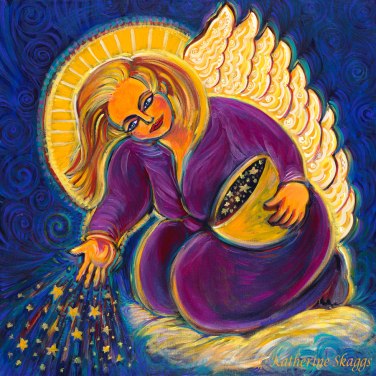
Katherine-Skaggs-1029.ABUNDANCE-ANGELI am not fond of Christmas and these holidays are very difficult for me to deal with. This has nothing to do with me being a Muslim. I have been a Grinch before this. I do not like excessive noise or crowds of people. It bothers me especially the excess, the lack of meaning and loud claims for kindness and mercy to decorate our lives for few days. This year is proving particularly hard for me.

Experiences of 2015 have forced me to question the paradigms under which I had lived until now. Life is suing me for an extra effort of introspective, growth and openness and that can be painful at times. A few weeks ago, I was venting my sorrows and doubts to my mother. I told her that the last thing I wanted to do was install a Xmas tree. She looked at her own Xmas tree full of golden balls and said:

“You know why I like Christmas trees? You were born a week before Pinochet’s coup. That year, the Dictatorship forbade people to buy, sell or cut pines trees under punishment, which ruined our Xmas, since plastic ones were very expensive. I built a tree for you at home, made of brass and wood. The center was a broomstick and the branches of wire. I cut leaves from empty cans of milk. I lost a child before you came to my life. And you were born in a country that suddenly lost freedom. I could not deny you hope. The Christmas tree has been my way to convey hope. That was my present.”

Listening to my mother, Christmas took on new meaning for me, a sacred dimension. I understand the sacred as those things, memories and spaces that are vital for us, all of what gives our lives meaning, purpose, reason and inspiration. I come from a family of women where husbands, brothers and male cousins are scarce. Joy, mourning, religion, knowledge or strength have been developed and shared from womb to womb. Continue reading “Xmas and Feminine Wisdom by Vanessa Rivera de la Fuente”

Painting Marys, Welcoming Refugees by Angela Yarber

angelaThis holiday season, in the midst of our ever-repeating mass shootings and debates about the welcoming of Syrian refugees, I have seen a meme, a pithy quote, a bumper sticker time and time again amidst my fellow liberals:

“If only we had a seasonally appropriate story about Middle Eastern people seeking refuge being turned away by the heartless.”

Similarly, many have posted pictures of nativity scenes with a tongue-in-cheek quip, “I’m so glad people are placing these lawn ornaments in their yards to indicate that they welcome refugees into their homes.”

Myriad articles have been published encouraging Christians to remember our calling to welcome the refugee, and as an ordained clergywoman, I affirm these thoughts. I believe it is our responsibility, as Christians and particularly as feminist Christians, to welcome the marginalized, the oppressed, the refugee. I am also a strong believer in the separation of church and state, a distinctive imperative both to my Baptist tradition and to my home country of the United States. So, in many ways, it doesn’t really matter politically that my faith tradition teaches me to welcome the refugee because my country is not a Christian nation, but it does matter that the primary symbol of my country—the Statue of Liberty—proclaims boldly and without apology: “Give me your tired, your poor, Your huddled masses yearning to breathe free, The wretched refuse of your teeming shore. Send these, the homeless, tempest-tossed to me, I lift my lamp beside the golden door!” Continue reading “Painting Marys, Welcoming Refugees by Angela Yarber”

Painting Aurora by Angela Yarber

angelaFor those of us in the northern hemisphere, December is one of the darkest months. The days are shorter. Night comes earlier. Each morning I eagerly await the dawn, the potential sliver of sunshine seeping through my window and warming my otherwise cold wintery skin. For those of us who struggle with seasonal depression, December can be difficult. The colder and shorter days cast shadows on our spirits as we yearn for the warm glow of light. Each December as we inch toward the winter solstice, I am reminded of the Goddess of the Dawn, Aurora, and of the unique ways in which a variety of wisdom traditions invoke the coming of light amidst the stark December night skies.

So, this December I welcome Aurora into the vast witness of Holy Women Icon with a folk feminist twist that I feature each month: Virginia Woolf , the Shulamite, Mary Daly, Baby Suggs, Pachamama and Gaia, Frida Kahlo, Salome, Guadalupe and Mary, Fatima, Sojourner Truth, Saraswati, Jarena Lee, Isadora Duncan, Miriam, Lilith, Georgia O’Keeffe, Guanyin, Dorothy Day, Sappho, Jephthah’s daughter, Anna Julia Cooper, the Holy Woman Icon archetype, Maya Angelou, Martha Graham, Pauli Murray, La Negrita, Tiamat/tehom, Mother Teresa, and many others.

Aurora is the Goddess of the dawn in Roman mythology; each morning she soars across the sky to announce the arrival of the sun. As the nights grow longer and longer, I can think of few other goddesses I hope for more than Aurora. In fact, many faith traditions invoke the coming of light during this month of long nights and short days.

In my own tradition, we are not yet celebrating Christmas (despite the capitalist consumer onslaught that has been on full throttle since October). Rather, we still dwell in the deep blue darkness of Advent, when we wait, long, and prepare for light to be birthed into our world. For most Christians, a candle is lit each Sunday during Advent and the light grows brighter as they anticipate the birth of Christ. Continue reading “Painting Aurora by Angela Yarber”

Awake! Awake! A Reflection on the Awakening of Conscience and Advent by Elise M. Edwards

Elise Edwards‘Tis the season to be…?

For me, this has not been a season to be jolly. I teach at a university, and again, I’m in the midst of the most hectic time of year of grading and exams and wrapping up projects due at the end of the calendar year. There have been moments of joy and rest. But I’ve been more reflective and sorrowful. This year, my heart and mind and soul have been opened up in new ways and I feel more urgency and need for social change. I’ve been experiencing “conscientization” during the time of year many Christians refer to as Advent.

I was introduced to the concept of conscientization in the work of Christian feminist and womanist ethicists like Beverly Wildung Harrison and Stacey Floyd-Thomas. Other feminist and liberationist thinkers had already convinced me of the vital role that critical thinking, consciousness-raising, and action occupy in ethical reflection and social change. In a chapter on “Feminist Liberative Ethics” in a textbook on liberative approaches to ethics, Michelle Tooley explains the meaning of conscientization:

“Activists speak of conscientization as waking up to the injustice in the world—or seeing it for the first time. It is not that the injustice is beginning; it is that you encounter oppression, injustice, violence yourself or you see it in a person or situation. You may have seen the same situation many times before, but for some reason you begin to connect the event with a deeper recognition that the injustice is wrong.”

(p. 185, Ethics: A Liberative Approach, Miguel A. De La Torre, Editor)

I was conscientized the night I heard that a grand jury did not indict Darren Wilson for killing Mike Brown, an unarmed black man. I was horrified to learn that this police officer doesn’t even have to stand trial for his violent and deadly act. Now it wasn’t like before grand jury’s decision I thought that black lives were given equal value in the US justice system. After all, for months I have been researching and preparing a paper called “When the Law does not Secure Justice or Peace” about artistic and religious responses to the dishonoring of black male personhood. I have been mourning the loss of Trayvon Martin and others as I write. But this decision left me sobbing in a hotel room as I watch the events unfold in Ferguson, Missouri. I gained a deeper social awareness about the depths to which the demonization and disregard of the lives of black women, men and children are entrenched in American life and the institutions within it.

I gained deeper self-awareness too. One reason the tragedy of the grand jury’s decision became so palpable to me is that just hours prior, I witnessed former president Jimmy Carter address the American Academy of Religion. He spoke passionately about the proliferation of violence, mistreatment of women, climate change, and other social concerns. To put it plainly, I was floored to see a white man in his 90s who was raised in Georgia and was a Southern Baptist until his 70s state without any qualms that people in power intentionally misinterpret religious texts to support the domination of women and nonwhites because those they do not want to lose their privilege. Yet he also called himself, like Archbishop Desmond Tutu, a “prisoner of hope.” He believes that things will change, and draws from his Christian convictions to sustain hope and motivate his work to fight injustice.

I was electrified by his words. I, too, had hope. In the days prior, I had gotten a break from my daily life, connected with friends, and conversed with like minds. I had been thinking about art and love. I had learned strategies for de-centering dominant narratives in the classroom and I was hopeful that I could use them to make a difference in my students’ lives. But mere hours later, while watching the news, the self-awareness I came to is that my hope is more fragile than I wish it to be. Futility consumed my hope.

A few weeks later, I can assert that my faith in God is not shaken, but my hope in humanity’s goodness has as much stability as a house of cards. In my present state of mind, I’m grateful that we are at a point in the church year that provides me with an opportunity to mourn the brokenness of our world. Christmas is approaching, but that doesn’t mean I have to sing merry carols. Advent is a season when Christians reflect on why the world needs God’s miraculous action and what it means to wait for light to emerge in the darkness. In the church calendar, it is a time when Christians re-enact and re-experience the anticipation of Jesus’ coming. Advent songs have a different character than Christmas carols. Many of them have a haunting tone or an eerie, sad, or mysterious sound. The lyrics of these songs place exhortations to “Rejoice!” next to pleas of “O come, o come, Emmanuel!” Emmanuel, also spelled Immanuel, means “God with us.” Christians draw this name from the Hebrew prophecies in Isaiah that are cited in the Gospel of Matthew’s account of Jesus’ birth. Matthew describes Jesus’ birth as the fulfillment of prophecy.

My conscientization allows me to hear these prophecies anew. They are familiar to me, as they are repeated often this time of year in Christian settings, but I hear them in new ways. I hear Isaiah 9:6 quite differently: For to us a child is born, to us a son is given, and the government will be on his shoulders. And he will be called Wonderful Counselor, Mighty God, Everlasting Father, Prince of Peace.

“The government will be upon his shoulders” likely means that this child will have authority. But as I hear those words this year, I imagine the Prince of Peace in the choke-hold of a law enforcement officer. I think of a little baby who are welcomed into the world with joy but who grows up only to be killed at a young age by threatened authorities and crowds of supporters. This is the story Christians tell about the God who is with us, the God who is also fully human. And this is the story we tell about Michael Brown, Eric Garner, Tamir Rice, Alesia Thomas, Aiyana Stanley-Jones and far too many others.

This Advent, I’m making a real effort to hold hope and despair together. I don’t want to become hopeless. I don’t want to think that my work in the classroom, in my church, in my community, on this site and in the printed page have no meaning. Hope is what sustains us to work for justice. I want to believe in that transformation of hearts and minds and souls is possible and immanent even when it emerges through sorrow and struggle. Suffering, sorrow, and killing without consequences must not be acceptable. With my new eyes, I see just how terrible they are.

Elise M. Edwards, PhD is a Lecturer in Christian Ethics at Baylor University and a graduate of Claremont Graduate University. She is also a registered architect in the State of Florida. Her interdisciplinary work examines issues of civic engagement and how beliefs and commitments are expressed publicly. As a black feminist, she primarily focuses on cultural expressions by, for, and about women and marginalized communities. Follow her on twitter, google+ or academia.edu.

The Wedding Dress by Natalie Weaver

Natalie Weaver editedA few weeks back, I was digging around for a picture, and in the process of looking for one picture I uncovered decades worth of memories. Here I was by the pool one Thanksgiving at my old apartment in California. That was where I cooked my first turkey. Here, in another photo, it was Christmas Eve at my mom’s house. I was with my best friend, wearing matching Santa hats. She was so beautiful as a girl. I have become accustomed to her as a woman and had forgotten how much I loved and admired her then as well. Weren’t we supposed to take off and travel the world together? And, then, here were the wedding photos of our Christmas wedding.

I noticed that it was an intimate party. At one point in the service, my father-in-law was holding my flowers since my sister was fixing my veil. He was chided the rest of the night for being my flower girl. I remembered that I did not have my hair professionally coiffed when I saw the backstage image of myself taking out bobby-pinned curls in lingerie before I dressed. Did I look like that? Who took that picture? The flowers were white roses, accented with holly berries and leaves, and my bouquet was a solid bundle of red roses.   Oh yes, and, here was our friend from Chicago… with his hair dyed blond? Why was he hanging out with my girlfriends in my room the night before I was married? And, didn’t my mom inadvertently catch his shirt on fire with some incense? Yes, that’s right. Very innocently, smilingly, moving casually, she patted out the near tragedy sparking on his back side, saying in her best southern accent, “Oh, my! We put a little hole in you, didn’t we?” A little disgruntled, he muttered, “That was a new shirt.”

The one great indulgence of the wedding was the dress itself. It was ivory with blush colored roses embroidered on the tulle overlay of the big skirt. I was not concerned that people would think me a non-virgin in ivory, but it was mentioned to me as a consideration. I loved the bustle in the back that was gathered from the generous material of the gown’s train so that I could walk and dance at the reception. The friendly ladies who sold me the dress came to the wedding specifically to make sure the bustle was perfectly drawn. The bodice had a gentle piping, which made the top sort of stand on its own. The same ladies also insisted that I have some extra padding in the top. Come to think of it, they seemed to have been globally concerned with the success of the garment and me in it. I wore a white silk wrap around my shoulders, which made me feel like Grace Kelly. The covering was my favorite part, which I added at the last minute. The photos prompted me to get out the dress once again, for I had not looked at it in the nearly fifteen years since I had it hermetically preserved following the wedding. So far, it had not yellowed. I was surprised to see how funerary it looked through the peep window, sealed up as it was in a box around cardboard shaped like my torso. It made me think that perhaps I should be buried in it some day. This thought has discomfited me with a complexity of sacramentality, morbidity, practicality, humor, despair, love and sorrow that I have yet to comprehend or shirk. Continue reading “The Wedding Dress by Natalie Weaver”

Awakening to Life: Hildegard’s Cure for Seasonal Depression by Mary Sharratt

mary sharratt

In midwinter 2002, I moved from the sun-drenched San Francisco Bay Area to Lancashire, in northern England, further north than I had ever lived. In bleak December, it was as though someone had switched off the lights. The sun barely managed to rise at 8:45 am. By 4:00 pm, it was pitch black. Even during the daylight hours, the sky remained muffled in oppressive clouds. There was no glittering white snow, either, just lashing, relentless rain. It was so oppressively dark, I felt as though I were trapped inside some claustrophobic gothic novel. For the first time in my life I began to suffer what they call winter depression. It didn’t help that it was Christmas and that I was new to the country and didn’t know anybody.                 

Every religious tradition that evolved in the northern reaches of the Northern Hemisphere honored the great mystery of the birth of the Divine Light from teeming midwinter darkness. As well as formal religious observances, countless folkways, carols, and mumming plays helped bring meaning and radiance to cold midwinter nights. Continue reading “Awakening to Life: Hildegard’s Cure for Seasonal Depression by Mary Sharratt”

Peace of mind vs Dogma and Capitalism by Oxana Poberejnaia

oxanaWhen I said in my response to Carol P. Christ’s comment that on one level Goddess spirituality and Buddhism are about the same thing, I am afraid it could have sounded shallow. What I wanted to express is that for a Goddess adherent, the primary goal is not to go through death and be reborn. Neither is the primary goal for a Buddhist to go through death and not be reborn. I believe they both seek the same thing: to be happy in this lifetime, to be comfortable with themselves and the world, to be OK with the reality of their own death. Carol says: “For me, regeneration applies to the community, to nature, to the whole, not to the individual”.

The two faiths just lead to this result by using different theology and practices. One of the ways Buddhism installs this peace of mind is by dissolving the very notion of an “individual” and thus, their impending death becomes less of a problem. From the Goddess side of things, listen to an episode of Karen Tate’s Sex, Religion, Politics podcast Enlightenment for the Rest of Us/Shamanism with Polly Campbell, author of Imperfect Spirituality: Extraordinary Enlightenment for Ordinary People. Karen is a Goddess advocate, and what Polly was teaching could be called secular Buddhism: the same breathing techniques, being in the moment and being grateful.

Continue reading “Peace of mind vs Dogma and Capitalism by Oxana Poberejnaia”

Happy Birthday, Solar Gods By Barbara Ardinger

Throughout history and all around the world, people have celebrated midwinter and the rebirth of the sun. My favorite night of the solstice-Hanukah-Christmas season is December 24, Modranicht. If we have Mother’s Day in the springtime, it seems only fair that we should celebrate Mother’s Night in the winter. We get the term Mothers’ Night from the English monk, Bede, who said that the Angles began their year on the night of December 24–25.

The winter solstice this year falls on December 21, though it can also occur on December 22 and December 23. The word “solstice” means “sun stand still.” No, it’s not Joshua’s long day again. On the solstice, the sun rises from the same point on the horizon for a couple days (this is the standing still), is at its lowest point in the sky at noon, and (in the Northern Hemisphere) is at its southernmost point. It’s the longest night of the year, and when the sun is reborn, it moves across the sky for six months to the summer solstice, where it’s at its northernmost point.

Continue reading “Happy Birthday, Solar Gods By Barbara Ardinger”

Solstice Comes But Once A Year, Now It’s Here! by Carol P. Christ

carol p. christ 2002 colorActually it comes twice, once in midsummer, the longest day of the year, and once in midwinter, the longest night.  Winter Solstice is also known as the first day of winter.

For those of us attuned to the cycles of Mother Earth, Winter Solstice is a time to celebrate the dark and the transformations that come in the dark. Many of the customs associated with Christmas and Hannukah, including candles, Yule logs, and trees decorated with lights were originally associated with Winter Solstice.  The extra pounds put on during winter feasting were insulation against the cold winter nights.

Those who fear that many of the customs of the Christmas season might be pagan are right.  As we learn again to honor our place within the cycles of birth, death, and regeneration, we can return these customs to their roots in the circle of life.

ChristmasTrees20060001

Continue reading “Solstice Comes But Once A Year, Now It’s Here! by Carol P. Christ”